







Washington – Said Arikat – 8/5/2026
News Analysis
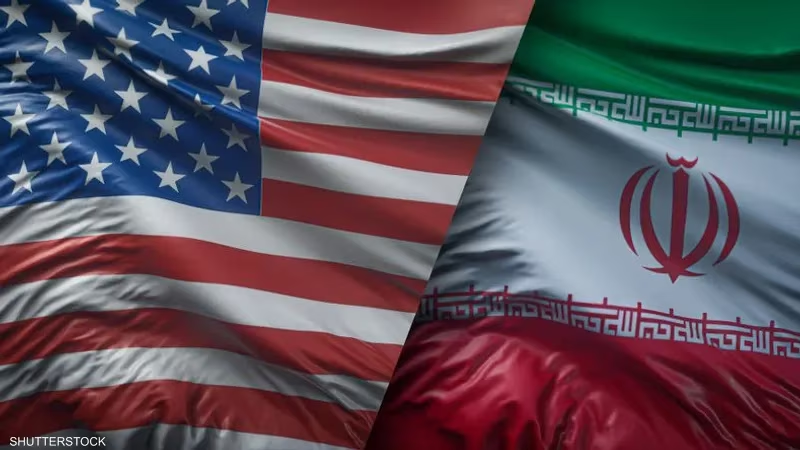
Despite some exchanges of blows between American forces and Iran on Thursday, US President Donald Trump, in his latest statements after announcing the targeting of Iranian naval vessels, which he held responsible for attacking a US warship, insisted that the door to negotiation with Tehran remains open, while at the same time affirming that Washington "will not hesitate to respond forcefully to any threat to American interests." This combination of escalating language and negotiating rhetoric now summarizes the nature of the current confrontation between Washington and Tehran, where military messages intertwine with diplomatic efforts in a scene that reflects the complexity of a war that has entered its third month with no clear horizon for resolution.
As the war between the United States and Iran enters its third month, the region appears stuck between two contradictory paths: open military escalation threatening the stability of the Gulf and the global economy, and faltering diplomatic attempts seeking to prevent a major explosion. While US President Donald Trump's administration speaks of "significant progress" in negotiations with Tehran, it simultaneously continues to strengthen its military presence and impose economic and naval pressures on Iran, revealing that Washington still treats negotiation more as a pressure tool than an equal path to political settlement.
In this context, Iranian Foreign Ministry spokesman Ismail Baqaei announced that Tehran is reviewing the American response to the fourteen-point Iranian initiative, confirming the continued exchange of messages through the Pakistani mediator. Diplomatic leaks also spoke of Oman and Qatar entering the mediation line, in an attempt to bridge views on highly sensitive issues, including economic sanctions, freedom of navigation, and the future of Iran's nuclear program. This movement reflects a regional and international realization that the continuation of the confrontation has become a threat that extends beyond the Gulf to affect the entire global economy.
However, Trump's rhetoric remained the most expressive of the confusion within the American administration. The US President spoke of "very good talks" with Iran, before threatening again to launch "broader and more intense" strikes if Tehran backed down from what he described as concessions. This contradiction reflects the division within Washington between a faction that fears the repercussions of a long and costly war, and another that believes military and economic pressure may force Iran into a broad strategic retreat. However, experience over the past months has shown that the "maximum pressure" policy has not broken the Iranian stance, but rather pushed Tehran to use its cards of strength, foremost among them the Strait of Hormuz.
Despite sanctions and military strikes, Iran has succeeded in exploiting its geographical location to turn the Strait into a sensitive international pressure point. Although the United States possesses overwhelming military superiority, the crisis revealed the limits of this superiority when it comes to a maritime passage through which about a fifth of global oil trade passes. Therefore, Washington's decision to suspend naval operations aimed at protecting navigation in the Strait was an indication of a growing American realization that any open confrontation could quickly turn into a global economic crisis that would be difficult to contain.
Despite the US administration's talk of "significant progress" in the talks, field tensions continued. The US Central Command announced that an F/A-18 Super Hornet fighter jet disabled an Iranian oil tanker that attempted to bypass the naval blockade imposed on Iranian ports, while Tehran denied responsibility for the explosion that hit a South Korean cargo ship in the Strait of Hormuz, but then warned against ships crossing "without Iranian permission." These events reflect the continuation of brinkmanship, where each party tries to avoid an all-out war while continuing to impose facts on the ground that strengthen its negotiating position.
Among the notable developments in recent weeks were reports revealing Saudi Arabia's refusal to allow the use of its military bases and airspace in an American operation aimed at securing navigation in the Strait of Hormuz. However, treating this stance as a radical strategic shift might be an overstatement. Saudi Arabia, like the rest of the Gulf states, primarily acts based on pragmatic calculations related to protecting its internal stability and avoiding being drawn into a direct confrontation with Iran, especially given its awareness of the economic and security costs of any widespread war in the Gulf.
Moreover, the Saudi position does not necessarily mean a departure from the security partnership with Washington, as much as it reflects an attempt to manage regional balances with greater caution. Riyadh realizes that full reliance on American military power no longer guarantees stability, but at the same time, it has no interest in the collapse of the strategic relationship with the United States. Therefore, Saudi behavior appears closer to a policy of risk containment and avoiding escalation, rather than a radical reformulation of the regional order as some interpretations try to portray it.
In contrast, Israel appears to be one of the parties most apprehensive about any potential breakthrough between Washington and Tehran. The Israeli government believes that any agreement could lead to a reduction of pressure on Iran and redirect international attention towards the war in Gaza and the ongoing Israeli violations in the occupied Palestinian territories. For years, Tel Aviv has sought to solidify the image of Iran as the central threat in the region, benefiting from this atmosphere to justify its security and expansionist policies.
The current crisis has also exposed the fragility of the global economy in the face of geopolitical tensions in the Gulf. Rising oil prices, marine insurance, and shipping have led to disruptions in international markets, while major companies have begun to reconsider trade and energy routes. With the global economy slowing down and competition intensifying among major powers, Washington is more aware today that continuing the war with Iran could turn from a political pressure tool into an economic and strategic burden whose consequences are difficult to control, not only for the Middle East but for the international system.
Share your opinion
Between Escalation and Negotiation: Washington and Tehran's War Enters a Phase of Political and Economic Attrition