







Washington – Said Arikat – 19/4/2026
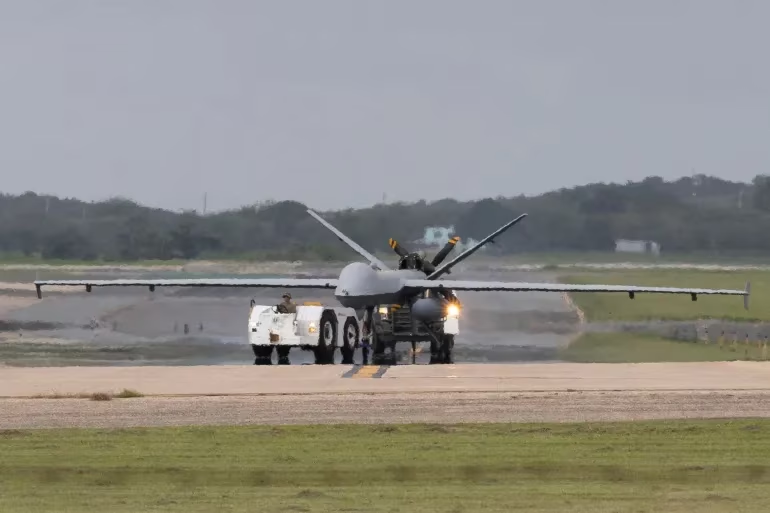
In a report published on Sunday, the "New York Times" stated that one of the most prominent conclusions from the war with Iran is that Tehran has proven itself a more capable adversary than previously thought in confronting the United States. In addition to its readiness to go on the offensive, Iran has succeeded in establishing a new military reality, characterized by cheap drones, which have disrupted the calculations of Washington and its allies in the region.
The report indicates that Iranian drones, manufactured with relatively accessible commercial technologies, cost no more than about $35,000 each, a paltry sum compared to the cost of the advanced interceptor missiles used to shoot them down, which can reach millions of dollars. Thus, the equation has been inverted: an inexpensive weapon draining expensive defense systems.
This shift is not entirely new, as the war in Ukraine previously demonstrated the effectiveness of cheap drones in changing the nature of battles. However, the confrontation with Iran more clearly revealed that American defense investments have for decades focused on traditional threats: ballistic missiles, advanced fighter jets, and high-speed targets. Swarms of relatively small and slow drones, however, did not receive the same attention.
According to former Pentagon officials and experts, confronting the drone threat has been a stated priority for years, but without accelerating the production of large-scale solutions. In the first six days of the war alone, the United States spent $11.3 billion, while research centers later estimated that total spending ranged between $25 and $35 billion, a large portion of which went to interceptor munitions. Concerns also escalated about inventories falling to dangerous levels.
In an ideal defensive scenario, an early warning aircraft (AWACS) detects the drone hundreds of miles away, then a fighter jet like the F-16 Fighting Falcon is sent to intercept it using short-range missiles. This method is more cost-efficient, but it is not always available due to the vastness of the confrontation area, as well as Iran's targeting of some early warning platforms that Washington relies on.
Another option is ground-based detection systems, but they suffer from limited detection of low-altitude targets due to the curvature of the Earth's surface. Among the systems specifically developed for this purpose is the "Coyote" system, capable of intercepting drones within a medium range, which is less expensive and more suitable than heavy systems originally designed to shoot down aircraft or ballistic missiles.
However, paradoxically, the US military has not purchased enough of these systems in recent years. Research reports indicate that US forces in the region were forced during previous attacks to move these systems between multiple bases almost daily due to their scarcity.
In contrast, the United States also relies on larger and more expensive systems, such as naval destroyers equipped with SM-2 missiles, or Patriot missile system batteries that use advanced interceptor missiles. Military doctrine often dictates launching at least two missiles against a single target, meaning a cheap drone can drain millions of dollars in minutes.
Military circles, according to the report, believe that this imbalance dates back to the post-Cold War era, when American strategic thinking focused on fewer, more sophisticated threats, rather than mass attacks carried out by swarms of inexpensive drones. Iran exploits this vacuum by launching several Shahed-136 drones at once, drones capable of traveling about 1,500 miles, placing many targets in the Middle East within their range.
Despite the high cost, Washington defends this approach by arguing that protecting strategic assets justifies the expenditure, especially when it comes to radars and military installations worth hundreds of millions of dollars. However, this does not negate the fact that the war exposed the fragility of the cost-effectiveness balance in American defense doctrine.
In the longer term, experts speak of a new future for drone countermeasures based on artificial intelligence, laser weapons, and electronic jamming systems, tools that could reduce interception costs and restore balance to the battlefield.
This war reveals that military superiority is not measured solely by budget size or weapon quality, but by a nation's ability to impose a successful attrition equation. Iran has not technically defeated the United States, but it has forced it to use expensive tools to counter inexpensive threats, a modern form of asymmetric deterrence. When intercepting a target becomes tens of times more expensive than producing it, the stronger party begins to lose part of its strategic advantage, even if it remains superior in firepower and on the ground.
The deeper problem also lies in the American military bureaucracy, where billions are allocated to developing complex systems, while simpler and faster-to-produce solutions are neglected. This pattern reflects the influence of major defense industries more than it reflects actual battlefield needs. If low-cost anti-drone systems had been invested in early, Washington would not find itself today chasing cheap drones with expensive missiles. It is a planning crisis as much as it is an armaments crisis, and perhaps a complete doctrinal crisis.
Politically, these results present President Donald Trump's administration with a double dilemma: how to justify a costly war to the public, and how to convince allies of the robustness of the American security umbrella? Every interceptor missile launched at enormous cost also sends a message of economic and strategic weakness. If adversaries continue to develop cheap and effective tools, the image of American deterrence will gradually erode, not through direct defeat, but through prolonged and costly attrition.
Share your opinion
Drone Warfare Exposes Gaps in American Power Against Iran