






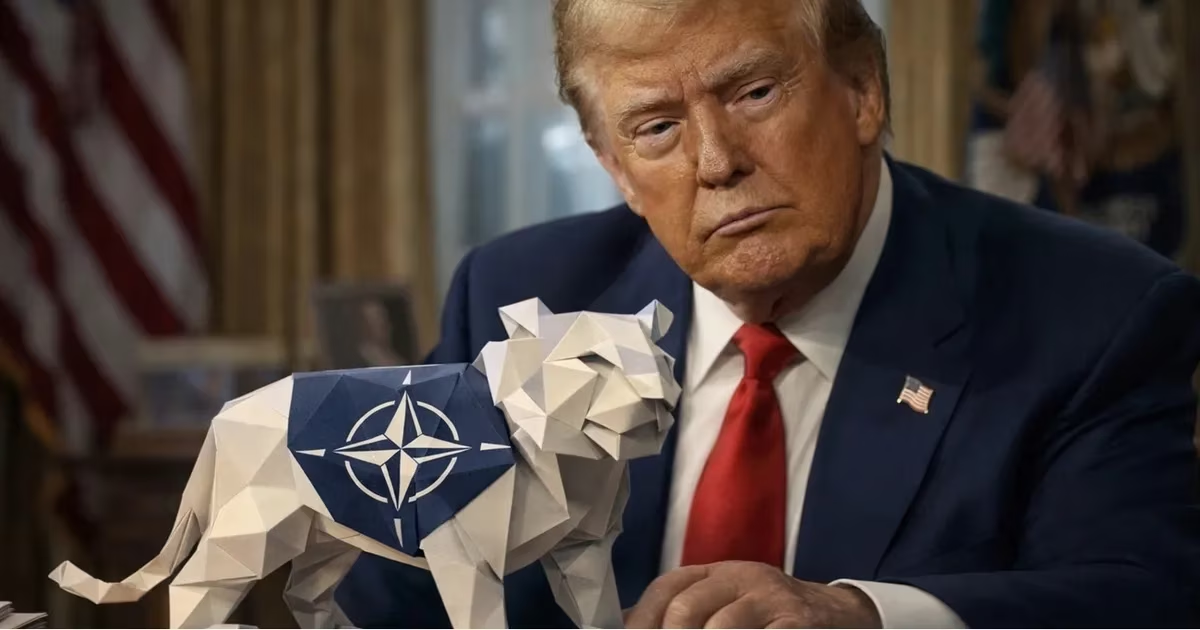
U.S. President Donald Trump has once again launched scathing criticism at the North Atlantic Treaty Organization (NATO), accusing it of failing to support efforts to secure navigation in the Strait of Hormuz. This attack comes in the context of Washington's ongoing attempts to internationalize the conflict with Iran and involve international powers in military operations led by the United States in cooperation with Israel.
The current U.S. administration seeks to persuade member states of the alliance of the necessity of direct involvement in protecting vital waterways, and to alleviate the financial and military burdens on Washington and Tel Aviv. Observers believe that Trump aims, through these pressures, to transform the confrontation with Tehran from a bilateral conflict into an international security issue for which allies are responsible.
In contrast, NATO countries show strong reluctance towards these demands, refusing to send naval frigates or combat forces to the Gulf region. These countries maintain that the current war does not fall within the alliance's defensive missions, but rather is a result of unilateral policies adopted by the Trump administration in coordination with the Israeli government.
Diplomatic sources reported that major European capitals view American moves as an attempt to drag them into a conflict that does not serve their strategic interests in the region. These sources confirm that the alliance countries prefer diplomatic paths to de-escalate tension, rather than military escalation that could lead to a permanent closure of waterways.
Despite the alliance's history of military intervention in areas such as Libya, Kosovo, and Afghanistan, the situation with Iran appears different for Europeans. In previous cases, there was a UN Security Council cover or collective consensus, which is lacking in the current action in the Strait of Hormuz.
Trump bases his pressures on the enormous military power possessed by the alliance, which includes about 3.5 million soldiers and more than 20,000 warplanes. The U.S. President believes that these capabilities should be harnessed to protect common interests, including global energy security that passes through the Strait of Hormuz.
For his part, French President Emmanuel Macron stressed that Paris is not currently considering participating in any military operations to secure the strait. This French position reflects a state of European caution towards being drawn into the American escalatory vision in the Middle East.
In London, British Prime Minister Keir Starmer indicated that his country is considering alternative plans to secure navigation, but he clearly affirmed that any move would not be under the umbrella of NATO. This position reinforces the isolation Trump faces in his attempt to activate Article 5 of the alliance's charter in this conflict.
As for Germany, it was more explicit in its rejection, as official sources in Berlin confirmed that the ongoing war has nothing to do with NATO's defensive obligations. Other countries such as Japan, Australia, and Spain joined the list of those rejecting any direct military intervention, preferring to stay away from the front lines.
In Brussels, EU foreign policy chief Kaja Kallas revealed the absence of any desire among foreign ministers to contribute to reopening the strait by force. This European consensus indicates a deep gap in strategic visions between the two sides of the Atlantic regarding how to deal with the Iranian file.
Despite Trump's repeated threats to withdraw from the alliance and his description of it as 'obsolete,' legal and political reality limits his ability to take such a step. New U.S. legislation imposes strict restrictions on any decision to withdraw from major international treaties without broad legislative approval.
Analysts believe that Trump's aggressive rhetoric primarily aims at political blackmail to gain financial benefits and increase member states' contributions to the defense budget. However, the allies' insistence on their position may lead to further tension in transatlantic relations in the coming period.
The Strait of Hormuz remains a focal point in the current geopolitical conflict, where global energy interests intertwine with complex military calculations. While Washington continues to pressure, allies remain steadfast in their refusal to turn NATO into a tool in wars they see no need to engage in.
The ongoing war is not the alliance's war; it is a conflict started by the Trump and Netanyahu administrations, and we have no stake in it.
Share your opinion
Trump Renews Attack on NATO Over Strait of Hormuz: Deep Divisions Over Internationalizing Conflict with Iran