






The Turkish capital, Ankara, is making intensive diplomatic efforts in an attempt to contain the escalating military escalation between the United States and Israel on one hand, and Iran on the other. The Turkish leadership realizes that the path back to the negotiating table faces serious challenges, especially in light of the profound field developments witnessed in the first month of confrontations.
Political readings in Ankara indicate that precedents for negotiations between Tehran and Washington, especially under the current US administration, do not inspire great optimism. Previous experiences have shown that military operations can continue and escalate even with scheduled negotiation rounds, making the possibility of continued war strong and real.
The possibility of Turkey's involvement in the conflict is no longer a mere theoretical hypothesis discussed by analysts, but has become a serious scenario on the decision-makers' table. Ankara is primarily concerned about deliberate "entrapment" operations aimed at drawing it into confrontation, more than its fear of automatic involvement resulting from the escalation of field events.
Turkish President Recep Tayyip Erdogan and his Foreign Minister Hakan Fidan have directly expressed this concern, holding Israeli Prime Minister Benjamin Netanyahu fully responsible. Turkish officials believe that the Israeli government seeks to turn the region into a comprehensive war zone, the catastrophic consequences of which the entire world will pay for.
For his part, Suleyman Soylu, head of the Interior Committee in the Turkish Parliament, warned against continuous Israeli provocations aimed at dragging his country into the conflict. These statements come at a time when regional and international pressures on Ankara are increasing to define its position on the rapidly developing Iranian issue.
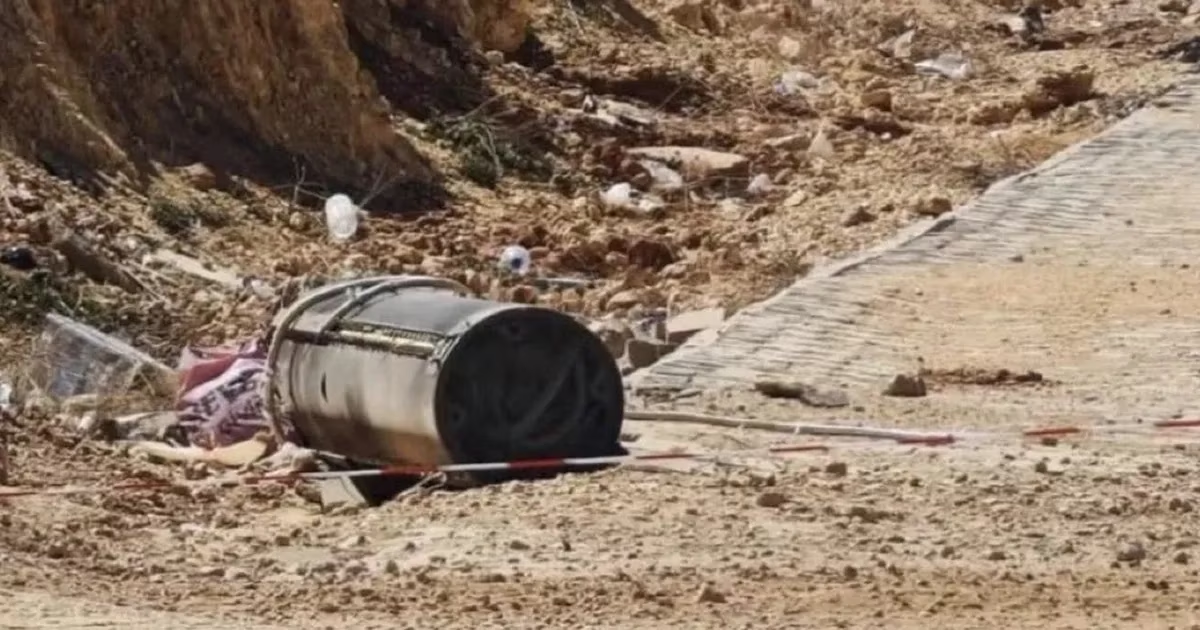
Four main scenarios could lead to unwanted Turkish involvement. The first is a direct response to targeting Turkish territory. Sources have reported the fall of three missiles in border areas, and despite Tehran's denial, NATO reports indicated targeting military bases housing alliance forces.
The second scenario relates to the expansion of the war regionally to include parties such as Greece and Cyprus, which would compel Turkey to act to protect its vital interests. This expansion could change the balance of power in the Eastern Mediterranean and force Ankara to take preemptive defensive or offensive measures.
The third scenario is intervention to protect Turkish national security in the event of widespread chaos or signs of the division of Iranian territory. Ankara fears the re-activation of the "Kurdish card" on its borders, an issue in which it has expended great efforts to close in both Syria and Iraq.
The fourth scenario is the possibility of NATO's involvement in the war, especially if the strategic Strait of Hormuz is closed. Despite Turkey's membership in the alliance, it has historically maintained a distinct distance in its positions, as was evident in the Ukrainian-Russian crisis.
In its endeavor to avoid these scenarios, Ankara has adopted an official discourse characterized by caution and firmness simultaneously, emphasizing its right to defend its people and territory. It has been noted that the Turkish discourse avoided directing direct accusations to any specific party regarding the fallen missiles, preferring to keep communication channels open.
On the ground, Turkey has strengthened its defensive capabilities by deploying additional NATO missile batteries, especially at Incirlik Air Base in the south of the country. This step aims to reduce the likelihood of direct targeting and send a clear deterrent message to any party attempting to infringe on Turkish sovereignty.
Diplomatically, Ankara is active in a collective mediation involving countries such as Oman, Pakistan, Egypt, and Qatar to bridge the views between Washington and Tehran. Turkey uses its geopolitical position and balanced relations with both parties to create suitable conditions for initiating confidence-building measures.
Despite these efforts, the Turkish presidency remains cautious about reports of its forces being positioned within Iranian territory in emergency situations, which it has officially denied. Nevertheless, Turkish concern remains about any shift that could lead to the collapse of the institutional system in the eastern neighbor.
In conclusion, Ankara realizes that the only guarantee against being drawn into the inferno of war is the immediate cessation of hostilities and the prevention of the conflict's escalation. This path requires diligent work and high-level coordination with regional and international powers to avoid the scenario of a comprehensive explosion that threatens the stability of the entire region.
Netanyahu and his government are seeking with their provocations to drag Turkey into this fireball, which directly threatens international peace.
Share your opinion
Scenarios of Involvement and Neutrality: How Turkey Maneuvers to Avoid Sliding into Regional Confrontation?