






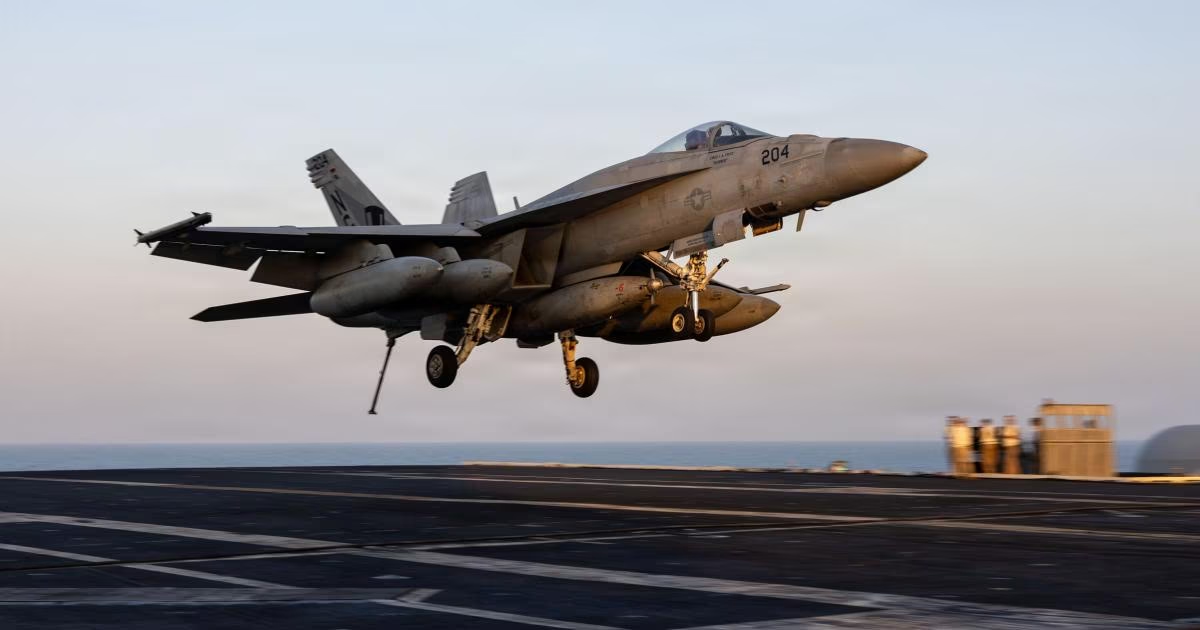
The direct military confrontation between the United States and Israel on one side, and Iran on the other, has entered its second month amidst increasing indications of a widespread field escalation. Visions diverge between Washington and Tel Aviv regarding the ultimate goals of this war, with fundamental questions emerging that may determine the outcomes of the conflict in the next phase.
The Strait of Hormuz stands out as one of the most urgent and impactful issues on global economic stability due to its extreme strategic importance. Approximately 20% of the world's oil supplies, mostly destined for Asian markets, pass through this vital waterway, making any disruption an international crisis par excellence.
Sources reported that Tehran has already begun threatening ships it classifies as hostile targets, with extensive use of naval mines observed in the region. These moves have led to a state of partial paralysis in international navigation, causing sharp jumps in global energy prices.
Reports indicate that the continued closure of the strait poses an obstacle to US President Donald Trump's ambitions to declare a swift victory and end military operations. Observers believe that what happens in this waterway will be the decisive factor in determining the duration of the current war.
On the ground, the question of a potential US ground intervention remains, despite the extreme caution shown by the US administration towards this option. Despite the deployment of thousands of Marine soldiers to the Gulf region, a decision for a full-scale invasion has not yet been officially made.
Military scenarios speak of the possibility of joint special forces conducting precise infiltration operations targeting fortified Iranian nuclear facilities underground. These hypothetical operations aim to seize sensitive nuclear materials and prevent Tehran from using them as a final bargaining chip in the conflict.
Military plans prioritize controlling strategic locations such as Kharg Island, as it is the main outlet for most of Iran's oil exports. This move aims to completely dry up Iranian funding sources and pressure the military leadership to reopen the Strait of Hormuz under international supervision.
The Iranian nuclear program represents the most prominent target of the air and ground operations led by Washington and Tel Aviv since the outbreak of the confrontation. Despite the fierce strikes that targeted vital facilities, the fate of Tehran's highly enriched uranium stockpile remains shrouded in mystery.
Israeli sources confirm that Iran has already lost its technical capability to enrich uranium as a result of the destruction of the necessary infrastructure. However, the United States seeks, through military force or coercive negotiations, to ensure the complete destruction of this stockpile to guarantee it will not be revived in the future.
Declared US objectives include the complete destruction of Iranian naval capabilities and the neutralization of ballistic missile programs that threaten regional interests. Washington also seeks to cut off all supply and funding lines reaching groups and organizations allied with Tehran in the Arab region.
Regarding the Iranian internal situation, great ambiguity surrounds the identity of who is governing after the assassination of Supreme Leader Ali Khamenei in previous airstrikes. His son, Mojtaba Khamenei, has emerged as a potential successor, amidst conflicting reports about his health and the extent of his control over state institutions.
Sources reported that US President Donald Trump refused to recognize the legitimacy of Mojtaba Khamenei's assumption of power, considering him an extension of the previous regime. At the same time, Israel threatens to target him directly, emphasizing that the elimination of top leaders is an integral part of its military strategy.
Officials in Washington and Tel Aviv acknowledge the difficulty of identifying the actual decision-making center within Tehran at present due to the state of internal confusion. While Israel explicitly aims for regime change, Trump merely calls on the Iranian people to revolt, without fully committing to making regime change a final goal.
The coming days will reveal the extent of international parties' ability to contain the conflict or slide into a comprehensive regional war that spares nothing. With continued military and economic pressure, the bet remains on the resilience of the Iranian internal front against successive strikes and the loss of historical leadership.
As long as the Strait of Hormuz remains closed, US President Donald Trump cannot declare victory and end the war, even if he wanted to.

Share your opinion
Four Major Questions Shaping the Escalation in the War on Iran