






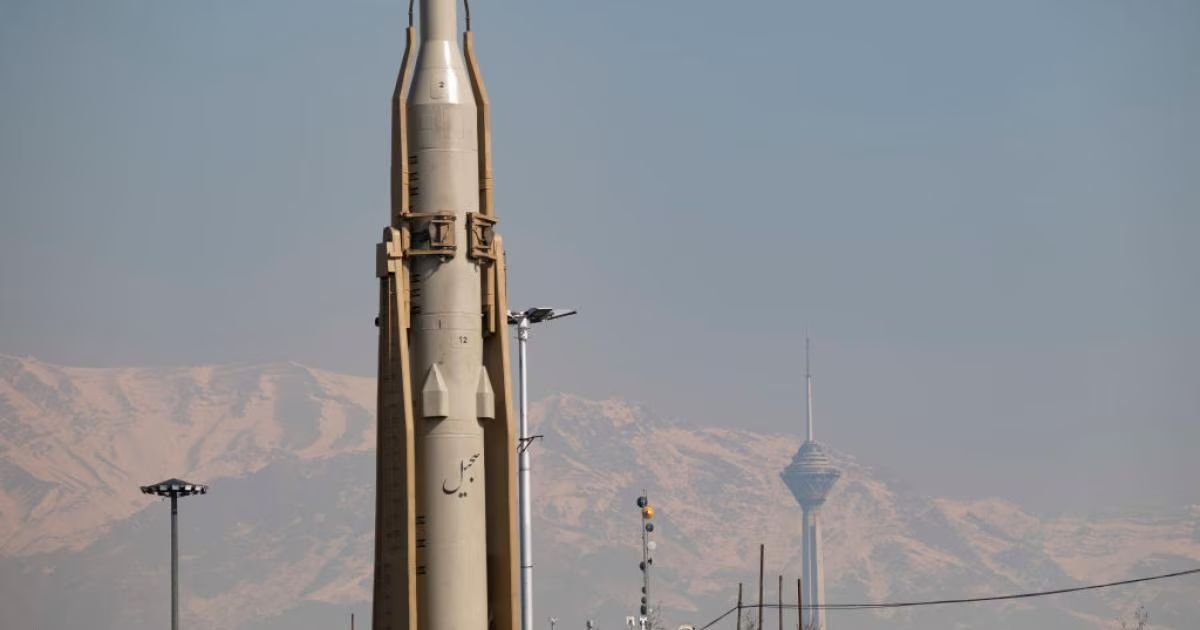
Official sources revealed a prominent field development in the course of ongoing military operations, as the launch of the fifty-fourth wave of "True Promise 4" operation was announced. This phase witnessed the use of the long-range "Sejil" ballistic missile for the first time since the beginning of the confrontation, which represents a shift in the type of weapons used in attacks directed deep into enemy territory.
Military data confirmed that the strikes accurately targeted air operations command centers and decision-making centers of the occupation, in addition to vital facilities in the defense industries sector. The sources explained that the attack also targeted military troop gathering points, indicating that the use of this missile system comes within the strategy of deterrence and expanding the scope of offensive operations.
The "Sejil" missile is classified as one of the most prominent weapons in the Iranian missile arsenal, which is the largest of its kind in the Middle East region. The missile's length reaches about 17.57 meters, while its total weight is 23,000 kilograms, and it is designed to carry heavy warheads weighing about 500 kilograms of highly destructive conventional explosives.
The propulsion technology for this missile relies on a dual propulsion system, where the first stage engine operates on solid fuel, giving it rapid launch speed, while the second stage operates on liquid fuel to ensure accuracy. Technical reports confirm that the missile is capable of flying at an enormous speed exceeding 17,000 kilometers per hour, which makes the task of intercepting it by air defenses extremely complex.
The operational capability of the "Sejil" missile extends to cover distances ranging between 2000 and 2500 kilometers, placing it in the category of cross-border missiles capable of reaching any point in the region. These capabilities raise widespread concern among Western powers, who see the development of these systems as a direct threat to regional stability and military power balances.
It is worth noting that ballistic missiles rely on initial rocket propulsion in their trajectory before following a free-fall path towards their designated targets. Tehran continues to enhance its missile capabilities as part of its defensive doctrine, while international warnings are increasing about the possibility of developing these missiles to become capable of carrying unconventional warheads in the future.
We successfully used strategic Sejil missiles to strike Israeli air operations command centers and troop gathering points.

Share your opinion
For the first time in the confrontation.. Tehran bombs Israeli targets with "Sejil" ballistic missiles