







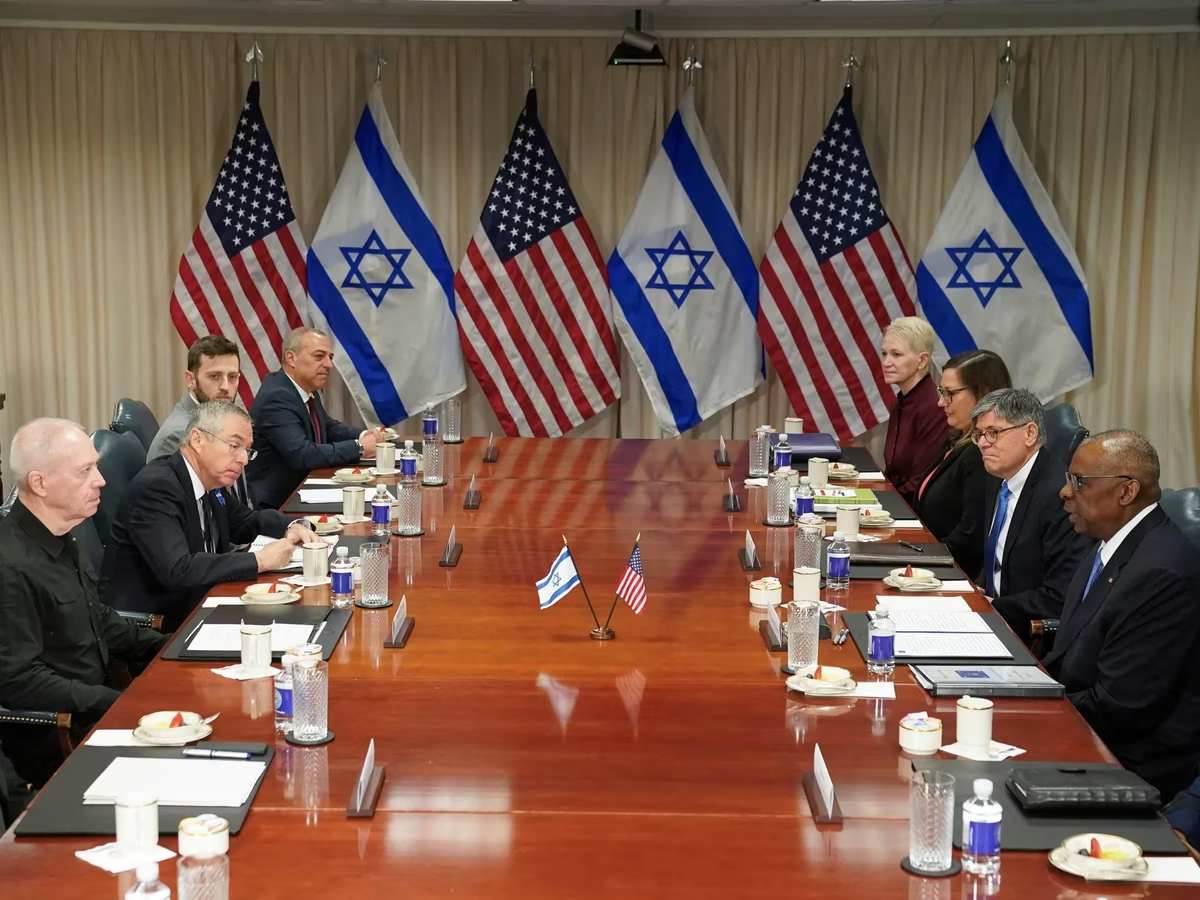
Signals from Washington and Tel Aviv continue to suggest that the Middle East is approaching a phase of military escalation that could redraw regional balance maps, amidst a clear increase in US-Israeli military coordination and an unprecedented intensification of field preparations. In this context, two American officials, who requested anonymity, revealed that the Chairman of the US Joint Chiefs of Staff, Dan Kaine, held a closed meeting at the US Department of Defense (the Pentagon) with the Chief of Staff of the Israeli occupation army, Eyal Zamir, last Friday.
Despite the American officials' refusal to disclose details of the talks, the timing and political and military context of the meeting give it implications that go beyond a mere protocolary nature. According to consistent reports, the United States is deploying additional military assets in the Middle East, including naval and air reinforcements and advanced air defense systems, in a move that reflects readiness for escalation scenarios, not just traditional deterrence measures.
This impression is reinforced by assessments issued from within the Israeli military establishment itself. The Israeli occupation army radio reported, after Zamir's return from his visit to Washington, that the Chief of Staff estimated internally that an American attack on Iran could occur within a period ranging from two weeks to two months. This assessment reflects a high level of confidence within the Israeli military leadership regarding the American decision, and also reveals the depth of strategic coordination between the two parties.
One day before that, "Drop Site News" had reported, in an article published on January 30, that the United States had informed a key Arab ally in the region that President Donald Trump might give the green light for an attack on Iran "very soon." The importance of this information lies not only in its content but also in Washington's choice to convey it in advance to regional capitals, in what appears to be a political prelude to potential repercussions, or an attempt to contain reactions before the event occurs.
Most indicative in this context is what a former American intelligence official, who works as an unofficial advisor to the current American administration and communicates with Arab governments, revealed when he said that the issue "is not about the Iranian nuclear program or the missile program, but about regime change." This statement shifts the essence of the American approach from a technical security framework to a comprehensive political project, and brings back to the forefront the discourse of regime change that has always formed the unstated background of American policy in the region.
This shift in rhetoric points to a chronic political dilemma in dealing with Iran. Instead of investing in negotiation paths or regional security arrangements, there is a direct leap to the military option, as if force alone is capable of re-engineering balances. However, past experiences, from Iraq to Afghanistan and Libya, confirm that overthrowing regimes by force does not produce stability, but rather opens the doors to extended chaos that transcends the borders of the targeted countries.
In this framework, Israeli Prime Minister Benjamin Netanyahu plays a pivotal role in pushing towards confrontation. According to the same American source, Netanyahu "hopes for an attack," and is working to reassure Trump that Israel is capable of contributing to the establishment of a new government in Tehran that would be "friendly to the West." However, this gamble largely reflects an internal Israeli crisis as much as it reflects strategic calculations, as Netanyahu finds in external escalation a means to reproduce deterrence and export his political and judicial crises.
On the ground, the US aircraft carrier "Abraham Lincoln" strike group recently arrived in the Middle East, in a move that confirms that American movements are not limited to political messages. Reports also indicated that the United States is working to strengthen air defense networks in the region, in anticipation of potential Iranian counter-attacks that could target American bases or Israeli territory in the event of a direct confrontation.
In conclusion, these developments suggest that the region stands on the threshold of a highly dangerous phase, where military calculations intertwine with narrow political stakes, and the logic of diplomacy recedes before the allure of power. In light of this scene, it seems that any miscalculation could push the Middle East into a wide regional war, whose trajectories cannot be predicted nor its repercussions controlled, at a time when the cost of previous wars is still present in the memory of the region.
Share your opinion
High-level US-Israeli military meeting at the Pentagon amid escalating threat of striking Iran