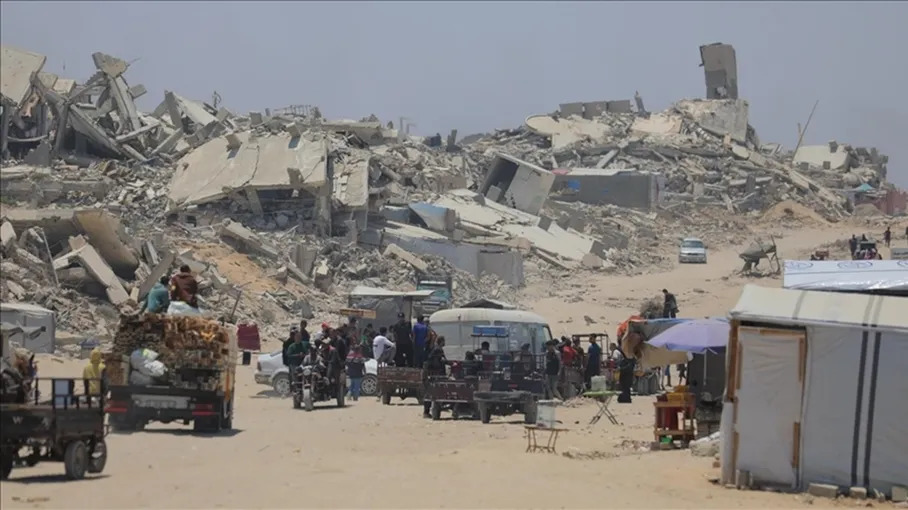







In the midst of intellectual and political discussions about the Israeli war on Gaza, former Tunisian minister and political thinker Ahmed Qalloul sheds light on the dimensions of this war through a deep historical reading. Qalloul connects the present with the past, invoking the experiences of peoples in confronting colonialism and hegemony, and considers that what is happening in Gaza is a continuation of the policies of collective punishment witnessed in Western history.
Qalloul begins by analyzing the roots of these policies, pointing out that what the Palestinian people are experiencing today is very similar to what other peoples have suffered in history. He invokes the concept of "detention camps" as a reality threatening Gaza in the twenty-first century, where Palestinians are subjected to harsh and inhumane conditions.
The history of concentration camps, as Qalloul mentions, dates back to World War II, where the Nazis committed horrific crimes against humanity by detaining hundreds of thousands in harsh conditions. These events have become part of Western memory and were later used to justify Israeli occupation policies in the region.
Qalloul reviews how the Israeli occupation has exploited this historical memory to justify its violations against Palestinians, noting that French philosopher Roger Garaudy considered these crimes to be part of serious violations of human rights, akin to the practices of other authoritarian regimes.
As the two-year mark approaches for the war waged by Israel on Gaza, Qalloul questions the objectives of Israeli Prime Minister Benjamin Netanyahu in his plan to sweep through the sector. He points out that history teaches us that tyrannical powers resort to radical solutions when they fail to suppress oppressed peoples.
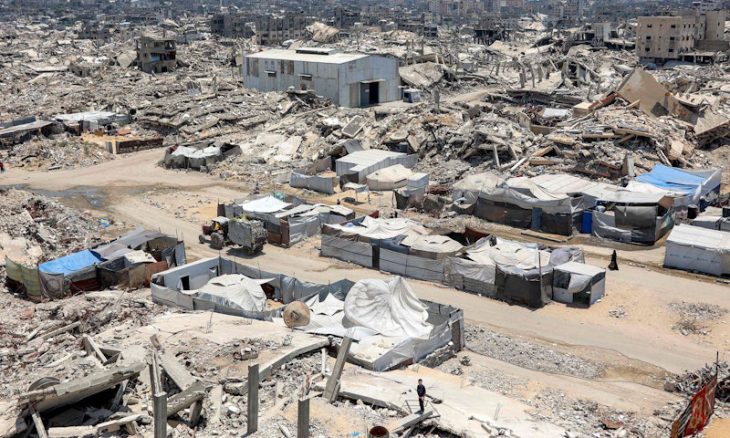
Qalloul asserts that the expected step from Netanyahu is not merely the occupation of Gaza, but its transformation into a detention camp for the twenty-first century, where the occupation seeks to starve the Palestinian people to death. He indicates that these camps aim to control the enemy and impose collective punishment.
The author reviews historical experiences of detention camps, starting from Spanish colonial rule in Cuba, through British occupation experiences in South Africa, and reaching the practices of the United States in the Philippines. These experiences illustrate how colonial powers used these tactics to suppress resistance.
Qalloul emphasizes that what is happening in Gaza today is an extension of a long history of crimes committed by the Western system, and that the Israeli occupation represents the culmination of this savagery. He points out that the crimes committed by Netanyahu are no different from those perpetrated by this system in the past.
In conclusion, Qalloul stresses that what the Palestinian resistance is doing in Gaza is a defense of human conscience, and that the scene of martyrs and the injured in Gaza should shake the conscience of the world. He affirms that hope for liberation will only be realized through the unity of the nation and Egypt's support for the Gaza cause.
What is happening in Gaza today is a struggle for survival, and there must be real international action to lift the siege on the sector, otherwise history will repeat itself, and Gaza will remain a symbol of resistance against injustice.
What the occupation is doing in Gaza is a manifestation of historical crimes similar to the practices of authoritarian regimes.





Share your opinion
Gaza and the Legacy of Concentration Camps.. When History Awakens in the Present