






By Gregory Mauzé
Is the growing internal protest against Prime Minister Benjamin Netanyahu and his conduct of the war signaling the emergence of a real opposition within Israeli society to the eradication of Gaza? Not even close.
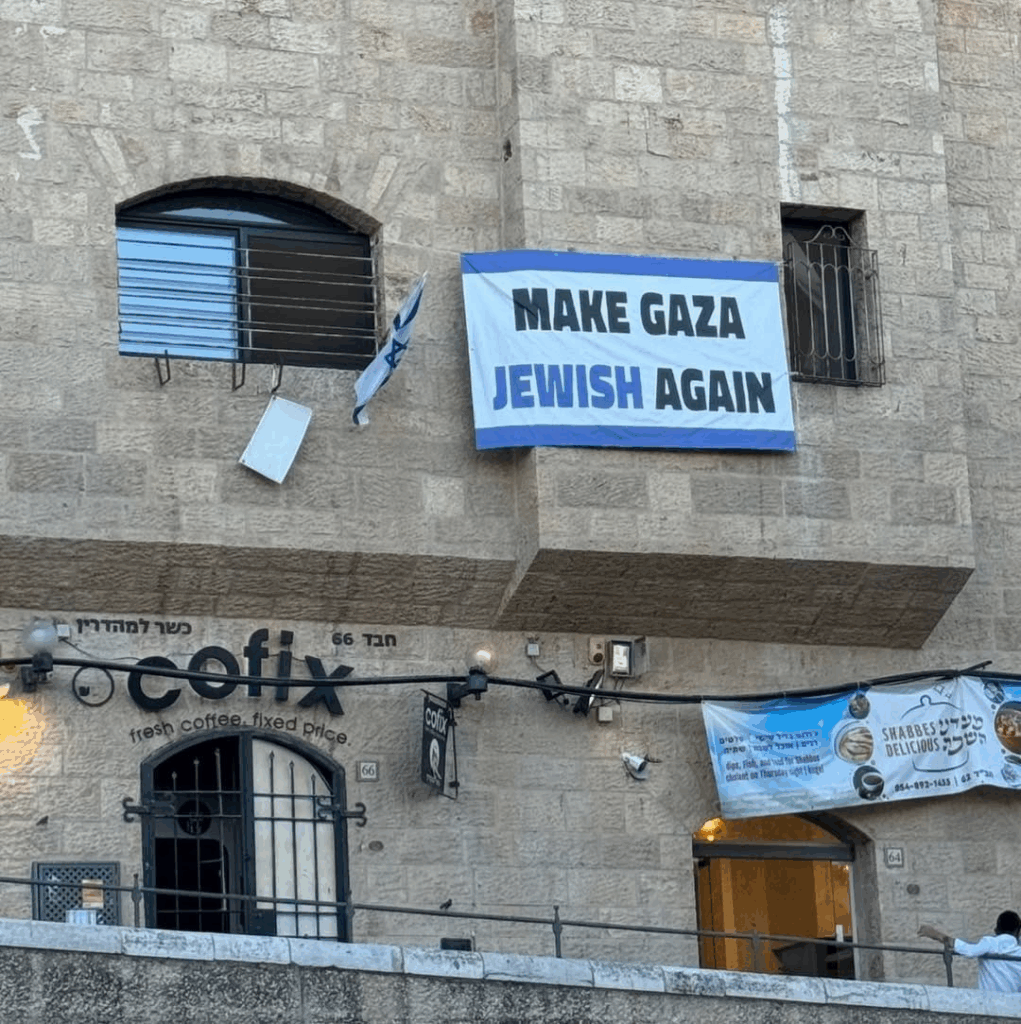
Poster calling for the re-colonization of Gaza, Jerusalem, June 2025
In recent months, the Israeli government has shown, if any proof were still needed, its determination to complete the ongoing genocidal process in Gaza. The unilateral breaking of the truce with Hamas on March 18 particularly exposed its disregard for the fate of the hostages taken on October 7—whose release, paradoxically, is a top priority for public opinion. Protests against a war seen as having "lost its meaning" grew significantly, evidenced by a record 20% desertion rate in the army.
Notably, on January 5, several hundred demonstrators protested in front of the Defense Ministry, holding not hostage photos, but images of children killed in Gaza—unimaginable at the start of the war.
In Western media, these developments have fostered the belief in a "collective awakening" among Israelis, as described by the France Télévisions Middle East correspondent—suggesting a growing awareness of the suffering inflicted on Gazans. Supporting this narrative were statements from so-called moderate figures who had previously helped legitimize the assault on the coastal enclave, such as Elie Barnavi. "I am ashamed of my country," Barnavi said on the TV show C Ce Soir on May 26—this from someone who had called, early in the conflict, to "carpet-bomb Gaza without asking questions."
But a closer look reveals that the idea of a progressive rebirth of the "peace camp" is a fantasy. While the ruling coalition is indeed unpopular, consensus remains strong on the need for brute force against Palestinians, and those challenging it face a harsh public backlash. Take, for example, the outrage sparked by comments from Yair Golan, leader of the "Zionist left," on May 20: "A healthy country does not wage war on civilians, does not enjoy killing babies, and does not aim to expel populations." Like Barnavi, Golan had initially backed a unified war effort—calling as early as October 13 to starve Gaza. Netanyahu immediately dismissed his comments as "antisemitic slander," while opposition figure Benny Gantz accused Golan of "endangering the freedom of our heroic fighters."
A Genocidal Atmosphere
Such outcries make sense within a broader context of extreme dehumanization of Palestinians in public discourse—paving the way for atrocities. Genocidal statements from government officials are numerous, not limited to the far-right, and provide mounting evidence for international courts.
For example, during a May 8 hearing in the Knesset, Sharon Shaul, head of humanitarian operations at the NGO Natan, spoke on the plight of civilians in Gaza. Furious, members of the majority fired back. Likud MP Amit Halevi declared, “I’m not sure you speak for us when you say we want to care for every woman and child… When fighting a group like this, the normal-world distinctions no longer apply.”
According to a May poll by Pennsylvania State University, 82% of Israeli Jews support expelling Gaza’s residents, and 56% support expelling Palestinian citizens of Israel.
Even the opposition joins in. In September 2024, Meirav Cohen from Yair Lapid’s Yesh Atid party criticized the government for allowing humanitarian aid trucks into Gaza: “The only threat they face is obesity,” she said, at a time when nearly a quarter of the population was facing the most extreme stage of famine, according to IPC data.
This hateful climate dominates Israeli media too—especially the far-right Channel 14, now the second most-watched station, known for its racism and genocidal incitement. Public opinion reflects this climate more than it contradicts it, challenging the narrative that blames a radical minority. The same Penn State poll found that nearly half (47%) of Israeli Jews support exterminating civilians in enemy cities captured by Israeli forces.
Colonial Society and Dehumanization
This terrifying radicalization can't be explained solely by the trauma of October 7. “In truth, it reveals long-standing trends in Israeli society, nurtured by education, media, and institutions,” writes researcher Tamir Sorek in an article co-authored with Shay Hazkani in Haaretz. “Zionism, like other colonial projects, faces resistance from indigenous populations and may veer toward extermination to ensure absolute security.”
So how should we interpret the sudden concern for Gaza’s civilians among a small, Western-favored segment of Israeli society? Without dismissing the sincerity of some, their outrage must also be viewed pragmatically. “Israel’s most globally connected, startup-savvy segment knows how crucial Western perception is,” explains researcher Thomas Vescovi. “That’s why they opposed Netanyahu’s anti-democratic reforms and now oppose the Gaza war—not necessarily because they see it as illegitimate, but because traditional Western support is slipping. They aim to keep alive the illusion that a different Israel exists—one separate from the extremists in power.”
"False portrayals of a 'peace camp' paradoxically hinder any real vision for a shared future between the Mediterranean and the Jordan River. They prolong belief in a natural democratic evolution of a colonial state, delaying the necessary steps to end its criminal policies."
A June 2025 poll from the Israel Democracy Institute (IDI) reveals the strategic logic behind this so-called "humanitarian awakening," especially in light of global backlash to the complete humanitarian blockade imposed on Gaza since March 2. While only 20% of respondents believed Palestinian suffering should influence military operations, 30.5% said more aid should be allowed into Gaza—“due to international pressure.”
Facing the Truth
This grim reality does not diminish the bravery of those who defied the genocidal consensus from the outset. Activists from the anti-occupation bloc, the radical left's Peace Partnership coalition, and the Standing Together organization recently protected humanitarian convoys to Gaza from right-wing attackers.
Still, even radicalized public opinion isn’t permanent. “In the 1980s and early 1990s, two-thirds of Israelis supported encouraging Arab emigration. But within a few years—after the Oslo Accords in 1993 and the creation of the Palestinian Authority—support for annexing the West Bank and Gaza and expelling their populations dropped to just 11%,” remind several academics in a Haaretz op-ed.
Nevertheless, overemphasizing these rare acts of compassion risks minimizing the broader societal complicity in Gaza’s annihilation. This misunderstanding perpetuates the myth that a democratic colonial state will naturally reform—and deflects attention from the international pressure required to stop its criminal policies.
Moreover, such portrayals of a “peace camp” paradoxically obstruct any vision of a shared future between the Mediterranean and the Jordan. As legal expert Johann Soufi noted on X (formerly Twitter) on May 24, this narrative de-responsibilizes Israeli society, making self-critique and collective recognition of wrongdoing more difficult. “One day, for peace and reconciliation, there must be a transitional justice process—with truth, justice, reparations, and deep reforms on both sides. But it starts with truth!” In other words, with a clear-eyed examination of the relationship between oppressors and oppressed—however painful that may be for the former.
Support for War on Iran Reveals Militarist Unity
The 12-day conflict between Iran and Israel (June 13–24) suddenly silenced internal Israeli divisions over the Gaza strategy. A flash poll by the IDI on June 19 showed 82% of Israeli Jews supported Netanyahu’s decision to open another deadly front against Tehran.
The country’s main media outlets, in sync with the government’s messaging, echoed this unanimity—as did the entire Israeli Zionist political spectrum. Even the “last-minute resisters” to the Gaza massacre now fell in line. On the day the truce took effect, Elie Barnavi praised the Israeli government’s “brilliantly successful gamble,” parroting false claims about the Iranian threat—claims refuted by both the IAEA and U.S. intelligence.
Can this war fever be compared to Israel’s genocidal policies toward Palestinians? The comparison has limits: the genocidal climate in Gaza and the West Bank is rooted in decades of apartheid-driven dehumanization. Still, similar logic applies to Iran: the belief that Israel is a "villa in the jungle" whose survival justifies ignoring all legal and moral restraints.
According to the IDI, only 22% of Israeli Jews believed operations against Iran should consider civilian suffering—even as Israeli authorities called on Iranian civilians to rise up against their rulers. That’s just two points higher than the share who said similar concern should be extended to the “human animals” of Gaza.
This widespread tolerance of devastation reflects the real goal behind these military campaigns: to block any peaceful resolution to Iran’s nuclear issue and prevent the Islamic Republic’s reintegration into the global community. In other words: to enforce the Pax Israelia—a regional order in which Tel Aviv dictates terms to all others. In this light, Israeli support for attacking Iran and for erasing Palestinians stems from the same colonial mindset.
Let me know if you’d like a summary or a version formatted for publication.
Share your opinion
Israeli Public Opinion on the Genocide in Gaza: Myths and Realities