






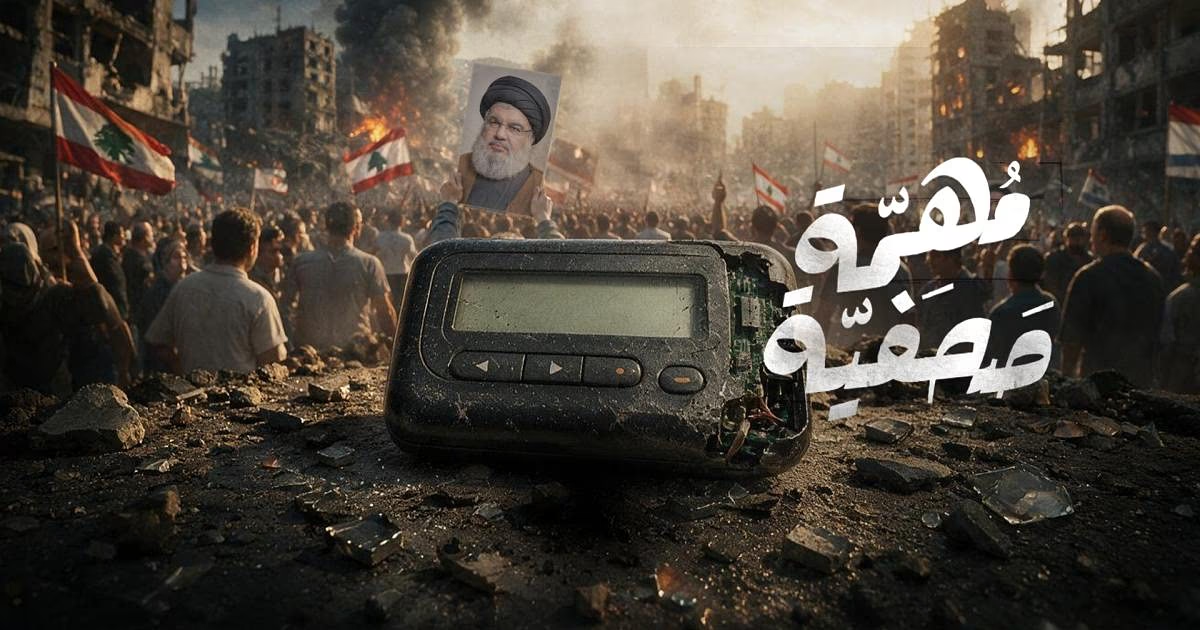
A recent investigative report revealed the historical roots of the 'Pager' operation that shook Lebanon in September 2024, indicating that the seeds of the plan were sown after the occupation's failures in the July 2006 war. Israeli intelligence agencies, specifically the Mossad and Unit 8200, worked on a long-term strategy known as 'The Buttons Plan' to retaliate against Hezbollah by penetrating its infrastructure.
Following the recommendations of the 'Winograd Committee,' Israeli security doctrine shifted from direct military confrontation to deep intelligence work. According to security sources, the goal was to access the internal fabric of the party and undermine it by turning everyday communication tools into inert explosive devices awaiting an activation signal for many years.
On September 17, 2024, specifically at 3:30 PM, thousands of pagers simultaneously exploded in Hezbollah strongholds in the southern suburbs, Beqaa, and the South. The shock did not stop there, as the following day witnessed a second wave targeting 'walkie-talkie' devices, resulting in over 3500 casualties, including martyrs and injured.
Sources reported that the investigation team traced the path of the booby-trapped devices, discovering a high technical capability in converting small batteries into highly explosive devices. Traditional metal detonators were replaced with flammable chemical materials, allowing these devices to pass through airports and precise inspection machines without raising any security suspicions.
The operation relied on a complex network of shell companies in European capitals, most notably 'BAC Consulting' in Budapest and 'Norta Global' in Sofia. It was revealed that these companies were merely paper fronts established to provide legal and logistical cover for the death shipments, with their managers disappearing immediately after the explosions.
Technical experts indicated that Unit 8200 did not merely booby-trap the devices but also contributed to 'creating the need' for them through digital campaigns that led the party to believe that smartphones were completely compromised. This psychological and technical pressure pushed the party's leadership to revert to using older technologies like pagers, thinking they were safer and beyond surveillance.
The criminal design of the devices included selecting specific alert tones that would prompt the user to immediately take out the device and look at its screen. Engineers estimated that a user needs approximately seven seconds to read the message, which was the timing set to ensure the explosion occurred directly in the victim's face to achieve maximum physical harm.
Injured individuals recounted painful testimonies about the moment of the explosion, with some initially believing that the devices were experiencing a technical malfunction or overheating. Medical engineer Hassan Nasrallah confirmed that hospitals turned into war zones within minutes, receiving hundreds of injured who lost limbs or suffered facial injuries due to the sudden explosions.
Injuries were not limited to military personnel but also affected a wide range of civilians such as doctors, engineers, and teachers who use these devices in their professional lives. Field testimonies confirmed that the explosions occurred inside homes and public markets, leading to injuries among women and children who had no connection to the party's military activities.
The investigation revealed that Hezbollah began to suspect the safety of the devices shortly before the disaster occurred, as technicians noticed a defect in some shipments. Samples were sent to experts in Iran for laboratory tests, but the occupation quickly carried out the bombings before the booby-trapped shipments were fully exposed.
The successive assassinations carried out by Israel, especially the assassination of leader Nabil Qaouq, hindered the internal investigations that the party was conducting regarding procurement deals. Qaouq was following the security penetration file and supply chains, which prevented the party from accessing the full details of how the Mossad infiltrated its devices.
From a legal perspective, international law researchers considered the conversion of civilian devices into killing tools a blatant violation of the principles of distinction and proportionality. Researcher Irene Petrobaoli affirmed that this operation constitutes a dangerous precedent in the history of armed conflicts, where commercial supply chains were exploited to carry out indiscriminate attacks against the population.
Observers believe that the 'Pager' operation was merely a prelude to a broader phase of military escalation, which included the elimination of first and second-tier leaders in Hezbollah. This campaign later culminated in targeting the party's Secretary-General, Hassan Nasrallah, reflecting the extent of intelligence penetration achieved by the occupation over years of planning.
Many details of this operation remain undisclosed, but it has redrawn the boundaries of modern intelligence warfare and raised global questions about the security of electronic products. 'The Buttons Plan' has proven that future wars may not begin with missiles, but with a simple text message that turns a device in your pocket into a deadly bomb.
The operation took only seconds to execute, but its preparation had been ongoing for a long time by converting civilian devices into ticking bombs.
شارك برأيك
Threads of 'The Buttons Plan': How did Israel trap Hezbollah's communication network over decades?