






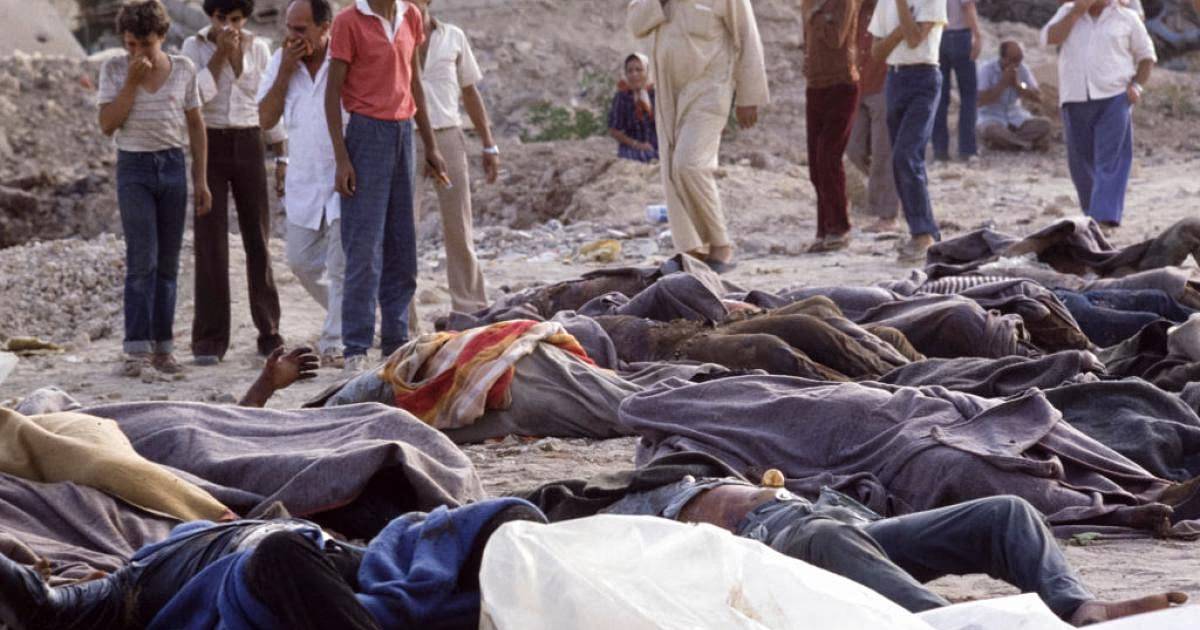
On the afternoon of July 17, 1981, the Israeli occupation's raids did not target isolated military sites or border villages, but extended to strike the heart of the Lebanese capital, Beirut. Warplanes reached the skies of the densely populated Fakhani area, dropping their bombs on passersby and residents in a tragic scene.
Within minutes, residential buildings completely collapsed, and vital streets turned into piles of rubble and fires, while ambulances rushed in a desperate attempt to rescue those trapped. This bombing constituted one of the most brutal Israeli attacks on Beirut, paving the way for a new phase of comprehensive military escalation.
Historical and documentary sources agree that the vast majority of the victims of that massacre were unarmed civilians who were caught off guard by the bombing in their homes and workplaces. Fakhani was not just a geographical point; it represented the pulse of shared life between Lebanese and Palestinians at that time.
These violent raids came amidst escalating confrontation between the occupation forces and the Palestine Liberation Organization, which was using Lebanon as a base for its operations. The occupation authorities at the time claimed that the bombing was in response to rockets fired towards northern settlements, using this as a pretext to violate the capital.
Israeli aircraft heavily targeted the Fakhani area, claiming the presence of Fatah and Democratic Front for the Liberation of Palestine offices within the neighborhood. Although the area included political and administrative centers, it was essentially a residential neighborhood teeming with children, women, and workers.
The massacre revealed a recurring Israeli approach that relies on turning densely populated civilian neighborhoods into legitimate military targets simply by the presence of a political office or organizational facility. This method led to buildings collapsing on their inhabitants, and rescue operations became a race against time amidst blocked roads and accumulated casualties.
Figures regarding the final death toll varied, with Palestinian documentation indicating over 300 martyrs, while other reports cited different numbers. This discrepancy reflects the conditions of the Lebanese Civil War at the time and the weakness of official institutions in accurately counting victims under the rubble.
Fakhani was not just a fleeting incident in the conflict's record; it was a test of the occupation's ability to move the battle from the borders to the heart of major cities. The images from Beirut that day showed the extent of the destruction inflicted on high-rise buildings, civilian, and service institutions.
One week after the massacre and bloody escalation, international efforts led by US envoy Philip Habib succeeded in reaching a ceasefire agreement on July 24, 1981. Although the truce temporarily silenced the guns, it did not defuse the large explosion looming on the horizon.
The armed Palestinian presence in Lebanon remained a concern for the occupation, which continued to plan a broader military operation to completely end this presence. Only a few months passed until the comprehensive Israeli invasion of Lebanon began in June 1982, leading to the famous siege of Beirut.
Analysts believe that the July 1981 raids were a military 'rehearsal' for what the occupation would later do in the 1982 invasion and the Sabra and Shatila massacres. International reactions to the bombing of Arab capitals and the direct and widespread targeting of civilians were tested.
Despite 45 years passing, the memory of the Fakhani neighborhood remains alive in the hearts of the area's residents and the families of the victims who lost their loved ones in treacherous moments. The tragedy is not limited to numbers and statistics, but in the human stories buried under the rubble of balconies and bedrooms.
The anniversary of the massacre raises legal and ethical questions about the protection of civilians in armed conflicts, and how the lives of hundreds are sacrificed for presumed military objectives. What happened in Fakhani remains a testament to the 'scorched earth' policy pursued by the occupation in confronting the Palestinian presence.
Today, Lebanese and Palestinians remember those moments not only as part of the past, but as a continuous lesson about the nature of the conflict in the region. The scenes witnessed in Beirut in 1981 are still recurring in different forms and shapes in other Palestinian and Lebanese cities to this day.
Within minutes, the streets of the Fakhani neighborhood turned into a scene of rubble and fires, a moment that showed how the occupation erases the boundaries between combatants and civilians.
شارك برأيك
45 Years Since the Fakhani Massacre: When the Occupation Invaded the Heart of Beirut with Iron and Fire