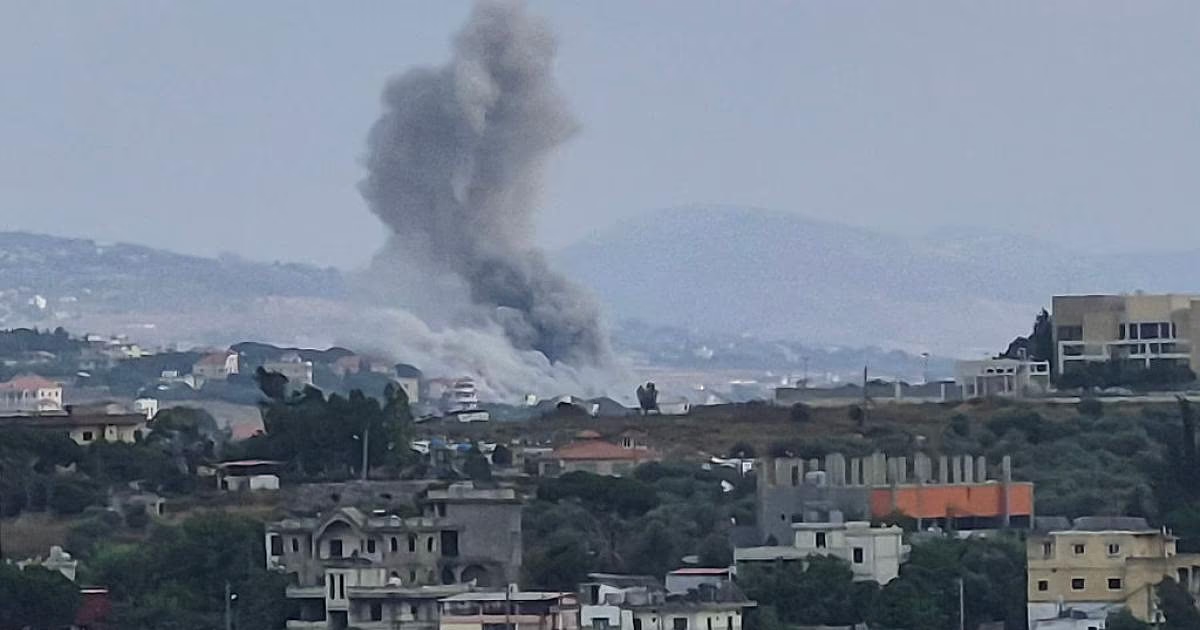







Lebanese media sources reported that Israeli occupation forces continued their field violations of the ceasefire agreement, carrying out extensive bombing operations in the town of Deir Sirian, part of the Nabatieh Governorate in the south of the country. This coincided with artillery attacks targeting the vicinity of the town of Nabatieh Fouqa towards the town of Meifdoun, reflecting the occupation's insistence on overstepping existing security understandings.
In a related context, the Emergency Health Operations Center of the Lebanese Ministry of Health revealed a tragic update to the cumulative toll of the Israeli aggression ongoing since early March. According to official data, the number of martyrs has risen to 4,320 people, while the number of injured and wounded reached approximately 12,203, as a result of continuous raids and shelling on various Lebanese regions.
For his part, Lebanese President Joseph Aoun strongly condemned the continued Israeli aggressions targeting civilians, noting the martyrdom of four citizens in Nabatieh yesterday. Aoun affirmed during his meetings with political and economic delegations in Beirut that the Lebanese state is committed to the ceasefire and demands that the international community exert effective pressure on Tel Aviv to respect international obligations.
The Lebanese President stressed that the state-building process has effectively begun, affirming that the decision regarding the exclusivity of weapons in the hands of legitimate Lebanese institutions will be implemented without retreat. Aoun clarified that the interest of the Lebanese lies in the establishment of a strong state capable of protecting its sovereignty, noting that Lebanon has secured international recognition that there are no Israeli ambitions in its territories.
On the diplomatic front, Israeli Foreign Minister Gidon Sa'ar announced that the next round of negotiations with the Lebanese side will be held next week in the Italian capital, Rome. Sa'ar's statements came during a meeting with his German counterpart in occupied Jerusalem, where he described the framework agreement reached two weeks ago as a historic step.
In contrast, official circles in Lebanon expressed reservations and rejection of choosing the Italian capital as the venue for the talks, indicating the presence of logistical and political obstacles to resuming dialogue. This disparity comes at a time when the United States is seeking to solidify the framework agreement signed on June 26 to ensure the stability of the northern borders.
The framework agreement, concluded under American patronage, stipulates a gradual and sequential withdrawal of occupation forces from the areas they infiltrated within Lebanese territory. This withdrawal is closely linked to the Lebanese army's ability to extend its full security control and disarm armed groups in border areas, in a clear reference to arrangements concerning Hezbollah.
Despite the ceasefire agreement in effect since November 2024, the field witnesses daily Israeli violations ranging from aerial and artillery shelling to sweeping operations. Beirut considers these movements an undermining of de-escalation efforts and an attempt to impose a new reality on the ground before completing the withdrawal phases stipulated in the recent agreements.
Field reports indicate that occupation forces still occupy large areas in southern Lebanon, having infiltrated some axes for a distance exceeding 10 kilometers. These forces are distributed in areas occupied during the current aggression that began in March 2026, in addition to border points controlled by the occupation for many years.
The international community faces repeated Lebanese demands for the necessity of setting a clear timetable for the Israeli withdrawal, especially since the framework agreement did not specify precise dates for ending the foreign military presence. Observers believe that Israeli procrastination in implementation aims to gain more time to strengthen defensive positions within Lebanese territory.
In conclusion, the situation in southern Lebanon remains subject to field developments and the extent of the parties' commitment to the signed agreements, amidst the continued fall of civilian casualties. The Lebanese government affirms that the only path to stability is the full implementation of international resolutions and ensuring the state's sovereignty over all its national territory without any external interference.
I will not under any circumstances accept anyone negotiating on behalf of Lebanon, and the decision regarding the exclusivity of weapons will be implemented, and there is no alternative to the establishment of the state.
شارك برأيك
Israel escalates its violations in southern Lebanon, and Aoun emphasizes the exclusivity of weapons