






Washington's Message
Washington – Saeed Arikat – 7/3/2026
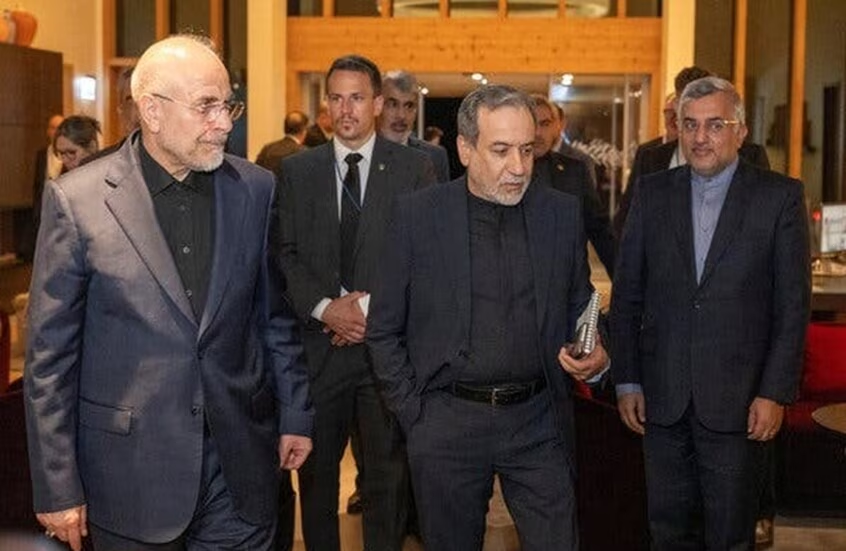
American press reports revealed that the Washington administration feared Israel would assassinate Iranian Foreign Minister Abbas Araqchi and Iranian Parliament Speaker Mohammad Bagher Ghalibaf during the round of negotiations held last April, a move that would have undermined the diplomatic path and returned the region to a wide-scale military confrontation.
The New York Times reported, citing American officials, that US agencies took seriously information indicating that the Iranian officials were on a potential Israeli target list. Although Washington had supported assassinations carried out by Israel against Iranian figures during the extensive conflict between the two sides, it believed that carrying out political assassinations in the midst of negotiations would have undermined opportunities for reaching understandings and destroyed ongoing diplomatic efforts.
According to the report, some American officials confirmed that the United States did not merely assess the risks internally but also conveyed messages through intermediary countries to warn Tehran of a potential Israeli plot to target high-ranking Iranian figures, in an attempt to prevent the collapse of the negotiation process before it bore fruit.
This information highlights the extent of the divergence between American and Israeli calculations during that period. While the Washington administration sought to maintain communication channels with Tehran, Israel, according to the report, believed that continuing the policy of assassinations and preemptive strikes was the most effective means to weaken the Iranian leadership and prevent any settlement that would grant it political or economic breathing room.
The report pointed to an incident that caused great concern within Iran when Parliament Speaker Mohammad Bagher Ghalibaf traveled to Pakistan to participate in negotiation meetings last April. During his return journey, Iranian security agencies informed the plane he was on that they had received intelligence indicating Israel's intention to target it, and that two Israeli fighter jets had entered Iranian airspace from the western side near the Iraqi border.
Following this information, it was decided to change the flight path, and the plane landed in the city of Mashhad instead of Tehran, before Ghalibaf and his accompanying delegation completed their journey by land to the Iranian capital. This account was confirmed by Mehdi Mohammadi, a senior advisor to Ghalibaf, which gave it further credibility within Iranian circles.
These events indicate that security concerns were not merely theoretical assessments but were based on intelligence that prompted Iranian officials to take extraordinary measures to avoid any potential assassination attempt at a time when negotiations were going through a highly sensitive phase.
In contrast, Israel, according to the report, did not hide its desire to resume the extensive war against Iran despite the signing of the memorandum of understanding between Washington and Tehran. The report clarified that decision-making circles in Tel Aviv still believe that targeting senior Iranian officials is an entry point to re-establish the deterrence equation, and that any new confrontation would likely begin with a series of assassinations targeting prominent political and military leaders.
The report also referred to what "Capital & Empire" published at the end of May, which stated that Israel had pressured the US administration to resume extensive military strikes against Iran, including an operation targeting Parliament Speaker Mohammad Bagher Ghalibaf.
These facts reflect the continued divergence in the priorities of the two parties; while Washington views understanding with Iran as a tool to control regional tension and prevent a slide into open war, Israel seems more inclined to use military force to thwart any negotiated path that might give Iran an opportunity to restore its political or economic capabilities.
These leaks reveal that the disagreement between Washington and Tel Aviv is no longer about the ultimate goal of containing Iran, but about the means and timing. The United States appears more eager to use negotiation as a tool to manage the conflict and reduce its cost, while Israel believes that any diplomatic truce gives Tehran an opportunity to reorganize its political and military capabilities. Therefore, for Israel, assassinations are not just security operations, but a means to thwart any understanding that could change the balance of power or limit its regional maneuverability.
The incident also highlights the fragility of any negotiation process conducted amidst ongoing military operations and intelligence warfare. When senior negotiators themselves become potential assassination targets, mutual trust erodes, and the success of negotiations becomes dependent on the ability of mediators to provide security guarantees before political ones. This reveals that contemporary conflicts are no longer managed only at the negotiating table, but also through covert operations that may decide the fate of understandings before they reach the signing stage, making the personal security of negotiators part of the negotiation equation itself.
If these accounts are true, they confirm that the region was closer to a comprehensive explosion than was publicly announced. The assassination of the Iranian Foreign Minister or Parliament Speaker during negotiations would have been interpreted in Tehran as a declaration of the permanent closure of the door to diplomacy, and perhaps would have pushed the Iranian leadership to a wide military response that would exceed previous rules of engagement. Therefore, American efforts to contain such a scenario appear to be a reflection of the understanding that any miscalculation could turn a manageable regional crisis into a war whose repercussions on the Middle East and the world would be difficult to contain.
شارك برأيك
Washington Feared Israeli Assassination of Senior Iranian Officials During Negotiations