






By: Said Arikat
March 22, 2026
News Analysis
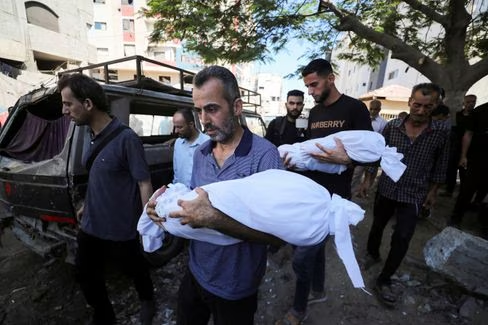
Washington, D.C - In her latest report to the United Nations Human Rights Council, Special Rapporteur Francesca Albanese confronts a question that much of the international community has strained to avoid: whether the devastation in Gaza should be understood not only as a humanitarian catastrophe or even a war crime, but as something far more grave—genocide.
This is not a rhetorical escalation. It is a legal argument, grounded in the framework of the Genocide Convention. Albanese does not claim that genocide has been definitively adjudicated; that is the role of courts. Instead, she argues that the observable facts—mass civilian killing, widespread destruction of infrastructure essential to life, and the imposition of conditions that make survival increasingly untenable—may satisfy the Convention’s criteria when coupled with evidence suggesting intent.
That distinction matters. The report does not seek to replace judicial bodies, but to trigger their relevance. It reframes Gaza from a site of recurring crisis into a test case for whether international law retains any operational meaning when its most serious prohibitions are plausibly engaged.
What gives the report its force is not only its legal framing but its insistence on continuity. Gaza is not treated as an isolated eruption of violence following a single triggering event, but as the most acute manifestation of a system that has evolved over decades. The occupation of Palestinian territory since 1967, the prolonged blockade of Gaza, and the progressive fragmentation of Palestinian life are presented not as background conditions but as integral to understanding the present moment. In this view, the current destruction is not an aberration—it is an intensification.
Within that broader context, the report also documents patterns that meet the threshold of torture and cruel, inhuman, or degrading treatment: arbitrary and mass detention, reported abuse of detainees, and conditions that strip individuals of dignity and security. These are not framed as incidental byproducts of war, but as recurring features of a system in which coercion and control are embedded practices.
Taken together, the allegations of torture and the analysis of potential genocidal acts converge on a single, uncomfortable implication: that what is unfolding may not simply be excessive force or even systematic violations of humanitarian law, but conduct that engages the highest level of international criminal responsibility.
The political implications are as significant as the legal ones. If the threshold of genocide is plausibly met, even as a matter of risk rather than final determination, states are not free to remain passive. The Genocide Convention imposes an obligation not only to punish but to prevent. This shifts the burden outward, onto governments that continue to provide military aid, diplomatic cover, or political support. The report does not name them as co-perpetrators, but it makes clear that the line between support and complicity is not infinitely elastic.
This is where the report becomes more than a legal document; it becomes an indictment of international inertia. For months, governments have responded to Gaza with a familiar vocabulary—calls for restraint, concern for civilian lives, appeals for humanitarian access—while largely maintaining the policies that enable the continuation of the conflict. Albanese’s analysis challenges that posture by suggesting that such responses may be not only inadequate but legally insufficient.
Unsurprisingly, the report has drawn sharp criticism. Israeli officials and several allied governments reject its conclusions outright, arguing that the genocide label is both unfounded and inflammatory. They question the impartiality of the Special Rapporteur and warn that such accusations risk politicizing international law. These objections are not new; they have accompanied previous UN findings on the occupied territories.
But dismissing the report does not neutralize its argument. The strength of Albanese’s case lies in its method: it applies established legal standards to a body of documented facts and asks whether the resulting picture fits the definitions that states themselves have codified. One may dispute the interpretation, but one cannot simply wish away the framework.
The deeper issue, then, is not whether this report is accepted in full or rejected outright. It is whether the international system is prepared to confront the possibility that its most solemn legal commitments are being tested—and perhaps found wanting. If the threshold for even investigating genocide is set so high that no contemporary case can meet it without unanimous political consent, then the Convention risks becoming a symbolic instrument rather than a binding one.
Gaza, in this sense, is not only a humanitarian tragedy; it is a legal reckoning. It forces a choice between a rules-based order that operates selectively and one that applies its standards consistently, even when politically inconvenient. Albanese’s report does not resolve that tension, but it strips away the ambiguity that often allows it to persist.
The question it leaves behind is stark: if this does not compel serious legal and political scrutiny, what would?
شارك برأيك
Genocide and the Burden of Proof in Gaza