






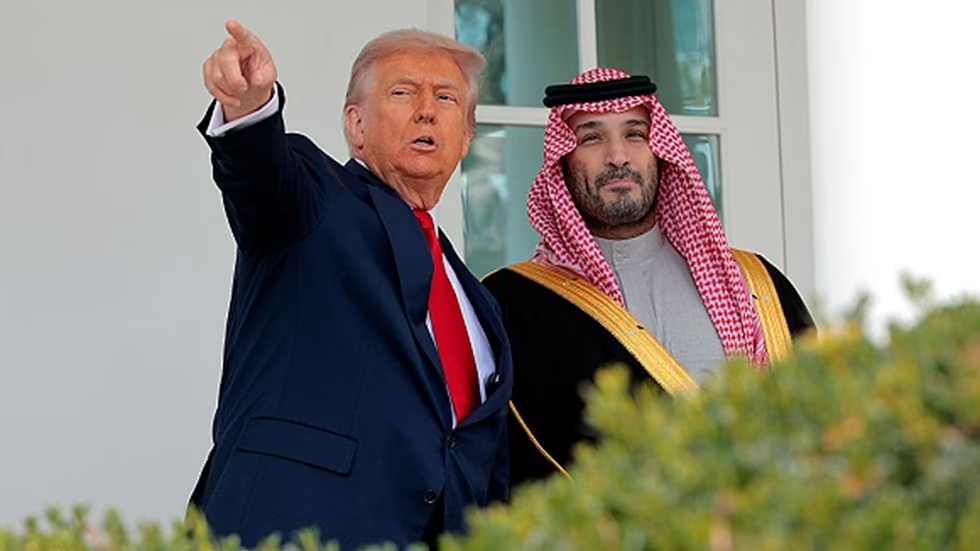
Sources reported that Israeli political circles are cautiously anticipating Saudi Arabia's firm stance on the normalization issue. Hebrew media outlets quoted a senior political source confirming that Riyadh continues to condition any normalization on a serious and clear political path leading to the establishment of an independent Palestinian state. This revelation reaffirms Saudi constants that the Kingdom has always expressed in international forums, placing Palestinian rights at the forefront of any potential regional understandings.
In a parallel dramatic development, the nuclear deal between Washington and Riyadh emerged as a new pressure element in the regional equation, after the two parties signed a historic agreement on July 22 under Article 123 of the US Atomic Energy Act. This agreement, which spans decades and is worth billions of dollars, opens the door for extensive peaceful nuclear cooperation between the two countries, but it is now closely linked to the political normalization file.
Sources clarified that the nuclear deal grants Saudi Arabia the possibility of building a uranium enrichment facility on its territory after joint technical studies with the American side. This clause represents a departure from the 'gold standard' previously followed by Washington in its nuclear agreements in the region, reflecting the strategic importance the current US administration attaches to strengthening its partnership with Riyadh.
For his part, US President Donald Trump brought about a major shift in the course of negotiations after explicitly announcing via his 'Truth Social' platform that final approval of the nuclear deal is contingent on Saudi Arabia joining the 'Abraham Accords.' This direct linkage places the nuclear deal at the mercy of political tug-of-war, especially since the official announcement of the agreement on its first day did not openly and explicitly include this condition.
There is a state of concern in international human rights and oversight circles due to the absence of the 'Additional Protocol' of the International Atomic Energy Agency from the terms of the agreement, a protocol that allows for surprise and comprehensive inspections. Experts in nuclear non-proliferation believe that this absence could set a precedent allowing other countries in the Middle East to demand similar conditions, which could open the door to an uncontrolled nuclear arms race.
Domestically in Israel, the Saudi nuclear deal sparked a wave of sharp criticism against the current government, with former officials describing what happened as a 'complete strategic failure' for Benjamin Netanyahu. The Israeli opposition accuses Netanyahu of being unable to prevent the emergence of a nuclear program in the vicinity, despite his continuous attempts to portray himself as a guardian of Israeli national security in the face of regional nuclear ambitions.
Despite Israeli Prime Minister Benjamin Netanyahu's repeated welcome of the idea of normalization with Saudi Arabia, analysts point to a deep gap between his ambitions and political reality. The Saudi condition regarding the Palestinian state clashes with a categorical rejection from the ruling coalition in Israel, making it difficult to achieve a real breakthrough in this file without making fundamental concessions to the Palestinians.
Observers believe that the recent American move to link the nuclear file with normalization may be a tactic to regain influence in the complex negotiations, and an attempt to calm Israeli fears on the one hand, and pressure the Saudi side on the other. However, Riyadh maintains official silence regarding these new American conditions, adhering to its declared position that the Palestinian issue must be resolved first.
The nuclear deal is currently undergoing a 90-day review period in the US Congress, a period that will witness heated discussions among lawmakers about the security and political implications of the deal. Pro-Israel lobbies are expected to play a role in attempting to amend the terms of the agreement or impose additional guarantees to ensure that the peaceful program does not turn into other paths in the future.
Ultimately, the future of the region remains suspended between nuclear development ambitions and the requirements of a just peace, with the Palestinian state remaining the cornerstone of any lasting regional stability. With the continued tug-of-war between Washington, Riyadh, and Tel Aviv, it appears that the path towards formulating a new regional equation is still fraught with major political and security obstacles.
The nuclear deal will be approved, but it is entirely contingent on Saudi Arabia joining the Abraham Accords.
שתף את דעתך
Israeli sources: Riyadh insists on Palestinian state path as condition for normalization