






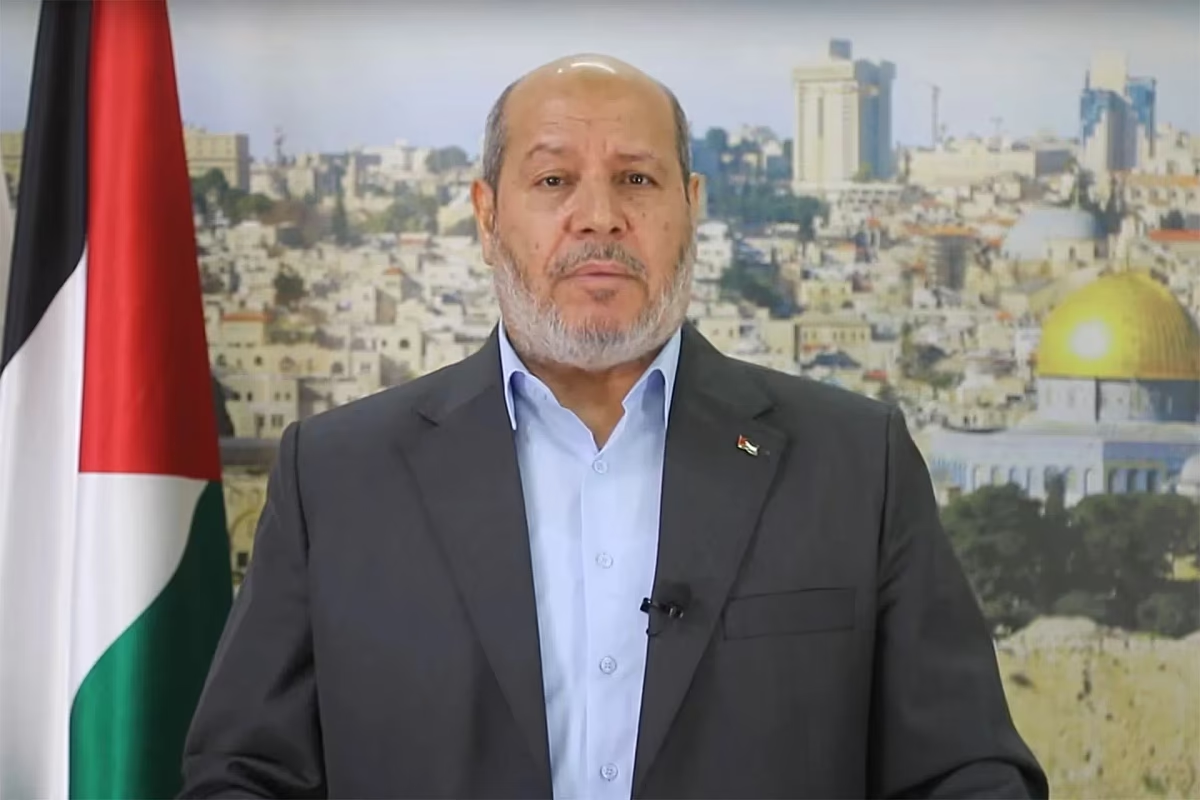
The election of Khalil al-Hayya as head of the Political Bureau of the Islamic Resistance Movement (Hamas) comes at a pivotal historical moment, as he assumes leadership more than 20 months after the martyrdom of his predecessor, Yahya Sinwar, in October 2024. This choice represents an important turning point in the movement's trajectory, especially since al-Hayya is considered part of the field-oriented current linked to the interior, reflecting a desire to maintain the momentum of the resistance despite field and political complexities.
The new leadership faces enormous challenges imposed by the repercussions of the ongoing Israeli aggression on the Gaza Strip and the changing balance of power in the region. Observers believe that al-Hayya came at a time when the movement needs a delicate balance between military action and international political maneuvering, especially with the decline of some traditional sources of power due to the long war and the widespread destruction of infrastructure.
Informed sources revealed that al-Hayya's election came after competition with Khaled Meshaal, with a narrow margin of votes, indicating the presence of multiple intellectual currents within the movement. However, al-Hayya's victory reinforces the continuity of the internal approach, while giving him theoretical space to conduct structural reviews that may be necessary to face the next stage, which requires greater political flexibility.
Al-Hayya outlined six strategic priorities for his term, foremost among them being a comprehensive cessation of aggression and a complete Israeli withdrawal from the Gaza Strip. He also stressed the need to provide urgent relief and ensure a dignified life for the residents, while thwarting forced displacement plans and immediately commencing reconstruction efforts and the release of prisoners from occupation jails.
Regarding the Palestinian internal front, national unity stands out as a top priority for al-Hayya, as he seeks to rebuild the institutions of the Palestine Liberation Organization on democratic foundations. This approach aims to create a united front capable of confronting political challenges, especially with the approaching legislative elections scheduled for November 2026, which raise questions about the extent of the movement's participation.
On the international level, al-Hayya seeks to strengthen the movement's relations with the Arab and Islamic surroundings, and to pressure for the activation of the role of sister countries to stop the war of extermination. His plan also includes activating international accountability to protect Palestinians and hold perpetrators of war crimes accountable, indicating a desire to use legal and diplomatic tools alongside field work.
Academics and political analysts believe that al-Hayya's inaugural speech was characterized by maintaining the movement's unity and avoiding openly raising contentious issues. Despite significant changes in the political landscape, al-Hayya did not explicitly refer to radical reviews, preferring to focus on constants that ensure the cohesion of organizational bases amid increasing external pressures.
The arms file remains the most prominent and complex challenge facing the new leadership, as the movement considers it a red line that cannot be crossed under any circumstances. With increasing regional and international pressures regarding the disarmament of Gaza, al-Hayya is likely to resort to a collective leadership approach and consult advisory bodies to distribute the responsibility of making fateful decisions in this regard.
Reports indicate a disparity in the movement's popular support, as it was significantly affected in Gaza due to the high humanitarian cost of the war, while it saw a rise in the West Bank. This disparity imposes on al-Hayya the necessity of re-weaving the relationship with the Palestinian public and listening to their aspirations, to ensure the restoration of popular and national legitimacy in the face of attempts at political exclusion.
Ultimately, experts agree that the most urgent task facing Khalil al-Hayya is to extricate the Gaza Strip from its current catastrophe and achieve genuine partnerships with national factions. Restoring credibility to the Palestinian national project requires a vision that transcends narrow partisan interests and focuses on strengthening popular steadfastness in the face of extremist Israeli policies targeting the Palestinian presence.
The six priorities announced by al-Hayya are a comprehensive cessation of aggression, relief and reconstruction, and achieving Palestinian national unity.
שתף את דעתך
Khalil al-Hayya as Head of Hamas Political Bureau: Field Challenges and Future Strategy