






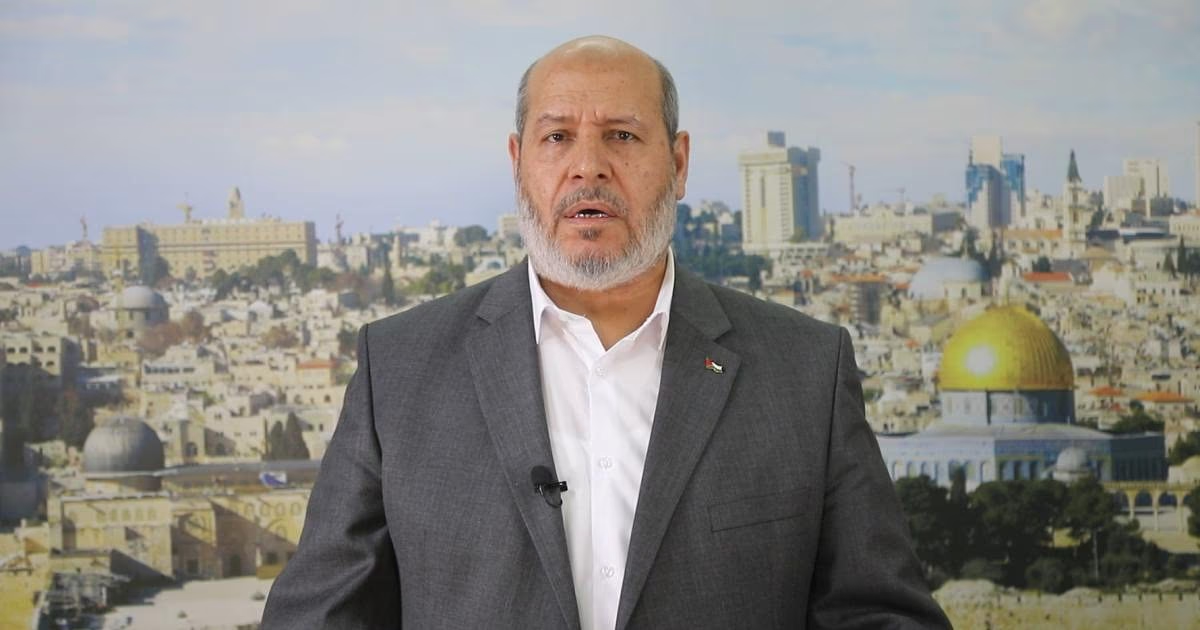
The Islamic Resistance Movement (Hamas) announced the election of Khalil al-Hayya as the head of its new political bureau, succeeding the late leader Yahya Sinwar. This decision comes at a highly sensitive time, as the Palestinian territories, particularly the Gaza Strip, are experiencing a state of anticipation amidst a fragile ceasefire and unprecedented field and political challenges.
Completing the electoral process in this exceptional circumstance reflects the movement's insistence on demonstrating the cohesion of its internal institutions and its ability to restore leadership structures. Sources within the movement confirmed that al-Hayya's selection reinforces the principle of Shura (consultation) and institutionalism that Hamas is keen to highlight as a fundamental pillar of its organizational work, despite repeated Israeli targeting.
Khalil al-Hayya, known by the nickname 'Abu Osama,' is not a new face on the political scene; rather, he is one of the most prominent leaders who witnessed the movement's founding in 1987. Al-Hayya was born in the Shuja'iyya neighborhood of Gaza City in 1960 and rose through organizational and political ranks until he became a member of the political bureau and responsible for major strategic files.
Al-Hayya's personal biography carries deep symbolic dimensions for the movement's supporters, given the great sacrifices his family has made during years of conflict. Al-Hayya lost several of his children and grandchildren in Israeli raids that targeted their homes, the latest of which was during the ongoing war, which gives him a special status as a leader who emerged from the heart of field suffering in Gaza.
Politically, al-Hayya is seen as the architect of indirect negotiations, having led the movement's delegations in complex rounds in Doha and Cairo. His role was pivotal in reaching the October 2025 understandings, reflecting his ability to combine adherence to principles with the political flexibility required in managing international crises.
Under al-Hayya's leadership, the new leadership faces a heavy legacy of managing the devastated Gaza Strip and dealing with the thorny prisoner file. The issue of reconstruction and consolidating the ceasefire also emerges as top priorities requiring high coordination with regional and international mediators amidst a severe financial and political blockade imposed by the occupation.
For its part, the Israeli occupation authorities appear preoccupied with monitoring developments within Hamas, despite their claims of indifference to the identity of individuals. Reports indicate that the Israeli discourse has shifted from 'absolute elimination' to focusing on reducing military capabilities and preventing the movement from regaining its administrative and security influence in the Strip.
Observers believe that al-Hayya's election represents a bridge between internal and external leadership, given his extensive relations with regional powers and his strong presence within Gaza. Al-Hayya previously succeeded in complex files, including restoring relations with the Syrian regime in 2022, which indicates a strategic vision for expanding the movement's alliances.
The biggest challenge for al-Hayya is how to balance the demands of armed resistance with the urgent humanitarian needs of the Strip's residents. The movement is now required to provide realistic solutions to the tragedy of displacement and hunger, amidst terrifying statistics indicating more than 73,000 martyrs since the outbreak of confrontation in October 2023.
In an analysis by political analysts, al-Hayya's rise does not necessarily mean a radical shift in the movement's ideology, but rather a continuation of the approach of previous leaders who emerged from Gaza. Al-Hayya, like Haniyeh and Sinwar, represents a current that sees Gaza as the primary center of gravity for the Palestinian national project, while preserving the national and Islamic dimension of the cause.
Sources indicate that al-Hayya survived a mysterious assassination attempt in the Qatari capital, Doha, last September, which confirms the continued security threats facing first-tier leaders. These risks impose a complex security pattern on the new leadership in movement and managing communication with organizational bases and mediators.
Hamas's success in conducting its internal elections amidst the rubble sends a clear message of defiance to the Israeli occupation that 'the idea does not die.' Researchers believe that this step enhances the legitimacy of the new leadership before the international community as a party that cannot be bypassed in any future arrangements related to the Palestinian issue.
The next phase will be a real test of al-Hayya's political maneuvering ability, especially in light of American and regional pressures to redraw the governance map in Gaza. The 'day after the war' file will be the table that tests the new leadership's skill in preserving field gains and transforming them into political achievements.
In conclusion, Khalil al-Hayya enters the movement's presidency office carrying a mandate from its consultative institutions to face the most difficult circumstances in its history. The bet remains on his ability to unite the internal Palestinian ranks and manage the conflict with the occupation with a mindset that combines field resilience and diplomatic shrewdness in a region teeming with transformations.
Khalil al-Hayya's election represents a message that the movement's organizational structure is still capable of producing new leadership despite significant losses.
שתף את דעתך
Khalil al-Hayya as Head of Hamas Political Bureau: Implications of the Choice and Challenges of the Post-Sinwar Era