PALESTINE

Sat 14 Mar 2026 7:43 pm - Jerusalem Time

West Bank Markets in the Grip of Recession: War and Siege Extinguish the Joy of Eid

The cart of the street vendor 'Abu Shaheen' roams the streets of Nablus city, north of the West Bank, laden with seasonal vegetables, but his voice, which passersby were accustomed to hearing, did not receive the usual echo this year. Despite the last ten days of Ramadan and the approaching Eid al-Fitr, commercial activity appears subdued and burdened by the worries of war and regional tensions that have cast a shadow over Palestinian consumer behavior.

Abu Shaheen describes the state of the markets as 'miserable,' indicating that the fear of the unknown has led many to drastically reduce their spending and settle for minimal purchases. The vendor believes that citizens now prefer to hold onto cash instead of shopping, in anticipation of any security or economic developments that may arise amid the ongoing escalation in the region.

For her part, government employee Mona Al-Aghbar expresses the compounded pressures facing Palestinian families, as the Eid season coincided with a suffocating salary crisis and escalating political tension. She explained that the irregular disbursement of financial dues forced her to reorder her priorities, limiting purchases to necessities only to ensure Eid clothes for her three children.

Nablus city, a vital economic center, faces a strict military siege imposed by the Israeli occupation on its main entrances, isolating it from surrounding villages and towns. This field closure has led to the absence of 'external purchasing power' that the city's markets primarily depend on, especially shoppers from rural areas and from within Palestine.

Traders in the city confirmed that the closure of checkpoints, such as the Beit Furik checkpoint, for several consecutive days caused a complete paralysis in some commercial sectors. They believe that the continued restriction on movement is the biggest obstacle to any attempt to revive the market, especially during seasons that are supposed to witness annual sales peaks.

Economic estimates indicate that the Palestinian market has lost about $9 billion since the start of the war in October 2023, due to the disruption of workers prevented from reaching their workplaces. This financial bleeding has led to a tangible decrease in general purchasing power, causing the head of the household to direct their limited spending towards food supplies and fuel only.

In the clothing and retail sector, trader Ayman Al-Masry speaks of goods piling up in warehouses due to citizens' reluctance to buy non-essential items. Al-Masry explained that traders are living in a state of uncertainty, as their capital is frozen in seasonal goods that may not find buyers, threatening their ability to meet their financial obligations to suppliers.

Al-Masry adds that consumer patterns have shifted radically towards household storage of food items and gas, fearing supply disruptions or complete closure of crossings. This shift has created a significant gap in the market, where luxury sectors suffer from a severe recession, while essential goods sectors face significant pressure that could lead to shortages in some items.

Yassin Dweikat, spokesperson for the Nablus Chamber of Commerce, explained that the city witnessed slight signs of recovery before Ramadan, but these quickly dissipated with the escalation of regional tensions. He pointed out that the absence of shoppers from within the occupied territories, who represent a significant commercial pillar, contributed to deepening the financial crisis plaguing shops.

Dweikat noted that accumulated financial crises, primarily the occupation's withholding of Palestinian clearance funds, estimated at $255 million monthly, have caused a liquidity shortage. This reality has placed traders under dual pressure, as they face the costs of accumulated inventory amid a complete absence of the usual purchasing activity at such times.

In an attempt to stir the stagnant waters, many traders resorted to offering huge discounts and sales on clothes, shoes, and sweets. Through these steps, they aim to collect any amount of cash liquidity to cover their operating expenses, despite realizing that the fear dominating consumers is stronger than any price temptations.

Regarding food security, official sources in the Ministry of Economy confirmed that the strategic stock of essential goods such as flour, oil, and sugar is sufficient for six months. However, Dweikat warned that uncalculated hoarding could create artificial crises in the markets, urging citizens to buy only according to actual need.

Economic circles are anxiously monitoring the repercussions of tension in international waterways, such as the Strait of Hormuz, and its impact on global commodity prices. Experts believe that any increase in shipping costs or global energy prices will inevitably reflect on the Palestinian market, already burdened by crises, which could lead to a new wave of unaffordable price hikes for consumers.

The scene in the West Bank markets remains suspended between traders' hopes for an imminent breakthrough and a field and political reality that is becoming increasingly complex. While families prepare to celebrate Eid with minimal means, shops remain full of goods and empty of customers, a picture that summarizes the depth of the economic crisis left by the war and siege.

People became fearful and tightened their belts; they refrain from buying and prefer to hold onto cash in anticipation of any emergency.

ANALYSIS

Sat 14 Mar 2026 7:43 pm - Jerusalem Time

The Cruel Law of History: Has the Era of Empires' Fall Begun from the Gates of Gaza?

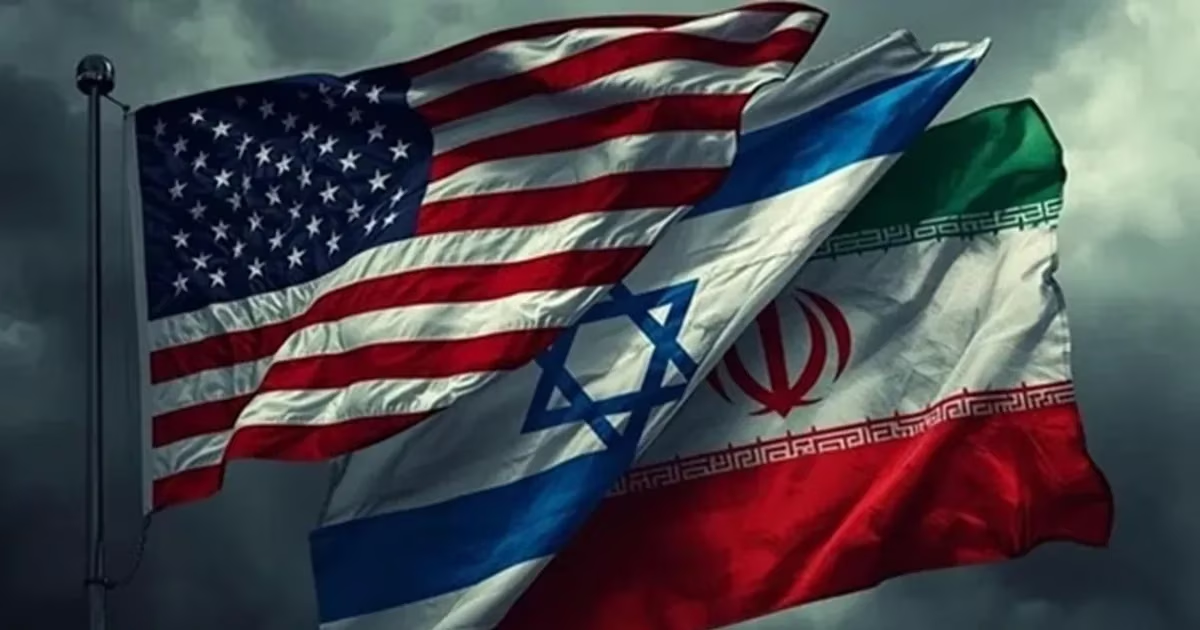
The current international scene appears to be closer to a moment of profound historical transformation, as the ongoing war in the Middle East and the escalating tension between Israel, America, and Iran point to a widespread political and strategic predicament. These events are no longer to be read solely within the framework of traditional military power balances, but in the context of the erosion of the political and moral prestige of the powers that have dominated the international system since the end of World War II.

In the Israeli case, it has become clear that the war aimed at restoring its eroded deterrence image in the Gaza Strip has led to completely counterproductive results. Israel has become entangled in a spiral of military and political crises that exposed the fragility of the 'absolute superiority' idea, and placed its conduct under the microscope of global moral scrutiny for the first time in many decades.

The humanitarian tragedy in Gaza is no longer just a fleeting news item; it has become a fundamental pillar in a broad international discussion about the limits of military power in imposing political realities. This Israeli predicament is organically linked to the American predicament, as Washington finds itself drifting behind short-sighted policies that lack a coherent strategic vision, especially in managing the conflict with Tehran.

The policies of successive US administrations, particularly the impulsiveness of the Donald Trump era, have contributed to pushing the region to the brink of confrontation without offering a clear vision for the ultimate outcomes. The world's greatest power seemed to be acting on a reactive logic rather than a leadership logic, leading to the erosion of the 'moral prestige' that Washington claimed to protect through slogans of human rights and international law.

This erosion of prestige is not merely a propaganda issue; it is a fundamental element in the stability of states, as Ibn Khaldun explained in his theory on the rise and fall of states. A state reaches the peak of its power when authority is balanced with justice, but when power transforms into a tool for mere domination and loses its ability to achieve justice, it inevitably enters a phase of gradual weakness and decline.

Moving to the Iranian role, we find that Tehran exploited the strategic vacuum left by the American invasion of Afghanistan and Iraq to expand its regional influence unprecedentedly. However, this expansion, which included Iraq, Syria, Lebanon, and Yemen, carried within it the seeds of a long-term crisis, as it was associated with militia networks and internal conflicts rather than stability and development projects.

Today, Iran faces a complex equation: widespread geographical influence fraught with enormous political, economic, and security burdens, embodying the concept of 'imperial overstretch' coined by historian Paul Kennedy. This concept describes the situation in which a state exceeds its economic and political capabilities in managing its external influence, ultimately leading to the depletion of its core resources.

History will record that the Gaza Strip was the first to break the prestige of the Israeli occupation, not only through its steadfastness in the face of the longest war of extermination but also through its legendary resilience on the ground and its rejection of displacement plans. Gaza exposed the entity's image as a brutal occupying power and redefined the conflict in the global consciousness as a matter of human justice against a military killing machine.

In contrast, Iran emerges as the first developing country to dare to confront the United States face-to-face, benefiting from the strategic mistakes of the major powers. This confrontation is no longer just a limited regional conflict; it has become a reflection of a broader battle for prestige and legitimacy in an international system undergoing a difficult birth and radical shifts in the balance of power.

While these international balances are changing, the official Arab system appears to be in a state of helplessness and stagnation, unable to formulate a unified position or influence the tumultuous transformations. The current Arab division makes the region captive to the policies of regional and international powers, as if the official Arab decision has become out of sync with the historical time in which other nations are moving.

The voice of the victims always remains more eloquent than political statements. The tragedy of the Syrian child in the Mediterranean waters and the faces of Gaza's children facing hunger and bombardment are living testimonies to the failure of the international system. These moral transgressions and the blood shed without cause are recorded in the annals of history and will not pass without a price paid by each party according to its role and responsibility.

The painful lesson offered by current events is that power without justice, and authority without mercy, quickly pave the way for total collapse. Empires, no matter how great, remain hostage to their moral system and their relationship with humanity, and history does not forgive those who betrayed justice or invested in the suffering of peoples for fleeting political gains.

The historical reckoning is inevitably coming for everyone who contributed to undermining the values of human dignity, as reality proves that the erosion of legitimacy is the actual prelude to the fall of great powers. What is happening in Gaza and the region today is not just another round of conflict; it is a rewriting of the rules of moral and political engagement that will govern the world in the coming decades.

Ultimately, the human being clinging to their right remains the true driver of history, while powers that rely on mere oppression fade away. The steadfastness of the oppressed in the face of advanced war machines sends a clear message that the era of absolute domination has passed, and a new dawn of power balance has begun to form from amidst the rubble and destruction.

Great powers do not suddenly fall due to a single military defeat; their decline usually begins with the erosion of their political and moral legitimacy in the eyes of others.

PALESTINE

Sat 14 Mar 2026 7:43 pm - Jerusalem Time

7 Dead in Two Days.. Sandstorm Doubles the Tragedy of Displaced Persons in Gaza Strip

The severity of the humanitarian suffering in the Gaza Strip escalated today, Saturday, as the blood of martyrs mingled with the dust of sandstorms that swept through the tents of displaced persons. Medical and field sources reported the martyrdom of a Palestinian woman by Israeli occupation army bullets in Al-Maghazi camp, coinciding with the injury of two children with varying degrees of wounds due to the collapse of a wall in Khan Yunis city as a result of the strong winds hitting the area.

In details of the field attacks, sources stated that occupation vehicles stationed in the eastern areas of Al-Maghazi camp fired live bullets directly at the woman from the Abu Shawarb family, leading to her immediate death. This incident comes in the context of a series of ongoing violations of the fragile ceasefire agreement that came into effect last October.

Official statistics issued by the Ministry of Health in Gaza revealed that hospitals received seven martyrs and 13 injured during the past forty-eight hours. With this new toll, the number of victims of Israeli violations since the start of the truce has risen to 659 martyrs and more than 1700 injured, raising questions about the seriousness of adherence to the concluded agreements.

Regarding the total toll of the aggression since October 2023, the ministry confirmed that the number of officially registered martyrs reached 72,234 martyrs, while the number of injured exceeded 171,000. Medical teams indicated that search operations under the rubble are still ongoing, with 756 bodies recovered since the cessation of major military operations.

Away from the bullets, displaced persons in the Strip faced a harsh climatic challenge with a dense sandstorm that covered the sky with a dark orange color. This storm led to an almost complete lack of horizontal visibility, and caused dust and sand to infiltrate the dilapidated tents housing hundreds of thousands of families in open displacement areas.

Residents in various shelter areas tried to secure their tents using ropes and heavy stones for fear of them being uprooted by strong winds. Thousands of families, including children, the sick, and the wounded, live in conditions lacking the minimum elements of protection from weather fluctuations, which exacerbated the deterioration of the health condition of those suffering from respiratory diseases.

For his part, the spokesman for the Gaza Municipality, Husni Muhanna, stated that the sandstorm caused severe damage to residents' property and tents, especially in shelter centers located along the coast. Muhanna explained that the continuation of these weather conditions in the absence of infrastructure puts the lives of thousands at stake, calling for immediate international intervention to provide alternative housing.

Muhanna issued an urgent appeal to the international community and relief organizations to pressure for the entry of humanitarian aid and mobile homes (caravans). He stressed that temporary solutions in the form of canvas tents are no longer effective in the face of successive low-pressure systems and sandstorms that repeatedly hit the afflicted Strip.

In the context of preventive measures, the General Directorate of Civil Defense in Gaza issued a set of recommendations to residents to deal with the dust wave. The directorate called on citizens to avoid leaving their tents except for extreme necessity, emphasizing wearing masks or using wet cloth to cover the nose to avoid suffocation.

UN and local estimates indicate that about 1.9 million Palestinians are now forcibly displaced within the Gaza Strip out of 2.4 million people. These suffer from the loss of permanent shelter after the destruction of vast areas of residential neighborhoods, making them vulnerable to direct targeting or death due to harsh environmental and health conditions.

Despite the relative calm that the ceasefire agreement is supposed to provide, the field reality indicates the continuation of Israeli hostile operations. These violations vary between intermittent artillery shelling and firing at farmers and displaced persons, making a return to normal life a distant prospect in light of the ongoing siege.

Harsher weather conditions exacerbate the suffering of thousands of families living in tents that lack minimal protection, amidst ongoing difficult humanitarian conditions.

ISRAELI AFFAIRS

Sat 14 Mar 2026 7:42 pm - Jerusalem Time

The 'Crusade' Doctrine in the Pentagon: How Does the US Secretary of Defense View the Islamic World?

US Secretary of Defense Pete Hegseth sparked a wide wave of controversy in political and international circles following his statements that directly linked US military operations against Iran with a religious ideological discourse. Hegseth affirmed in media interviews that the US armed forces do not fight solely with their technical capabilities, but are supported by 'God's providence,' warning that questioning Washington's resolve is a strategic mistake made by adversaries.

Observers believe that this type of discourse reinforces the prevailing impression in the Islamic world that the United States is waging a 'religious war' under political and military cover. During his recent appearance, the Secretary emphasized the superiority of the American fighter not only in equipment but also in will and spiritual connection, considering the current confrontation a struggle against 'extremists' seeking to fulfill destructive religious prophecies.

Hegseth did not limit himself to verbal statements but brought this religious spirit into the halls of the Pentagon, where he quoted verses from 'Psalms' during official ceremonies for the repatriation of soldiers' remains. The Secretary spoke of the Lord as 'the rock' who trains the hands of soldiers for battle and their fingers for war, reflecting a deep overlap between his personal beliefs and his official duties as the leader of the world's most powerful army.

Hegseth's vision is based on a firm conviction that the United States is a Christian nation in its essence and historical formation, which he seeks to preserve and enshrine within the military institution. The Secretary believes that the 'arsenal of faith' is no less important than the 'arsenal of liberty,' calling for the restoration of the religious identity that he believes has been marginalized in favor of secular language in recent decades.

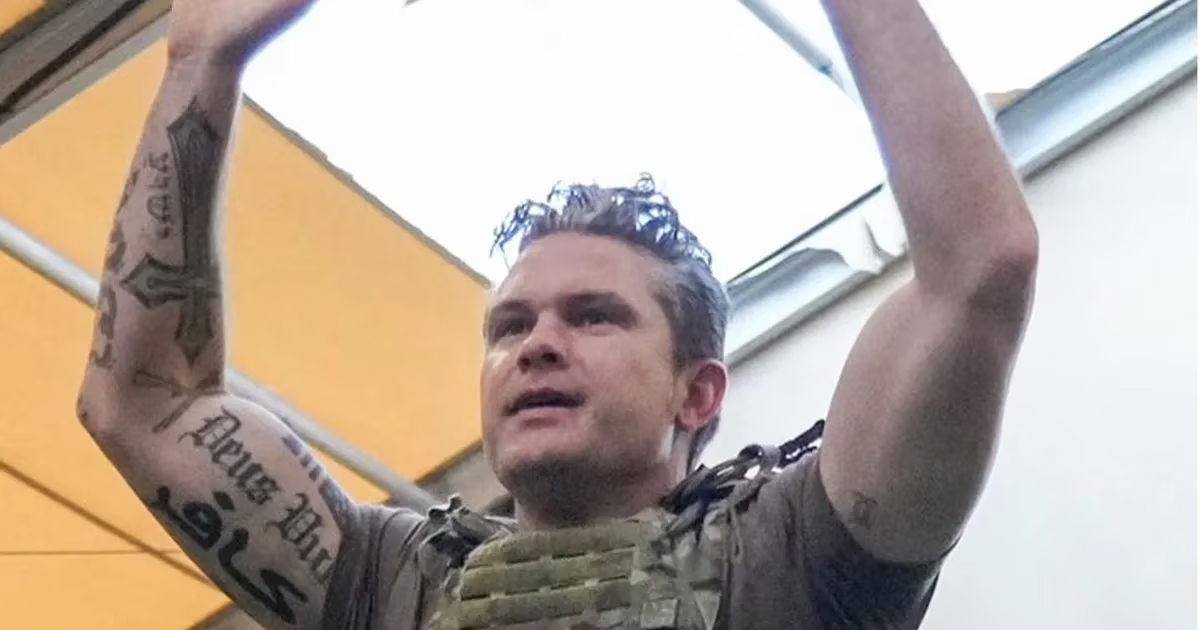
The symbols chosen by the Secretary show the depth of his influence by the history of the Crusades, as he bears tattoos of the 'Jerusalem Cross' and Latin phrases that were the motto of European fighters in the Middle Ages. These symbols, according to analyses by international media sources, are not mere adornment but express the 'God wills it' philosophy he adopts in confronting what he describes as existential threats.

In his book 'American Crusade,' Hegseth goes further, describing the current phase as a 'crusading moment' that requires a Christian mobilization similar to what happened a thousand years ago. The book warns of the danger of 'Islamists' who seek to reshape societies, emphasizing the necessity of military, cultural, and geographical confrontation to push back this tide.

The Secretary adopts a hardline stance on the concept of 'Islam as a religion of peace,' considering it an 'illusion' that hinders the American mission to protect its values and interests. He claims in his writings that Islam has been in a perpetual state of war with those he describes as 'infidels' since its inception, a confrontational view that raises fears of transforming political conflicts into ideological wars that do not accept compromises.

In terms of foreign policy, Hegseth's absolute support for the Israeli occupation stands out as part of his 'Christian Zionist' doctrine. He sees Israel's strength and existential defense as part of biblical prophecies, considering the alliance between Washington and Tel Aviv a religious and moral alliance that transcends traditional geopolitical interests.

Within the Department of Defense, the Secretary launched initiatives aimed at strengthening the role of military chaplains and amending their guidance manuals to include more explicit religious language. He also began organizing monthly prayers at the Pentagon and hosting religious figures who advocate for 'Christian Nationalism,' raising concerns among organizations defending religious freedoms within the military.

Military human rights sources reported receiving numerous complaints about the transformation of discourse within combat units into language associated with 'the end times.' Experts warn that this trend provides rich propaganda material for extremist groups in the Islamic world, portraying the conflict as a new crusade directly targeting Muslim countries.

Academic research indicates that Hegseth's ideas represent a blend of 'Christian Nationalism' and 'American Exceptionalism,' a vision that arranges the world in a hierarchy placing Christians at the top. This thinking makes the conflict with countries like Iran a battle of values and beliefs, not merely a dispute over regional influence or the nuclear program.

Despite the criticism, Hegseth appears to enjoy support from a broad popular base that believes the United States must return to its religious roots to confront global challenges. These supporters believe that 'tolerance' in the Secretary's view may mean 'surrender,' which he completely rejects in the context of his management of defense and national security files.

The Secretary's attempts to reconcile Christian teachings of peace with his calls for military confrontation reflect the nature of the current phase of the US administration. He believes that the commandments of 'turning the other cheek' do not apply to a Secretary of Defense tasked with protecting a nation in conflict, thereby legitimizing the use of excessive force under religious cover.

In conclusion, Pete Hegseth represents a new model of American leadership that does not hide its ideological agenda, putting US relations with the Islamic world to a real test. As the military and political war continues, the question remains about the extent of the impact of this 'crusading' vision on regional stability and the future of international alliances.

America was founded as a Christian nation, and it remains a Christian nation in its DNA, and we are not only warriors armed with the arsenal of liberty, but we are also armed with the arsenal of faith.

OPINIONS

Sat 14 Mar 2026 7:42 pm - Jerusalem Time

Speculation Mounts Over Israeli Ground Invasion of Lebanon Amid Escalating Regional War

Said Erikat

Opinion Writer

Washington – Said Arikkat – 3/14/2026

News Analysis

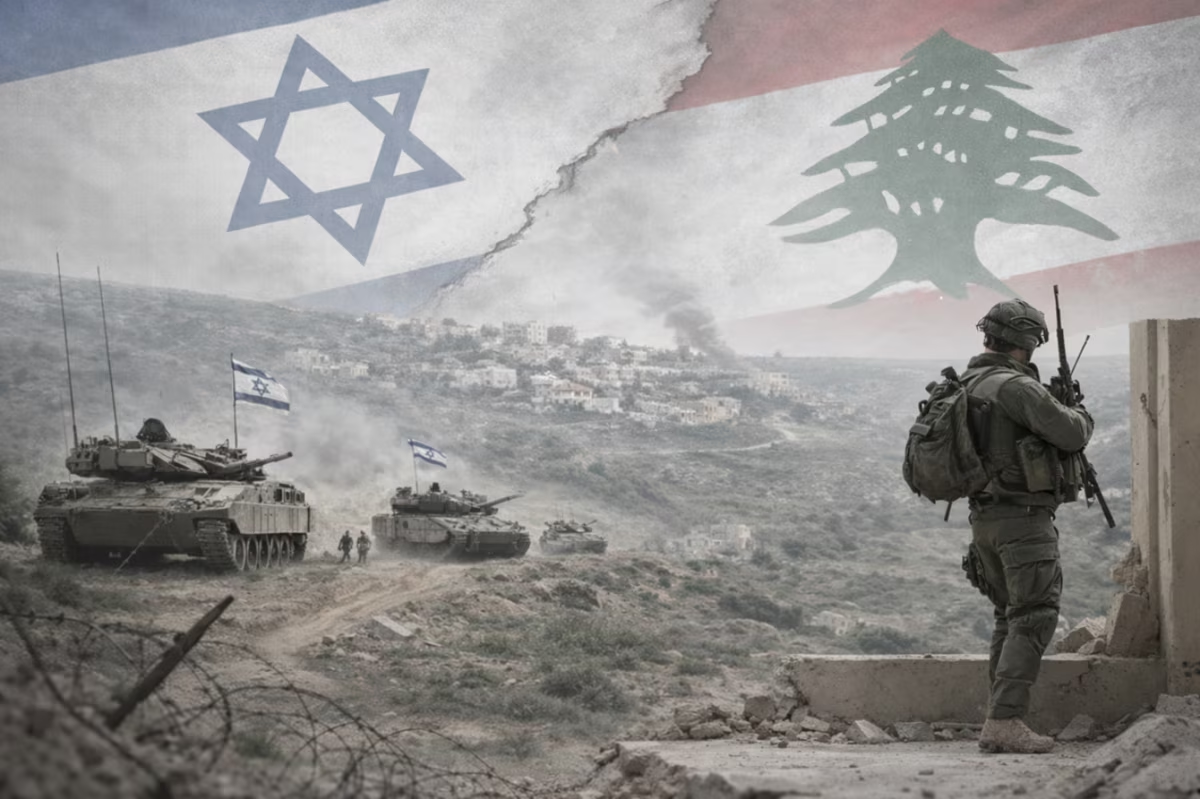
Speculation has been mounting in recent weeks about the possibility of Israel launching a large-scale ground invasion into Lebanese territory, a move that could represent the most dangerous expansion of the ongoing war in the region since the confrontation with Iran erupted in late February. American and Israeli media reports indicate accelerated military preparations on Israel's northern border, while diplomatic warnings are increasing that any major ground operation could push the region into a new phase of escalation that would be difficult to contain politically or militarily, especially given the currently very high tensions between Tehran and Washington and their allies in the Middle East.

According to what the American news website Axios reported on Saturday, citing Israeli and American officials, the plan being discussed by Tel Aviv involves expanding ground operations with the aim of controlling areas south of the Litani River and pushing Hezbollah fighters north away from the Israeli border, in addition to destroying the party's military infrastructure in southern villages. An Israeli official says that the government, led by Benjamin Netanyahu, had been inclined to contain the confrontation to focus on the Iranian front, but the launch of more than two hundred rockets from Lebanon changed calculations and pushed the military leadership to consider the option of a potential large-scale ground invasion.

Field reports indicate that since the war with Iran erupted, the Israeli occupation army has maintained large armored units and infantry forces near the Lebanese border and has carried out limited incursions into some border villages in recent weeks. On Friday, the occupation army announced the dispatch of additional reinforcements and the call-up of reserve forces in preparation for a wider operation. Officials say the immediate goal is to control the land and dismantle Hezbollah's positions and weapons depots, but observers warn that such an operation could quickly turn into a long war of attrition within the densely populated southern villages and towns.

In contrast, Hezbollah affirms its readiness to confront any potential ground invasion. Leader Naim Qassem said that Israeli threats do not intimidate the party but could turn into a military trap for the attacking forces. This stance is based on the experience of the long conflict with Israel, where the party previously managed to force the Israeli army to withdraw from southern Lebanon after years of fighting, and also engaged in a fierce confrontation in the 2006 war, which leads its leaders to believe that any new ground incursion will face violent and prolonged resistance within the party's local environment there.

Humanitarianly, the cost appears set to rise rapidly. The Israeli occupation army has issued widespread evacuation orders in southern Lebanon, which for the first time included towns north of the Litani River, in addition to areas in the southern suburbs of Beirut. Lebanese estimates indicate that about eight hundred thousand people have been forced to flee their homes, while the death toll has exceeded seven hundred people, many of whom are civilians. Humanitarian organizations have warned that the expansion of ground operations could exacerbate the humanitarian crisis in a country already suffering from a severe economic collapse and weakness in health infrastructure and basic services for many, many years.

Politically, American sources confirm that the Trump administration has asked Israel to avoid targeting Beirut airport or major government facilities, but these controls do not significantly change the reality of broad American support for the military operation. Axios quoted an Israeli official as saying that Tel Aviv feels it has full American support. Washington, at the same time, is betting that military pressure will lead to broader negotiations that may ultimately result in an agreement that officially ends the state of war that has existed between Israel and Lebanon since 1948, at least theoretically, until today.

However, developments in the regional war make these calculations extremely complex. The confrontation escalated after the assassination of Iranian Supreme Leader Ayatollah Ali Khamenei in a joint American-Israeli attack, an event that pushed Tehran and its allies to expand their military response across multiple fronts, including Lebanon, Iraq, and the Gulf. UN experts also warned that American and Israeli strikes against Iran and Lebanon could constitute a violation of international law and threaten to expand the conflict to include the entire region, especially with the threat to energy routes in the Gulf and the Strait of Hormuz, through which a large part of the world's oil passes today.

The increasing talk of a potential Israeli ground invasion of Lebanon reveals an old strategic dilemma facing Tel Aviv whenever it considers an incursion into Lebanese territory. Historical experience from the 1982 invasion to the 2006 war shows that military control does not necessarily mean achieving political or security stability; rather, occupied territories often turn into a long-term war of attrition, which Israeli military planners are well aware of. But internal political calculations and regional deterrence calculations sometimes push the Israeli leadership to risk large-scale operations despite the expected human and military cost in such a scenario.

Observers believe that the Trump administration's stance reflects a traditional pattern in American policy based on granting Israel a wide margin of military freedom of action while contenting itself with some formal controls related to infrastructure or civilians. However, this political and military support places Washington practically in the position of a partner in any potential escalation, especially if the ground invasion turns into a broader regional confrontation with Iran and its allies. At that point, the American administration may find itself facing a difficult equation that combines protecting its Israeli ally and avoiding slipping into an open war in the Middle East that may exceed its calculations.

The ongoing escalation on the Lebanese front cannot be separated from the broader war between the United States and Israel on one side and Iran on the other. The assassination of Iranian leader Ali Khamenei constituted a strategic turning point that pushed Tehran's allies in the region to direct involvement in the confrontation. Hence, Lebanon becomes a central arena in this complex conflict where local, regional, and international elements intertwine. With continued mutual strikes, the risk of the war expanding beyond the borders of Lebanon and Israel increases, threatening global energy routes and regional stability and placing the region before a new phase of long strategic uncertainty.

PALESTINE

Sat 14 Mar 2026 2:40 pm - Jerusalem Time

British Soldier Documents 'Amusement Executions' of Starving Gazans at American Aid Centers

A British recruit named David McIntosh revealed horrific details he witnessed during his military service in the Gaza Strip, where he documented, through video clips, the brutality of Israeli occupation forces in dealing with Palestinian civilians searching for food. The recruit explained that these violations occurred around aid distribution points belonging to the 'Gaza Humanitarian' organization, an initiative previously launched by the United States to secure relief in the Strip.

The video clips published by McIntosh on his personal accounts showed Israeli soldiers positioned on their tanks, opening fire directly and shockingly at queues of starving people. The recruit described these actions as being carried out for 'amusement' by the soldiers, noting that the locations where these crimes occurred were the same where hundreds of Palestinians were killed while waiting to receive meager food rations.

Commenting on the scenes, the British recruit affirmed that what he saw was extremely painful and incomprehensible, despite him working within a joint force that included elite elements of the American army. He praised the skills of his colleagues in the joint force but stressed that the Israeli forces surrounding those locations showed no humanity, deliberately targeting unarmed civilians in cold blood.

McIntosh accused the occupation army of systematically attempting to sabotage relief efforts by terrorizing and killing residents at their most vulnerable moments. He pointed out that Palestinians in those areas refused to surrender to hunger or let their families die, which was met with occupation bullets, committing clear and easily documented war crimes at those sensitive points.

This testimony sparked a wide wave of anger across social media platforms, where activists and human rights defenders circulated the clips as additional evidence of the genocide. Bloggers recalled the violations associated with the work of the 'Gaza Humanitarian' organization, considering that its presence did not provide protection for civilians but rather turned them into easy targets for Israeli snipers and shells.

Local sources reported painful testimonies from families who lost their children at those locations, with one citizen mentioning that his uncle was martyred while searching for food for his children at the same point the soldier filmed. Testimonies confirmed that the occupation prevented any attempts to document these field executions, even going so far as to bury some victims alive under the rubble of distribution centers.

Observers described the scenes as an embodiment of 'human hunting' operations, where starving people are lured into exposed areas under the pretext of aid distribution and then targeted. Human rights activists believed that these clips expose the falsity of the humanitarian slogans raised when these centers were established, emphasizing that the absence of international accountability encouraged the occupation to continue these practices.

Palestinian activists pointed out that the 'Gaza Humanitarian' organization left the Strip, leaving behind a legacy of blood and harsh memories, as it was accused of being 'harsher than shells.' They considered that what the British soldier published represents the beginning of a new phase of uncovering facts that the occupation tried to obscure throughout the war, stressing the need to present this evidence to international courts.

In a related context, some residents of the Strip noted that American soldiers participating in the joint force were not far from the scene, with some accusing them of implicit or actual participation in some attacks. They affirmed that the tragedy of hunger imposed by the occupation was exploited militarily and security-wise to lure citizens into real 'death traps' under the guise of relief.

Statistical data issued by the Government Media Office in Gaza indicates shocking figures related to the victims of these centers, where approximately 1109 Palestinians were directly martyred as a result of shelling or shooting inside or around American distribution centers. Among these victims were 225 children, 852 adults, and 32 elderly people, all of whom died while trying to secure a livelihood.

According to statistics, the total number of martyrs targeted while waiting for aid throughout two years of war reached 1506 martyrs, in addition to more than 19,000 injured. This means that the number of martyrs who fell in front of the 'Gaza Humanitarian' organization's centers alone represents about 73% of the total victims of aid targeting in the Strip.

The organization began its work in May of last year as an alternative imposed by circumstances and Israeli restrictions on international and UN agencies. However, UN experts warned from the outset that this mechanism was inadequate and lacked safety guarantees, as it operated only 4 centers at a time when the Strip needed hundreds of relief points to avoid overcrowding and targeting.

Field reports confirm that the transformation of relief centers into fields of field executions reflects a systematic starvation policy pursued by the occupation authorities to break the will of the popular base. The British soldier's testimony reinforces this narrative, describing the scenes as resembling clips from dark fantasy films, where humans are killed simply for their desire to survive.

In conclusion, these documents and clips remain a living testament to one of the most horrific chapters of the war on Gaza, where hunger was mixed with bullets. Human rights activists demand the necessity of opening an independent international investigation into the role of the joint forces and the direct responsibility of the occupation for turning humanitarian aid into a means of organized mass killing.

Israeli forces were openly firing at civilians for amusement at aid sites.

PALESTINE

Sat 14 Mar 2026 12:25 pm - Jerusalem Time

Injuries from settler bullets and seizure of livestock in an attack targeting Kisan village in Bethlehem

Kisan village, located east of Bethlehem city, witnessed a violent attack this Saturday morning carried out by groups of settlers under the protection of occupation forces. The assault resulted in four Palestinian citizens sustaining injuries of varying degrees, as settlers directly fired live ammunition at residents, leading to injuries in the lower extremities, while others were severely beaten with rifle butts and sharp tools.

Local sources confirmed that Red Crescent ambulance crews dealt with two live bullet injuries, one 52 years old and the other 39 years old, and they were transferred to the hospital for treatment after their condition was described as moderate. The sources indicated that the occupation forces deliberately obstructed the access of ambulances to the attack site initially, delaying the provision of first aid to the injured who were bleeding in the field.

The attack was not limited to physical assault but extended to looting property, as settlers seized approximately 100 head of sheep belonging to citizen Attallah Ibrahim Abyat. This theft comes in the context of the economic squeeze policy practiced by settlers against Palestinian farmers and herders in areas classified as 'C', with the aim of forcing them to leave their lands for the benefit of pastoral settlement expansion.

For its part, the Wall and Settlement Resistance Commission clarified that the pace of these attacks has dangerously escalated since the end of last February, with more than 192 settlement attacks recorded in various governorates of the West Bank. This wave of violence has led to the martyrdom of six individuals and the displacement of four entire Palestinian families, amidst settlers' exploitation of current regional circumstances and international preoccupation to implement annexation and silent displacement plans.

Kisan village, in particular, suffers from continuous targeting, as it is surrounded by settlement outposts that devour vast areas of its pastoral and agricultural lands. Observers confirm that these attacks are not spontaneous but come within a systematic plan to impose a new reality on the ground, through intimidating residents and preventing them from accessing their lands, and destroying the elements of their livelihood resilience in rural and marginalized areas.

The assault comes within the framework of repeated and systematic attacks targeting citizens and their property in the region to forcibly displace them.

ARAB AND WORLD

Sat 14 Mar 2026 12:25 pm - Jerusalem Time

Closure of the Strait of Hormuz Disrupts Global Navigation, Hundreds of Ships Stranded in Alternative Ports

The Israeli-American war on Iran has begun to impose a bitter economic reality on global trade, with its effects extending from the energy sector to impact international supply chains. The fighting has effectively led to the closure of the Strait of Hormuz by an Iranian decision, the most vital shipping lane between Iran and Oman, causing a partial paralysis of ship movement.

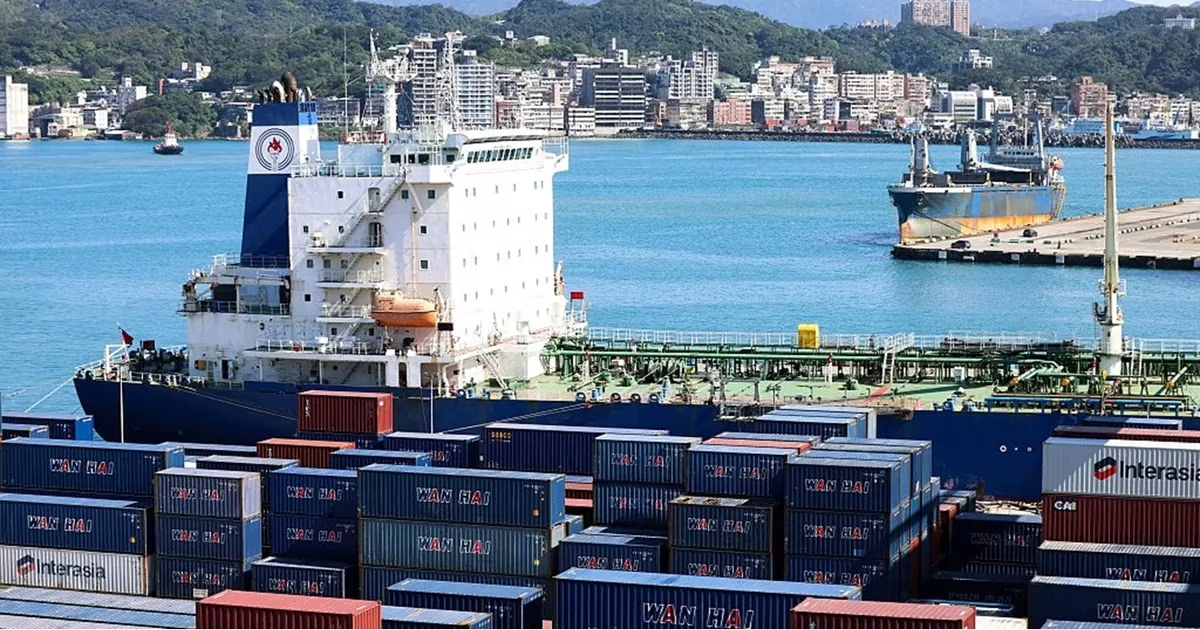
Informed sources reported that the closure of the strait has caused more than a hundred commercial vessels to be stranded in Gulf waters, amidst a frantic rise in maritime transport costs. Shipping companies face unprecedented challenges in securing alternative routes, leading to severe congestion in ports on the Indian Ocean, far from the conflict zone.

Italian businessman Emanuele Grimaldi, CEO of the 'Grimaldi' Group, confirmed that shipments of European cars destined for the Gulf could not reach their destination due to shelling and fighting. He explained that these shipments were forced to stop in distant African ports such as Kenya, where they were stored in secure areas awaiting stabilization of the situation.

Economic reports indicated that the war, which shook oil and gas markets over the past two weeks, has begun to permeate other industrial and commercial sectors. Major shipping hubs in Asia are currently suffering from a severe fuel shortage, while dozens of ships remain trapped within the Gulf waters unable to exit or unload their cargo.

Grimaldi mentioned that one of his company's ships is still searching for an alternative port to unload thousands of cars, while another ship remained completely trapped inside the Gulf. The major crisis lies in the fact that most nearby ports have reached their maximum capacity, as unloading a single ship requires vast areas of logistical land.

Major global shipping companies, including 'Maersk' and 'Hapag-Lloyd', announced the suspension of their operations on some key routes leading to the Middle East. This decision was made for maritime safety reasons, which immediately resulted in increased delays in cargo arrivals and higher insurance costs for ships worldwide.

This disruption represents a significant setback for the shipping sector, which was trying to recover from the repercussions of the Red Sea attacks that lasted for two years. With escalating risks in the Strait of Hormuz, companies were forced to rely entirely on the Cape of Good Hope route around Africa, despite the long distance and exorbitant additional costs.

Maritime transport experts are monitoring the situation with great concern, especially with the potential for direct impact on fuel supplies in the Asian continent. Although shipping routes across the Pacific heading to America have not been fully affected yet, the continued closure of the strait threatens the collapse of the global supply system if the conflict prolongs.

Vincent Clerc, CEO of Maersk, said that the closure of the Strait of Hormuz hinders efforts to replenish strategic oil reserves in Asia. He revealed that his company has ten ships stranded inside the Gulf, emphasizing that a return to normal operations would require at least ten days after any ceasefire agreement is reached.

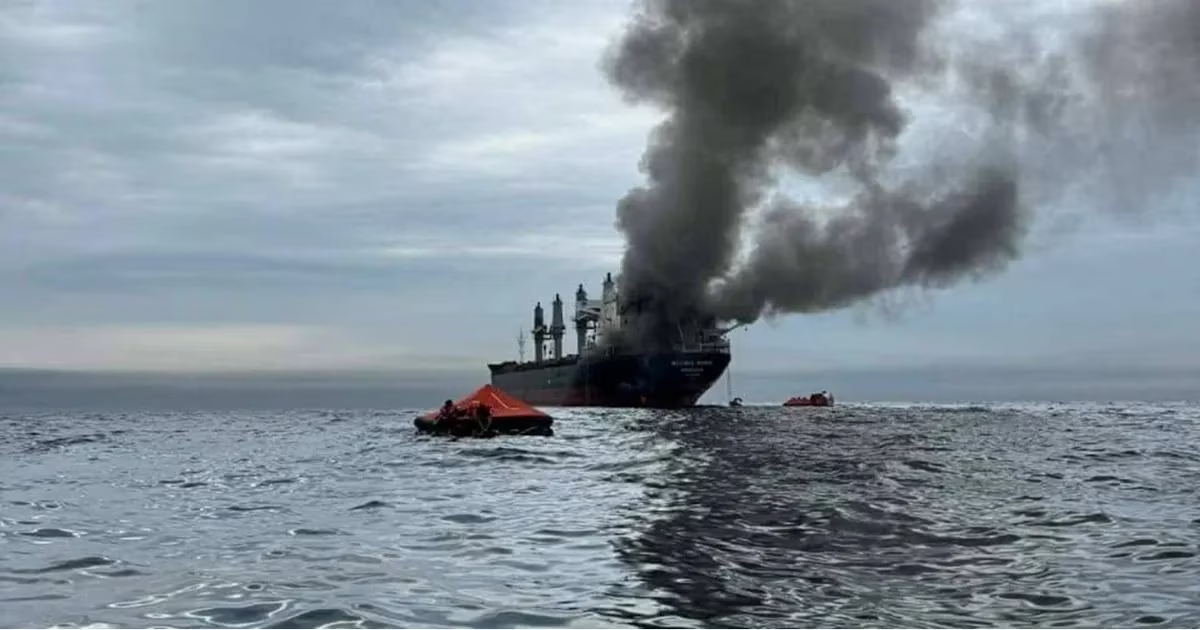
One of Maersk's ships was directly hit by projectile fragments while sailing between Qatar and Oman, leading to a fire on board. The ship is currently stopped off the coast of Dubai to assess the damage, an incident that confirms the high danger faced by commercial vessels in this volatile region.

Alternative ports such as Mumbai in India witnessed unprecedented container congestion, leading to a significant jump in shipping prices from China. According to specialized data, the average cost of transporting a single container increased by 56% since the start of US and Israeli military strikes on Iranian territory.

One Chinese exporter recounted the suffering of his goods destined for Dubai, which were forcibly diverted to Karachi port in Pakistan. These shipments face daily ground fees of up to $200, while shipping companies demand additional amounts under the name of 'war fees' to transport them overland to their final destination.

Some global shipping companies have resorted to activating a rare legal procedure known as 'end of voyage', which allows them to deliver shipments to unagreed ports. This procedure is similar to a 'force majeure' situation, where the carrier disclaims responsibility for delivering goods to the original port due to compelling wartime conditions that prevent navigation.

Analysts confirm that the complete closure of a maritime area to commercial vessels is a historical precedent in the modern era of the shipping sector. Attention is now focused on international efforts to try and open safe passages, amidst warnings that the continuation of the current situation will lead to a new wave of global inflation affecting the prices of all basic commodities.

The closure of the Strait of Hormuz has made it difficult to replenish oil reserves in Asia, and resuming operations could take ten days even in the event of a ceasefire.

PALESTINE

Sat 14 Mar 2026 12:25 pm - Jerusalem Time

23 Dead in Lebanon, Occupation Threatens to Target Medical Teams and Expand Ground Operations

The early hours of Saturday witnessed a bloody military escalation on the Lebanese front, as the Israeli occupation army intensified its airstrikes and artillery shelling on various areas, resulting in the martyrdom of at least 23 people. The attacks notably focused on medical teams and relief centers, a move reflecting the occupation's determination to disrupt the healthcare system in the targeted areas.

The Lebanese Ministry of Health announced a massacre in the town of Burj Qalawiyah in the Bint Jbeil district, where an Israeli raid targeted a primary healthcare center, leading to the martyrdom of 12 doctors, paramedics, and nurses while performing their humanitarian work. The ministry clarified that this attack is the second of its kind within a few hours after paramedics were targeted in the town of Al-Sawana.

In a related context, the Israeli occupation army issued explicit threats to target medical facilities and ambulance vehicles across Lebanese territories, claiming their use for military purposes by Hezbollah. These threats come at a time when Lebanese hospitals are suffering immense pressure due to the increasing number of wounded and injured as a result of the continuous raids.

On the ground, the death toll from the massacre committed by the occupation in the Al-Rahibat neighborhood of Nabatieh city rose to 7 martyrs, while 4 other citizens were martyred as a result of shelling that targeted a residential apartment in the Taamir Haret Saida area in the south of the country. The raids also hit the Al-Nabaa area in Burj Hammoud for the second time in one day, causing widespread property damage.

Regarding ground movements, media sources revealed Israeli plans to significantly expand ground operations in southern Lebanon, with the aim of imposing full control over the area south of the Litani River. This coincided with new evacuation orders issued by the occupation army for residents of wide areas in the south, portending a wave of displacement and broader military escalation.

For its part, Hezbollah responded with a series of intensive military operations, announcing the targeting of gatherings of occupation soldiers in the vicinity of the towns of Khiam, Maroun al-Ras, and Adaysseh with rocket salvos and artillery shells. Field sources confirmed that the resistance targeted newly established occupation sites in 'Balat' and 'Nimr al-Jamal' opposite the border town of Alma al-Shaab.

In a qualitative development, Hezbollah launched an attack with a swarm of kamikaze drones targeting the 'Stella Maris' and 'Ein Shemer' bases east of Hadera, in addition to the 'Ein Zeitim' base north of the occupied city of Safed. Rocket shelling also hit the settlements of Metula and Kiryat Shmona, achieving direct hits among the military forces stationed there.

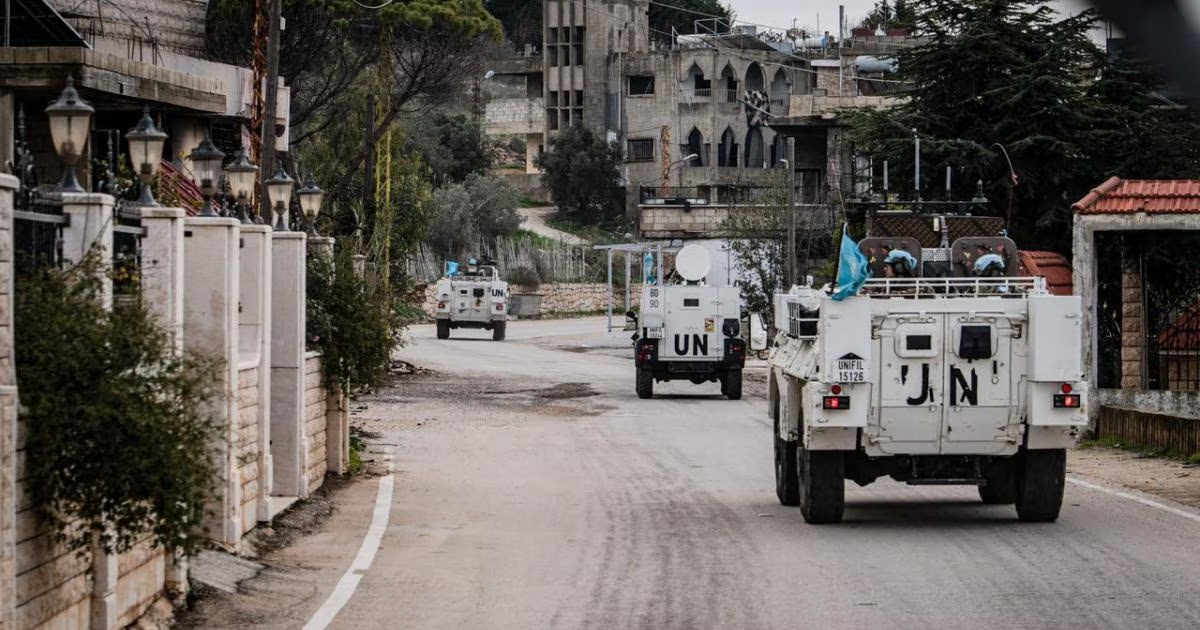
At the international level, reports indicated that Israeli shells fell inside the headquarters of the Nepalese battalion of 'UNIFIL' forces in the town of Mays al-Jabal, which the Nepalese consulate in Beirut considered a blatant violation of international law. Despite no casualties among the international soldiers, the incident increases the tension surrounding the missions of international forces in the south.

Politically, diplomatic sources quoted Israeli officials as intending to continue the war in Lebanon even after the end of any potential military operations against other regional parties. Israeli Defense Minister Yisrael Katz threatened that the Lebanese state would pay an 'increasing price' in its infrastructure, in reference to the occupation's intention to expand the circle of destruction to include vital facilities.

Official statistics indicate that the toll of the expanded Israeli aggression since the beginning of March has reached 773 martyrs, including more than one hundred children, while the number of injured has exceeded 1900. Military operations have also caused the displacement of more than 830,000 Lebanese from their villages and cities, amid extremely difficult humanitarian conditions.

In the Beqaa region, the sons of the official in the Islamic Group, Youssef Al-Dahouk, were martyred in a raid that targeted the town of Bar Elias, and Sheikh Hassan Ghandour was martyred in another raid that targeted his home in the town of Nabatieh Al-Fawqa. Rescue teams continue to search for missing persons under the rubble of destroyed buildings in several Lebanese areas despite the intensive drone flights.

In the capital Beirut, Israeli planes dropped leaflets over the areas of Verdun, Hamra, and Ain al-Mreisseh, which included inciting messages calling for the disarmament of the resistance. This comes at a time when Lebanese political leaders have affirmed that resistance remains the only option to confront the occupation's plans that target Lebanon's sovereignty and national existence.

This attack on the primary healthcare center in Burj Qalawiyah is the second within hours, and it comes as part of a series of deliberate targeting of medical teams.

PALESTINE

Sat 14 Mar 2026 12:24 pm - Jerusalem Time

Gaza Fetuses Under Siege of Hunger: Malnutrition Threatens Future Generations with Chronic Diseases

Despite the cessation of military operations in the Gaza Strip since October 2025, the health consequences of the siege continue to plague the population, with approximately 1.6 million Palestinians, or 77% of the total population, facing critical levels of food insecurity. This harsh reality puts the lives of children, pregnant women, and breastfeeding mothers at risk, amid warnings of chronic health problems that could extend for decades as a result of prolonged nutritional deprivation.

Documented data indicates 317 deaths directly linked to malnutrition since the outbreak of aggression in October 2023, including 119 children who died due to lack of food. International reports issued by UNICEF confirm that over 100,000 children and 37,000 pregnant women currently suffer from acute malnutrition, with expectations that this crisis will continue until at least next April.

UN statistics reveal a shocking reality, where one in five children under the age of five in the Strip suffers from wasting and acute malnutrition. The figures also show that more than 40% of pregnant and breastfeeding women lack essential nutrients, threatening the collapse of the health system for future generations who begin their lives in an environment lacking the most basic necessities for survival.

International medical sources have warned that acute malnutrition's impact is not limited to general weakness but is closely linked to an increased incidence of non-communicable diseases such as strokes, heart disease, and cancer. Unhealthy diets imposed by the siege are considered among the most significant risk factors that will lead to increased rates of premature deaths due to diabetes and blood pressure disorders in the near future.

Despite the calm of the guns, protein-rich and essential nutrient foods remain very scarce and expensive in Gaza's markets, leaving 79% of families unable to secure complete meals. Reports indicate that two-thirds of children suffer from severe food poverty, with their daily consumption limited to only one or two food groups, which is far below the minimum required for healthy growth.

Scientific studies indicate that survivors of childhood malnutrition face ongoing cognitive and educational difficulties, with their academic abilities and self-confidence lower compared to their healthy peers. Research conducted on adolescents who suffered from malnutrition in their early years also showed a persistent decrease in height rates and a significant increase in psychological and behavioral disorders that accompany them throughout their lives.

Indeed, the risk of malnutrition in Gaza effectively begins in the womb, as the effects of nutritional deprivation are transferred from mothers to fetuses, leading to the birth of extremely low-weight babies. UNICEF sources explained that these newborns face a risk of death 20 times higher than normal newborns, making the beginning of their lives a harsh battle for survival amidst collapsed humanitarian conditions.

Academic research links malnutrition during pregnancy to an increased likelihood of developing cardiovascular diseases and chronic obstructive pulmonary disease in adulthood. Furthermore, congenital changes associated with fetal malnutrition increase the risks of childhood obesity, in addition to osteoporosis and muscle mass loss, making the next generation in Gaza susceptible to premature aging and chronic diseases.

Regarding breastfeeding, sources from the United Nations Population Fund reported that continuous anxiety and acute malnutrition hinder the ability of three-quarters of new mothers to breastfeed their infants naturally. This inability comes at a time when the Strip lacks alternative infant formula, depriving infants of the essential antibodies contained in breast milk, which are the first line of defense against infectious diseases and death.

Reduced breastfeeding rates add a heavy burden on the health system, as children's chances of contracting fatal childhood diseases increase, while mothers' risks of certain types of cancer rise. This close link between maternal and child health makes them the primary victims of starvation policies that have left deep scars on the vital fabric of the Gaza Strip's population, scars that temporary aid will not erase.

In conclusion, the humanitarian situation in Gaza continues to require urgent international intervention that goes beyond merely providing calories to securing quality food that addresses the severe deficiency in vitamins and minerals. The persistence of the nutritional gap means that thousands of children will continue to suffer from stunting and impaired cognitive functions, mortgaging the future of an entire society to the consequences of a siege that spared not even the fetuses in their mothers' wombs.

Low-birth-weight infants face a risk of death approximately 20 times higher than those born at a healthy weight due to maternal malnutrition.

ARAB AND WORLD

Sat 14 Mar 2026 12:24 pm - Jerusalem Time

US Military Move to Open Strait of Hormuz: Marine Force Heads to Region Amidst Iranian Threats

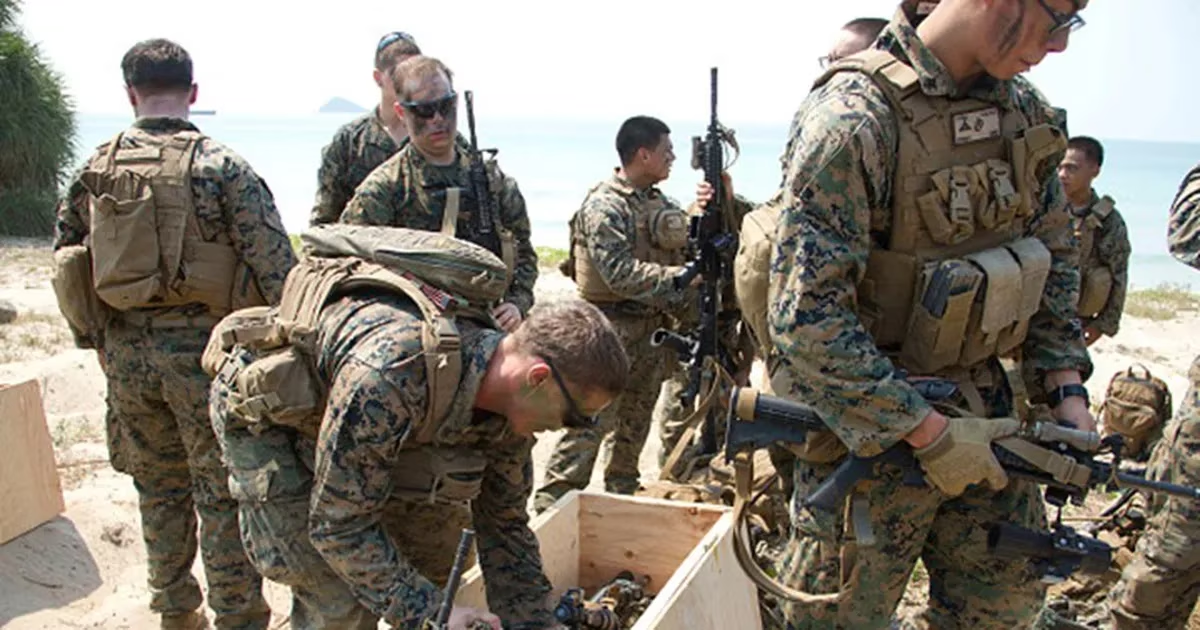
US President Donald Trump has issued urgent orders to move a force of Marines towards the Middle East, in a step aimed at forcibly reopening the Strait of Hormuz. These military movements come amidst growing fears of a global economic recession that could be caused by a sharp rise in energy prices due to escalating tensions.

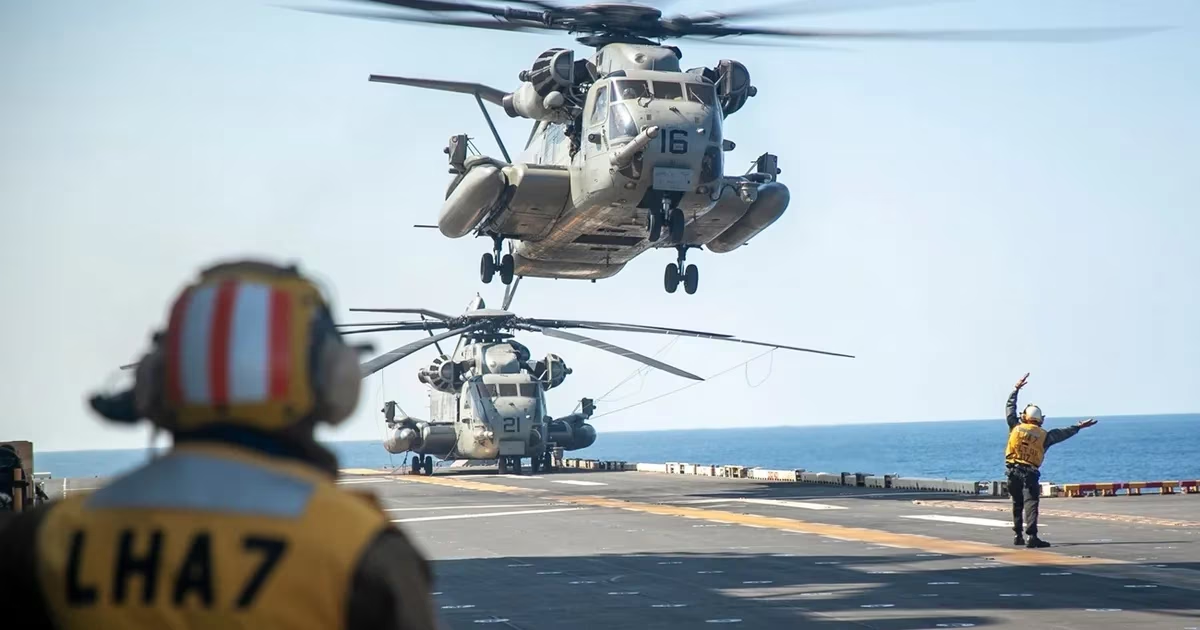
Official sources confirmed that the warship 'USS Tripoli' has already sailed from Okinawa base in Japan, carrying approximately 5,000 sailors. This force includes the 31st Marine Expeditionary Unit, a unit specialized in special ground and air operations and capable of executing complex amphibious landings.

On the ground, Friday witnessed a significant escalation after additional oil tankers were fired upon by Iranian forces in the Gulf waters. This attack followed statements by the new Iranian Supreme Leader, in which he affirmed Tehran's commitment to closing the strategic strait until military attacks targeting Iranian territory cease.

Military analysts believe that the mission to secure the international shipping lane may not be limited to naval escort, but may require a large-scale ground operation. Reports published by international newspapers warned that such an intervention could lead to significant human casualties among US and allied forces due to the complex military geography of the region.

In a related context, General Dan Caine, Chairman of the Joint Chiefs of Staff, indicated that the Pentagon is dealing with a 'very complex tactical environment.' Caine explained during a press briefing that the military leadership is seeking to confirm all details before taking any executive step that could lead to a direct and comprehensive confrontation.

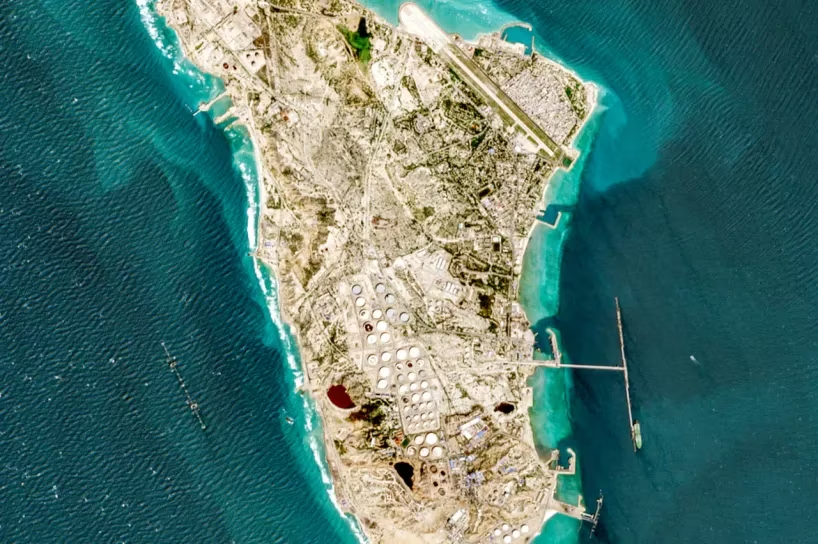
Proposals have emerged within US political circles calling for the seizure of Kharg Island, which is Iran's most important oil center. Although the island has not been directly affected by the conflict so far, controlling it could represent a strategic bargaining chip to ensure oil flow and prevent Tehran from using it as a base for its operations.

On the economic front, Washington took a surprising step by easing sanctions on Russian oil in an attempt to calm global markets. This decision created a rift in positions with London, where the British government expressed the need to continue financial pressure on Moscow and not to compromise on the Russian 'war chest' issue.

For his part, US Energy Secretary Chris Wright stated that the US Navy may begin escorting oil tankers by the end of this month. Wright admitted that US forces are not fully prepared for this mission at present, as military assets are currently focused on destroying Iranian offensive capabilities and military manufacturing industries.

Economic data indicates that fuel prices in the United States have reached record levels, with the price per gallon in California reaching approximately $8. Experts warn that the continued closure of the strait, through which 20% of the world's supplies pass, could push oil barrels to exceed the $300 mark if the conflict is prolonged.

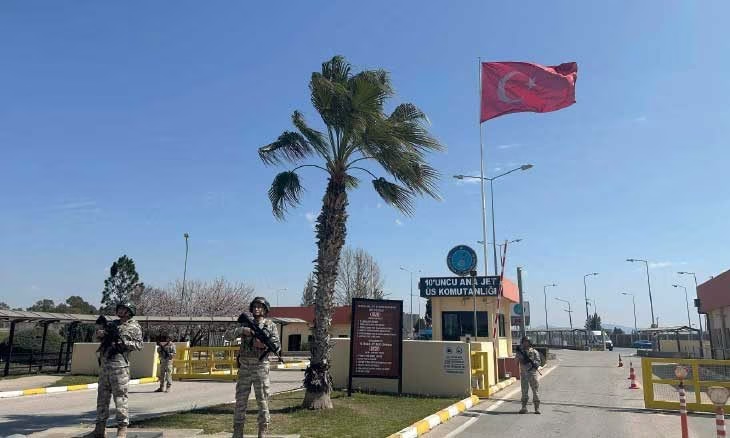
Amidst this deadlock, a Turkish mediating role emerged, with the Turkish Minister of Transport announcing that a vessel belonging to his country had crossed the strait after obtaining direct permission from Iranian authorities. 14 other Turkish vessels are still waiting in the region for coordination with Tehran, at a time when Washington lacks conclusive evidence of Iran planting naval mines so far.

It's a complex tactical environment, and before we execute anything, we want to make sure we have all the field data.

PALESTINE

Sat 14 Mar 2026 12:24 pm - Jerusalem Time

Absence of the "Peace Council": The War on Iran Marginalizes the Gaza File

Dr. Raed Abu Badawiya: Israel may benefit from international preoccupation to reframe what is happening in Gaza within the regional conflict

Majed Hudeib: The continued freezing of the Peace Council will have direct repercussions on the internal situation in Gaza

Sari Sammour: Israel is trying to exploit the world's preoccupation with the war to intensify pressure on Gaza to impose new realities

Dr. Suhail Diab: If the war ends through an agreement in which Tehran seeks a regional approach, this may extend to include Lebanon and Gaza

Talal Awkal: Manifestations of obstructing entry into the second phase preceded the war on Iran, reflecting the failure of Trump's plan

Labib Taha: The absence of the Peace Council deepens the humanitarian and political crises in Gaza and reflects a clear denial of agreements

Ramallah - Exclusive to "Al-Quds" -

Amidst the Israeli war on Iran, the Gaza Strip's presence on the international agenda has receded, and the so-called Peace Council has been effectively frozen, as the attention of international powers and global media turned to the repercussions of the broader conflict in the region.

According to writers, political analysts, specialists, and university professors in separate interviews with "Al-Quds," this shift has led to a decline in political and diplomatic interest in the Palestinian issue, including initiatives proposed to address the situation in the Gaza Strip, most notably the "Peace Council," which was supposed to form a political and administrative framework for addressing the post-war phase.

They believe that the decline in international pressure has provided Israel with a wider margin for action in the Gaza Strip, amidst a lower level of political and media scrutiny of its field policies.

In contrast, the freezing of political initiatives and the decline in international interest directly impact the humanitarian and administrative reality in the Strip, which already suffers from severe living crises and a shortage of food, medicine, and basic services.

This continued stalemate also threatens to delay the reconstruction process and keep Gaza in a cycle of successive crises, awaiting the new balance of power that the regional war will bring, which may reshape the region's priorities and the future of the Palestinian issue.

Gaza and the Impact of Major Transformations

Dr. Raed Abu Badawiya, Professor of International Law and International Relations at the Arab American University, believes that the rapid regional developments, especially the ongoing war with Iran, have led to a significant decline in the presence of the Palestinian issue, particularly regarding the Gaza Strip, on the international political, media, and diplomatic agenda. This has been reflected in the initiatives proposed to address the situation in the Strip, including the "Gaza Peace Council."

Abu Badawiya explains that Gaza is not only affected by what happens within its narrow borders but is also greatly affected by major transformations in its surrounding regional and international environment. The Palestinian issue, despite its historical centrality in the Middle East, often recedes into the background during moments of major regional escalation, when the attention of international powers turns to conflicts considered more threatening to regional stability or the international order.

Abu Badawiya clarifies that the escalation of major crises, especially the war on Iran, pushes the international community to reorder its political and diplomatic priorities, as attention focuses on the repercussions of that confrontation and the possibilities of its expansion and its impact on regional stability, energy security, and the global economy. Similarly, international pressure related to Gaza declines, whether in terms of demanding a cessation of military operations or pushing for political and humanitarian solutions to address the crisis in the Strip.

Vacuum of International Attention

Abu Badawiya points out that this reality creates what can be described as a "vacuum of international attention," a vacuum that is practically reflected in the low level of international scrutiny and pressure on Israeli policies in Gaza, which gives Israel a wider margin to act and manage the conflict according to its own calculations, both militarily and politically.

Abu Badawiya notes that the nature of the regional system in the Middle East is based on the intertwining of crises and their competition for the agenda of international powers, as these crises are often dealt with according to a logic of prioritizing, even if the Gaza crisis has extremely dangerous humanitarian and political repercussions, making it a victim of this competition in regional crises.

Behind the Din of the War on Iran

Abu Badawiya explains that the disappearance of the Peace Council behind the din of the war on Iran reflects the preoccupation of the international environment that could support such initiatives with other more pressing priorities. When attention shifts to a broader regional conflict, the opportunities to push for initiatives aimed at calming the situation in the Strip or restarting political tracks related to it diminish.

Abu Badawiya indicates that Israel may benefit from the international community's preoccupation with other priorities by reframing what is happening in Gaza within the context of the broader regional conflict with Iran, a discourse that sometimes contributes to strengthening the acceptance of the Israeli narrative among some international powers.

Israel and the Opportunity to Establish Facts

According to Abu Badawiya, the decline in international scrutiny may also provide Israel with an opportunity to establish new field or political realities in the Strip, at a time when the level of diplomatic and media pressure related to developments in Gaza is decreasing.

Slow Humanitarian Response

On the humanitarian level, Abu Badawiya warns that the decline in international attention directly impacts the living conditions in the Strip, which already suffers from a severe shortage of basic necessities, including food, medicine, energy, and health services.

According to Abu Badawiya, the low level of political and media attention often leads to a slowdown in the international humanitarian response, given the significant role played by media coverage and political attention in mobilizing resources and directing aid.

Abu Badawiya points out that the absence of effective political initiatives perpetuates the stalemate related to the Gaza Strip, as the crisis continues to be dealt with within the framework of conflict management instead of seeking sustainable political solutions.

Abu Badawiya believes that the disappearance of the Peace Council behind the din of the war on Iran reveals the fragility of the political tracks related to the Strip and their great dependence on a supportive international environment.

Link to the Results of the War on Iran

Writer and political analyst Majed Hudeib confirms that the ongoing war on Iran has practically withdrawn the aspirations and hopes of Palestinians related to reconstruction and the restoration of normal life in the Gaza Strip, in addition to disrupting any political horizon that was proposed in the previous phase or activating the role of the Peace Council.

Hudeib explains that the freezing of the Peace Council's work is not only linked to the international parties' preoccupation with the war but is also connected to the broader context related to the project of reshaping the region in what is known as the "New Middle East," which Israel seeks to establish.

Hudeib notes that Israeli Prime Minister Benjamin Netanyahu's vision for the future of Gaza and the Palestinian issue in general is linked to the results of the war on Iran and the new regional balance of power it will produce.

Hudeib indicates that this war has resulted in a clear shift in the international community's priorities, as attention has moved from the Gaza file to the broader conflict in the region, which has been reflected in the decline in discussions about the Peace Council or attempts to create conditions for its work to begin.

Disputes Related to the Administration of the Gaza Strip

Hudeib points out that the political scene related to the administration of the Gaza Strip is still witnessing multiple disputes, both among Palestinian forces themselves and among the concerned international parties. There are ongoing disputes about the role of the Palestinian Authority, Hamas's position on future administrative arrangements for the Strip, in addition to differences between the United States and Israel regarding "the day after" arrangements for the war, especially concerning the security file and the party that will manage the Strip and grant political legitimacy.

On the security level, Hudeib believes that the war on Iran makes it difficult to implement any security arrangements related to the Peace Council, especially those related to deploying stabilization forces or transferring security powers in Gaza.

Hudeib explains that these forces are the backbone of the Council, but their work is linked to security agreements that have not yet been reached between the United States and Israel, or between the United States and other parties involved in the Council.

Hudeib indicates that Israel, in light of the regional war and the possibilities of its expansion, focuses its security priorities on the regional front, which makes it unwilling to withdraw from Gaza or transfer security control to another party, for fear of a security vacuum that parties Israel considers linked to Iran might exploit.

Hesitation in Funding

On the economic front, Hudeib confirms that the freezing of the Peace Council's work carries clear economic implications, because the Council was supposed to form a framework for managing international aid and reconstruction projects in coordination with donor countries. However, the war on Iran led to the hesitation of these countries and international institutions to inject funding, in the absence of stability and the unclear outcomes of the regional conflict.

According to Hudeib, this reality of freezing the Peace Council's work practically means the continuation of the Gaza Strip in a state of "relief economy" dependent on limited aid instead of moving to a phase of reconstruction and development, until the results of the war become clear and the features of the new balances in the region are determined.

Continued Administrative and Political Vacuum

Hudeib warns that the continued freezing of the Peace Council will have direct repercussions on the internal situation in Gaza, including the continuation of the administrative and political vacuum and the weakening of the ability to organize civilian life and public services, at a time when the Strip already suffers from a severe shortage of food, medicine, water, and fuel.

Hudeib indicates that this vacuum may allow Hamas to strengthen its security and administrative control within the Strip, including in the police, municipalities, and judiciary sectors, which may complicate "the day after" arrangements and lead to a re-raising of the issue of the movement's role in any future political equation related to the administration of Gaza.

According to Hudeib, the shift of international attention from managing the Gaza crisis to managing the broader regional conflict practically means postponing any political or economic project related to the Strip, which threatens to exacerbate the humanitarian and administrative crisis and delay the reconstruction and stabilization process in Gaza until the results of the war in the region become clear.

Overwhelming Nature of the Ongoing War with Iran

Writer and political analyst Sari Sammour explains that news from the Gaza Strip and the West Bank has clearly receded, due to the overwhelming nature of the ongoing war with Iran on the general scene, as the magnitude of the event and its strategic repercussions have made it a global focus, while other issues, including the Palestinian issue, have fallen into the background.

Sammour believes that this decline is not only linked to the momentum of the war but also to an attempt to reprogram the political scene in the region, including the Palestinian issue itself.

Israel and Exploiting War Outcomes

Sammour believes that some scenarios Israel aspires to are based on exploiting the results of the war if it ends with an American-Israeli victory over Iran, which could open the door to dangerous political and security steps affecting the Palestinian demographic reality.

Sammour explains that one of the most dangerous of these scenarios is the attempt to impose a large-scale displacement of Palestinians from the Gaza Strip towards Egypt, through political or regional pressure, in addition to pushing Jordan to receive large numbers of Palestinians from the West Bank.

Sammour notes that this vision, according to its planners, aims in the long run to reshape the reality in Gaza to return to what it was decades ago, while reducing the Palestinian population in the West Bank.

Sammour indicates that this scenario remains dependent on the results of the war, stressing that its end in a draw or without a clear resolution may limit the possibility of implementing such plans, and perhaps open different paths that may not necessarily be negative for the Gaza Strip, while any American-Israeli victory poses the most dangerous possibilities for the region and the Palestinian issue.

Major Strategic Repercussions

Sammour explains that the war with Iran carries major strategic repercussions, especially concerning energy and the global economy, which makes it a central issue for most countries in the world.

Sammour points out that the Gulf states themselves have been affected by the war, and a large part of the Arab media is Gulf-funded, at a time when the countries of the region are preoccupied with their arrangements and interests related to the war and its repercussions.

On the ground, Sammour notes that Israeli shelling of the Gaza Strip has relatively decreased compared to previous periods, but it has not stopped, while the siege and restrictions continue, exacerbating the suffering of the residents and affecting basic necessities of life.

Sammour believes that Israel is trying to exploit the world's preoccupation with the war on Iran to intensify pressure on the Strip and complicate humanitarian conditions, in order to impose new realities.

Sammour considers that the current phase is witnessing the introduction of new approaches in American and Israeli policy based on the principle of "peace through strength," meaning imposing realities by military force, and that the results of the confrontation with Iran will determine the shape of future policies in the region, including the future of the Palestinian issue and its political arrangements.

Netanyahu's Escape Forward

Dr. Suhail Diab, Professor of Political Science and specialist in Israeli affairs, believes that the ongoing war between the United States and Israel on one hand and Iran on the other has pushed the Gaza Strip file to a lower rank in regional and international priorities, without meaning the closure of the file or the end of its political path, but rather its temporary freezing pending the developments of the confrontation in the region.

Diab indicates that this shift was not merely a side effect of the war, but rather consistent with the political calculations of Israeli Prime Minister Benjamin Netanyahu, who sought to "escape forward" towards the Iranian file to avoid commitments related to the second phase of arrangements for the Gaza Strip, as well as understandings related to Lebanon and other regional files.

Diab points out that Netanyahu believed that engaging in a confrontation with Iran might strengthen his internal political position and restore his electoral popularity, especially since he had previously hinted at the possibility of bringing forward the election date before the outbreak of the war.

Gaza's Scene After the Current Confrontation

Regarding the impact of the war on the future of the Gaza Strip, Diab proposes two main scenarios for the current confrontation. The first is a limited ceasefire similar to what is described as the "Twelve-Day War," which is the option preferred by the United States. In this case, the Gaza file is expected to return to its pre-war status, with the possibility of some adjustments that would give Washington political gains that the American president could leverage domestically, especially in the context of the midterm elections, which might raise Israeli reservations.

The second scenario, according to Diab, concerns ending the war through a comprehensive agreement that addresses the roots of the conflict, which is the proposal Iran tends towards, fearing that a temporary ceasefire would lead to a renewed war within a few months.

In this context, Diab emphasizes that Tehran seeks a comprehensive regional approach to Middle East issues, so that the agreement is not limited to ending the war in Iran only, but also extends to include the situations in Lebanon and the Gaza Strip.

Diab notes the existence of understandings and contacts between Iran and a number of regional parties, including Egypt, Qatar, and Turkey, aimed at presenting the Gaza file as part of any potential comprehensive settlement. If this happens, the Palestinian issue – and especially the situation in Gaza – may benefit from a broader regional framework for settlement.

The Palestinian Crisis Towards the Peace Council

In contrast, Diab points to a growing crisis of confidence among the Palestinian public towards the so-called "Peace Council," led by the United States and including prominent figures such as US President Donald Trump and Israeli Prime Minister Benjamin Netanyahu, who are also leading the war on Iran at the same time they are talking about arrangements for Gaza, which creates a clear contradiction that weakens Palestinian trust in any future role for it.

Diab indicates that the Gaza file is currently in a state of freeze pending the outcomes of the war, warning that the continued disagreement between the option of "ceasefire" and the option of "ending the war" may open the door for Israel to make deep field changes in Gaza and Lebanon, which could reshuffle the cards in the region and leave additional negative repercussions on the Palestinian issue.

Continued Obstruction of Transition to the Second Phase

Writer and political analyst Talal Awkal explains that the passage of about five months since the implementation of US President Donald Trump's plan, along with weeks since the last ceremonial meeting of the so-called "Trump Peace Council," has not been reflected in any tangible change on the ground in the Gaza Strip. He points out that Israel continues to obstruct the transition to the second phase of the plan and continues to impose its policies on the ground without any actual movement from the Council or its members.

Awkal indicates that Israel, at the same time, continues its policy of assassinations, shelling, and complete control over crossings and entry and exit movements, in addition to managing the file of humanitarian aid and the requirements for improving life in the Strip according to its own calculations.

Awkal notes that the Council, despite its composition which includes international, Arab, and Islamic figures alongside international envoys, has not even been able to secure the entry of the technocrat committee that is supposed to undertake administrative tasks in Gaza.

Awkal confirms that the manifestations of obstructing entry into the second phase preceded the war on Iran by a long period, which reflects the failure of Trump's plan and the submission of the concerned parties to Israeli dictates, rather than the claim due to the ongoing war in the region.

Difficult Conditions in Gaza

Awkal indicates that the living reality in Gaza has not undergone a fundamental change, as the level of fear of shelling has relatively decreased, while some foodstuffs have become available in the markets but are sold at high prices, although lower than those that prevailed during the period of widespread war. Nevertheless, manifestations of hunger, poverty, unemployment, and the spread of diseases continue to burden the lives of the residents.

Awkal affirms that the people of Gaza, despite these harsh conditions, continue to stand firm on their land, stressing that surrendering to despair or abandoning the will to live is not an option for Gazans despite the severity of the suffering.

Decline in the Presence of the Palestinian File

Researcher and political analyst Labib Taha believes that the absence of the so-called "Peace Council," which primarily includes American figures close to the US administration, poses deep and negative political implications for the Palestinian issue, amidst international transformations and preoccupation with the ongoing war against Iran. This has led to a decline in international interest in what is happening in the Palestinian territories, especially in the Gaza Strip.

Taha indicates that this Council was supposed to play a role in advancing the settlement process or keeping the Palestinian issue within the priorities of international political discussion. However, its absence at this sensitive stage reflects a shift in international attention to other files, primarily the war with Iran, which has contributed to the decline in the presence of the Palestinian file on the international stage.

Taha notes that the world is almost forgetting what is happening in Gaza, as news related to the Strip has no longer topped the international scene in the last two weeks, with the exception of scattered reports addressing the continued killing, destruction, and the war that has not stopped, even if its pace has relatively decreased compared to previous periods. He explains that this media and political decline reflects a deep imbalance in the balance of international attention.

Taha affirms that the absence of the "Peace Council" inherently carries negative messages for Palestinians, as it reflects the reality that the Palestinian side is the weakest in the international political equation, and that history has often shown that the weak pay the highest price when interests take precedence over principles.

This absence also reflects – according to Taha – that power has taken precedence over right in the management of international relations, and that the strategic interests of the United States, Israel, and their allies take precedence over the suffering of the Palestinian people.

Prioritizing International Policy

Taha believes that one of the clear indicators in this context is the prioritization of international policy, where it appears that the Palestinian issue is no longer among the priorities of the US-led international system, while other issues receive greater attention in light of escalating regional and international conflicts.

Regarding the repercussions of this on the Palestinian reality, Taha explains that this absence deepens the humanitarian and political crisis in the Gaza Strip, pointing out that what the Strip is experiencing is no longer just a passing crisis or an emergency, but a prolonged catastrophe that has lasted for more than two years, reflecting a clear denial of the agreements concluded with the Palestinian side.

Taha affirms that these developments practically mean the continued deprivation of Palestinians of their most basic human rights, noting that the discussion here is not only about political rights but about the fundamental rights with which every human being is born.

Taha explains that these rights are absent in the reality of Palestinians, especially in the Gaza Strip, while the situation in the West Bank is not much different in essence, although it differs in terms of severity, as the overall reality remains characterized by harshness, suffering, and tragic dimensions.


ARAB AND WORLD

Sat 14 Mar 2026 12:24 pm - Jerusalem Time

Iran War Puts US Hegemony to the Test: A New 'Suez' Crisis Reshapes the Global Order

The military confrontation between the US-Israeli alliance and Iran has entered a critical phase in its third week, with observers noting that this conflict has become the greatest burden on the structure of US national security since the end of the Cold War. Sources reported that the US administration was forced to withdraw air defense systems and troops from strategic areas in East Asia and Europe to compensate for shortages on the Middle East front, raising questions about its efficiency and ability to manage multiple crises simultaneously.

On the ground, Washington boasted of targeting some 6,000 sites within Iranian territory in attacks that began with a swift strike that killed Supreme Leader Ali Khamenei. Despite these intensive strikes, the Iranian government showed no signs of imminent collapse, as Mojtaba Khamenei was appointed to succeed his father, while President Masoud Pezeshkian and security officials appeared in the streets of Tehran, confirming the regime's continuity.

The war caused severe disruptions in the global energy market, especially with the closure of the Strait of Hormuz, through which 20% of the world's supplies pass. Sources indicated that Iran, despite continuous raids, managed to target at least six ships in the strait, in addition to launching a missile strike that shook Tel Aviv, reflecting its ability to inflict severe damage on the infrastructure of its opponents and their allies.

Fawaz Gerges, a professor of international relations, described this moment as a new 'Suez Crisis' for the United States, likening the situation to what happened to Britain and France in 1956. Gerges considered the failure to protect waterways and secure allies as a decline in the prestige of the superpower, emphasizing that the world is heading towards a more chaotic multipolar system with the erosion of American credibility.

In the Gulf region, Washington's traditional allies began to re-evaluate their security bets as a result of what they described as uncertainty in American commitments. Saudi Arabia signed a mutual defense agreement with Pakistan, while the UAE moved to strengthen its military relations with China, a step reflecting the desire to diversify security sources away from total reliance on US bases that no longer provide adequate protection against cheap drones.

The repercussions of the conflict extended to East Asia, where South Korea expressed deep concern after the withdrawal of 'Patriot' and 'THAAD' systems from its territory and their transfer to the Middle East. Experts believe that reducing the US military presence in the Indo-Pacific region serves Chinese interests and weakens deterrence against North Korea, casting doubt on US defense commitments to its Asian allies.

In Europe, NATO was forced to transfer surveillance equipment and air defense systems from Germany and Greece to support US bases in Turkey and Romania. This move coincided with immense economic pressure on European countries suffering from the disruption of fuel supplies from the Gulf, prompting the Trump administration to ease sanctions on Russian oil in an attempt to curb soaring global prices.

Reports indicated that major countries such as France, Italy, and India began direct communication channels with Tehran to secure the passage of their tankers through the Strait of Hormuz, a clear bypass of the American leadership role. This independent diplomatic move reflects a loss of confidence in Washington's ability to enforce order in international maritime lanes, which had been a cornerstone of its global hegemony for decades.

In the context of military movements, the Pentagon sent the amphibious ship 'USS Tripoli' with thousands of Marines from Japan to the region in an attempt to bolster its field presence. However, analysts believe that these movements further drain US resources and make deployed forces easy targets for Iranian missile attacks, which have proven effective despite the sanctions imposed on Tehran for forty years.

The report noted that Russia is playing a supporting role for Iran in confronting US attacks, which President Trump himself acknowledged. This Russian-Iranian cooperation further complicates the military landscape, as Tehran benefits from technical and intelligence support to counter the superior military technology of the US-Israeli alliance, prolonging the conflict and increasing its human and material cost.

On the internal political level in Iran, American bets on a popular uprising to overthrow the regime after Khamenei's death failed. Instead, the military and security establishment appears to have tightened its grip, maintaining the ability to threaten regional capitals with 'Shahed' drones that deplete expensive American interceptor missiles in a clear strategy of attrition.

Professor Peter Frankopan considered the real problem the United States will face in the future to be 'loss of credibility,' as Washington opened 'Pandora's Box' without a clear post-war plan. He explained that restoring international trust in American power will take years, especially after the war proved that regional powers are capable of challenging American will and causing paralysis in global trade.

Gulf states face increasing pressure to engage directly in the war, which most of these countries refuse for fear of their oil facilities being subjected to retaliatory strikes. This pressure has accelerated the pace of 'strategic diversification,' as these countries seek weapon systems and security investments from China and other countries, threatening the American monopoly on the arms market in the region.

In conclusion, experts believe that the results of this war will inevitably lead to a redefinition of the balance of power, as the United States is no longer the sole power capable of imposing stability. With continued mutual shelling and tension in waterways, the old world order appears to be fading in favor of a new reality where decision-making centers are diversified and unipolar hegemony declines.

We are witnessing a 'Suez Crisis' moment for the United States, as this conflict represents an imperial overreach that could lead to a more chaotic and multipolar world.

ANALYSIS

Sat 14 Mar 2026 4:36 am - Jerusalem Time

War of Narratives in the Gulf: Washington Talks of Kharg's Destruction, Tehran Responds with Painful Strikes

Said Erikat

Opinion Writer

Washington – Said Arikat – 3/14/2026

News Analysis

US President Donald Trump said on Friday that the US military had carried out one of the "most powerful airstrikes" in its modern history, confirming that US forces had completely destroyed "all military targets" on Iran's Kharg Island. The island is considered one of Iran's most vital economic centers, serving as the main export point for Iranian oil to global markets.

Trump explained that the military strike was precise and focused, noting that the US military refrained, "out of consideration for principles of decency," from targeting the island's oil infrastructure, even though about 90 percent of Iranian oil exports pass through these facilities.

However, the US President linked this decision to Iran's behavior in the Gulf waters, warning that Washington might reconsider exempting oil facilities if Iran or any other party obstructs international navigation. Trump wrote in a post on his "Truth Social" platform that the United States would immediately reconsider its decision if the free and safe passage of ships through the Strait of Hormuz was threatened in any way.

The targeting of Kharg Island, located in the Arabian Gulf, comes at a time when global energy markets are experiencing increasing tension since the outbreak of war on February 28. Oil prices have risen significantly amid fears that the military confrontation could turn into a direct threat to global energy supplies.

Iran had responded to the American strikes by targeting passing ships in the Strait of Hormuz, through which about 20 percent of the world's oil and gas supplies pass, which renewed international concerns about the potential disruption of one of the most important strategic energy corridors.

In a striking political development, Iran's new Supreme Leader, Mojtaba Khamenei, issued his first statement since taking office on Thursday, in which he affirmed that the Strait of Hormuz would remain closed and that Iran would continue to target US allies in the Gulf region.

In subsequent statements, Trump said that Iran "does not have the ability to defend any target Washington wishes to attack," adding that Tehran would not be able to possess nuclear weapons or threaten the United States, the Middle East, or the world. The US President also called on the Iranian army to lay down its arms, considering that this might be the only way to save what remains of the country.

For his part, US Secretary of Defense Pete Hegseth announced that US forces are preparing to carry out what he described as the "largest wave of airstrikes" over Iran and the capital Tehran since the beginning of the war.

Hegseth said during a press briefing at the Pentagon that the number of sorties and bombing waves had reached unprecedented levels, indicating that military operations are continuously escalating. He added that the US and Israeli armies have targeted more than 15,000 targets inside Iran since the outbreak of the war.

The Secretary explained that this number is equivalent to targeting more than a thousand targets daily, stressing that "no other military alliance in the world is capable of carrying out operations of this magnitude."

However, this decisive American rhetoric is met with increasing skepticism among a number of observers who believe that official statements in Washington are characterized by a degree of exaggeration in portraying the extent of military superiority and the results of airstrikes. The repeated assertion of the complete destruction of Iranian military capabilities contradicts multiple field indicators that suggest Tehran still retains effective deterrent capabilities.

In recent weeks, Iran has demonstrated the ability to carry out precise and painful strikes targeting a number of US military bases in the region, causing operational damage to some military facilities and raising the level of defensive readiness at US bases deployed in the Gulf and the Middle East.

Moreover, the Iranian response was not limited to American interests alone but extended to include strong strikes against sensitive Israeli targets. Multiple reports indicate that these attacks affected strategic facilities and vital infrastructure within Israel, causing widespread disruptions in economic activity.

According to initial estimates, the strikes led to the disruption of some ports, logistics centers, and economic facilities, causing a state of paralysis in commercial and financial sectors, and directly affecting the movement of commercial transactions.

Analysts believe that these developments reveal that the confrontation is no longer merely an American air campaign inside Iran but has turned into a multi-front regional conflict in which military considerations intertwine with economic and strategic calculations.

In this context, experts believe that the focus of American rhetoric on the idea of "overwhelming superiority" may be part of a psychological war aimed at consolidating the image of military decisiveness and enhancing deterrence. However, past experiences in Middle Eastern wars indicate that military superiority, especially in airstrikes, does not necessarily translate into rapid political results.

In asymmetric wars, weaker parties possess multiple tools for retaliation, such as ballistic missiles, drones, and targeting vital infrastructure and energy corridors. With the continued exchange of strikes in the Gulf and the Eastern Mediterranean, the war appears poised for further escalation, with all the wide-ranging repercussions this may have on the regional economy and global energy markets.

A growing number of analysts also point out that President Trump's contradictory statements, which sometimes change within a few hours, reflect a lack of real clarity in the war's objectives and strategy. Between threatening to expand strikes and sometimes calling for complete victory and a swift end to the conflict, American messages appear contradictory, which has fueled criticism within political and media circles in Washington. Some critics believe that Trump allowed Israeli Prime Minister Benjamin Netanyahu to push the United States into a wide-ranging war with Iran, which could entangle Washington in a long and complex regional quagmire from which it would be difficult to exit without significant political, military, and economic costs.

ISRAELI AFFAIRS

Sat 14 Mar 2026 4:36 am - Jerusalem Time

Ankara warns of 'regional chaos' and refuses to engage in military escalation against Iran

Anxiety is escalating in the Turkish capital, Ankara, due to the rapid military developments in the region following the American-Israeli strikes targeting Iran. The Turkish leadership has affirmed its strong opposition to this escalation from the very first moment, calling for the necessity of prioritizing the diplomatic path and returning to the negotiating table to avoid a comprehensive regional conflict that could spiral out of control.

Turkish President Recep Tayyip Erdogan warned that the continuation of military operations would completely destabilize the Middle East, describing the ongoing confrontations as an illegal war that opens the door to chaos. He explained that his country is making intensive diplomatic efforts with all international parties to de-escalate tensions, emphasizing that the top priority is an immediate ceasefire.

In a remarkable field development, the Turkish Ministry of Defense revealed that NATO air defenses intercepted a third Iranian ballistic missile in Turkish airspace last Friday. This incident is the third of its kind in March, as two missiles were previously shot down on the fourth and ninth of the same month, prompting Ankara to demand official explanations from Tehran.

Despite the presence of American forces at Incirlik Air Base, official sources confirmed that Washington did not use the base to carry out any air attacks against Iranian targets. The Turkish government maintains a cautious stance aimed at protecting its national security and economic stability, declaring its categorical refusal to be drawn into the war or to provide operational support for military attacks.

Reports indicate that Turkey has sharply criticized Israeli policies, considering that recent military moves increase the chances of a catastrophic expansion of the conflict. Ankara believes that relying on military solutions instead of political paths poses a direct threat to the delicate balance it tries to maintain between its commitments to the West and its regional interests.

In a related context, research sources revealed previous Turkish attempts to bring the warring parties together in Istanbul to launch a negotiating path that excludes the military option, but these efforts faced obstacles that led to the relocation of the meetings. This regional rivalry reflects the complexity of the political scene, as Ankara believes that what is happening represents a dangerous shift that changes the rules of the game in the region.

The issue of 'proxy forces' stands out as one of Turkey's biggest security concerns, as Ankara has warned against the exploitation of armed factions, specifically Kurdish groups in northern Iran and Syria, to carry out subversive agendas. Diplomatic sources confirmed that Turkey will not tolerate any attempts to launch an internal rebellion in Iran through elements linked to the 'People's Protection Units' or the 'Kurdistan Workers' Party'.

Information indicates concerns about the infiltration of armed elements possessing advanced military equipment across the Iraqi-Iranian border to stir up unrest in areas such as Mahabad. Ankara has informed the American side of the necessity of not using these groups as tools in the confrontation with Iran, due to the direct implications this would have on Turkish internal security and regional stability.

Political analyses concluded that Israel is playing a destabilizing role through policies that violate international law, exploiting absolute American support to implement its own agendas. Sources emphasize that the fundamental challenge facing the international community lies in curbing policies that deviate from international rules, rather than focusing solely on the repercussions of the conflict with Iran.

The ongoing war is absurd, chaotic, and illegal, and will lead to the ignition of the entire Middle East if the escalation is not contained quickly.

PALESTINE

Sat 14 Mar 2026 4:36 am - Jerusalem Time

Erdogan warns against attempts to drag Turkey into war and criticizes international silence on Gaza

Turkish President Recep Tayyip Erdogan stressed that his country's top priority at the moment is to avoid sliding into the 'pits of fire' raging in the region. Erdogan explained that Ankara is moving with strategic caution to confront the schemes and traps aimed at drawing the Turkish state into the regional wars, emphasizing that internal cohesion is the only way to break the hands that extend to the country's independence and future.

In the context of protecting national sovereignty, the Turkish President affirmed that military and security institutions are taking all necessary preventive measures against any threat that might violate the country's airspace. These statements came concurrently with the Turkish Ministry of Defense's announcement of the success of NATO defenses deployed in the Eastern Mediterranean in intercepting and destroying ballistic ammunition launched from Iran and entering Turkish airspace, in an incident that is the third of its kind since the recent escalation began.

Erdogan called on the Turkish people to be vigilant against provocations of a sectarian or ethnic nature, which are systematically amplified in conjunction with military attacks targeting Iran. He pointed out that maintaining national unity is the primary guarantee for thwarting external schemes that seek to destabilize Turkey and drag it into conflicts that do not serve its national interests.

On the humanitarian front, the Turkish President expressed his deep regret over the continued conflicts and wars in the Islamic world, noting that the Gaza Strip, which has seen about 72,000 martyrs, still lacks real security despite announcements of calm. He pointed out that Israeli violations have not stopped, with the West Bank recording the deaths of more than 1,120 civilians in the past two years, in addition to hundreds of martyrs in Gaza since the agreement of last October 10.

Erdogan strongly criticized the double standards of the international community and the 'fake' conscience displayed by the virtual world, where attention is paid to simple environmental or animal issues while the tragedy of tens of thousands of children in Syria and Palestine is ignored. He affirmed that entire families have been subjected to genocide without moving a muscle among the major powers that claim to defend human rights, describing this disparity as a moral fall of the international community.

The Turkish President pointed out that some countries chose to ignore blatant injustice and war of extermination, while other countries went further by providing direct support to the perpetrators of these crimes. At the same time, he praised the few countries and organizations that had the courage to stand against the injustices in the region, emphasizing that the absence of international will is what fuels the continuation and expansion of conflicts.

In conclusion, these warnings come at a time when the region is witnessing escalating military tensions, as Turkey insists on adopting a balanced policy that protects its borders and prevents it from being drawn into direct confrontation. Official sources confirm that Turkish military vigilance will remain at its highest levels to ensure that airspace violations are not repeated, while continuing diplomatic pressure to stop the ongoing massacres in the occupied Palestinian territories.

Gaza, which has lost 72,000 martyrs, still longs for peace despite the calm, and the virtual world shows a fake conscience that ignores the extermination of entire families.

ARAB AND WORLD

Sat 14 Mar 2026 4:36 am - Jerusalem Time

Israeli shells target UNIFIL headquarters, massacre in Nabatieh leaves martyrs and wounded

The headquarters of the United Nations Interim Force in Lebanon (UNIFIL) was subjected to Israeli artillery shelling on Friday evening, with several shells falling inside the barracks of the Nepalese battalion stationed in the town of Mays al-Jabal. Official sources reported that this attack comes in the context of the widespread military escalation launched by the occupation army on Lebanese territory since the beginning of March.

For its part, the Nepalese Consulate in Beirut quickly condemned this direct targeting of its military sites, expressing its relief that there were no human casualties among its soldiers. The consulate stressed in a statement that targeting peacekeeping forces represents a clear violation of international conventions that protect UN missions in conflict zones.

On the ground, the occupation army committed a new massacre in the city of Nabatieh, where an airstrike targeted the residential Al-Rahibat neighborhood, resulting in the martyrdom of five citizens and the injury of five others with varying degrees of wounds. The Lebanese Ministry of Health clarified that this toll is preliminary and is likely to rise as rubble removal and search for missing persons operations continue.

Israeli raids did not stop there, but included a series of violent attacks on the towns of Al-Khraib, Zawtar Al-Sharqiyah, Al-Qasibah, Bint Jbeil, and Al-Khiam. The shelling also targeted a health center in the town of Burj Qallawi, reflecting a systematic targeting of infrastructure and relief and medical facilities in the south.

In the capital Beirut, the occupation aircraft renewed its raids on the southern suburbs, targeting the densely populated Al-Jamouz neighborhood, which led to widespread destruction of property and a state of panic among the residents. These raids come within the 'scorched earth' policy pursued by the occupation in an attempt to pressure the popular base of the resistance.

On the opposite front, the resistance in Lebanon announced the implementation of a series of qualitative operations in response to the ongoing aggressions, where it targeted a gathering of occupation soldiers in the 'Yaara' settlement with a swarm of kamikaze drones. The resistance confirmed that the drones accurately hit their targets, achieving direct hits among the forces stationed there.

Retaliatory operations also included targeting the 'Al-Sadah' military site opposite the border town of Maroun al-Ras with an intense rocket barrage, in addition to shelling gatherings of the occupation army in the northern neighborhood of the city of Al-Khiam. These field movements confirm the resistance's readiness to confront attempts at ground incursions recently initiated by the occupation.

In the context of political positions, Hezbollah Secretary-General Sheikh Naim Qassem stressed that the resistance has prepared itself for a long-term battle, noting that diplomatic solutions have not succeeded in curbing the aggression. Qassem considered that the option of resistance is the only one capable of protecting Lebanon from the danger of annihilation that threatens it due to Israeli ambitions.

Official statistics issued by health authorities in Lebanon indicate that the toll of the ongoing aggression since March 2nd has reached 773 martyrs, including 103 children who fell in indiscriminate raids. The number of wounded also rose to 1933 injured, amid difficult health conditions suffered by Lebanese hospitals as a result of the siege and shelling.

On the humanitarian front, Israeli military operations caused a widespread wave of displacement, with more than 830,000 Lebanese forced to leave their homes and head to safer areas. Shelter centers face major challenges in securing basic needs for the displaced amid a severe shortage of resources and international aid.

It is worth noting that this escalation came after repeated Israeli violations of the ceasefire agreement previously reached, as the occupation expanded its targeting to include political assassinations and intense airstrikes. The resistance responded to these violations by targeting military sites in the occupied north, which led to the outbreak of the current confrontation.

International circles are watching with great concern the deterioration of the situation on the Lebanese border, especially with the repeated targeting of UNIFIL forces, which have been subjected to previous attacks that resulted in the injury of Ghanaian soldiers. Expectations remain open to further escalation in light of the occupation's insistence on continuing its aggression and the resistance's refusal to back down from defending Lebanese sovereignty.

Targeting UN peacekeeping forces' positions is a serious violation of international law and the principles that guarantee the protection of UN forces while carrying out their duties.

PALESTINE

Sat 14 Mar 2026 4:36 am - Jerusalem Time

Martyrs in a raid on Gaza and Al-Qassam praises Iranian missile strikes

Palestinian medical sources announced the martyrdom of three people, including two youths under the age of seventeen, as a result of an airstrike carried out by Israeli occupation aircraft on the Gaza Strip. This raid comes amid a continuous military escalation in the Strip, as occupation forces continue to target residential areas, causing more casualties among civilians.

In the occupied West Bank, the Palestinian bloodshed did not stop, as two Palestinians were martyred by occupation army bullets during a raid on Nablus yesterday, Thursday. Field reports indicate that the pace of Israeli attacks in the West Bank has significantly escalated, with sources recording the martyrdom of at least eight citizens by settler and army forces since the start of the recent regional tensions.

The field situation in the Gaza Strip is rapidly deteriorating, with the number of martyrs rising to 23 since late February, coinciding with joint attacks launched by the United States and Israel against Iran. This escalation comes despite a ceasefire agreement that came into effect in October 2025, but repeated Israeli violations have emptied it of its content.

For his part, the military spokesman for the Izz ad-Din al-Qassam Brigades, 'Abu Ubaida,' appeared in a speech on the occasion of International Quds Day, praising the military operations carried out by the Iranian Revolutionary Guard. Abu Ubaida affirmed that the missile strikes that targeted the 'enemy entity' using qualitative and fragmentation missiles achieved significant deterrence and brought joy to the hearts of Palestinians suffering from the ravages of continuous aggression.

The Al-Qassam spokesman considered that the millions of Iranian people marching in support of Al-Aqsa, despite pressures and the raging war, represents conclusive evidence of the Islamic Republic's principled and steadfast stance on the Palestinian issue. He pointed out that the unity of the leadership with the masses in Tehran strengthens the steadfastness of the resistance front in the face of liquidation projects targeting the region.

Abu Ubaida stressed in his speech that the current Iranian leadership, under the shadow of Sayyed Mojtaba Khamenei, continues to follow the same approach drawn by the martyr Sayyed Ali Khamenei. He clarified that this continuity in military and political support represents a fundamental pillar in confronting Israeli expansionism, which is no longer limited to Palestine but extends to affect the security of the entire nation.

In conclusion of his statements, Abu Ubaida called for unifying all the energies of the Islamic nation and correcting the compass of major issues, emphasizing that Jerusalem and Al-Aqsa Mosque are going through their most dangerous phase under siege and Judaization. He warned that the Israeli occupation remains the true and sole enemy seeking to expand its circle of aggression, which requires comprehensive mobilization to defend the holy sites.

The qualitative and fragmentation missile strikes brought joy to the hearts of our afflicted people and illuminated the hearts of the free before lighting up the sky of Tel Aviv.

OPINIONS

Sat 14 Mar 2026 4:35 am - Jerusalem Time

The Carpet Weaver's Deception: How Washington Lured Tehran into the Temporary Alliance Trap?

Ramallah - "Al-Quds" Dot Com

Ramallah - "Al-Quds" Dot Com

Opinion Writer

Observers believe that the prophecy made by American futurist George Friedman at the beginning of this century about a tripartite alliance bringing together Washington, Tehran, and Tel Aviv was not mere speculation but a reflection of a reality that began to take shape on the ground. Since the invasion of Iraq in 2003, Iranian-American coordination has been evident, which Iranian officials at the time confirmed by indicating that Iranian efforts were crucial to the success of American military operations in Afghanistan and Iraq, leading to the handover of power in Baghdad to forces loyal to Tehran.

In the Syrian scene, the question arises about the long Israeli silence regarding the expansion of Iranian-backed militias, where analysis suggests that this infiltration served a 'divide and conquer' strategy to pit societal components against each other. International and regional powers allowed these militias to move freely to sensitive border areas, reinforcing the hypothesis of an implicit green light aimed at draining the region and changing its demographic and political identity under the guise of hostile slogans.

Political readings of events indicate that Washington used the Iranian regime and its military arms as a cat's paw to weaken traditional powers in the Arab world and fragment the social fabric in four Arab capitals. This functional role allowed Iran to expand and believe that it had become an indispensable strategic partner, while the truth lay in exploiting this ambition to implement subversive agendas with Islamic tools, exactly as happened in previous historical experiences with other groups.

Today, it seems that the scene is heading towards an American reversal on the Iranian 'carpet weaver' after the assigned mission is completed, in a repeat of the scenario of dealing with Afghan fighters in the 1980s. Despite the fundamental differences between the power of the Iranian state and armed groups, the lesson remains in the outcomes; Washington has begun to pursue and demonize the tools it used for decades, which puts the region before dire consequences as a result of this shift in American strategy towards Tehran.

Did it ever occur to the ruling elites in Tehran that they were merely tools used by the Americans and Israelis to cross dirty swamps and destabilize the region?

ARAB AND WORLD

Sat 14 Mar 2026 4:35 am - Jerusalem Time

Washington boosts military presence in Middle East with 5,000 troops and warships

International media reports, citing US administration officials, revealed that the Department of Defense 'Pentagon' has effectively begun moving large-scale military reinforcements towards the Middle East region. This step comes as part of Washington's efforts to enhance its combat and deterrent capabilities amid escalating tensions in the vital waterways of the region.

Sources clarified that US Secretary of Defense, Pete Hegseth, issued direct directives to the US Central Command to deploy the amphibious readiness group. This group includes an integrated exploratory unit of Marine Corps 'Marines' forces, known for their high capabilities in carrying out rapid landing and intervention operations in complex conditions.
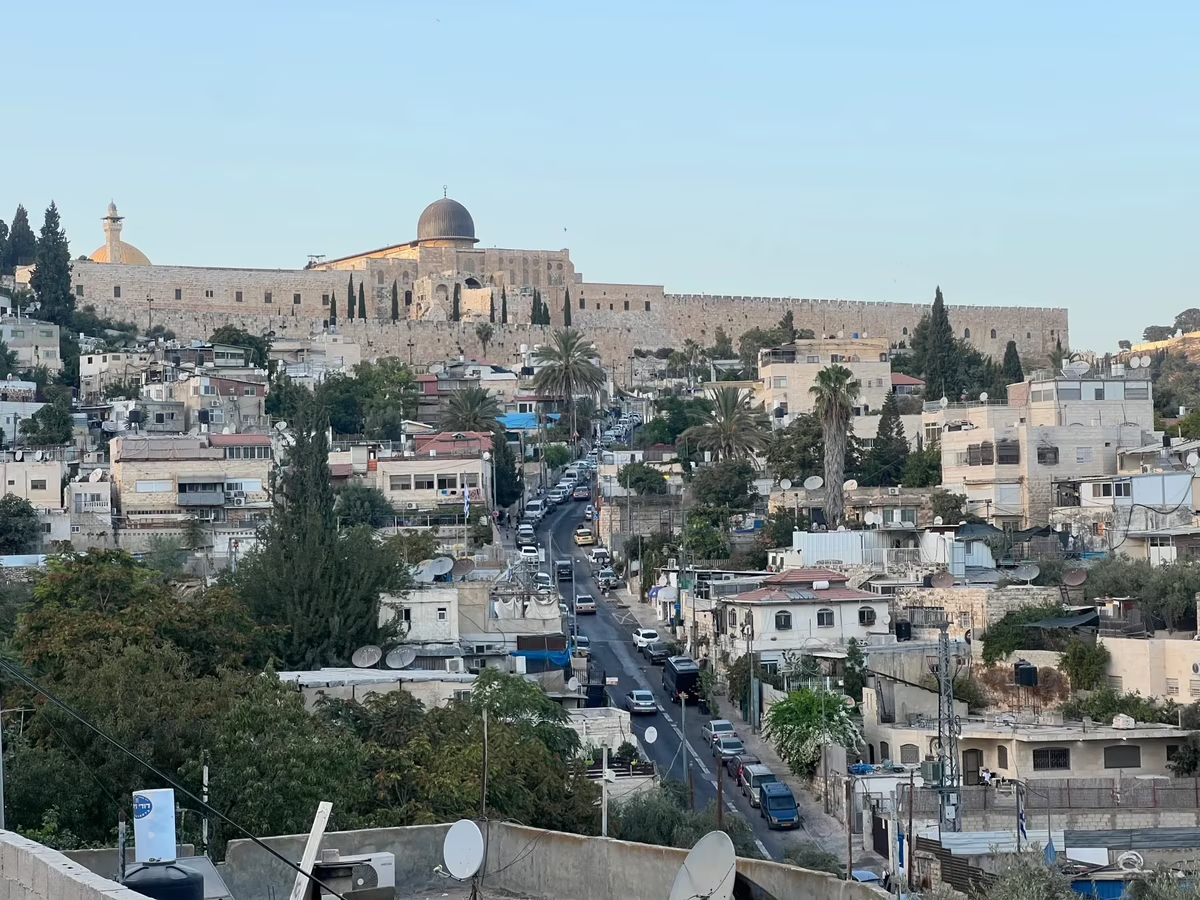
Military data indicates that the human force involved in this mission amounts to approximately 5,000 personnel, combining Marines and specialized sailors. These forces are scheduled to be deployed on several warships equipped with the latest combat technologies, to ensure full readiness to deal with any security emergency that may arise in regional waters.

In the context of field movements, officials confirmed that the warship 'USS Tripoli', which was previously stationed at US bases in Japan, has begun its journey towards the Middle East. This ship accompanies its forces to join the Marine units currently present in the region, whose primary tasks are focused on supporting operations directed against Iranian movements.

Observers believe that this American military escalation comes as a direct response to recent Iranian actions that have obstructed international navigation through the Strait of Hormuz. These Iranian pressures have led to clear disruptions in the global economy, manifested in a noticeable rise in fuel prices, placing additional pressure on international markets.

These field developments represent a significant strategic challenge for President Donald Trump's administration, which seeks to balance military deterrence with avoiding a slide into a full-scale confrontation. World capitals are closely monitoring the arrival of these reinforcements, and what may result from them in terms of a change in the balance of power or the restoration of stability to global maritime trade.

This step comes amid Iran's crippling of navigation in the Strait of Hormuz, disrupting the global economy and raising fuel prices.

ARAB AND WORLD

Sat 14 Mar 2026 4:35 am - Jerusalem Time

Explosions rock Baghdad, reports of Popular Mobilization Forces leader assassinated in airstrike

The Iraqi capital, Baghdad, woke up on Friday night to Saturday to the sound of two massive explosions that shook the city, triggering a widespread security alert. Field sources reported that the sounds resulted from a direct targeting in the heart of the capital, with columns of smoke rising from the targeted sites amidst conflicting initial reports about the nature of the attack.

Circulating information indicates that the explosions targeted an assassination operation against a prominent figure in the Popular Mobilization Forces within the vital Arasat area in central Baghdad. Security sources confirmed casualties from this powerful explosion, while security forces imposed a tight cordon around the scene, preventing access pending the results of initial investigations.
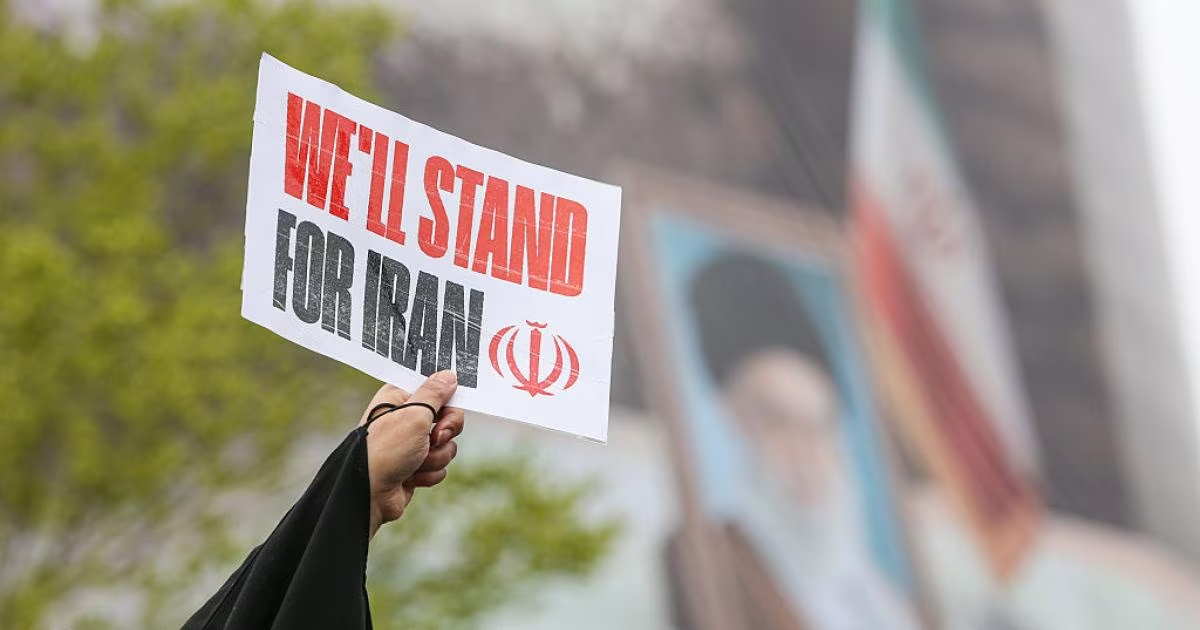
For its part, international news agencies quoted sources in the Iraqi police as saying that an airstrike targeted a house used as a headquarters for a meeting of Popular Mobilization Forces leaders. The sources clarified that the attack was precise and resulted in the death and injury of a number of people who were present inside the headquarters at the moment of the airstrike, which supports the hypothesis of a systematic assassination.

Coinciding with the events in Baghdad, security sources revealed another airstrike targeting a military site in the Nineveh Plain region in the north of the country. The direct link between the two attacks is not yet clear, but the temporal coincidence suggests a large-scale military operation targeting Popular Mobilization Forces factions in more than one geographical location within Iraq.

This security escalation comes at a sensitive time for Iraq, as the Iraqi government has previously condemned similar attacks targeting Popular Mobilization Forces headquarters, which resulted in dozens of deaths. Political and popular circles are awaiting an official statement from government agencies to identify the perpetrators of the recent airstrikes and confirm the names of the targeted individuals.

An airstrike targeted a house used as a headquarters for Popular Mobilization Forces leaders in Baghdad, with reports of deaths and injuries.

OPINIONS

Sat 14 Mar 2026 4:26 am - Jerusalem Time

Oil Profits for the Top, Pain at the Pump

By Said Arikat

March 14, 2026

News Analysis

Washington, D.C- When oil prices surged in the days following the U.S.–Israeli war against Iran, President Donald Trump reacted in a way that revealed more about his economic outlook than perhaps he intended. Rather than acknowledge the burden the spike would place on American households, he celebrated it. Writing on Truth Social, the president noted that because the United States is now the world’s largest oil producer, higher prices mean the country is “making a lot of money.”


The comment was meant to sound triumphant. Instead, it underscored a widening gap between the economic lens guiding the administration and the financial reality confronting millions of Americans.


For the energy industry, higher oil prices can indeed translate into greater profits. For most Americans, however, rising fuel costs function very differently. They appear immediately at the gas pump, then spread through transportation costs and, eventually, into the price of groceries, airline tickets, and everyday goods.
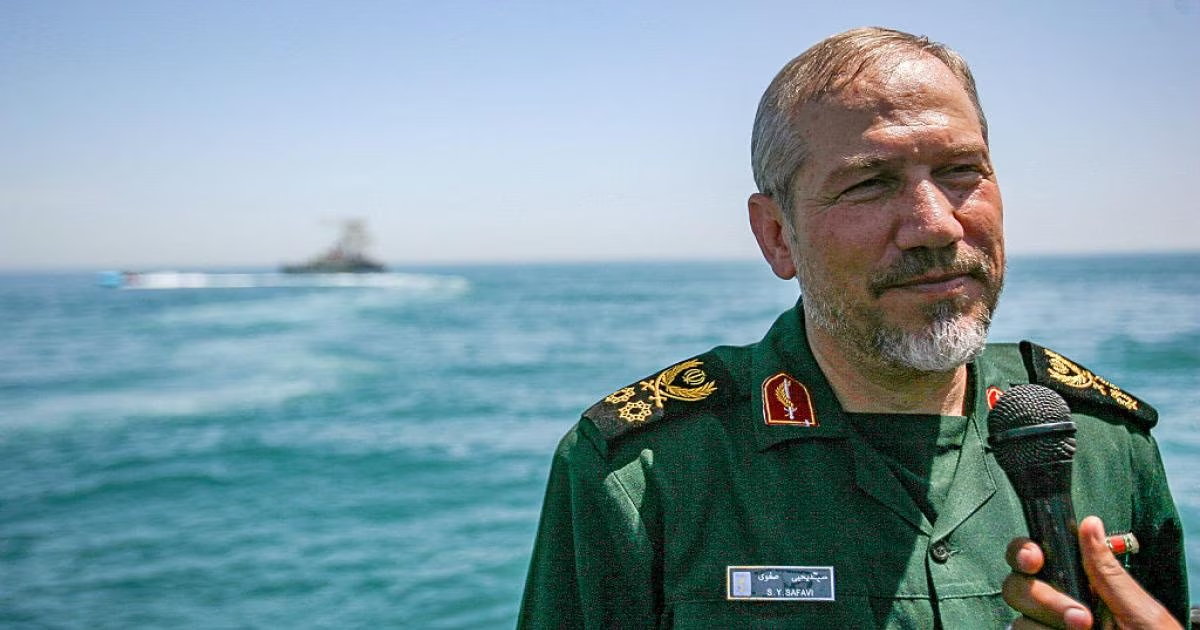
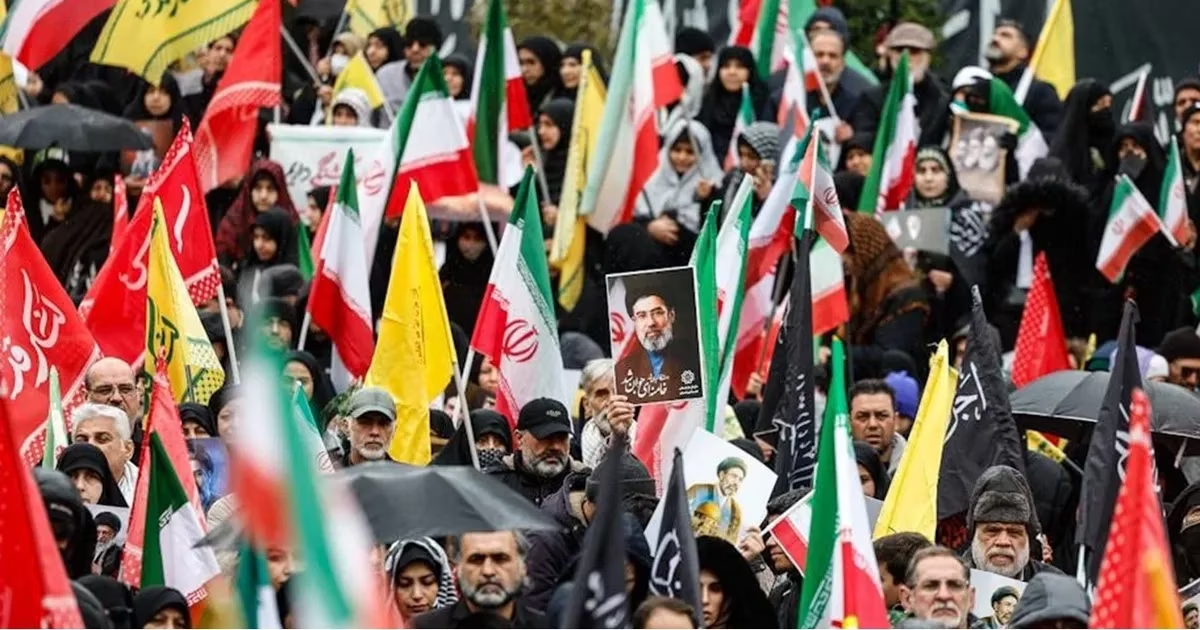

The “money” Trump referred to is not shared evenly across the country. It flows largely to oil companies, investors, and executives who dominate the energy sector—many already firmly entrenched in the wealthiest tier of the American economy.


For ordinary families, the price spike feels less like a national gain than a new bill arriving without warning.


This contradiction has become especially visible since the conflict with Iran began.


Before the war, Trump frequently pointed to low gasoline prices as proof that his economic policies were working. Cheap fuel became a staple talking point in speeches and campaign-style appearances. It was presented as clear evidence that the administration’s approach was delivering results for everyday Americans.


Just a day before hostilities began, the president spoke in Corpus Christi, where he praised gasoline prices that had fallen below $2.30 per gallon. Two weeks earlier, during an appearance in Iowa, he highlighted stations selling fuel for as little as $1.85 a gallon. The message was unmistakable: low fuel prices were proof of economic success.


Then the war began—and the numbers shifted almost overnight.


According to industry tracking by GasBuddy, the national average price of gasoline stood at $2.94 per gallon on March 1, the day the conflict erupted. Within eleven days it had climbed to $3.61—a jump of roughly 23 percent in less than two weeks.


For households already grappling with rising housing, healthcare, and food costs, the increase has been immediate and unavoidable. Unlike abstract economic indicators, gasoline prices are visible every day. Americans see them flashing on station signs as they drive past.


What makes the surge even more striking is how predictable it was.


Any military confrontation involving Iran inevitably rattles global energy markets because of one critical location: the Strait of Hormuz. This narrow waterway links the Persian Gulf to global shipping lanes and remains one of the world’s most vital energy chokepoints. In 2025, roughly one-fifth of all seaborne oil shipments passed through it.


Once the war began, tensions in the Gulf escalated quickly. Iranian authorities warned that vessels crossing the strait would require authorization from Tehran for safe passage. Several commercial ships reported harassment and drone activity attributed to the Islamic Revolutionary Guard Corps.


Energy analysts have long warned that any disruption in the Strait of Hormuz would send shockwaves through global oil markets. The moment that risk becomes credible, traders respond—and prices climb.


That is precisely what happened.


Yet the central question is not why oil prices rose. The geopolitical mechanics are well understood. The more revealing question is why the administration appears so comfortable with the consequences.


Trump’s framing of higher oil prices as a national advantage reflects an economic outlook shaped more by corporate balance sheets than by household budgets. When crude prices rise, American energy companies see revenues grow. Shareholders watch stock values climb. Executives report stronger quarterly earnings.


But those gains rarely reach ordinary Americans in any immediate or meaningful way.


Instead, higher fuel prices function much like a regressive tax. They raise commuting costs for workers, increase the expense of shipping goods across the country, and ripple through supply chains until the effects surface in supermarkets, retail stores, and airline fares.


In short, the benefits remain concentrated while the costs spread broadly.


This imbalance reveals something deeper about the political economy of the moment. Policies that generate profits for powerful industries are often framed as national achievements—even when the financial burden falls largely on ordinary citizens.


Trump’s reaction to the oil surge captures that dynamic with unusual clarity. Rather than highlight the economic strain Americans would face, he emphasized the revenue supposedly flowing into the country.


But a nation is not a corporation, and its prosperity cannot be measured solely by the profits of its largest industries.


For millions of Americans filling their tanks this week, the economic impact of the war is not an abstract geopolitical calculation. It is a number glowing on a gas pump.


And that number tells a far less celebratory story than the one emerging from Washington.


For oil companies and billionaire investors, rising crude prices can look like opportunity. For the average American driver, the war’s first visible consequence is far less abstract: a higher price at the pump. It is a reminder that in moments of geopolitical crisis, the gains often rise to the top while the costs settle squarely on everyone else

OPINIONS

Fri 13 Mar 2026 9:15 pm - Jerusalem Time

The Individual State and the Institutional State: Why Does Iran Seem Resistant to Rapid Collapse?

In the analysis of international politics, disagreement is not always about facts as much as it is about how to interpret them and assess their future outcomes. In Iran's case, the debate is not about whether it is a state prone to rapid collapse, but rather how to deal with a state that has proven its resilience under prolonged pressure, while simultaneously seeking to establish a regional and international position that extends beyond its traditional borders.

This discussion relates to a deeper issue in understanding state stability: the difference between a state based on the person of the ruler and a state based on a system of deeply rooted institutions. States where power is concentrated in the hands of an individual or a very narrow circle often become an extension of that person. When the center of power falls, the state collapses with it or its institutions rapidly disintegrate, because the institutional structure was not independent enough to continue without it.

Experiences in the Middle East over recent decades provide clear examples of this pattern. In Iraq, the political system was highly linked to the individual leadership. When that leadership fell in 2003, large parts of the state structure collapsed with it, because the system was largely based on a single, highly concentrated center of power. In Libya, too, the fall of the regime led to a wide institutional vacuum, because the state structure had not developed into independent institutions capable of managing the transition of power. As for Syria, the long conflict revealed the fragility of balances when central authority is subjected to a violent shock, because the state structure was largely linked to the center of power itself.

These experiences reinforced among some decision-makers the idea that overthrowing the leadership might be the quickest way to reshape states. However, this perception does not apply to states that possess a cohesive institutional structure. In such states, the regime does not disappear with the fall of the leadership, because the state's political, administrative, and security institutions continue to function, reproducing power within the existing framework.

It is precisely in this context that the Iranian case can be understood. For decades, the United States and Israel have treated Iran as one of the major strategic challenges in the Middle East. But over time, it became clear that Iran is not a fragile regime that can crumble under economic pressure or political isolation. The Iranian state was formed after the revolution on the basis of a complex and intertwined institutional structure, including constitutional, political, security, and administrative institutions capable of continuing even under conditions of extreme pressure.

This institutional factor has been crucial to Iran's ability to withstand prolonged international sanctions. For years, the Iranian economy has been subjected to severe pressure, and the state has been subjected to widespread attempts at political and financial isolation. Nevertheless, these pressures did not lead to the state's destabilization or the collapse of its structure; rather, they often pushed it to develop alternative mechanisms for adaptation and survival.

For decision-making circles in Washington and Tel Aviv, this experience carried a clear implication: sanctions alone will not bring down a state with established institutions. On the contrary, they may give it time to reorganize its economy and strengthen its strategic capabilities. As Iran continues to develop its technical and military programs and expand its regional presence, a growing conviction began to form that allowing things to proceed in this manner might ultimately mean the entrenchment of a regional power that would be difficult to contain.

From this perspective, the shift in strategic thinking was not a result of a misunderstanding of the nature of the Iranian state as much as it was a result of a growing recognition of its resilience. After many years of pressure and sanctions that did not lead to the expected collapse, it became clear that Iran is moving along a path aimed at solidifying its position as a regional power with international weight.

This path is not only related to foreign policy but also to the structure of the state itself. States with established institutions do not only seek to endure but also to ensure their continuity by solidifying their position in the regional and international system. From this standpoint, Iran views its regional role and its political and security influence as part of a broader strategy to ensure that it is not marginalized or bypassed in power equations.

This is precisely where the dilemma lies for the United States and Israel. The longer the status quo persists, the greater Iran's chances of strengthening its regional presence and developing its strategic capabilities. This has led to increasing debate within decision-making circles about whether continuing the policy of waiting and containment will make dealing with Iran more difficult in the future.

From the perspective of some of these assessments, inaction now could mean facing a new regional reality in which Iran becomes a more entrenched and influential power. Initiating confrontation or escalation, however, remains a risky option given the nature of the Iranian state itself and the network of influence it has built in the region.

Ultimately, this equation reveals a fundamental lesson in understanding state stability: states based on the person of the ruler may fall with his downfall, but states based on established institutions do not fall easily. For this reason, Iran appears to its adversaries not merely as a political regime that can be quickly changed, but as an institutional state that has managed to endure under prolonged pressure, while simultaneously working to solidify its position as an undeniable power in the balances of the Middle East.

PALESTINE

Fri 13 Mar 2026 9:15 pm - Jerusalem Time

New settlement plan to seize Silwan lands and isolate it from Al-Aqsa Mosque

The Alternative Planning Center team monitored technical and field changes, which it described as alarming, on the official maps of the occupation municipality in occupied Jerusalem. The center explained that these changes show a deliberate reduction of the municipal boundaries of Silwan town, with the re-annexation of vital areas to what is called the 'City of David' settlement neighborhood.

This new classification aims to reduce the officially recognized Palestinian urban space in favor of tourism and archaeological projects led by settlement associations. This step leads to the inclusion of areas historically and socially linked to the Palestinian fabric within the direct control of the occupation under the guise of 'heritage'.

Local sources in Jerusalem Governorate confirmed that these measures are null and illegitimate, and primarily aim to restructure the spatial and political landscape of the holy city. The Governorate warned of the danger of linking Palestinian neighborhoods to a false heritage framework that serves the Zionist narrative in the areas surrounding the Old City.

For his part, Khalil Al-Tafakji, an expert in maps and settlement, explained that the latest change effectively divides Silwan town into two parts; one Arab and the other Jewish. He pointed out that the occupation municipality now considers the annexed parts of Wadi Hilweh neighborhood as part of the Jewish neighborhood whose boundaries are continuously being expanded.

Through this demarcation, the occupation authorities seek to transform the Al-Bustan, Wadi Al-Rababa, and Wadi Hilweh neighborhoods into areas with a complete Jewish character. These annexed areas enjoy various privileges and services aimed at strengthening the settlement presence at the expense of the indigenous population who face the risk of displacement.

These moves are linked to major Judaization projects previously implemented, such as the suspended aerial bridge and the 'Kedem' settlement project, in addition to the 'Pilgrims' Path' tunnel. The 'King's Garden' plan also stands out as one of the most dangerous projects threatening to demolish Palestinian homes in Al-Bustan neighborhood to establish Talmudic facilities.

Jerusalemite experts estimate the area of the planned Jewish neighborhood in the heart of Silwan to be about two square kilometers, all of which fall within what is called the 'Holy Basin'. This plan aims to tighten control over East Jerusalem and link it to the western part of the city within a comprehensive Judaization vision that abolishes the Green Line.

Observers believe that this redrawing of borders this time stems from religious motives that serve expansionist political goals, as the occupation claims that parts of Silwan represent the historical 'City of King David'. These religious narratives are used as a legal cover for land confiscation and changing the demographic reality in the area adjacent to Al-Aqsa.

Fakhri Abu Diab, a member of the Committee for the Defense of Silwan Lands, affirmed that the town represents the first line of defense for Al-Aqsa Mosque from the southern and southeastern sides. He stressed that targeting Silwan is a direct targeting of the identity of Al-Aqsa Mosque, as the occupation seeks to change the demographic composition to facilitate an assault on the mosque.

Silwan town contains a treasure trove of historical artifacts dating back to the Canaanite, Islamic, and Umayyad periods, which are living testimonies to the Arab identity of the city. Among the most prominent of these landmarks are the Silwan Spring, dug by the Canaanites thousands of years ago, and the Umayyad palaces located adjacent to the southern wall of Al-Aqsa Mosque.

Historical data indicate that Silwan's lands historically extended to the Khan al-Ahmar area, but successive confiscations reduced its area to only about 5640 dunams. The occupation has so far succeeded in controlling about 22.5% of this remaining area through settlement projects and biblical gardens.

About 60,000 Jerusalemites live in Silwan's 12 neighborhoods, facing daily pressures from 3200 settlers who have been planted in settlement outposts within Palestinian properties. The town is considered one of the areas most exposed to demolition and forced displacement operations with the aim of turning the Arab residents into a minority in their region.

The new plan aims to transform 334 dunams of the town's land into a 'national park' that Palestinians are prevented from using or building on. This falls within efforts to impose the occupation's 'historical sovereignty' and transform the area into an open museum that promotes Talmudic myths and erases Arab and Islamic identity.

Concerns are growing about the establishment of facilities belonging to the alleged 'Third Temple' within Silwan neighborhoods, especially with the occupation promoting the existence of historical 'purification pools' in the area. What is happening in Silwan represents a microcosm of what the occupation authorities plan for all neighborhoods of occupied Jerusalem to impose a new reality that cannot be changed.

The Judaization of Al-Aqsa Mosque inevitably passes through the gateway of Judaizing Silwan town and completely changing its demographic and geographical composition.

ARAB AND WORLD

Fri 13 Mar 2026 9:15 pm - Jerusalem Time

Between betting on popular movement and military action.. Trump's and Netanyahu's strategies to confront Iran

US President Donald Trump expressed his conviction in the Iranian people's ability to act to overthrow the ruling regime in Tehran, considering that current military pressures may pave the way for this transformation. Trump explained in radio statements that the absence of weapons among civilians represents a major obstacle at present, which may delay the expected results of this popular movement.

Regarding the nuclear file, Trump indicated that Washington does not prioritize seizing Iranian uranium at this stage, but he did not rule out focusing on this goal in the future. These statements come at a time when the region is witnessing unprecedented escalation, including targeting vital sites and high-ranking leaders in the Iranian regime's structure.

For his part, Israeli Prime Minister Benjamin Netanyahu expressed reservations about the speed of the regime's collapse in Tehran, emphasizing his uncertainty about it happening in the foreseeable future. Tel Aviv is currently adopting a dual strategy aimed at weakening security forces and the regime's infrastructure, to reduce obstacles to any potential internal protests that may erupt in the Iranian street.

Informed sources indicate that the Israeli leadership places the uranium file at the top of its priorities, with hints of operational surprises that may include elite units. Security circles in Tel Aviv are studying three scenarios for dealing with nuclear reactors, ranging from concentrated air strikes to swift ground operations by commando forces.

On the ground, media reports revealed the extent of the widespread destruction caused by recent attacks, with about 9,000 targets inside Iranian territory being hit during the first ten days of the confrontation. This figure represents a huge leap compared to previous rounds of escalation, reflecting a desire to completely and quickly cripple Iranian military capabilities.

In contrast, Tehran is adopting an asymmetric warfare strategy to exhaust the Washington-led coalition, exploiting the large differences in the cost of military equipment. While the cost of an Iranian drone is a few thousand dollars, air defenses are forced to use interceptor missiles worth millions of dollars, raising the cost of daily American operations to about one billion dollars.

International concerns extend to global energy security, as the Strait of Hormuz represents a strategic pressure card in Iran's hand, being a passage for 20% of global oil supplies. Sources reported that Tehran aims, by prolonging the conflict, to drain the massive US military budget and use the 'alliance trap' to destabilize the financial stability of countries participating in military operations.

Israel faces a strategic dilemma in balancing intense military pressure with avoiding a comprehensive regional war whose consequences cannot be controlled. Intelligence agencies are closely monitoring any signs of a return of popular demonstrations, considering that weakening the grip of the Revolutionary Guard is the real key to changing the political equation in Tehran, away from traditional military solutions.

In conclusion, the diplomatic path remains an option, although its chances of success have diminished amid continued mutual shelling and targeting of vital interests in the region. With the parties adhering to their positions, the confrontation appears to be heading towards further escalation, awaiting the results of economic and military pressures on the structure of the Iranian regime and its ability to withstand.

I really think it's a big obstacle that is difficult to overcome for those who don't have weapons.. that (the fall of the regime) will happen, but perhaps not immediately.

PALESTINE

Fri 13 Mar 2026 5:05 pm - Jerusalem Time

20 Dead in Intense Israeli Raids on Lebanon, Guterres Calls for End to War

The intensity of Israeli aggression on Lebanese territories has escalated since dawn on Friday, with at least 20 people martyred and dozens injured in a series of airstrikes targeting towns in the South, Bekaa, and the southern suburbs of Beirut. These deadly attacks come in the context of an expanded military campaign launched by the occupation army since the beginning of March, leaving widespread destruction in residential facilities and infrastructure.

In the city of Sidon, in the south of the country, occupation aircraft committed a massacre in the eastern suburbs of the city, where an airstrike targeted a populated residential building, resulting in the martyrdom of 8 citizens and the injury of 9 others with varying degrees of wounds. Search and rescue operations continued in the town of Qleileh in the Tyre district, where specialized teams were able to extract two people from under the rubble of a destroyed building, while the search for missing persons is still ongoing.

Nabatieh district witnessed concentrated targeting by drones, one of which targeted a motorcycle on the road connecting the towns of Kafr Tibnit and Arnoun, leading to the immediate martyrdom of its driver. The raids also hit the town of Yater in the Bint Jbeil district, and the towns of Shaqra and Kafr Dunin, as part of a policy of direct targeting of both civilian and military movements in the border areas.

In the central Bekaa region, eastern Lebanon, an Israeli raid targeted a residential apartment in the town of Bar Elias, leading to the martyrdom of the two sons of Youssef Dahouk, an official in the Islamic Group, and injuring him and two others seriously. Warplanes also launched simultaneous raids on various areas in the Hermel district, causing damage to many homes and public and private properties in the region.

The capital Beirut was not spared from targeting, as one person was martyred in a raid that targeted a civilian car in the Jnah area of the southern suburbs, amidst a state of panic among residents. In the border town of Shebaa, an Israeli drone targeted two citizens, Mahmoud Akrama Nassif and Hadi Mohammad Kanaan, on the outskirts of the town, leading to their immediate martyrdom at the attack site.

In the town of Nabatieh Fawqa, local activists mourned Sheikh Hassan Ghandour, who was martyred as a result of an airstrike that directly targeted his home, leading to its complete destruction. The town of Abba in the Nabatieh district also recorded the martyrdom of citizen Ataf Maalem Sabra and the serious injury of her husband, following an aerial bombardment that hit their home at dawn today, as part of a series of attacks targeting southern villages and towns.

On the ground, an Israeli drone also targeted a car on the Shaaitiyeh road in the Tyre district, resulting in one martyr and injuries among passersby, coinciding with intense artillery shelling that hit the outskirts of the towns of Qawzah and Ramiya. Field sources reported that warplanes carried out a raid between the towns of Siddiqin and Ramadieh, and another targeted the town of Tayr Felsay near the vital bridge, leading to the قطع of some secondary roads.

Official statistics issued by the Lebanese authorities indicate that the toll of the expanded Israeli aggression reached 687 martyrs and 1774 injured by Thursday evening, while the number of displaced persons exceeded 822,000. These figures reflect the scale of the humanitarian catastrophe that Lebanon is experiencing amidst the continued daily and regular aerial and artillery bombardment affecting most Lebanese governorates.

Diplomatically, UN Secretary-General Antonio Guterres, during a press conference in Beirut, called on both Israel and Hezbollah for an immediate cessation of hostilities and to reach a comprehensive political agreement. Guterres affirmed, after meeting with Lebanese President Joseph Aoun, the necessity of respecting Lebanon's sovereignty and independence, stressing that the Lebanese people have been drawn into a war they do not want and that does not serve their national interests.

Guterres expressed his full solidarity with the Lebanese people in these difficult circumstances, hoping that his next visit would be at a time of peace and when the state is the sole authority and decision-maker. He noted that the United Nations is making strenuous efforts to secure humanitarian aid for the displaced and affected, emphasizing that a military solution will only lead to more destruction and suffering for both sides.

For his part, Lebanese President Joseph Aoun affirmed that the Lebanese state is looking for all possible ways to stop the war and protect civilians from the Israeli killing machine. Aoun stressed that negotiations under the auspices of the United Nations are the optimal path to reaching a sustainable solution, emphasizing the necessity of confining weapons to the hands of the Lebanese state to ensure its ability to make decisions of peace and war in a way that serves the supreme national interest.

In a notable development, occupation aircraft dropped leaflets over the capital Beirut, specifically in the areas of Verdun, Hamra, and Ain El Mreisseh, coinciding with intense low-altitude flights that caused a tremendous boom. These leaflets contained inciting messages calling on Lebanese to disarm Hezbollah, and also contained electronic scan symbols (QR Codes) belonging to Unit 504 of Israeli military intelligence for information gathering.

Local sources reported that the sound of the sonic boom was repeated four times in a short interval, causing a state of terror and panic among residents and students in schools around the capital. This Israeli move comes within the framework of psychological warfare practiced by the occupation in parallel with field military operations, in an attempt to pressure the popular base and stir up internal public opinion.

Amidst this escalation, civil defense and ambulance teams continue their work in extremely dangerous conditions, as some teams are directly targeted while performing their humanitarian duties in recovering victims. The field situation remains prone to further escalation in the absence of any signs of an imminent ceasefire agreement, and the continuation of Israeli threats to expand ground operations deep into Lebanese territory.

I call on Israel and Hezbollah to achieve a ceasefire, and for the war to stop and an agreement to be reached that enables Lebanon to be an independent and sovereign country.

ARAB AND WORLD

Fri 13 Mar 2026 5:05 pm - Jerusalem Time

Iranian military advisor expects end of confrontation before 'Nowruz' amid new wave of missiles

Rahim Safavi, military advisor to the Iranian Supreme Leader, predicted that the ongoing military confrontation would end before Nowruz, which marks the beginning of the new Iranian year in about ten days. Safavi explained that this assessment is based on a field reading indicating a relative decline in the pace of exchanged strikes between the parties involved in the conflict over the past few days.

Meanwhile, media sources in Tehran reported the launch of a third wave of Iranian missile attacks, targeting sites described as strategic. The sources stated that these strikes coincided with the launch of other missile barrages directed towards US military bases and vital targets deep within Israeli territory, in a remarkable field escalation.

Despite the absence of a detailed official statement specifying the nature of the losses, initial estimates indicate that the attacks targeted radar systems and sensitive military installations. This wave comes as part of a series of successive operations through which Tehran seeks to respond to the targeting of its facilities, confirming the entry of new sites into the direct confrontation circle.

In parallel with the military operations, Iranian media published detailed images and data of economic and military facilities inside Israel, in addition to sites in the Gulf region. This step aims to convey a political and military message that the Iranian target bank is expanding to include vital centers capable of influencing the economic and security balance of power in the region.

Tehran accuses the US administration of working to expand the scope of military operations to include infrastructure and vital facilities within Iranian territory. Political circles in Iran believe that this American approach aims to double the economic pressures on the country, which is already suffering from the consequences of severe international sanctions that have been ongoing for years.

The question remains about the realism of Safavi's predictions of an imminent end to the war, given the continued exchange of missile barrages and ongoing military buildup. While Tehran speaks of a decline in pace, on-the-ground data indicates that the confrontation may take new forms of a war of attrition targeting the economic and military nerve of all parties.

Our estimates indicate the possibility of ending the war before Nowruz, given the noticeable recent decline in the intensity of mutual military operations.

ISRAELI AFFAIRS

Fri 13 Mar 2026 5:05 pm - Jerusalem Time

Harel: Washington and Tel Aviv's bets on the collapse of the Iranian regime from within have failed

The military analyst for Haaretz newspaper, Amos Harel, confirmed that direct military confrontation with Iran has entered a phase of reviewing expectations after major bets evaporated. He explained that Washington and Tel Aviv built their strategies on the premise that military pressure would generate a popular uprising leading to the overthrow of the regime, which did not happen.

Harel pointed out that intelligence estimates indicated that delivering devastating blows to vital regime apparatuses, such as the Revolutionary Guard and the Basij, would paralyze their ability to suppress. This state of security weakness was supposed to give the masses an impetus to take to the streets, but two weeks of intense bombing did not change the internal scene.

The military analyst touched on another disappointment related to the Kurdish component in Iran, where expectations prevailed that the Kurds would move from the mountains to ignite a rebellion in the cities. Despite widespread media promotion of this hypothesis in Hebrew circles, the reality on the ground proved the inability of these groups to change the internal balance of power.

Regarding the nuclear file, Harel noted that air strikes, despite their intensity, did not completely end the Iranian threat. Iran still retains about 440 kilograms of 60% enriched uranium, a sufficient quantity to produce a rudimentary nuclear weapon if a political decision is made to do so.

The analysis warned that Tehran has succeeded in distributing its nuclear stockpile and sensitive facilities to fortified underground sites, making their elimination by traditional means complex. Iran's technical capability to resume military manufacturing appears to remain intact and strong despite the damage to infrastructure.

On the level of missile capabilities, sources revealed that Iran resumed accelerating its ballistic missile program immediately after the previous fighting subsided. Estimates indicate that Tehran could succeed within just two years in possessing an arsenal of thousands of missiles capable of reaching deep into the occupied territories with high accuracy.

In the context of American motives, Harel explained that President Donald Trump was initially hesitant about the idea of a comprehensive attack. But Washington's success in overthrowing Maduro in Venezuela, and previous protests in Iran, stimulated his desire to repeat the experience to dominate the global energy market and compete with China.

The military analyst believes that there is a recurring pattern in joint military campaigns, where they begin with technological and intelligence surprises that provide a temporary advantage. But the adversary quickly absorbs the shock and begins to implement counter-plans aimed at expanding the conflict and exhausting the attacking forces in a long-term war.

Economic data indicates a huge gap in costs, with the US military budget amounting to 886 billion dollars compared to only 25 billion for Iran. However, Tehran succeeds in draining these huge budgets by using inexpensive weapons such as drones, which cost no more than 50,000 dollars.

In contrast, air defenses are forced to use interceptor missiles, each costing up to two million dollars, making continued confrontation a heavy financial burden. Sources estimate that the daily cost of US military operations in the region has reached about one billion dollars, which serves the strategy of 'exhausting the adversary'.

The Iranian strategy relies primarily on asymmetric warfare and targeting vital global system joints such as shipping lanes and oil supplies. The Strait of Hormuz, through which 20% of the world's oil passes, represents a strategic pressure card in Tehran's hand that it can use to disrupt the global economy at any moment.

Harel noted that Hezbollah in Lebanon also proved to be less vulnerable than initial estimates indicated before the operations began. This steadfastness on the fronts supporting Iran contributed to dispersing Washington and Tel Aviv's military efforts, and led to prolonging the fighting and increasing damage on the home front.

The analysis concluded that the current outcome indicates an escalation of risks for the Gulf states and the internal front of the occupation in the face of an adversary with long endurance. It appears that the 'alliance trap' set by Iran has begun to bear fruit in draining the military and financial capabilities of the United States and its allies in the region.

The new reality forces decision-makers to conduct a comprehensive reassessment of future plans, especially with the failure of the bet on change from within. Iran has proven its ability to adapt to military strikes, while maintaining a pace of military production that threatens the security of the region for years to come.

Hope for Kurdish action or Iranians taking to the streets was dashed, and reality proved that the regime was not affected by the harsh blows as expected.

ISRAELI AFFAIRS

Fri 13 Mar 2026 4:14 pm - Jerusalem Time

Netanyahu threatens to assassinate Mojtaba Khamenei and warns of the danger of 'extremist Islam'

The Prime Minister of the Israeli occupation government, Benjamin Netanyahu, issued direct threats against the new Iranian Supreme Leader, Ayatollah Mojtaba Khamenei, hinting at assassination as an unprecedented escalation. During his first press conference since the outbreak of widespread military confrontations, Netanyahu claimed that Tel Aviv had succeeded in achieving major strategic accomplishments that would fundamentally reshape the balance of power in the Middle East.

Netanyahu affirmed that the Israeli army forces continue to launch intensive strikes against the headquarters and checkpoints of the Iranian Revolutionary Guard and the 'Basij' mobilization forces, noting that Tehran's current situation has completely changed from what it was before the start of joint military operations with the United States. He added that Israel is gradually transforming into a dominant regional power, and even aspires to strengthen its position as a global power in specific fields, based on new alliances that sources described as unattainable just a few weeks ago.

In a striking context, Netanyahu touched upon religious and political dimensions, stating that the arrival of the 'return of the Messiah' is possible but requires facing grave challenges, ruling out its occurrence in the very near future. He warned that what he described as 'extremist Islam,' both Sunni and Shiite, poses an imminent danger threatening global stability, emphasizing that this dilemma will not find a solution without direct and decisive intervention to confront its roots.

Netanyahu stressed that military action against Iran was an urgent necessity to prevent the fortification of its underground military industries, which he considered the greatest threat to Israel's existence. He also claimed that Tel Aviv is systematically working to create suitable conditions for the Iranian people to enable them to overthrow the ruling regime, asserting that the moment for Iranians to gain their freedom is near, despite his emphasis that this change remains the responsibility of the people alone.

On the international relations front, Netanyahu boasted about building an exceptional and unprecedented alliance with the current American administration, highlighting the strength of his ties with President Donald Trump. Netanyahu described this relationship as surpassing in its strength and coordination any previous relationship witnessed in the history of ties between American presidents and Israeli prime ministers, which provides Tel Aviv with broad political and military cover.

Netanyahu concluded his statements by affirming that the ongoing operations aim to ensure Israel's long-term security by dismantling the threats surrounding it from all fronts. Sources indicated that Netanyahu's tone reflects a desire to leverage absolute American support to achieve political and military goals that transcend the traditional boundaries of the conflict, in light of the rapid changes taking place in the region.

Extremist Islam, whether Sunni or Shiite, poses a threat to the entire world, and it cannot be assumed that this problem will solve itself.

PALESTINE

Fri 13 Mar 2026 4:14 pm - Jerusalem Time

Why are the Houthis hesitant to directly engage in the regional war against Iran?

Questions are escalating in political circles regarding the Houthi group's stance in Yemen on the ongoing war in the region, which erupted following intense American and Israeli airstrikes on Iran. Despite Tehran's allies in Lebanon and Iraq directly engaging in the confrontation, the Houthis, who possess a missile arsenal capable of threatening international navigation, have not yet officially announced their entry into the battle.\n\nThe Houthi group is a military and political movement rooted in northern Yemen, which fought years of guerrilla warfare before seizing control of the capital Sana'a in 2014. Since then, the group has developed advanced military capabilities in drones and ballistic missiles, enabling it to target vital facilities deep within neighboring countries in recent years.\n\nAfter the events of October 7, 2023, the Houthis began a series of attacks in the Red Sea targeting commercial vessels, declaring that this was in support of Palestinians in the Gaza Strip. These attacks prompted a military response from the United States and Israel, who launched airstrikes on the group's positions in Yemen, further complicating the field situation.\n\nIn a recent speech, the group's leader, Abdul-Malik al-Houthi, affirmed that his forces are on high alert and ready for military action at any moment dictated by field developments. However, observers note that the group has not issued an official statement of full involvement in the war, unlike other factions in the Iran-led axis.\n\nExperts on Yemeni affairs indicate that the Houthis, despite their political rapprochement with Tehran, have their own internal agenda and do not absolutely adhere to the Iranian Supreme Leader's authority. This doctrinal and political distinction gives the group room for maneuver away from direct external dictates, and makes its decisions linked to its interests within Yemen.\n\nEconomic pressures and difficult humanitarian conditions in Yemen play a crucial role in curbing Houthi escalation, as the group fears the collapse of the fragile truce in place since 2022. Entering a full-scale war could mean further destruction of the dilapidated infrastructure in areas under their control, threatening their internal stability.\n\nOn the other hand, concerns arise about violent international and regional reactions if the Houthis target global energy corridors, especially the Strait of Hormuz, through which 20% of the world's oil passes. Any disruption to navigation in this vital artery would lead to global economic repercussions that could prompt major powers to launch an uncompromising military campaign against the group.\n\nIntelligence reports suggest that Iran may prefer to keep the Houthis as a reserve deterrent force, rather than exhausting them in an early confrontation. Iran's strategy relies on asymmetrical 'war of attrition,' using inexpensive drones to force opponents to use interceptor missiles costing millions of dollars.\n\nIn a related context, regional concerns have increased in countries such as Egypt, Turkey, and Saudi Arabia about the expansion of the conflict and its impact on energy supplies. These countries seek to strengthen their strategic cooperation to confront the security challenges arising from the escalation between Iran and Israel, and to try to contain any repercussions that may result from the intervention of non-state actors like the Houthis.\n\nAmerican sources claim that recent military operations have significantly reduced Iran's missile capabilities, which may affect the logistical support provided to the Houthis. However, the Houthis consistently deny being proxies for Tehran, asserting that they develop their weapons independently.\n\nAnalysts believe that the Houthis may choose to distance themselves from direct conflict amid increasing economic pressures in Yemen. The possibility of intense attacks from the United States, Israel, and even Saudi Arabia, represents a strong deterrent preventing them from full engagement in the war.\n\nConversely, some diplomats believe that the Houthis may carry out sporadic and limited attacks on targets in neighboring countries to increase pressure. These attacks, though limited, aim to show solidarity with Iran without provoking a comprehensive and destructive military response.\n\nEstimates indicate that the daily cost of American military operations in the region reaches one billion dollars, placing enormous financial pressure on Washington. The strategy of Iran and its allies aims to prolong the conflict and use the 'alliance trap' to exhaust Western military budgets.\n\nIn conclusion, the Houthis' position remains subject to field and political developments in the region, and their ability to balance their commitments to the 'axis of resistance' with their internal interests. Any decision to directly enter the war will change the rules of the game in the Arabian Peninsula and will have unpredictable global repercussions.\n\n"Our fingers are on the trigger regarding escalation and military action at any moment developments require."\n