PALESTINE

Sun 12 Apr 2026 7:16 am - Jerusalem Time

Netanyahu sets impossible conditions for negotiations with Lebanon and threatens military escalation

Israeli Prime Minister Benjamin Netanyahu announced on Saturday evening the continuation of military operations in Lebanon and threatened further escalation in the coming period. Netanyahu affirmed in a recorded speech that Tel Aviv would not agree to enter into any negotiation process unless its conditions, which include the complete dismantling of Hezbollah's military capabilities, are met.

Netanyahu claimed that the Lebanese side had recently sought repeatedly to open direct communication channels with Israel, considering that this approach came as a result of the intense military pressure exerted by the occupation army. He clarified that he had set two basic conditions for approving these discussions: the disarmament of Hezbollah and the conclusion of a peace treaty that guarantees stability for future generations.

In a related context, the Lebanese presidency confirmed in an official statement that an agreement had been reached to hold the first direct meeting between delegations from Lebanon and Israel in the American capital, Washington, next Tuesday. This announcement sparked angry reactions from Hezbollah, which condemned the move and considered it a violation of national principles in light of the ongoing aggression.

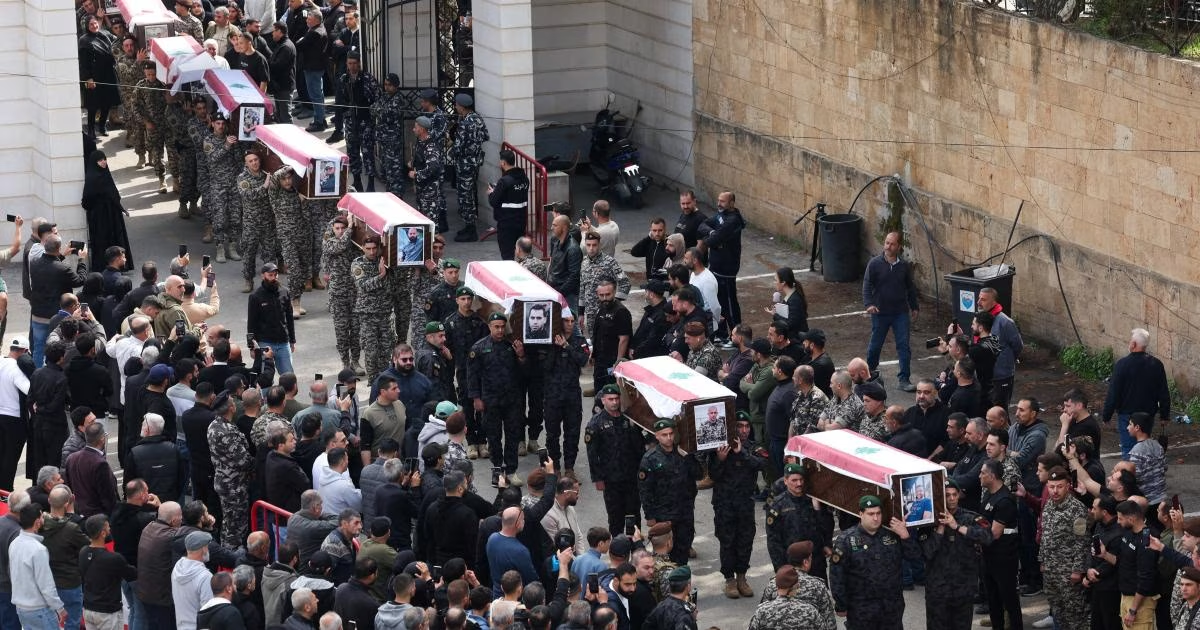
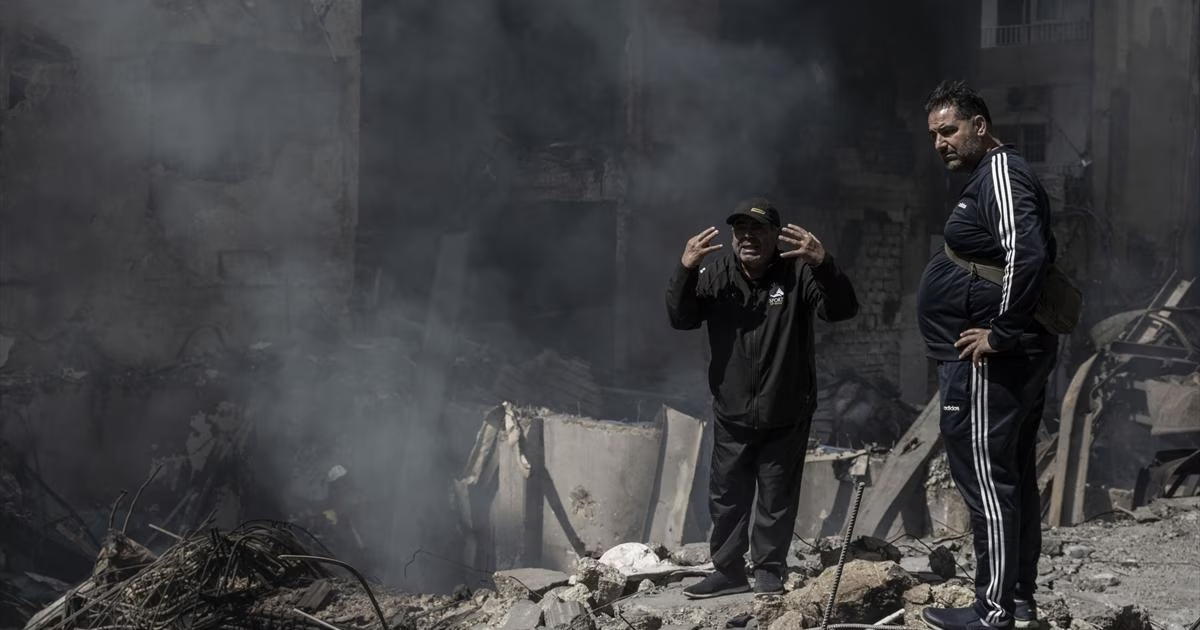
On the ground, the widespread Israeli aggression on Lebanese territories continues to claim more lives, with statistics indicating 2020 martyrs and over 6400 injured since early March. Saturday alone witnessed the fall of 97 martyrs in a series of violent raids targeting various areas, reflecting the extent of the ongoing destruction.

Netanyahu touched upon the Iranian file in his speech, claiming that Tehran is going through an unprecedented phase of weakness and facing internal crises that threaten the regime's survival. He stressed that Israel would not allow hostile forces on its borders, pledging to work to prevent Iran from acquiring enriched uranium by all available means, including military option.

The Israeli Prime Minister praised the level of coordination with the American administration in confronting Iranian threats, describing the current partnership as unprecedented. He indicated that the direct involvement of the United States in fighting alongside Israel against Iranian targets represents a major strategic shift that was not expected a year ago.

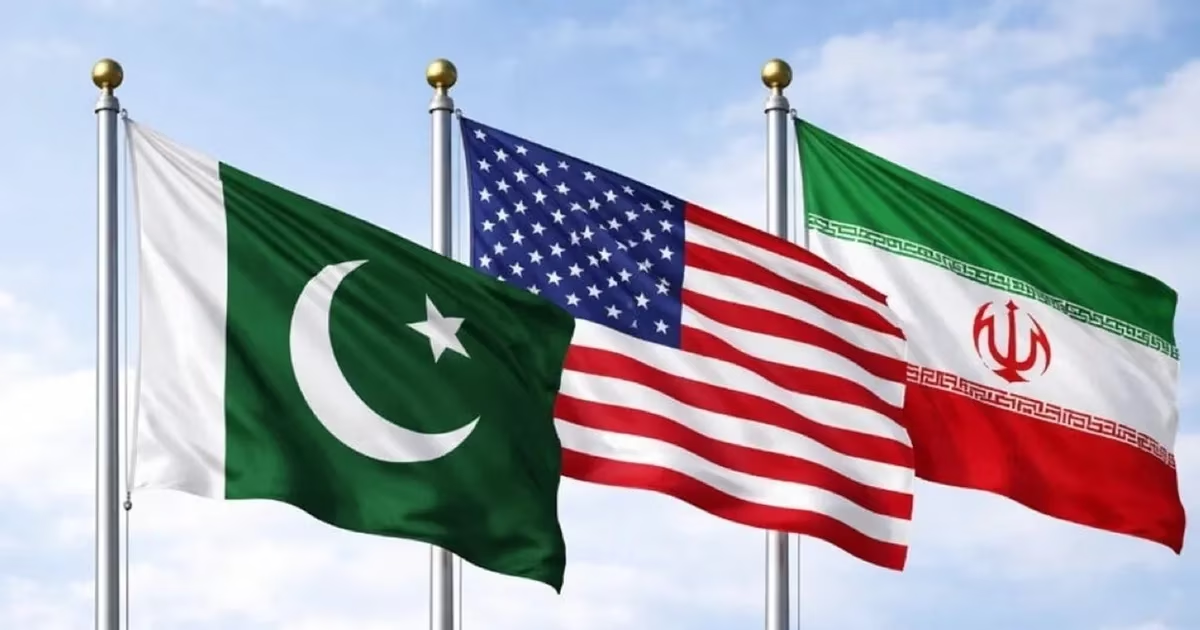
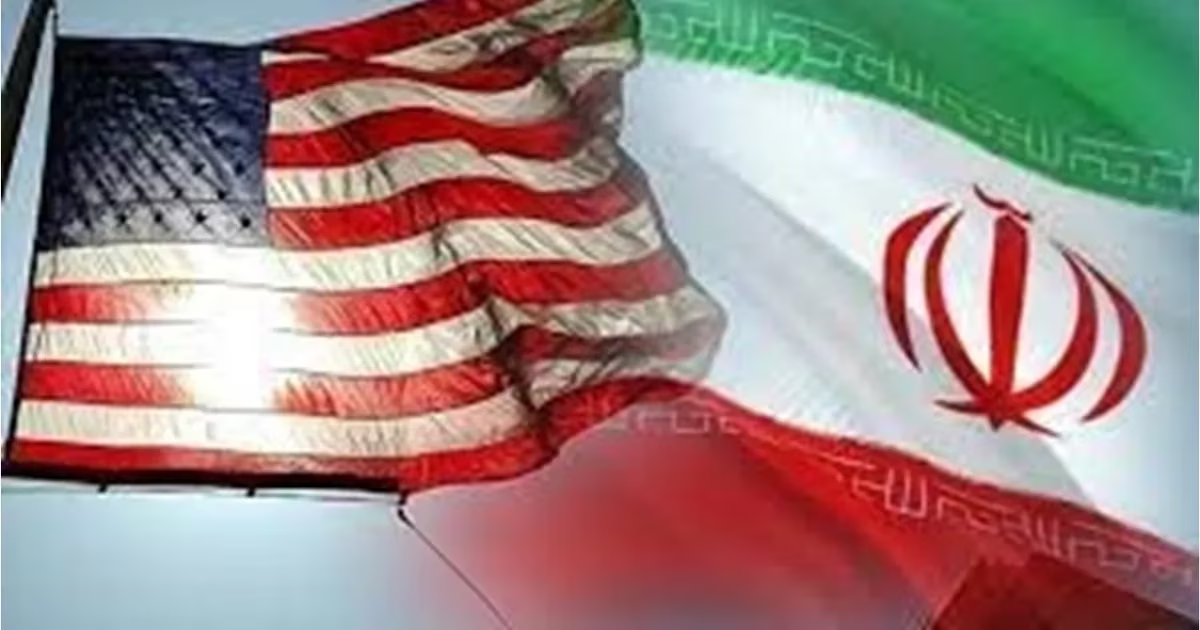
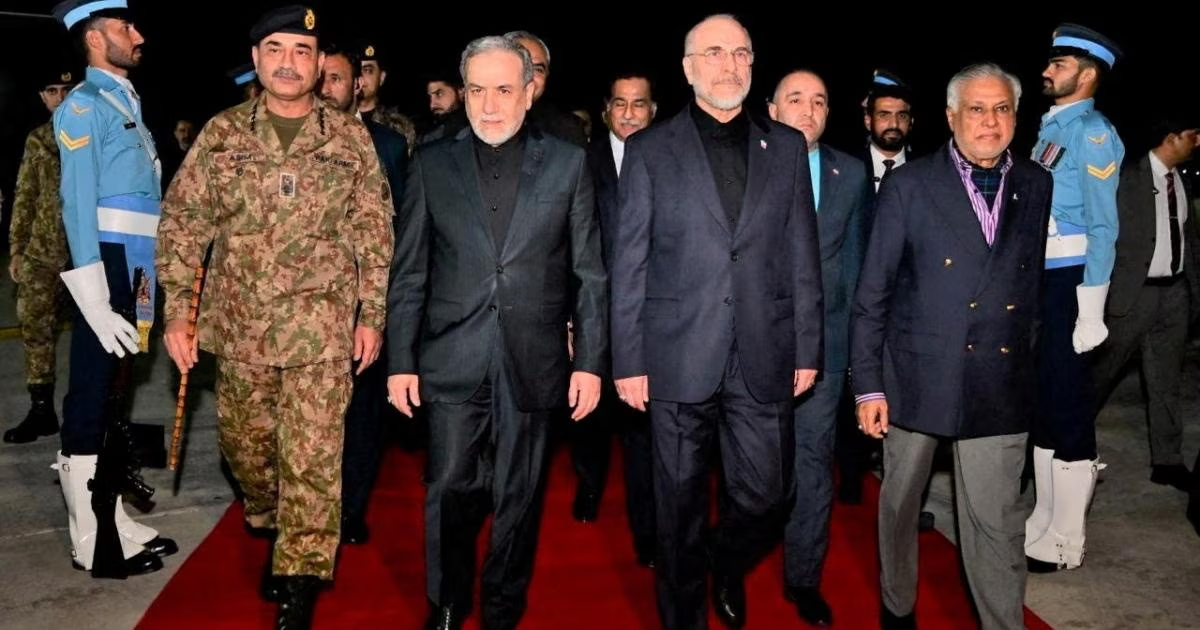
Regarding international diplomatic efforts, the United States and Iran announced last Wednesday a temporary two-week truce mediated by Pakistan. This truce aims to pave the way for a comprehensive agreement that ends the state of war that erupted last February, which has left enormous human and material losses in the region.

Despite Islamabad's and Tehran's assurances that the de-escalation should include the Lebanese front, Washington and Tel Aviv denied any correlation between the two tracks. Israel translated this stance by launching raids described as the most violent since the start of the aggression, targeting various sites in Lebanon immediately after the announcement of the Iranian-American truce.

For its part, Hebrew media sources quoted security officials as issuing instructions to the army to reduce the pace of attacks in Lebanon in the coming days. This step, according to the sources, is an attempt to build trust before the Washington talks begin, despite Israel's insistence on not withdrawing from the areas it has controlled.

In contrast, political assessments in Tel Aviv indicate that Hezbollah may resort to escalating its military operations before the start of the Washington meeting to strengthen its negotiating position. Israeli circles expect the next 48 hours to witness a wave of intense rocket attacks targeting the depth and border settlements.

Indeed, Hezbollah announced the execution of 34 diverse military operations since dawn on Saturday, targeting gatherings of occupation soldiers, military vehicles, and strategic sites. The party affirmed in its statements that these operations come in response to the ongoing massacres against Lebanese civilians and in defense of national sovereignty in the face of Israeli encroachment.

The Lebanese scene remains suspended between the hammer of military escalation on the ground and the anvil of anticipated political negotiations in Washington. While Netanyahu insists on his difficult security and political conditions, the Israeli military machine continues its operations, leaving the region facing scenarios open to all possibilities during this week.

We will not agree to any negotiations except on the two conditions of disarming Hezbollah and reaching a peace agreement that endures for generations.

PALESTINE

Sun 12 Apr 2026 7:16 am - Jerusalem Time

Diplomatic Crisis Between Seoul and Tel Aviv Following Korean President's Condemnation of Mutilation of Palestinian Bodies

South Korean President Lee Jae-myung has once again highlighted the violations committed by the Israeli occupation army in the occupied Palestinian territories by publishing a video documenting a brutal assault on a Palestinian body in the West Bank. The Korean President demanded a thorough investigation into the circumstances of the incident and information on the legal actions taken against the soldiers involved in this act, which violates international norms.

The details of the incident date back to September 2024, when occupation forces surrounded a house in the town of Qabatiya, south of Jenin. The military operation at the time resulted in the martyrdom of several young Palestinians after they were heavily fired upon inside the besieged building.

The videos, re-shared by the Korean President, documented harsh moments showing occupation soldiers dragging and mutilating the bodies of the martyrs before throwing them from the rooftop of the house. These scenes sparked a massive wave of local and international condemnation when they first spread, due to their blatant violation of the dignity of the deceased.

On the 'X' platform, Lee Jae-myung stressed that war crimes cannot be separated from major historical crimes condemned by the world. The Korean President compared the occupation's practices to forced slavery and massacres suffered by Jews, in a clear reference to the Holocaust and the crimes of the Japanese occupation of Korea.

In his clarification of the incident, Lee noted that the White House had previously described the incident as 'deeply disturbing.' He also pointed out that the occupation authorities had announced their intention to investigate the incident, which led him to question the actual results of those alleged investigations.

In his posts, the Korean President emphasized the need for strict adherence to international humanitarian law and the preservation of human dignity under all circumstances. He considered human rights to be the last bastion and supreme value that cannot be bartered or compromised, regardless of military justifications.

For its part, the Israeli Ministry of Foreign Affairs sharply responded to the Korean President's statements, accusing him of spreading 'misinformation.' Israeli sources claimed that the video was re-circulated out of its temporal context, alleging that the incident occurred during a complex military operation in which soldiers faced direct threats.

Tel Aviv claimed that the incident had undergone a comprehensive investigation and disciplinary actions were taken regarding it two years ago, attacking the Korean President for relying on what it described as 'fake accounts.' The Israeli Foreign Ministry also criticized Lee for ignoring attacks targeting Israel by other regional parties.

Seoul's official response was not delayed, as the South Korean Ministry of Foreign Affairs expressed its regret for what it described as Israel's 'misunderstanding' of the President's statements. The ministry clarified that Lee Jae-myung's words were an expression of his deeply held personal convictions regarding universal human rights.

In its official statement, the Korean government affirmed its firm stance rejecting all forms of violence and anti-humanitarian acts. It stressed that respect for international humanitarian law must be a general principle applied without exception in all conflict zones around the world.

This diplomatic crisis comes at a time when the West Bank is witnessing an unprecedented escalation by occupation forces since the start of the genocide war on the Gaza Strip. Field reports indicate that more than 1,147 Palestinians have been martyred and thousands injured in West Bank cities and refugee camps in recent months.

The systematic occupation policies continue in the West Bank, including killing, mutilation, demolition of structures, and expansion of illegal settlements. The United Nations considers these practices a blatant violation of Palestinian rights in territories that international legitimacy recognizes as occupied territories.

War crimes are no different from the issues we strongly criticize, such as forced slavery and massacres committed against Jews.

PALESTINE

Sun 12 Apr 2026 7:16 am - Jerusalem Time

8 Martyrs in Gaza and West Bank, Hamas Calls for Escalation of Resistance to Deter Settler Attacks

The Palestinian territories witnessed another bloody day, resulting in the martyrdom of eight individuals in various areas. A young Palestinian man was martyred on Saturday evening by armed settlers during an attack on the village of Deir Jarir in Ramallah. The Palestinian Ministry of Health confirmed that Ali Hamadneh, 23, died after being shot in the back and chest while confronting the settlers.\n\nLocal sources in Deir Jarir village reported that groups of settlers stormed the western entrance of the village under heavy protection from Israeli occupation forces, who provided them with security cover. The settlers fired live ammunition indiscriminately at citizens and their properties, leading to severe tension and confrontations in the area.\n\nIn a related context of attacks in the West Bank, a Palestinian child was injured and suffered from suffocation after an attack by settlers in the Khalayel al-Louz area southeast of Bethlehem. Security sources stated that the settlers used pepper spray in their attack on citizens, necessitating on-site first aid for the injured.\n\nFor its part, Hamas condemned the escalation of settler crimes in the West Bank and occupied Jerusalem, describing them as part of ongoing Judaization schemes. The movement called on Palestinian youth to utilize all available means of resistance to deter these attacks and make the settlers pay for their brutal crimes targeting the Palestinian presence on the land.\n\nOfficial statistics indicate that the number of martyrs in the West Bank has risen to at least 1,148 since early October 2023, amid an unprecedented Israeli escalation. The number of injuries has reached approximately 11,750, while arrests have exceeded 22,000 in various cities and camps in the West Bank.\n\nAccording to data from the Wall and Settlement Resistance Commission, settlers carried out more than 443 attacks in just one month, including shootings and property arson. These systematic attacks resulted in the martyrdom of 9 Palestinians and the destruction of vast agricultural lands, in an attempt to establish new settlement outposts by force of arms.\n\nIn the Gaza Strip, occupation forces committed a new massacre early Saturday morning, targeting a gathering of civilians in Al-Bureij camp in the central Strip. The Israeli airstrike resulted in the martyrdom of 6 citizens and varying injuries to others, continuing the policy of targeting densely populated residential areas.\n\nIn another field development, a seventh Palestinian was martyred following an airstrike carried out by occupation aircraft on the town of Beit Lahia in the northern Gaza Strip. These raids come amid ongoing military operations targeting infrastructure and inhabited homes, daily increasing the toll of civilian casualties.\n\nOn the political front, Hamas demanded that the Israeli occupation be compelled to implement the first phase of the previously concluded ceasefire agreement. The movement considered that the continuation of raids and massacres in Gaza represents an "extension of the war of extermination" and a clear disregard for the efforts of international mediators and the guarantor states of the agreement.\n\nMovement spokesman Hazem Qassem stated that the crime in Al-Bureij camp proves the legitimacy of the resistance's demands to stop Israeli violations before moving to any other stages. Qassem clarified that Israel disregards all international calls to stop the genocide operations and adhere to the announced de-escalation requirements.\n\nFor its part, the Palestinian Ministry of Foreign Affairs and Expatriates condemned the Al-Bureij massacre and called on the international community to act immediately to provide international protection for the Palestinian people. The ministry stressed in its statement the necessity of imposing deterrent sanctions on the occupation authorities and activating international accountability mechanisms to prosecute those who commit ethnic cleansing crimes.\n\nAccording to the latest updates from the Ministry of Health, Israeli violations of last October's agreement have so far led to the martyrdom of 749 Palestinians and the injury of more than two thousand others. These figures reflect the extent of ongoing violations by the occupation army despite understandings reached under regional and international sponsorship.\n\nIn contrast, the Israeli occupation army admitted on Saturday evening that one of its soldiers was seriously injured during what it described as an "operational incident" in the central Gaza Strip. The army did not provide further details about the nature of the incident, at a time when intermittent clashes continue in several axes of the besieged Strip.\n\nThis crime confirms the legitimacy of the resistance forces' demand that the Israeli enemy be compelled to implement the first phase of the ceasefire agreement and stop its violations.

ARAB AND WORLD

Sun 12 Apr 2026 7:16 am - Jerusalem Time

London: 92 Protesters Arrested During Demonstrations Supporting 'Palestine Action' Group

The Metropolitan Police in London announced the arrest of 92 individuals today, Saturday, during their participation in a protest event in the famous Trafalgar Square. These arrests came against the backdrop of participants' support for the 'Palestine Action' group, which is being pursued by British authorities due to its activities against companies collaborating with the Israeli occupation.

The square witnessed the gathering of about 500 demonstrators, called by the 'Defend Our Juries' organization, to express their rejection of classifying 'Palestine Action' as a banned organization. Protesters raised slogans condemning the genocide in the Gaza Strip, affirming their right to peaceful demonstration and support for movements seeking to stop the flow of weapons to Israel.

Field sources reported that police forces conducted thorough searches of participants before escorting them in small buses to detention centers. Official data indicated that the ages of those arrested varied significantly, including young people aged 27 and elderly individuals, some as old as 82.

These developments come about two weeks after the London police decided to resume prosecuting individuals who display slogans supporting the group. This measure had been temporarily suspended following a ruling by the British High Court in mid-February, which deemed the government's ban illegal.

Prominently present at the protest were British Jews opposed to Israeli policies, in addition to Holocaust survivors and members of their families. They expressed their solidarity with the Palestinian cause, considering the restriction of 'Palestine Action's' activities an assault on freedom of expression and democratic values.

In a related context, demonstrators raised a effigy of British Prime Minister Keir Starmer, accusing him of supporting genocide and opposing solidarity movements. This step reflects the extent of public anger towards the British government's official stance on the ongoing war against the Palestinian people and military cooperation with Tel Aviv.

The police stated in their announcement that the arrests took place with record speed, with dozens being apprehended within less than two hours of the event's start. Sources indicated that authorities had obtained legal permission to challenge the High Court's decision, paving the way for the return of arrest campaigns against activists.

'Palestine Action' has faced severe legal pressure since July 2025, when then-Home Secretary Yvette Cooper officially banned it. Anyone proven to support the organization faces harsh penalties under anti-terrorism law, potentially including up to 14 years in prison.

The group is known for its direct protest methods, which include targeting weapons factories belonging to the Israeli company 'Elbit Systems' on British soil. Its activists have previously carried out incursions into air bases, where they disabled military aircraft and sprayed them with red paint to express their rejection of bloodshed.

Human rights estimates indicate that the number of individuals arrested for activities supporting the group has reached about 3,000 since last year. Despite the prosecutions, the organization, founded in 2020, affirms its continuation of work until what it describes as the apartheid system and genocide is ended.

For its part, the High Court, in its previous review, found that the vast majority of 'Palestine Action's' activities did not amount to terrorism. Nevertheless, the British government insists on prosecuting its members, placing the judiciary and security in continuous confrontation with the escalating international solidarity movements in the United Kingdom.

I am against genocide and I support Palestine Action.

PALESTINE

Sun 12 Apr 2026 7:16 am - Jerusalem Time

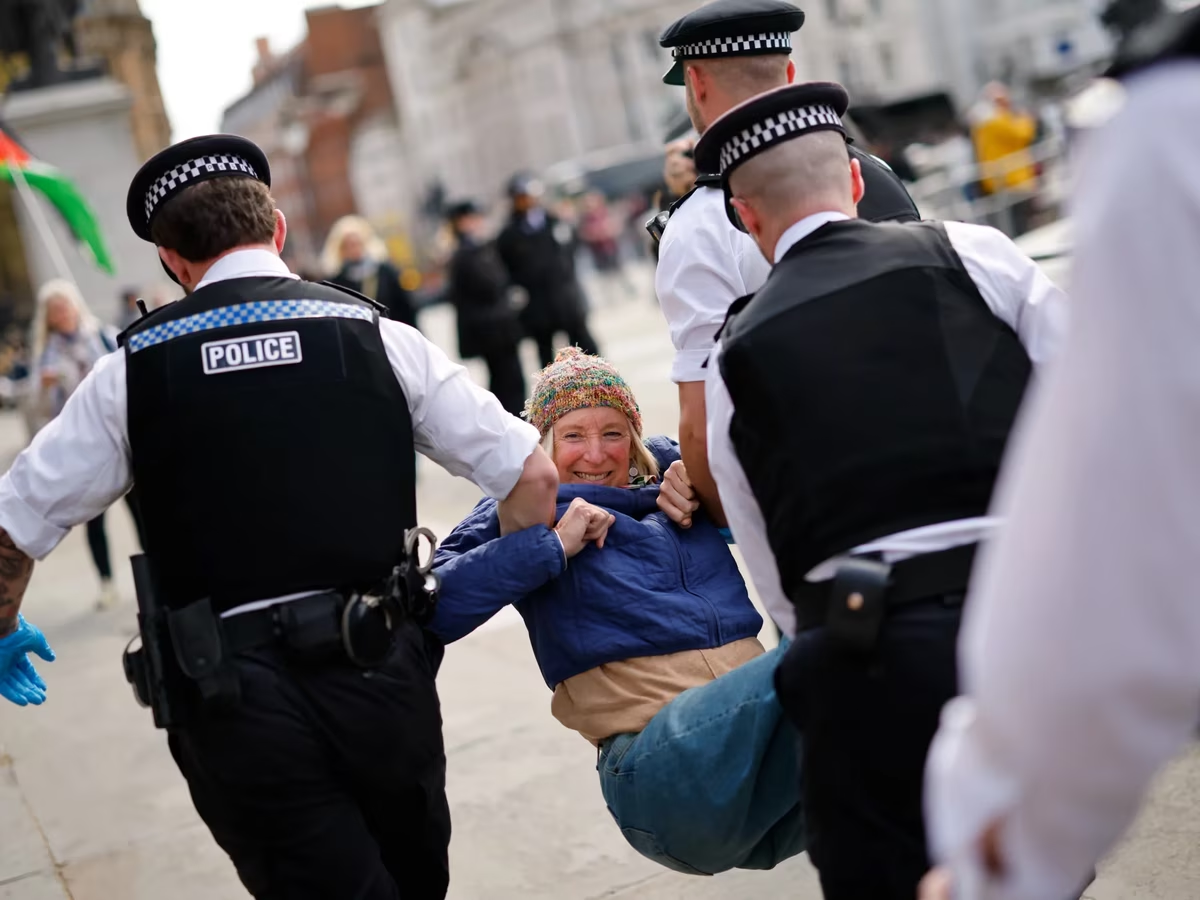
London: Dozens arrested at Trafalgar Square sit-in in support of "Palestine Action"

The British capital, London, witnessed a new wave of security tensions after police arrested dozens of pro-Palestinian demonstrators. These security actions took place during a massive demonstration organized to support the "Palestine Action" organization, which is being pursued by British authorities due to its activities against companies dealing with the Israeli occupation.

Field sources reported that security forces led activists away from the center of the famous Trafalgar Square, amidst cheers and applause from hundreds of other demonstrators who participated in the sit-in. Protesters held explicit banners supporting the banned organization, making them subject to direct arrest under current laws that criminalize support for groups classified as terrorist.

London police had issued prior warnings stating that any activities aimed at supporting the group were considered "illegal." Authorities confirmed that participants in these gatherings would face legal prosecution, which was effectively translated by the intervention of forces to disperse the protesters, most of whom were elderly British citizens.

Estimates indicate that about 500 people participated in the sit-in held in Trafalgar Square, expressing their rejection of the organization's classification as a banned entity. Participants raised slogans condemning the genocide in the Gaza Strip, affirming their full solidarity with the goals of "Palestine Action" in pursuing Israeli arms factories.

Police carried out mass arrests of seated demonstrators, who were then transported to temporary collection points on the edges of the square for thorough inspection. Following this, those arrested were taken by small buses to various police stations, in an attempt to end the sit-in that lasted for several hours.

The demonstration saw a notable presence of Jewish groups opposing Israeli policies, in addition to Holocaust survivors and members of their families. Protesters carried a effigy of British Prime Minister Keir Starmer, accusing him of supporting genocide and opposing peaceful popular anti-war movements.

This security escalation comes after the decision to ban the organization and classify it as a terrorist organization last July, a decision that makes membership a criminal offense. Penalties stipulated in this context can reach up to 14 years in prison, placing activists under immense legal pressure in the United Kingdom.

For its part, the High Court in London issued a ruling in mid-February stating that the ban might conflict with the right to freedom of expression. This ruling came in response to a legal challenge, leading to a temporary suspension of arrests before the government announced its intention to appeal the judicial decision.

"Defend Our Juries" movement, the organizer of the protest, announced that the demonstration comes in response to what it described as the British government's complicity in Israeli crimes. The movement criticized the police's continued arrests despite judicial decisions questioning the legality of the ban imposed on the group.

The movement affirmed that prominent lawyers had warned authorities that these arrests might be illegal and lack strong constitutional backing. Nevertheless, security agencies continued to pursue participants, announcing by Saturday afternoon the arrest of 92 people ranging from young to elderly.

In testimonies from the field, one participant said that continuing to demonstrate is a moral duty that cannot be abandoned, no matter the legal pressures. She added that the moral stance of the demonstrators is firm in the face of genocide, even if the political and legal positions of the British government change.

Statistics indicate that nearly three thousand people have been arrested since the ban on "Palestine Action" was issued last year. Hundreds of these face formal criminal charges, most of which relate to carrying banners or publicly expressing support for the organization in public forums.

Judicially, British courts decided to halt all trials related to supporting the organization pending a comprehensive review of the cases at the end of next July. This judicial freeze raises questions about the government's ability to proceed with criminalizing solidarity activities with Palestine under the guise of anti-terrorism laws.

It is worth noting that "Palestine Action" was founded in 2020 with the stated goal of ending global complicity in the Israeli apartheid system. Most of its field operations focused on disrupting the production of weapons factories belonging to the Israeli company "Elbit Systems" located on British soil.

It is important that we all continue to oppose genocide; the government may backtrack on its legal position, but the ethics of the people here do not change.

OPINIONS

Sun 12 Apr 2026 7:14 am - Jerusalem Time

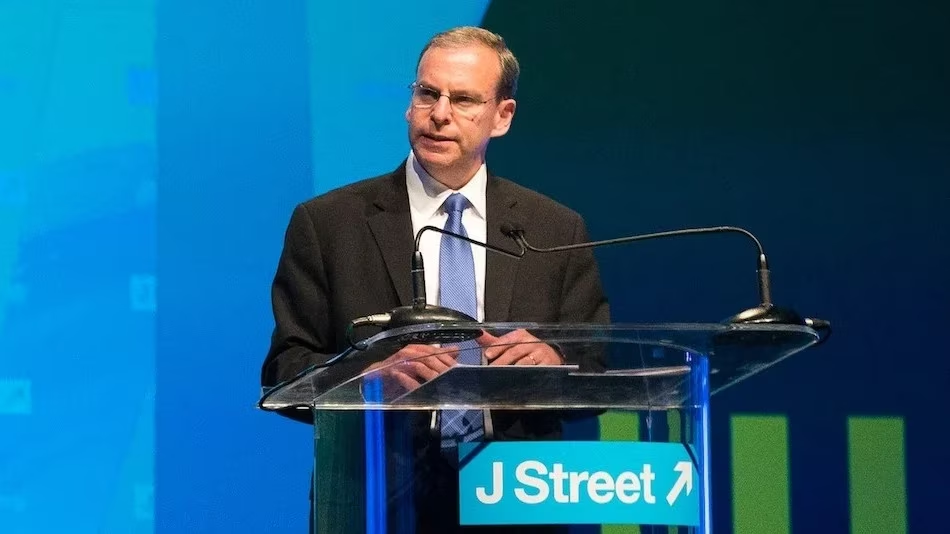
J Street joins group calling for an end to arms supplies to Israel, including defensive ones

Washington — Said Arikat – 4/11/2026

The political debate in the United States is witnessing a remarkable shift regarding the nature and extent of military aid provided to Israel, with parties traditionally considered within the camp of steadfast support entering the escalating controversy. In this context, the American Jewish organization J Street, which defines itself as "pro-Israel and pro-peace," announced its support for the growing calls within progressive circles in Congress to reconsider US funding for Israeli missile defense systems, especially the Iron Dome system.

This stance reflects a growing crack in the traditional consensus that has long governed the American-Israeli relationship, where missile defense programs, unlike other forms of military support, enjoyed almost absolute political immunity due to their direct defensive nature and their role in protecting civilians from missile attacks.

However, J Street's entry into this debate indicates that this politically "forbidden zone" is no longer immune to re-evaluation, in light of rising voices within the Democratic Party, especially from the progressive wing, demanding a redirection of US foreign spending priorities and linking aid to stricter political and moral conditions.

In statements quoted by "Jewish Insider" magazine, a spokesperson for the organization considered that the positions of progressives should not be described as "radical," but rather fall within a legitimate debate that remarkably intersects with statements issued by both Israeli Prime Minister Benjamin Netanyahu, wanted for war crimes before the International Criminal Court, and Republican Senator Lindsey Graham, who affirmed on different occasions that Israel has the economic capacity to finance its defense needs, including its missile systems.

This unexpected intersection in political discourse reflects a complex scene, as the positions of ideologically disparate parties converge at one point, but they stem from contradictory motives. While progressives seek to reduce American support based on financial and ethical considerations, some Israeli leaders and American conservatives put forward the idea of "self-sufficiency" as a sign of strength, not an entry point for redefining the alliance.

J Street's position gains particular importance given its centrist position within the spectrum of pro-Israel lobbying groups, where it has consistently combined support for Israel's security with criticism of its governments' policies, especially under Benjamin Netanyahu. This positioning could give it greater ability to reshape the debate within liberal Jewish circles in the United States, and perhaps influence public opinion trends within the Democratic Party.

This development comes in a broader context of political and diplomatic tensions in American-Israeli relations, where calls are increasing within Congress to re-evaluate US foreign policy priorities, in light of internal challenges and growing financial pressures, as well as broader geopolitical shifts in the Middle East.

Although any radical change in funding policies does not seem imminent, the inclusion of systems such as the "Iron Dome" in the public debate indicates a qualitative shift in the nature of political discourse, and may open the door for deeper reviews in the near future.

The Iron Dome system has long been a red line in the American debate, as a purely defensive tool that enjoys moral and political consensus. However, J Street's position reflects the beginning of the erosion of this consensus, with the rise of a new political generation within the Democratic Party that does not deal with traditional axioms with the same degree of commitment. The debate is no longer about Israel's right to defend itself, but about the limits of the United States' commitment to funding this defense, especially in light of Israel's advanced economic and technological capabilities and increasing internal American pressures.

What is striking in this debate is the invocation of Netanyahu's and Lindsey Graham's positions to justify the progressive proposal, an apparent intersection that conceals a fundamental divergence in motives. While progressives stem from a desire to reduce American military involvement and redirect resources, the other side uses the same argument to highlight Israel's strength and independence. This rhetorical convergence gives the progressive proposal broader political cover, and removes it from the circle of "extremism," but at the same time reflects the fragility of rhetorical alliances in a highly polarized and volatile political environment.

The debate is no longer confined to the cost of support or its strategic feasibility, but rather reflects a remarkable escalation in feelings of resentment and annoyance with Israeli policies, especially in light of what is seen as repeated aggressive actions. This mood is no longer limited to progressive circles, but has begun to spread across wider segments of American society, including sectors of American Jews, some of whom are involved in frameworks such as J Street. In this context, the debate over funding becomes an expression of a deeper shift in public opinion and its trends.

OPINIONS

Sun 12 Apr 2026 7:13 am - Jerusalem Time

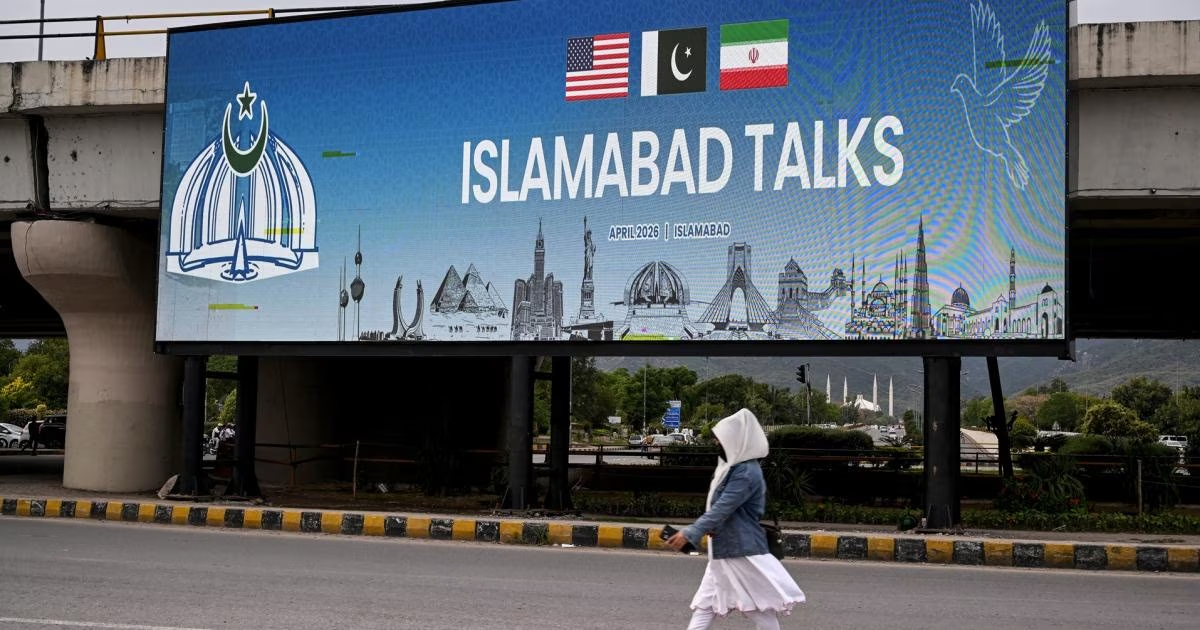
Washington-Tehran Negotiations Collapse in Islamabad: Fundamental Differences Over Nuclear Program Bring Escalation Back to the Fore

Washington – Said Arikat – 12/4/2026

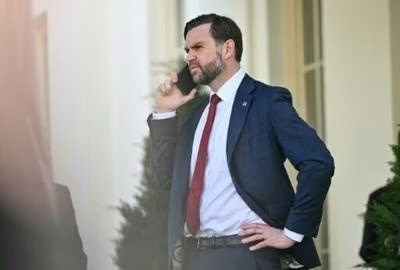
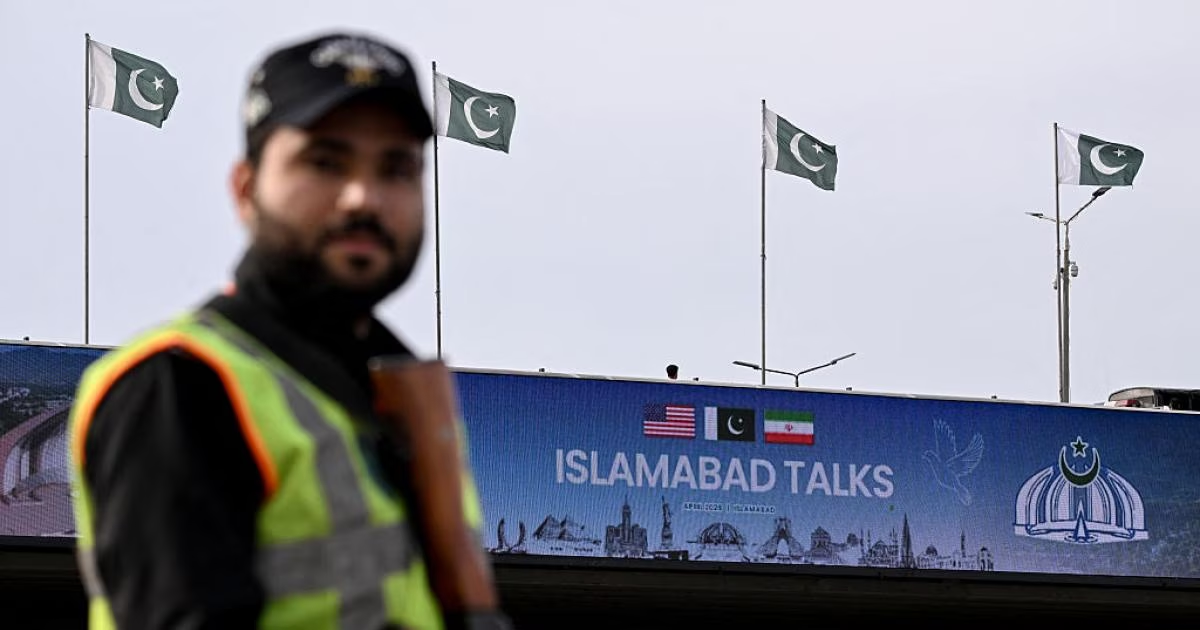
US Vice President J.D. Vance announced on Saturday evening the conclusion of the sensitive round of negotiations between the United States and Iran in the Pakistani capital, Islamabad, without reaching an agreement, after Tehran rejected American conditions related to its nuclear program, a development that brings tension back to the forefront of the regional and international scene.

In statements to reporters, Vance said that the talks, which lasted for about 21 continuous hours, ended without a breakthrough, indicating that the American delegation would leave Pakistan and return to Washington. He explained that the US administration was seeking a "clear and explicit commitment" from Iran not to seek to acquire nuclear weapons or develop the tools that would enable it to achieve that quickly.

He added: "The primary goal of the President of the United States is to ensure that Iran does not possess nuclear weapons, and this is what we tried to achieve through these negotiations," noting that he was in constant contact with President Donald Trump and senior officials during the negotiation process.

Background of the Negotiations

This round came amidst a highly tense regional atmosphere, especially after the recent military escalation between Israel and Iran, and the accompanying mutual threats, in addition to the repercussions of the war in Gaza and Lebanon. Islamabad had hosted the talks in an attempt to de-escalate tensions and open a new diplomatic window between the two parties.

According to informed sources, the differences centered on the nature of the guarantees requested by Washington, which go beyond merely halting uranium enrichment, to include dismantling parts of Iran's nuclear infrastructure, in addition to strict restrictions on ballistic missile programs.

In contrast, Tehran rejected these conditions, considering them to infringe upon "national sovereignty" and to go beyond what could be accepted within any agreement, asserting that its nuclear program is peaceful in nature, and that it will not abandon its "legitimate rights" in developing nuclear technology.

Expected Failure or Negotiating Tactic?

Observers believe that the failure of this round was not surprising, given the widening trust gap between the two parties, especially after Washington's withdrawal from the previous nuclear agreement in 2018 during President Trump's term, and the subsequent "maximum pressure" policy that reimposed harsh sanctions on Iran.

Moreover, the nature of the current American conditions, which Tehran describes as "dictates," makes it difficult to achieve a quick breakthrough, especially in the absence of American guarantees not to repeat a withdrawal from any future agreement.

Regional and International Repercussions

The collapse of the talks is expected to increase tension in the region, with the possibility of a return to indirect military escalation between Iran and Israel, in addition to rising concerns about the acceleration of the Iranian nuclear program as a reaction to American pressures.

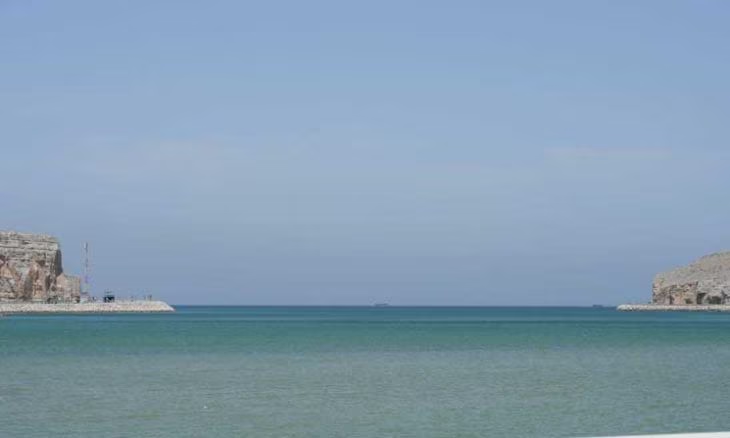
This failure may also affect global energy markets, given the repeated threats to close the Strait of Hormuz, one of the world's most important oil passages, which could impact oil prices and international economic stability.

At the same time, Washington may find itself facing limited options, ranging from tightening sanctions or returning to a new diplomatic path with less stringent conditions, or even sliding into an indirect military confrontation.

The American stance in this round reflects a continuation of an approach based on imposing maximum conditions without offering meaningful reciprocal incentives, which weakens the chances of reaching a sustainable agreement. Instead of building on the previous nuclear agreement, Washington chose to unilaterally redefine the rules of the game, ignoring that the loss of trust is the primary obstacle. Moreover, insisting on absolute guarantees from one side, without offering similar commitments, turns diplomacy into a tool of pressure rather than a means of understanding. This approach reproduces the causes of previous failures and undermines any real opportunity for a long-term negotiated solution.

American policy appears to be captive to internal considerations and regional alliances, particularly concerning Israel, more than it is based on a coherent strategic vision for nuclear non-proliferation. The rigidity of demands is inseparable from political pressures in Washington, which transforms negotiations into an arena for satisfying internal and external parties, rather than a serious path to a solution. This intertwining of domestic and foreign policy weakens the credibility of the United States as a mediator and reinforces Tehran's conviction that any agreement may be temporary and subject to collapse with changing administrations.

This round also reveals a deeper flaw in the American approach, which is the excessive reliance on pressure tools and sanctions, while neglecting to build a gradual path of trust. Previous experiences have shown that Iran responds more to balanced diplomatic engagement, not to dictates. Nevertheless, Washington continues to repeat the same approach, expecting different results. This contradiction reflects the absence of a long-term vision and increases the likelihood of escalation instead of containment. In a volatile regional environment, the continuation of this approach may push the region towards an open confrontation, rather than sparing it further crises.

OPINIONS

Sun 12 Apr 2026 7:11 am - Jerusalem Time

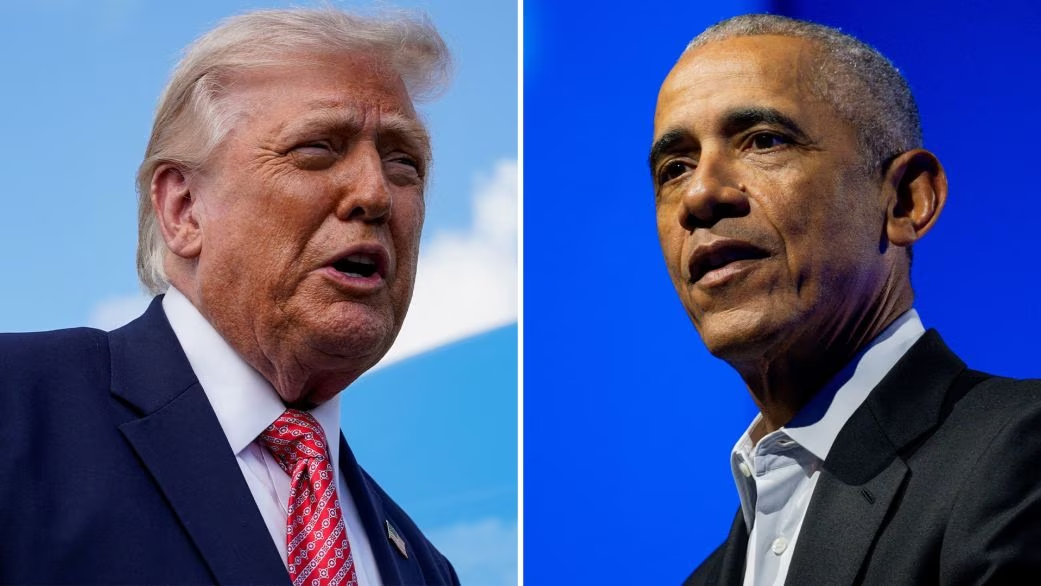
Trump’s Iran War Is Much About Obama


By: Said Arikat


April 12, 2026


News Analysis


Washington, D.C- The contrasts between Barack Obama and Donald Trump are not just striking but clarifying. One president invested in diplomacy, coalition building, and negotiated restraint. The other has repeatedly chosen confrontation, escalation, and ultimately war. Yet the real story behind the current crisis with Iran is not simply about policy differences. It is about Trump’s enduring fixation on dismantling Obama’s legacy and proving that everything his predecessor built was fundamentally wrong.


At the center of this rivalry stands the Joint Comprehensive Plan of Action, the 2015 Iran nuclear deal negotiated by Obama and major world powers. The agreement placed strict limits on Iran’s nuclear activities and allowed international inspections in exchange for sanctions relief. For Obama, it was a pragmatic solution to prevent war. For Trump, it became a symbol of weakness and capitulation.


From the beginning of his political rise, Trump treated Obama’s achievements as targets for elimination. The Iran deal became his most consistent obsession. He did not merely argue that it was flawed. He portrayed it as a betrayal of American interests and of Israel, echoing the objections of Israeli Prime Minister Benjamin Netanyahu. But where Netanyahu’s opposition was strategic, Trump’s often sounded personal.


Trump repeatedly invoked Obama’s name when attacking the deal, framing its existence as proof of failed leadership. He insisted that Obama had empowered Iran and endangered allies. In doing so, Trump transformed a complex diplomatic agreement into a political grievance. Ending it was not simply policy. It was a declaration that Obama had been wrong.


That declaration came in 2018, when Trump withdrew the United States from the agreement despite international verification that Iran was largely complying. European allies opposed the move and tried to preserve the deal. But Trump was unmoved. The priority was clear: dismantle Obama’s signature foreign policy achievement regardless of the consequences.


Those consequences arrived quickly. Within a year, Iran began expanding its nuclear activities, enriching more uranium and reducing cooperation with inspectors. The limits that had constrained its program eroded. Instead of eliminating the threat, Trump’s decision accelerated it. Yet his rhetoric did not change. He continued to describe the deal as a path to a nuclear weapon, reinforcing his long standing narrative.


That narrative now shapes the war itself. After abandoning negotiations for a revised agreement, Trump turned to military action. Reports indicate that Netanyahu played a key role in pushing the U.S to wage the war, reinforcing a dynamic in which Israeli concerns aligned with Trump’s instincts. But the decision to escalate also reflected Trump’s impatience with diplomacy, particularly diplomacy associated with Obama.


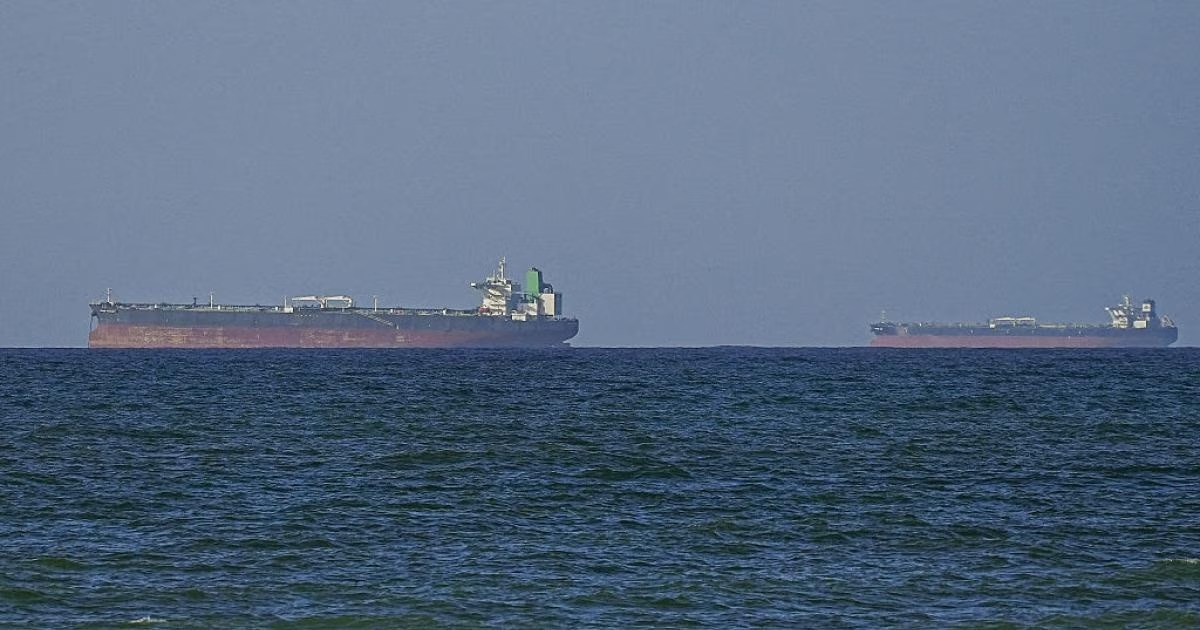
The war, however, has not produced a clean resolution. While U.S. and Israeli forces damaged Iranian capabilities, they did not eliminate its nuclear potential. More importantly, Iran has gained leverage by tightening control over the Strait of Hormuz, a critical route for global energy supplies. This new reality complicates any effort to claim decisive victory.


Now Washington once again needs negotiations. Talks aimed at stabilizing the situation underscore an uncomfortable truth: diplomacy remains unavoidable. Yet the context has changed. Iran enters discussions with greater leverage, and the United States faces higher costs. The very outcome Obama sought to prevent—greater instability and reduced oversight—has become reality.


Still, Trump appears determined to secure an agreement of his own. The distinction matters deeply to him. Any deal must not only resolve the crisis but also surpass Obama’s achievement. This is the core of his approach: dismantle first, then rebuild in a way that asserts personal and political superiority.


That approach carries risks. Trump’s maximalist demands, including calls for Iran to abandon enrichment entirely, are far more rigid than the incremental limits of the original agreement. Such positions may satisfy political instincts, but they reduce the chances of a workable compromise. Iran is unlikely to accept terms that appear to erase its sovereignty.


The result is a cycle in which confrontation leads back to negotiation, but on worse terms. Trump may eventually reach a deal, yet it will reflect the realities created by his own decisions. In that sense, Obama’s legacy remains unavoidable. It continues to define the baseline against which success is measured.


In trying to erase Obama, Trump has instead ensured his predecessor’s influence endures. The Iran crisis is not just a geopolitical conflict. It is also a political echo, shaped by one president’s determination to undo another. And that determination may prove to be the most consequential decision of all.


The missed opportunities before the war further highlight this dynamic. Mediators indicated that Iran had been prepared to accept significant limits on its nuclear activities, including tighter verification and reduced stockpiles. Yet these openings failed to gain traction in Washington. Critics argued that Trump’s team lacked either the patience or the technical focus to recognize what was on the table. Whether that assessment is entirely fair or not, the result is clear: a potential diplomatic offramp was bypassed in favor of escalation. That choice again reflects a broader pattern in which rejecting Obama era frameworks took precedence over refining them. It is a pattern that continues to shape events today.


Ultimately, Trump’s Iran policy cannot be separated from his view of Obama. It is driven as much by rivalry as by strategy. Until that changes, American policy risks repeating the same cycle of rupture, escalation, and reluctant return to diplomacy with higher costs and fewer options.

ARAB AND WORLD

Sat 11 Apr 2026 5:08 pm - Jerusalem Time

Pakistani Mediation Ends 40 Days of Confrontation: Ceasefire Agreement Disrupts Netanyahu's Calculations

The dawn of April 8, 2026, witnessed a dramatic shift in the regional confrontation, as the Pakistani government announced that it had reached a ceasefire agreement through direct consensus between Tehran and Washington. This announcement came forty days after the outbreak of a widespread war launched by US President Donald Trump, in coordination with Israeli Prime Minister Benjamin Netanyahu, against Iranian targets.\n\n The agreement, sponsored by Islamabad, came as a major political surprise, especially as it was reached just one hour before Trump was to implement his threats of unprecedented escalation against Iran. According to official Pakistani sources, the understandings included a comprehensive de-escalation in Iran, Lebanon, Yemen, and Iraq, reflecting an international desire to contain the conflict and prevent it from sliding into a full-scale global war.\n\n For his part, Benjamin Netanyahu received this agreement as a harsh political shock, finding himself forced to deal with a reality imposed by his American ally, who had previously entrusted him with the decision of war and peace. Despite his official approval of the de-escalation, Netanyahu tried to circumvent the agreement by unilaterally excluding the Lebanese front from his field calculations.\n\n In a reaction described by observers as insane, Israeli forces launched intense bombing campaigns targeting the capital Beirut and areas of southern Lebanon and the Beqaa Valley. These attacks resulted in hundreds of martyrs and more than 1,600 wounded, in a wave of destruction considered the deadliest since the start of military operations in the region.\n\n These field developments revealed the extent of the gap between the American administration and the Israeli government, as Trump tried to deny Lebanon's inclusion in the agreement in line with Netanyahu's wishes. However, the Prime Minister of Pakistan reiterated the comprehensiveness of the de-escalation to all fronts, putting the White House in an embarrassing position before the international community.\n\n Analysts believe that Trump's retreat from the option of a full-scale war was not driven by a desire for peace, but rather by internal and external pressures and a shift in the balance of power on the ground. Political blackmail and pressures exerted by the Zionist lobby (AIPAC) on the American administration to ensure continued absolute support for Israeli actions are also emerging on the horizon.\n\n In contrast, the Israeli interior is experiencing a state of political turmoil, as Netanyahu faced a wave of harsh criticism from the opposition and the Hebrew press, which accused him of failing to manage the crisis. This internal crisis is considered the most severe in Netanyahu's career, as his ability to maneuver is narrowing between field pressures and Washington's international understandings.\n\n On the Iranian side, there was a kind of caution and pessimism regarding the intentions of the American administration, as commentators in Tehran considered Trump's approval to be part of a strategy of treachery and deception. Official Iranian statements stressed the need to keep "the finger on the trigger," affirming that trust in American promises remains non-existent based on previous experiences.\n\n Despite this caution, experts believe that the current reality compels all parties to deal with Pakistani mediation as a mandatory path to avoid total collapse. The increasing pressures on Trump, both from within America and from global powers, force him to submit to the logic of politics instead of the logic of pure military force.\n\n The balance of power that emerged during the "Forty-Day War" proved that escalation options no longer achieve the desired results for Netanyahu and Trump. The axis faced military and political steadfastness that prevented the achievement of the aggression's goals, leading to cracks in the regional and international position supporting Israeli military operations.\n\n Sources confirm that politics, in the end, is subject to field realities and tangible results, not just the personal desires of leaders. The failure to achieve a quick military decisive victory against Iran and its allies pushed the United States to seek a diplomatic way out through Islamabad, which explains the sudden retreat in the escalatory rhetoric.\n\n In this atmosphere, Netanyahu began to hint at the possibility of opening negotiations with the Lebanese state, at Trump's direct request to reduce the intensity of the bombing. This shift reflects an Israeli attempt to absorb international anger and circumvent the internal crisis that threatens the stability of the government in Tel Aviv.\n\n The question remains about the sustainability of this agreement in light of the ongoing field violations in Lebanon and the mutual suspicions between the parties. However, what is certain is that Pakistani mediation has succeeded in putting initial brakes on the war train that was heading towards a comprehensive regional confrontation whose end could not be predicted.\n\n In conclusion, the current scene proves that Trump, despite all displays of power, remains bound by the responsibility of political outcomes and the failure of Netanyahu's dependent policies. The coming days will reveal whether this agreement is merely a warrior's respite or the beginning of a new political path that redraws the map of conflict in the Middle East.\n\n Netanyahu's reaction revealed the severity of the political blow he received from the agreement, and the extent of Trump's submission to the pressures of the Zionist lobby.

ARAB AND WORLD

Sat 11 Apr 2026 5:07 pm - Jerusalem Time

Tehran Approves Bill to Impose Transit Fees in Strait of Hormuz in Iranian Rial, Trump Vows Confrontation

The head of the National Security and Foreign Policy Committee in the Iranian Parliament, Ibrahim Azizi, revealed details of a new bill concerning the regulation of navigation in the Strait of Hormuz. Azizi explained that the proposed legislation explicitly stipulates that passing ships must pay transit fees in Iranian Rial, a step aimed at strengthening national sovereignty and the local currency.

In statements to state television, the Iranian official indicated that the bill, titled 'Safe Passage,' will place the strategic strait under the full and comprehensive control of the Iranian armed forces immediately upon its final approval. These moves come amidst escalating military tensions witnessed in the region over the past weeks.

Azizi touched upon the diplomatic aspect of managing the waterway, stating that there is a possibility of signing a bilateral cooperation agreement with the Sultanate of Oman regarding the regulation of navigation in the strait. He stressed that imposing fees in the national currency is a sovereign decision consistent with the new directions of the Iranian state in managing its geopolitical resources.

In response, US President Donald Trump quickly reacted with a harsh tone, asserting that the United States will not allow Tehran to impose any transit fees in this international passage. Trump wrote on his 'Truth Social' platform, warning that reports of imposing fees on oil tankers must stop immediately, describing the measure as dangerous.

Trump's statements coincided with the arrival of diplomatic delegations in the Pakistani capital, Islamabad, in preparation for the launch of negotiations aimed at reaching a permanent ceasefire. The Iranian delegation in these talks is led by Parliament Speaker Mohammad Bagher Ghalibaf, amidst international anticipation for the results of this crucial round of direct dialogue.

From the American side, the White House announced that Vice President J.D. Vance will attend the first round of talks, reflecting the importance Washington attaches to this issue. International parties are seeking to reach a formula that ensures the stability of global energy flows, which have been severely affected by recent confrontations in the region.

President Trump had previously announced his approval to suspend military strikes against Iranian targets for two weeks as a gesture of goodwill. The US administration conditioned this suspension on the full and immediate opening of the Strait of Hormuz to international navigation without any obstacles or Iranian restrictions.

It is worth noting that navigation in the Strait of Hormuz was regular before the outbreak of military confrontations on February 28, as the strait is the main lifeline for global trade. Approximately 20 million barrels of oil pass through this waterway daily, representing about one-fifth of global consumption.

The outbreak of the war led to widespread disruptions in global energy markets, with oil and gas prices soaring to record levels due to fears of the strait's closure. International powers consider any threat to the safety of navigation in Hormuz a direct threat to global economic security and supply stability.

Iranian authorities officially announced the closure of the strait on March 2, threatening to target any vessel attempting to cross without prior coordination with its forces. This Iranian decision came in response to what it described as American-Israeli aggression, leading to a near-complete paralysis of major tanker traffic.

Observers believe that Tehran's insistence on collecting fees in Iranian Rial represents a direct challenge to the economic dominance of the US dollar in international transactions. This step comes in the context of a broader strategy pursued by some countries to reduce reliance on the Western financial system in light of the economic sanctions imposed on them.

These developments raise concerns about a new round of escalation if Iranian forces attempt to intercept ships that refuse to pay the proposed fees. Global shipping companies and international exchanges are closely monitoring the results of the Islamabad talks, hoping to defuse the crisis and avoid a comprehensive economic catastrophe.

On the ground, sources reported that the naval forces of the Revolutionary Guard have raised their readiness in the areas surrounding the strait and strategic islands. These field movements coincide with the political pressures exerted by the Iranian Parliament to quickly turn the fee bill into a reality on the ground.

The question remains about the international community's ability to find a compromise that guarantees the sovereignty of the littoral states of the strait while preserving the freedom of international navigation. The next few days are crucial in determining the course of the conflict, either towards comprehensive de-escalation or sliding into a wide-ranging naval confrontation.

According to the bill prepared by Parliament, transit fees through the Strait of Hormuz will be paid in Rial, Iran's national currency.

PALESTINE

Sat 11 Apr 2026 5:07 pm - Jerusalem Time

Sharp Lebanese division and military warnings after Aoun's announcement of direct negotiations with Israel

The announcement by Lebanese President Joseph Aoun of his country's intention to enter into direct negotiations with Israel in the American capital, Washington, next week, has sparked a wave of sharp division in the Lebanese street. This tension quickly manifested in field protests, with dozens of Hezbollah supporters demonstrating around the Grand Serail and various areas of the capital Beirut, raising slogans condemning this sudden political move.

In a related context, field sources observed widespread calls on social media platforms for popular mobilization in front of the Grand Serail this Saturday afternoon. These movements express an absolute rejection of the negotiation path announced by the presidency, amidst ongoing military operations and existing border tensions that have not yet subsided.

For its part, the Lebanese Army command quickly issued a strongly worded warning statement, emphasizing that it would not tolerate any movements that might threaten internal stability or civil peace. The statement clarified that the military institution respects the right to peaceful expression of opinion, but it will intervene firmly to prevent any aggression against public and private property or attempts to destabilize security in these delicate circumstances.

In its statement, the army stressed the need for citizens to exercise the highest degrees of awareness and national responsibility, calling on everyone to fully respond to the directives of the military units deployed in the field. These warnings come at a time when observers fear that the protests could escalate into internal confrontations, further complicating the already critical Lebanese scene.

On the political front, Hezbollah bloc MP Hassan Fadlallah expressed the party's absolute rejection of these negotiations, considering them a constitutional and legal violation that cannot be overlooked. Fadlallah pointed out that this step contributes to deepening internal division at a time when Lebanon needs national unity to confront external challenges and ongoing aggression.

Fadlallah clarified in his statements that tampering with the country's fate through nationally unagreed-upon negotiation channels threatens coexistence and civil peace. He affirmed that the priority should be to preserve the cohesion of the internal front rather than engaging in political paths that the party considers illegitimate and serving external agendas.

According to a statement issued by the Lebanese President's office, a tripartite phone call took place involving the Lebanese and Israeli ambassadors to Washington, in the presence of the US ambassador to Beirut, who is currently in the United States. This call resulted in an agreement to hold the first meeting between the two parties next Tuesday at the US State Department headquarters to discuss thorny issues.

The anticipated meeting aims to discuss mechanisms for announcing a ceasefire and setting a timetable for the start of official negotiations under direct American patronage. President Aoun had previously expressed his readiness for direct dialogue with the Israeli side, especially after the expansion of military confrontations that began in early March.

In contrast, the Israeli ambassador to Washington, Yehiel Leiter, confirmed Tel Aviv's approval to begin official peace negotiations with the Lebanese government. Leiter clarified in an official statement that Israel seeks to reach an agreement with the Lebanese state, but at the same time rejects any discussion regarding a ceasefire with Hezbollah, which it describes as a terrorist organization.

The Israeli ambassador considered Hezbollah to be the main obstacle to achieving peace between the two states, noting that Israeli military operations target the party's infrastructure. These statements confirm the wide gap in visions between the concerned parties regarding the nature of the required truce and who it should include in the next phase.

On the other hand, press sources quoted a Lebanese government official confirming that Beirut's official position stipulates achieving a comprehensive ceasefire before engaging in any negotiation details. This position comes amidst continued intensive Israeli raids on various Lebanese regions, which Hezbollah responds to with counter-rocket attacks, making the prospects for a political solution fraught with risks.

The negotiations represent a blatant violation of the Lebanese Charter, Constitution, and laws, and a manipulation of the country's fate and future.

ARAB AND WORLD

Sat 11 Apr 2026 5:07 pm - Jerusalem Time

Mali withdraws its recognition of 'Polisario' and supports Morocco's sovereignty over the Sahara

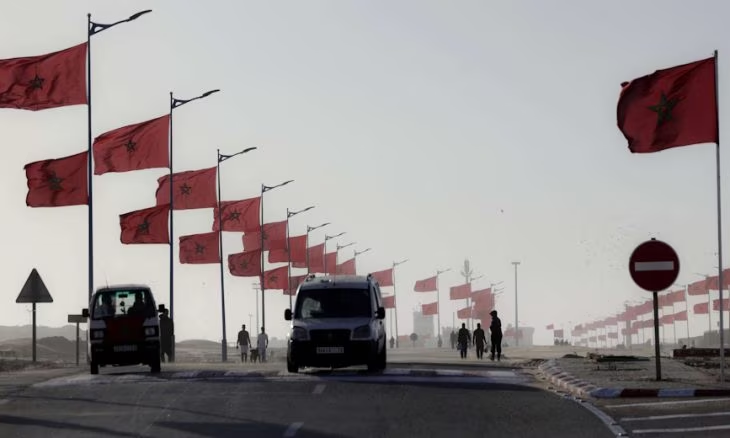
The Republic of Mali, in a prominent diplomatic move, announced its official decision to withdraw recognition of the 'Sahrawi Arab Democratic Republic' overseen by the Polisario Front. This announcement came during an official visit by Malian Foreign Minister Abdoulaye Diop to the Moroccan capital, Rabat, where he met with his Moroccan counterpart, Nasser Bourita, to discuss bilateral relations and regional issues.

The Malian Foreign Minister affirmed that this shift in Bamako's position came after a deep and comprehensive analysis of the Sahara file, given its direct implications for peace and security in the region. Diop explained that his country now sees the Moroccan proposal as the most realistic path to end this protracted conflict, emphasizing the importance of regional stability at this sensitive stage.

The official declaration of the Malian government stressed Bamako's full support for the autonomy plan presented by Morocco, describing it as the only serious and credible basis for reaching a final settlement. Mali believes that granting autonomy to the Sahara under Moroccan sovereignty represents the optimal solution that aligns with political and on-the-ground realities, and guarantees the rights of all concerned parties.

In a related context, Mali reiterated its commitment to supporting the efforts of the United Nations and the Personal Envoy of the Secretary-General for the Sahara to reach a mutually agreed political solution. Sources indicated that the new Malian position is based on relevant UN Security Council resolutions, particularly the latest Resolution 2797 issued at the end of October last year, which enhances the momentum of the political process.

Malian diplomacy is scheduled to disseminate this new position to all regional and international organizations of which it is a member, in addition to informing diplomatic missions accredited in Bamako. This step reflects Mali's desire to align its foreign policy with the growing international trends that support the Moroccan approach to the Sahara issue.

Reports indicate that Moroccan diplomacy has achieved successive successes in this file over the past two decades, with the number of countries recognizing the Sahrawi entity significantly decreasing. According to official statistics, about 54 countries have withdrawn their recognition of the Polisario over the past 25 years, reflecting a shift in the political convictions of the African continent and the international community.

Current data confirm that more than two-thirds of the member states of the United Nations, exceeding 120 countries, now support the autonomy initiative under Moroccan sovereignty. Observers believe that this widespread support strengthens Rabat's position in international forums and places the Polisario Front in increasing diplomatic isolation, especially with the joining of influential African countries to this trend.

Despite the internal political challenges facing Mali, its recent decision is seen as a strong signal of its desire to strengthen cooperation with Morocco in security and economic fields. Analysts believe that the rapprochement between Bamako and Rabat could open new horizons for cooperation in the Sahel and Sahara region, which faces common terrorist and security threats.

In contrast, the Malian decision sparked mixed reactions, with some considering it a response to political realism, while others saw it as an attempt by the transitional authorities in Mali to break international isolation. Mali faces pressure from regional organizations such as ECOWAS and the African Union, which keeps its diplomatic moves under continuous international scrutiny.

Historically, Morocco suffered from the consequences of dual French and Spanish colonialism, which led to the recovery of its territories in varying stages through a long political and diplomatic struggle. Rabat considers the Sahara file to be 'the lens through which Morocco views the world,' and the primary criterion that determines the sincerity of friendships and the effectiveness of international partnerships.

Negotiations and international efforts continue under UN auspices to find a final solution to this conflict, while Rabat insists that autonomy is the most that can be offered. Major international powers such as the United States, France, and Spain support the Moroccan position, which gives the autonomy initiative strong legal and political momentum in the corridors of the Security Council.

Observers of African affairs believe that Mali's withdrawal of recognition represents a strong blow to the Polisario Front in its African heartland, especially since Mali was previously considered one of the countries that adopted differing positions. This shift proves the ability of Moroccan diplomacy to penetrate traditional alliances and build partnerships based on mutual interests and respect for territorial integrity.

From a legal perspective, the Malian decision strengthens the legitimacy of Moroccan demands in African forums and contributes to changing the balance of power within the African Union regarding this file. Diplomatic sources expect other countries to follow Mali's lead in the near future, given the growing conviction of the futility of separatist options in the region.

In conclusion, the Western Sahara file remains a cornerstone of the foreign policy of the region's countries, where geopolitical interests intertwine with national aspirations. With each new recognition of the autonomy initiative, the region moves closer to resolving one of the oldest conflicts on the African continent, serving the development and stability of all peoples in the region.

Mali supports the autonomy plan proposed by Morocco as the only serious and credible basis for resolving this conflict.

ARAB AND WORLD

Sat 11 Apr 2026 5:07 pm - Jerusalem Time

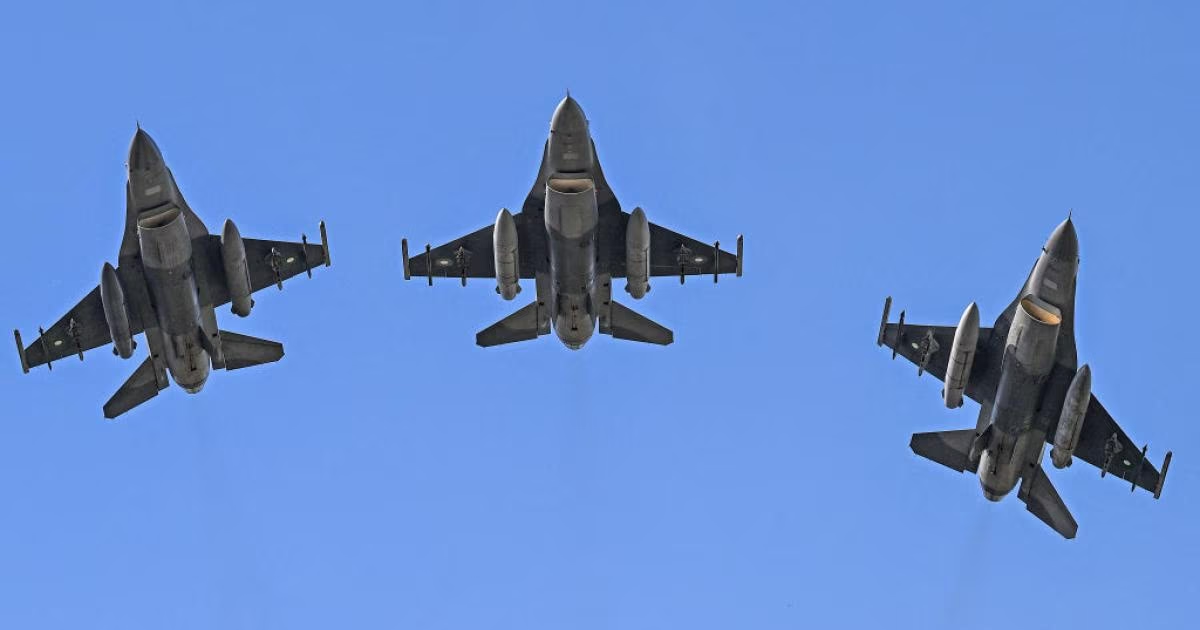
Pakistani Fighters Arrive in Saudi Arabia to Activate Joint Defense Agreement

King Abdulaziz Air Base in the Eastern Sector of the Kingdom of Saudi Arabia received a military force from the Islamic Republic of Pakistan on Saturday. This step comes within the framework of activating the provisions of the joint strategic defense agreement signed by the two countries earlier, to enhance military and security cooperation frameworks between Riyadh and Islamabad.

Saudi Arabia's Ministry of Defense stated in an official statement that the arriving force includes fighter jets and support aircraft belonging to the Pakistan Air Force. This military presence aims to raise the level of operational readiness and develop mechanisms for joint coordination between the armed forces of the two countries, serving the stability of the region and the balance of power within it.

This military deployment is the first announced field cooperation since the signing of the joint defense agreement last September between the Kingdom and Pakistan, which is known as the only nuclear power in the Islamic world. This move comes at a sensitive time in the region, sending clear signals about the nature of new defensive alliances.

The arrival of Pakistani fighters coincided with a temporary two-week truce in the ongoing conflict in the Middle East, which includes international and regional parties such as the United States, Israel, and Iran. The past period has witnessed widespread security tensions, including military strikes targeting vital facilities in the Gulf Arab states.

Observers and political analysts believe that the activation of this agreement fundamentally changes the strategic equation in the region. Experts in international politics considered the presence of Pakistani pilots and fighters on Saudi soil to be a strong deterrent message to any regional parties considering targeting the Kingdom's security, considering that the security of the two countries has become an indivisible unit.

These military movements also aim to ensure continued stability in the event of diplomatic impasses or the collapse of ongoing negotiations between major powers and Iran. Through these partnerships, Riyadh seeks to diversify its defensive options and rely on strategic allies with significant military weight on the international stage.

Deploying this force means activating the joint strategic defense agreement, and the presence of the Pakistan Air Force makes any attack on Saudi Arabia an attack on Pakistan.

ARAB AND WORLD

Sat 11 Apr 2026 5:07 pm - Jerusalem Time

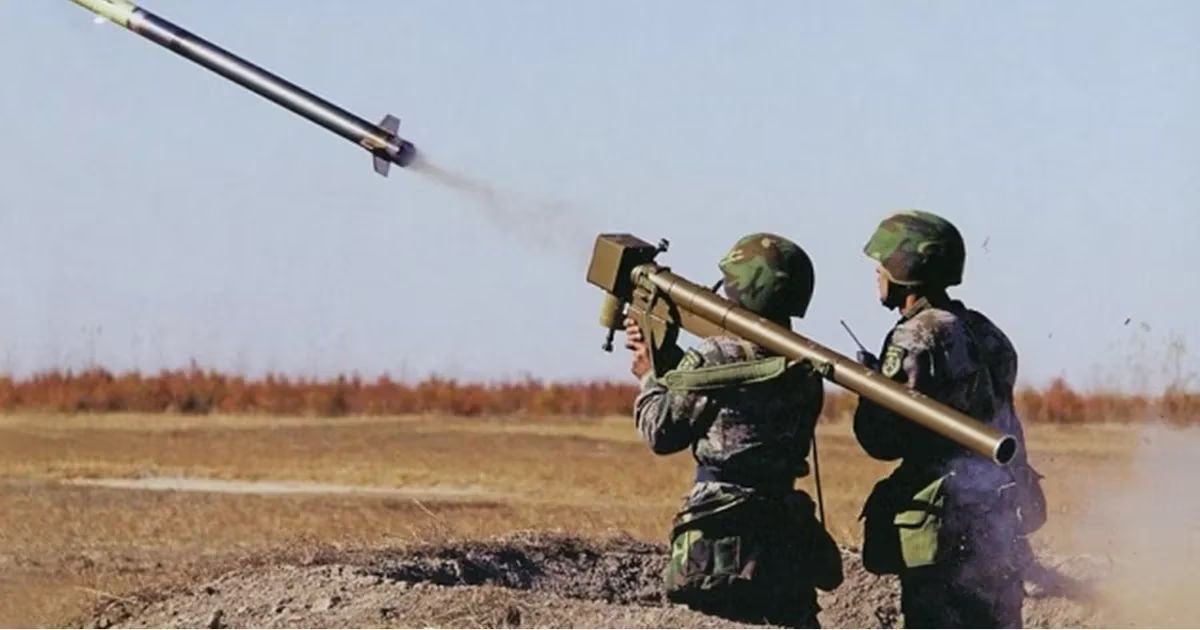
Chinese Defensive Reinforcements for Iran: What are the Capabilities of Portable 'MANPADS' Systems?

International media sources reported that Beijing is on the verge of finalizing a deal to deliver advanced 'MANPADS' air defense systems to Tehran in the near future. This move comes as Iran seeks to bolster its military arsenal and replenish its stock of defensive weapons, utilizing periods of field calm to develop its combat systems.

Portable shoulder-launched air defense systems (MANPADS) are classified as one of the most important pillars of short-range air defense in modern warfare. Chinese military industries have been developing these systems since the 1970s to compete with their Russian and American counterparts in accuracy and field effectiveness.

China's journey in this field began with the first generation known as (HN-5), a system primarily based on reverse engineering of the famous Soviet 'Strela-2' missile. This generation was characterized by an effective range of up to 4.4 kilometers and the ability to hit targets at an altitude of 2.5 kilometers, despite lacking modern digital technologies.

The 1990s witnessed a qualitative leap with the entry of the (QW) series, or 'Vanguard,' into active military service. The QW-1 model is considered the first relatively modern Chinese system, as it was equipped with an advanced infrared seeker and an engagement range exceeding 5 kilometers against hostile targets.

Development continued, leading to the QW-2 model, which primarily focused on enhancing the ability to counter defensive countermeasures. This system possesses high accuracy in neutralizing targets that use flares and thermal balloons for deception, making it very effective against helicopters at low altitudes.

The QW-3 system represents a major technological shift in the family of Chinese systems, as it relies on semi-active infrared guidance. Its unique advantage lies in its ability to engage aircraft from the front rather than just pursuing them from behind, a performance comparable to advanced Western systems.

These industries culminated in the advanced (FN) generation, specifically the FN-6 system, which has gained widespread international fame in recent regional conflicts. This missile has a range of 6 kilometers with an altitude ceiling of 3.5 kilometers, making it a real threat to jet fighters and suicide drones.

Modern generations of these missiles are characterized by a superior ability to resist complex electronic and thermal jamming imposed by modern electronic warfare systems. Intelligence reports have detected the presence of these systems in several hot spots in the Middle East, with a particular focus on their increasing presence in the Iranian arsenal.

Through acquiring these Chinese technologies, Iran seeks to fill gaps in its field air defenses and protect its vital facilities from surprise attacks. These weapons provide high flexibility for ground forces due to their ease of portability and their ability to deal with a wide range of modern aerial threats.

These systems represent an extension of Soviet designs that Beijing developed into smart generations equipped with digital technologies to counter drones and fighter jets.

ARAB AND WORLD

Sat 11 Apr 2026 5:07 pm - Jerusalem Time

US diplomatic team survives drone attack at Baghdad airport during evacuation of kidnapped journalist

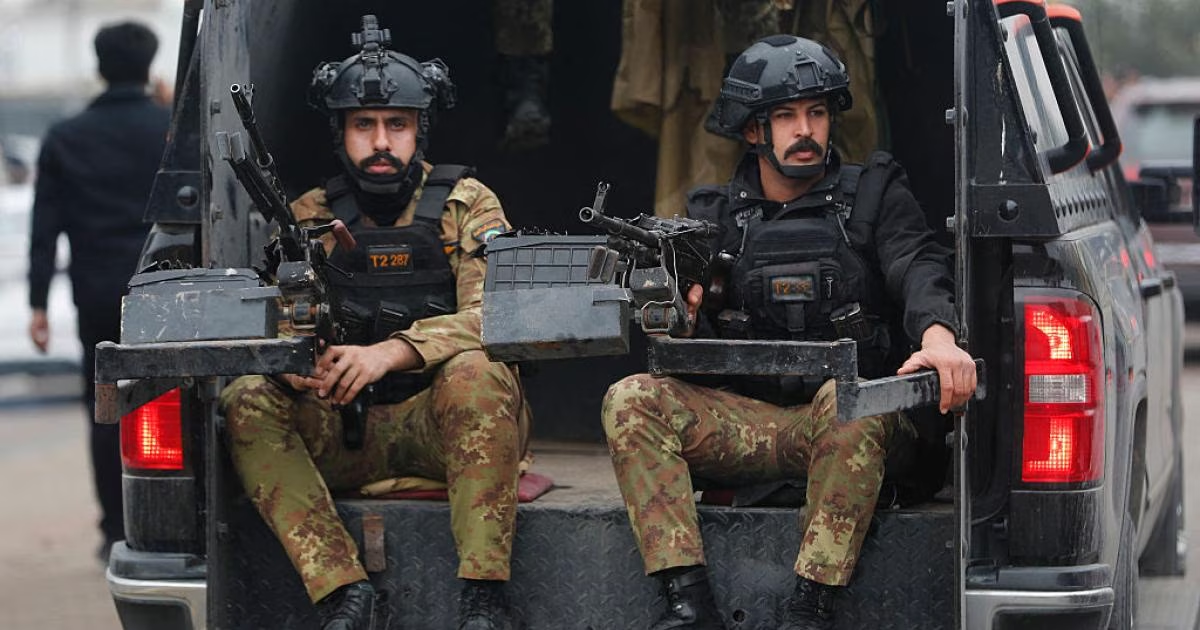
High-level Iraqi security sources reported that the US diplomatic support center within the Baghdad International Airport complex was subjected to a violent attack using three suicide drones. The sources stated that the attack occurred last Wednesday, with one of the drones falling very close, no more than 50 meters, from a diplomatic team on a sensitive logistical mission.

The targeted diplomatic team was accompanying American journalist Shelley Kittleson, who was recently released after being kidnapped for a full week. The transfer operation was part of strict security arrangements aimed at securing her departure from Iraqi territory immediately after she was handed over by local authorities, who in turn received her from the abducting party.

In a related context, the US State Department announced the summoning of the Iraqi ambassador in Washington to lodge a strong official protest against what it described as 'heinous terrorist attacks.' Washington accused Iran-backed armed factions of carrying out an ambush against its diplomats on April 8, considering these actions to undermine security stability in the region.

Details indicate that journalist Kittleson was initially transferred to the US Embassy in Baghdad, and then moved on Wednesday morning to the diplomatic support center via a specialized ambulance plane. The transfer operation was accompanied by two air protection aircraft, as she was scheduled to board a military cargo plane to leave the country before the sudden drone attack occurred.

The aerial bombardment caused a state of alert within the airport, leading to the postponement of the journalist's departure for several continuous hours. Sources confirmed that the additional security measures taken after the incident enabled the team to successfully complete the evacuation, with Kittleson safely leaving Iraq after the field situation stabilized.

This field escalation comes at a sensitive time, as factions under the banner of the 'Islamic Resistance in Iraq' had previously announced a suspension of their operations against US interests. This de-escalation was supposed to last for two weeks, coinciding with regional understandings between Washington and Tehran, but the recent attack violated this announcement.

For its part, the US Embassy in Baghdad warned its citizens of the possibility of additional attacks in the diplomatic vicinity and Baghdad International Airport. The embassy indicated that armed factions carried out several drone attacks just hours after the alleged de-escalation announcement, reflecting the fragility of the commitments declared by these groups.

The past period has witnessed a series of missile and drone attacks targeting the US Embassy and the diplomatic support center, especially following the military tensions that erupted last February. Washington and Baghdad exchange accusations regarding shortcomings in protecting missions, with the United States pushing for more stringent security measures to prevent the recurrence of these incidents.

Despite the Iraqi government's announcement of its full commitment to protecting diplomatic missions and intensifying security cooperation with the American side since late March, the field reality still witnesses major breaches. The recent attack on Baghdad Airport highlights the serious challenges faced by authorities in controlling uncontrolled weapons and ensuring the security of foreign diplomats.

One of the drones fell less than 50 meters from the US diplomatic team accompanying journalist Shelley Kittleson in preparation for her departure from Iraq.

PALESTINE

Sat 11 Apr 2026 5:06 pm - Jerusalem Time

The Execution Law for Prisoners: Radical Shifts in the Concept of Waiting and the Suffering of Palestinian Families

Human rights and humanitarian warnings are escalating regarding the dangerous repercussions of the proposed law for the execution of Palestinian prisoners, whose effects are not limited to prison cells but extend to strike at the social fabric of the Gaza Strip. This legislative move comes in a complex political context that places the issue of prisoners at the heart of field escalation equations, raising fundamental questions about the transformation in Israeli repressive tools and their repercussions on families living in exceptional circumstances.

Live testimonies from prisoners' families confirm that their suffering has gone beyond the absence of their children to become a psychological and social siege that pursues them in the details of their daily lives. Prisoners' families see this law as the pinnacle of criminality and injustice, as the relatives of detainees pay a heavy price of isolation and marginalization, in the absence of effective international or local action that places their humanitarian suffering among the priorities of public political debate.

Psychologically, the proposed law has created a rift in the concept of 'waiting,' which for decades represented a fundamental pillar in the experience of Palestinian steadfastness behind bars. After waiting was associated with the hope of release and reunion, it has transformed, due to the threat of execution, into a source of constant anxiety and apprehension tinged with fear of losing children by a politicized judicial decision, thus emptying families' lives of any stable future horizon.

The wife of a prisoner from the Gaza Strip recounts how her life changed after the introduction of this law, as continuous fear became the primary driver of her daily life instead of optimism for freedom. She explains that the absence of legal guarantees and positive indicators has made the psychological state of families a direct target of this legislation, which seeks to undermine the morale of the popular base of prisoners through the threat of deliberate killing.

The suffering is not limited to adults but extends to children who face deep emotional and temporal gaps as a result of long deprivation from their fathers. A Palestinian child expresses this reality in poignant words, noting that her relationship with her imprisoned father has become confined to dreams and distant memories, while the new law threatens to turn these dreams into permanent nightmares that haunt the rising generation of youth.

From the perspective of prisoners inside prisons, former detainees believe that this law falls within a broader system of systematic pressures aimed at breaking the will of detainees. Conditions inside prisons already suffer from a severe shortage of basic needs and strict restrictions on communication, and the threat of execution comes as a direct psychological pressure tool aimed at destabilizing the balance of steadfastness inside detention rooms.

Observers point out that the draft law allows for the issuance of death sentences without the need for a request from the public prosecution, and does not require unanimity in the court panel; a simple majority is sufficient. These broad powers are granted to military courts, with the Minister of Defense having the right to intervene and express an opinion, which transforms the judicial process into a purely political and security tool lacking the minimum standards of international justice.

This legislation directly targets about 117 Palestinian prisoners accused of killing Israelis, placing it in the context of an escalating path that seeks to redefine the rules of engagement with the prisoner movement. This comes at a time when more than 9,500 Palestinians are held in Israeli prisons, including women and children, suffering from harsh detention conditions that lack the minimum human rights guaranteed by international conventions.

These legislative moves coincide with international and local human rights reports documenting serious violations against prisoners, including systematic torture, deliberate medical neglect, and starvation policies. Human rights sources confirm that the approval of the execution law will represent a dangerous precedent that legitimizes extrajudicial killing and further complicates the humanitarian and political scene in the region, portending new waves of popular anger.

The introduction of the execution law reflects great criminality and injustice to the reality of prisoners, whose families live in a state of isolation and daily suffering.

PALESTINE

Sat 11 Apr 2026 5:06 pm - Jerusalem Time

Palestinian Entrepreneurs Attract Attention at "GITEX Africa – Marrakech"

At the heart of "GITEX Africa – Marrakech" exhibition, amidst competing ideas from around the world, Jerusalemite entrepreneurs stood out with their nascent projects in technology and innovation, asserting their presence not only as specialists but as young people capable of creativity and excellence despite the challenges facing their city.

With remarkable confidence, these entrepreneurs showcased their projects on one of the largest technological platforms in the African continent, expressing their ambitions to expand their businesses and build partnerships with international investors, enabling them to develop their companies and transform them into tools of support and resilience, and paving the way for other entrepreneurs.

This participation was not merely an attendance at an international exhibition, but a real opportunity to discover new markets and open up to global experiences, with the support of the Bayt Mal Al-Quds Al-Sharif Agency, affiliated with the Al-Quds Committee, chaired by the Moroccan monarch King Mohammed VI.

In this context, Doaa Al-Balawi, who developed the "GrowApp" application with her partner Safaa Abu Helou, says that "the idea originated from daily challenges within nurseries, before transforming into a digital solution that allows parents to follow the details of their children's day instantly, in addition to providing an integrated administrative and financial system for institutions."

She adds: "Our participation in GITEX Africa is not just a presentation of an idea, but an opportunity to meet companies from different countries, and to prove that innovation can be born even in the most difficult environments."

In another corner of the exhibition, Abdul Rahman Barham presented his project "Hives 360", based on employing the Internet of Things in developing the beekeeping sector, through smart monitoring systems and data analysis that contributes to increasing productivity.

He points out that this participation comes as a continuation of a previous experience in which his project was ranked among the top 80 companies, adding: "This time we are participating with a clear plan to expand into the African market, especially the Moroccan one, and build partnerships with specialists in agricultural technology."

As for Amal Al-Maati, she presented the "Burhan" platform, which relies on artificial intelligence in psychological assessment and recruitment, with the aim of aligning youth skills with the needs of the labor market.

She explains that the platform "does not only look for skills, but for inclinations and passion, in an attempt to redefine the relationship between youth and the labor market, and help companies and stakeholders choose the right person in the right place."

She indicates that her journey with the Bayt Mal Al-Quds Al-Sharif Agency began from the stages of incubation and training, leading to participation in this international event.

She adds: "We have achieved important results by communicating with investors and gaining a deeper understanding of African markets, which will help us expand in the future."

Despite the diversity of their projects, these entrepreneurs are united in their gratitude to the Kingdom of Morocco and the Bayt Mal Al-Quds Al-Sharif Agency, which provided them with this opportunity, emphasizing that they were not just participants, but ambassadors for their city and their cause.

For his part, the Director in charge of managing the Bayt Mal Al-Quds Al-Sharif Agency, Mohammed Salem Al-Sharqawi, affirmed that the participation of six Palestinian startups in "GITEX Africa-Marrakech" falls within the agency's vision to empower youth and enhance their presence in technology fields, as part of its digital strategy for the period 2024-2027.

He explained that this initiative receives continuous support from the Kingdom of Morocco under the leadership of King Mohammed VI, Chairman of the Al-Quds Committee, in the context of supporting sustainable development projects in Jerusalem, in addition to direct social and humanitarian aid.

He added that participation in the exhibition provided entrepreneurs with unique opportunities to communicate with international investors and explore new markets, emphasizing that the agency's support begins with incubation, training, and capacity building, leading to empowering youth to showcase their projects on international platforms.

He pointed out that these efforts contribute to transforming ideas into sustainable projects, capable of creating job opportunities and providing stable sources of income, thereby strengthening the resilience of Jerusalemites on their land.

The participation of the Bayt Mal Al-Quds Al-Sharif Agency in the fourth edition of the exhibition was distinguished by the establishment of an institutional pavilion and a special wing for the "BMAQ Innovation Hub" incubator, with the participation of six Palestinian startups working in various fields, including artificial intelligence, financial technology, e-commerce, agricultural technology, and digital solutions.

ARAB AND WORLD

Sat 11 Apr 2026 5:06 pm - Jerusalem Time

Islamabad Negotiations: Iran's Last Chance to Avoid Total Collapse Against US and Israeli Pressure

The Pakistani capital, Islamabad, is hosting a crucial round of negotiations between Tehran and Washington, in a last-ditch effort to defuse a comprehensive explosion in the region. These talks are led by US Vice President J.D. Vance and Mohammad Bagher Ghalibaf, at a time when Iran is suffering from severe military and economic repercussions that have weakened its negotiating position unprecedentedly.

2025 marked a dramatic turning point, as Iran lost most of its deterrent capabilities after the destruction of its air defense systems and the targeting of its nuclear facilities. This strategic exposure made the Iranian heartland accessible to Israeli fighter jets, changing the equation of conflict that had lasted for decades since the 1979 Iranian Revolution, and presenting the Iranian leadership with choices, the least bitter of which was still bitter.

Reports indicate that the current truce, which ends on April 22, represents a very narrow window for reaching a sustainable agreement. International parties are seeking to solidify the ceasefire, despite doubts about diplomacy's ability to overcome the effects of the '12-day war' that systematically destroyed Iran's military infrastructure.

US assessments previously suggested that Iran would be forced to negotiate a bilateral agreement guaranteeing the dismantling of militias and opening the energy sector to international companies. However, internal Iranian calculations, which relied on the factor of time and containing successive US administrations, ultimately led to a direct military confrontation for which Tehran was unprepared.

Tehran's rejection of previous regional initiatives, including Turkish mediation, exacerbated the crisis and led it to the stage of armed confrontation. Today, the Iranian negotiator finds himself in Islamabad stripped of many of the power cards he used to maneuver with, especially after the assassination of key figures and the destruction of major nuclear sites in June 2025.

In contrast, Israel continues to exert intense pressure on the US administration to ensure that no concessions are made that would allow Iran to rebuild its capabilities. Informed sources believe that Tel Aviv is currently fighting a 'low-cost, high-yield' war, relying on US cover to ensure the continued absolute military superiority in the region.

Currently, the negotiations address thorny issues including the right to limited enrichment in exchange for strict oversight, and the lifting of UN sanctions that were reimposed at European request. But the major obstacle lies in mutual distrust, and a long history of official estrangement that began with the famous hostage crisis nearly half a century ago.

Diplomatic sources confirm that the Iranian side believed that the US military buildup was merely maneuvers for political pressure, which proved wrong when military operations broke out. This failure in strategic assessment led to Iran's loss of regional influence in Iraq and Syria, where its loyal militias gradually began to lose control.

The scenario currently being discussed in Islamabad oscillates between periodically extending the truce or returning to the square of comprehensive military escalation. Neither Washington nor Tehran seems to desire further slide into war, but the Israeli role remains the most dangerous variable and capable of thwarting any understandings that do not align with its security vision.

Proposed US demands include a comprehensive solution for Iranian militias in the region and normalization of relations with Arab and Turkish neighbors to secure a new regional depth. This radical shift in Iranian foreign policy is the price Tehran may have to pay to ensure the survival of the regime and avoid a knockout blow to its remaining vital facilities.

Economically, Iran is suffering from a suffocating blockade after the re-activation of the UN sanctions 'snapback,' which has brought its economy to the brink of collapse. The current leadership hopes that opening up to American companies in the energy sector will revive the budget, but this requires painful sovereign concessions that were previously unacceptable.

Observers believe that the remaining two-week truce period will not be enough to address complex issues that have accumulated over decades. Nevertheless, the mere sitting of high-level delegations at one table reflects the magnitude of the crisis facing both parties, and their desire to avoid a long-term war of attrition whose end cannot be predicted.

The question remains about the extent to which Iranian negotiators can convince internal power centers of the necessity of accepting the political 'poisoned chalice.' The changes that occurred in the power structure after the events of 2025 imposed a new reality that requires flexibility not previously seen in traditional Iranian revolutionary discourse.

In conclusion, the outcome of the Islamabad talks will determine the shape of the Middle East for at least the next ten years. Either we will witness the birth of a new regional order that integrates Iran under international conditions, or we will await a new round of conflict that could lead to a complete redrawing of influence maps in the region.

Today, Iran goes to negotiations with far fewer cards than it possessed before the war, and the Israeli side is always present to sabotage any agreement that does not serve its interests.

ARAB AND WORLD

Sat 11 Apr 2026 5:06 pm - Jerusalem Time

Bloody Israeli escalation in southern Lebanon: Martyrs in intense raids and funeral for 13 State Security personnel

The Israeli occupation army intensified its air raids and artillery shelling on wide areas in southern Lebanon this Saturday morning, resulting in the martyrdom of at least 11 people and the destruction of a number of residential units. These attacks come on the fourth day of a wave of violent escalation, despite prior international talks about de-escalation efforts that have not found their way to implementation on the ground.

In the southern city of Sidon, an atmosphere of sadness prevailed during the funeral of 13 members of the Lebanese State Security apparatus, who were martyred as a result of an Israeli raid that targeted the Serail government building in the city of Nabatieh yesterday. This toll is the largest among official Lebanese security and military institutions since the outbreak and expansion of border confrontations.

Field sources reported that the difficult security conditions prevented the burial of some martyrs in their original villages due to the continuous shelling and violent clashes. It was decided to bury them in temporary cemeteries in the Sidon area, awaiting a ceasefire that would allow their families to transfer them to their hometowns later.

On the ground, Israeli aircraft destroyed a residential building in the town of Mayfadoun, in the Nabatieh district, leading to the martyrdom of three citizens under the rubble. The raids also targeted the town of Toul, where missiles struck several residential buildings in Martyr Sabra Street and Al-Maqam neighborhood, causing massive destruction to infrastructure and properties.

In the town of Jibsheet, occupation aircraft targeted a gathering of private electricity generators, completely destroying them and igniting huge fires at the site. An Israeli drone also carried out a raid near the Communism roundabout in the town of Kafr Rumman, while the residents of Jbaa town escaped a disaster after an unexploded missile fell in the middle of the residential area.

In the Marjayoun district, warplanes continued to target the town of Khiam with successive raids, coinciding with intense overflights by reconnaissance drones. This was accompanied by intense artillery shelling that targeted the outskirts of the town and its neighboring areas, leading to the displacement of more families to safer areas.

In the Tyre district, the occupation army used 'Merkava' tanks to shell the town of Mansouri after midnight with a number of direct shells. The towns of Qleileh and Hanine also came under concentrated artillery shelling, amidst continuous drone overflights that did not leave the area's airspace, further complicating the movement of paramedics and relief teams.

Reports indicate that Friday was exceptionally bloody, as Israel launched widespread attacks that included 59 Lebanese cities and towns, resulting in the martyrdom of 28 people. The most violent of these attacks were concentrated on the city of Nabatieh, which was subjected to what resembled a 'fire belt,' the most severe aggression the city has witnessed since early March.

On the political front, this field escalation comes at a time when news about a truce is conflicting, as Washington and Tel Aviv denied that Lebanon was included in any de-escalation agreement that regional parties had announced. Nevertheless, all eyes remain on the American capital, Washington, which is scheduled to host a direct meeting between Lebanese and Israeli delegations next Tuesday.

The upcoming meeting at the US State Department aims to set a timeline for the launch of direct negotiations aimed at halting military operations. However, the explosive field reality indicates a large gap between diplomatic efforts and the military operations launched by the occupation, directly targeting civilians and official Lebanese facilities.
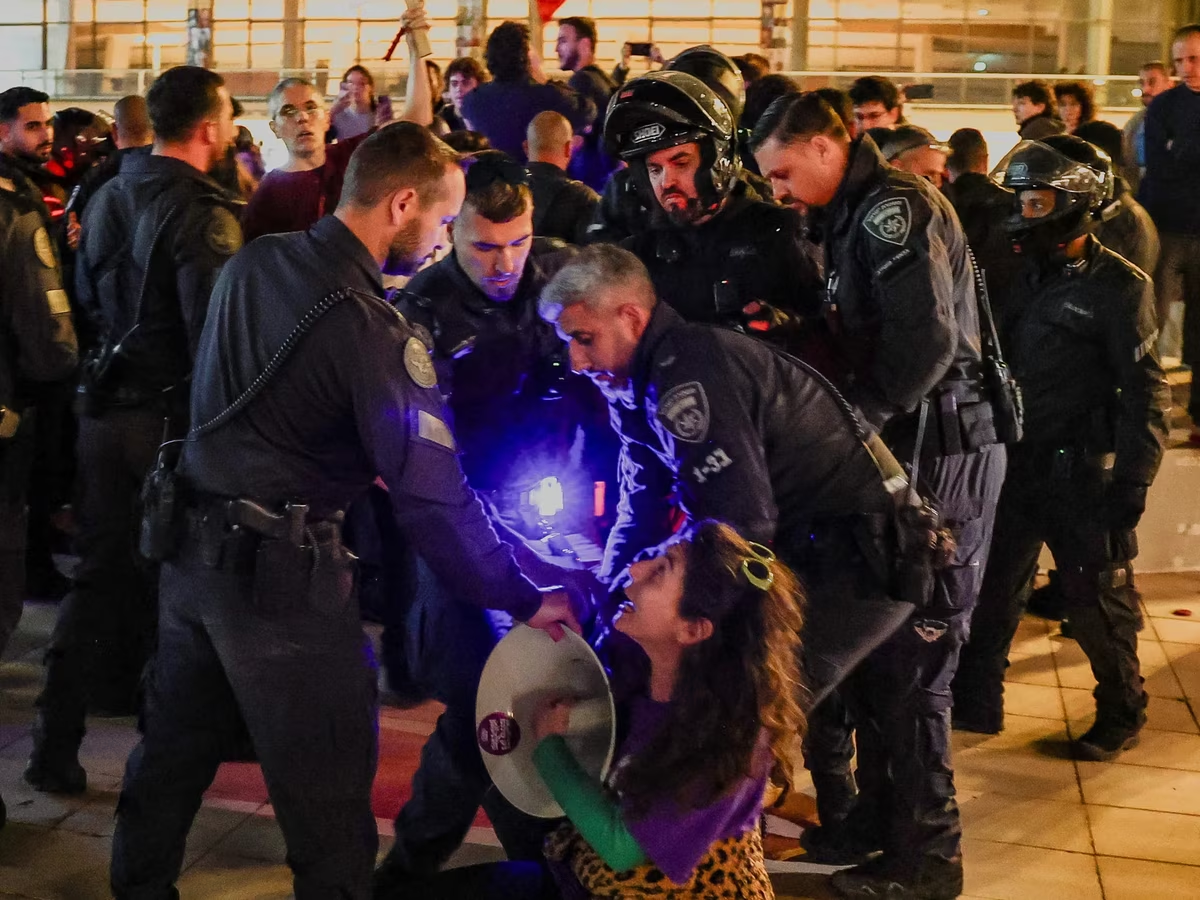
Yesterday's attack caused the largest number of casualties in an official military-security institution in Lebanon since the expansion of the war began.

ARAB AND WORLD

Sat 11 Apr 2026 10:04 am - Jerusalem Time

Strait of Hormuz Turns into a Minefield: Washington and Tehran Face 'Last Chance' Negotiations in Pakistan

International attention is turning towards the Pakistani capital, Islamabad, which is preparing to host a high-level round of negotiations between Iran and the United States of America. These diplomatic moves come at a time when the Strait of Hormuz is emerging as the most important strategic pressure card in Tehran's hand, posing complex challenges for the American administration to restore global navigation.\n\nUS President Donald Trump believes that the nature of the Iranian threat has radically transformed, as the nuclear file is no longer the sole concern. Since the outbreak of direct military confrontation on February 28th, the Strait of Hormuz has become the primary dilemma threatening the stability of the global economy and energy security.\n\nDuring these negotiations, Washington seeks to secure an agreement that guarantees the full and permanent reopening of the Strait to commercial shipping. The American administration insists on the necessity of canceling any fees or restrictions that Tehran attempts to impose on international navigation, considering freedom of passage in this waterway non-negotiable.\n\nIn contrast, media reports, citing American officials, revealed a major technical crisis involving Iran's random planting of a large number of naval mines. This defensive tactic has made the process of clearing the waterway extremely complex, requiring a long time and arduous international efforts to ensure the safety of passing ships.\n\nTechnical estimates indicate that the United States may not currently possess the technology capable of sweeping these mines quickly and with complete safety. This technical reality was reflected in the statements of Iranian Foreign Minister Abbas Araghchi, who linked progress in clearing the Strait to meeting broader Iranian political demands.\n\nOn the ground, intelligence agencies have monitored Iranian movements that included withdrawing large naval vessels from the Strait area, while retaining hundreds of small, fast boats. The danger of these boats lies in their ability to deploy mines and move flexibly, increasing the likelihood of catastrophic incidents that could target commercial tankers at any moment.\n\nShipping traffic has recorded a sharp and unprecedented decline, with only nine ships passing through yesterday, a very small number compared to the normal average of 150 ships per day. This shipping paralysis places immense pressure on global supply chains and pushes Washington to seek urgent solutions to avoid a comprehensive energy crisis.\n\nUS Vice President J.D. Vance is accompanied on his trip to Islamabad by a high-level delegation including military and technical experts from the Pentagon and the National Security Council. This delegation aims to provide technical and political support in negotiations that observers describe as the 'last chance' to prevent the region from sliding into a broader, uncontrollable confrontation.\n\nPolitically, the Trump administration faces increasing domestic pressure, particularly from the Democratic Party, regarding support for Israeli military operations. Questions are mounting about Washington's ability to rein in Benjamin Netanyahu's government in Gaza and Lebanon, as part of a comprehensive deal that could lead to de-escalation on the inflamed fronts with Iran and its allies.\n\n"The Iranian threat is no longer limited to the nuclear bomb; today it is represented by the Strait of Hormuz, which has become the most dangerous pressure point in the confrontation.

ARAB AND WORLD

Sat 11 Apr 2026 10:04 am - Jerusalem Time

Islamabad Negotiations: Washington and Tehran Discuss 'Hormuz Truce' Amidst Distrust

The eyes of the world turn today, Saturday, to the Pakistani capital, Islamabad, where a crucial round of negotiations between Iran and the United States of America is set to begin. These talks come amidst an atmosphere charged with mutual distrust, as both parties seek to reach understandings on complex security and economic issues that arose from the recent military confrontation in the region.

The Iranian delegation, comprising over 70 members led by Parliament Speaker Mohammad Bagher Ghalibaf, arrived in Pakistan amidst tight security measures. Ghalibaf affirmed upon his arrival that his country enters this round with good intentions, but he stressed at the same time that the history of negotiations with Washington has been characterized by broken promises and failure, making Iranian caution paramount.

In contrast, US Vice President J.D. Vance leads his country's delegation, which also includes former White House advisor Jared Kushner and special envoy Steve Witkoff. Vance stated before departing Washington that the United States is ready for positive negotiations, provided that Tehran shows genuine seriousness, warning against any attempts at political maneuvering during the sessions.

The issue of the Strait of Hormuz tops the agenda, as US President Donald Trump conditions a two-week ceasefire on the immediate reopening of the strait. This waterway is a vital artery for global energy, with about 20% of oil and gas supplies passing through it, and its closure has caused severe disruptions in global energy markets and a record rise in prices.

For its part, Tehran adheres to clear demands to move forward with any understanding, foremost among them being an immediate and comprehensive ceasefire in Lebanon. Iran also demands the release of its frozen financial assets, estimated at about $120 billion, considering these steps as the only guarantee to prove American good faith at this critical stage.

On the nuclear front, a wide gap emerges between the visions of the two parties, as Trump insists, within his 15-point plan, on a complete end to uranium enrichment operations in Iranian facilities. In contrast, Tehran presented a counter-proposal of 10 points focusing on its right to enrichment for peaceful purposes, which represents a stumbling block to reaching a final agreement.

These diplomatic moves come after the outbreak of a direct military confrontation on February 28, during which the United States and Israel launched attacks on Iranian targets, followed by a response from Tehran. The conflict expanded to include a widespread Israeli aggression on Lebanon since early March, resulting in thousands of martyrs and the displacement of over a million civilians.

Sources reported that the US President expressed his dissatisfaction with the slow pace of NATO allies in supporting efforts to secure navigation in the Strait of Hormuz. Trump affirmed that Washington is capable of reopening the strait 'very soon,' either with Iranian cooperation or through other international alliances that have expressed their readiness to participate in this strategic mission.

In a related context, reports indicate that the current truce, which began early Wednesday with Pakistani mediation, remains very fragile due to disagreement over its inclusiveness of the Lebanese arena. While Tehran and Islamabad insist that the truce must include Lebanon, Washington and Tel Aviv deny any commitment to halt military operations there at present.

The role of Israeli Prime Minister Benjamin Netanyahu stands out in this equation, as he conditioned his personal approval of any strikes in Beirut on a direct request from Trump. This coordination reflects Washington's desire to manage military escalation in parallel with the ongoing diplomatic track in Islamabad to exert maximum pressure on the Iranian negotiator.

The chances of a rapid breakthrough in these negotiations remain dependent on the extent of both parties' willingness to make mutual concessions on the most complex issues. With the continued closure of the Strait of Hormuz and ongoing raids in Lebanon, the regional scene remains open to all possibilities, awaiting what the coming hours of talks in Pakistan will reveal.

Tehran's experience with Washington in negotiations has always ended in failure and broken promises.

ARAB AND WORLD

Sat 11 Apr 2026 6:59 am - Jerusalem Time

Vatican Denies Its Ambassador Was 'Reprimanded' by US, Pope Criticizes Language of Bombs

Pope Leo XIV of the Vatican today, Friday, issued strong statements implicitly criticizing the military policies of both the United States and Israel in the Middle East. The Pontiff affirmed that faith in Christ is incompatible with the practices of violence and the dropping of bombs currently witnessed in the region.

Through his official account on the 'X' platform, the Pope stressed that the Creator does not bless armed conflicts in any way. He clarified that those who follow the path of the 'Prince of Peace' cannot side with those who have chosen the language of the sword and bombing as a means of dealing with international crises.

Pope Leo XIV indicated that military operations and wars will not open horizons for freedom or establish sustainable peace in the world. He considered that the only way to achieve stability is through promoting the values of coexistence and managing dialogue between peoples with patience and deliberation.

These positions come amidst escalating international criticism directed at Washington and Tel Aviv, especially with the use of religious rhetoric in the context of military confrontation with Iran. Observers believe that these statements reflect the Church's concern about the transformation of political disputes into wars with a sacred character.

In a related context, the Vatican quickly denied reports that its former ambassador in Washington had been reprimanded by the US Department of War. This denial came concurrently with similar clarifications issued by the Pentagon to calm the charged diplomatic atmosphere.

An official spokesperson for the Holy See stated that the journalistic accounts circulated by some media outlets regarding last January's meeting were completely inaccurate. He affirmed that what was published had no connection to the truth, emphasizing the strength of existing diplomatic relations.

Press reports had claimed that Cardinal Christophe Pierre received a sharp reprimand from US Under Secretary of War for Policy, Elbridge Colby. These reports alleged that the American side demanded the Church explicitly support the military power of the United States.

For its part, the Pentagon, in an official statement, described these reports as greatly exaggerated and distorted and not reflective of the nature of the discussion. The statement clarified that the meeting was a respectful discussion that addressed issues of ethics in foreign policy and national security strategies in various regions.

In turn, the US Ambassador to the Vatican, Bryan Birch, confirmed that he had contacted Cardinal Pierre, who in turn denied the validity of those claims. The Cardinal described the meeting as 'frank and very friendly,' and falling within the usual routine diplomatic encounters.

Matteo Bruni, Director of the Holy See Press Office, explained that the dialogue with American officials addressed matters of common interest. He indicated that the meeting was part of the normal activities of the Papal Envoy within the framework of his diplomatic duties in Washington.

It is worth noting that Pope Leo XIV represents a unique case as the first Pope of American origin to assume the leadership of the Catholic Church. Despite this, he takes cautious and sometimes critical stances towards the directions of President Donald Trump's administration, especially regarding diplomacy based on force.

The Pontiff had previously called, on occasions including his Easter address, for influential international powers to choose the path of peace instead of igniting wars. The Church continues to emphasize the necessity of prioritizing peaceful solutions over military options in all global conflict zones.

God does not bless any conflict, and whoever follows Christ, the Prince of Peace, cannot stand with those who carried the sword yesterday and drop bombs today.

ARAB AND WORLD

Sat 11 Apr 2026 6:59 am - Jerusalem Time

Intensive Diplomatic Moves Ahead of Washington Negotiations: Lebanon Requests Truce, Trump Pushes for Ceasefire

Official sources revealed that Lebanese diplomacy in the American capital, Washington, is heading to demand an immediate cessation of military operations or the approval of a temporary truce. This step comes as a necessary goodwill gesture before engaging in the round of negotiations scheduled for next week, as Beirut seeks to establish a state of field stability preceding any political discussion.

In the context of ongoing preparations, there is widespread anticipation for a tripartite phone call bringing together Lebanon's ambassador in Washington with her Israeli counterpart, and with the participation of the American ambassador to Beirut. This preliminary communication aims to set the general frameworks for the upcoming discussions, amidst field and political complexities that impose themselves on the international research table.

For its part, international press reports stated that officials from the United States, Israel, and Lebanon have already held initial contacts to prepare the atmosphere before the start of official talks. These moves come at a very sensitive time, as international parties try to bridge divergent viewpoints regarding the conditions for stopping the ongoing military escalation.

On the American political front, media sources reported that President Donald Trump is exerting direct pressure on Israeli Prime Minister Benjamin Netanyahu to reach an agreement. Leaks speak of an American desire to announce a ceasefire by next Tuesday, to serve as a strong start for the negotiation process in Washington.

On the ground, the pace of military operations remains high, with Hebrew reports indicating that Netanyahu is personally overseeing the approval of air attacks targeting the capital, Beirut. This approach reflects the Israeli side's insistence on continuing military pressure simultaneously with diplomatic efforts, which Netanyahu described as negotiating 'under fire'.

Inside Lebanon, the intensity of political stances rejecting any concessions described as 'gratuitous' to the Israeli occupation is increasing. Hezbollah Secretary-General, Sheikh Naim Qassem, called on Lebanese officials to remain steadfast in their positions, stressing that the resistance will not accept the imposition of conditions that serve Israeli interests at the expense of national sovereignty.

Hezbollah representatives in the Lebanese parliament also affirmed their categorical rejection of any form of direct negotiations with the Israeli side at the present time. The party reiterated its demands for the complete and comprehensive withdrawal of occupation forces from all Lebanese territories in the south, considering it the only path to any future stability.

These developments come against the backdrop of a worsening humanitarian tragedy, as the Lebanese Ministry of Health announced a significant increase in the number of victims due to recent raids. The ministry documented the martyrdom of hundreds and the injury of thousands in the latest wave of escalation, which places the international community before an urgent responsibility to impose a de-escalation that ends the suffering of civilians.

The priority for Beirut lies in achieving a ceasefire before embarking on any official negotiations.

ARAB AND WORLD

Sat 11 Apr 2026 6:59 am - Jerusalem Time

Trump threatens Iran with military strikes ahead of Islamabad negotiations

US President Donald Trump issued stern warnings to the Iranian leadership, hinting at the possibility of large-scale military strikes if the anticipated negotiations in the Pakistani capital, Islamabad, falter. These statements come in the context of a temporary ceasefire agreement through which both parties seek to reach broader understandings to end the escalating tension in the region.

Trump affirmed in statements reported by American media sources that the United States has already begun loading its warships with the latest types of advanced ammunition and newly manufactured weapons. He described this arsenal as far superior to what was used in previous confrontations, emphasizing that his country would not hesitate to use it with maximum effectiveness if a satisfactory agreement is not reached.

In his reading of Tehran's negotiating position, the US President considered that Iran does not possess any real leverage in the upcoming talks, with the exception of its ability to threaten maritime navigation in the Strait of Hormuz. He indicated via his 'Truth Social' platform that Tehran relies on a policy of international blackmail through waterways, asserting that Washington's acceptance of negotiations is what keeps the Iranian regime afloat so far.

For his part, US Vice President J.D. Vance traveled to Pakistan today, Friday, to represent Washington in the first round of these fateful negotiations. Vance expressed his hope for positive results, but at the same time warned against any Iranian attempts at evasion or deception, emphasizing that the American negotiating team would be firm and would not tolerate any manipulation.

Reports from Washington indicate that the US administration places the issue of releasing its citizens detained in Iranian prisons at the top of its priorities in this round. The administration seeks to extract clear commitments in this regard as an integral part of any comprehensive agreement that may be reached with the Iranian negotiating delegation.

On the other hand, Pakistani sources reported the arrival of the high-level Iranian delegation in Islamabad, headed by Parliament Speaker Mohammad Bagher Ghalibaf and Foreign Minister Abbas Araghchi. The level of Iranian representation reflects the importance Tehran attaches to these talks, despite the threatening tone emanating from the White House.

Tehran has set clear conditions for the start of official sessions, with Ghalibaf emphasizing the necessity of implementing a ceasefire in Lebanon first. Iran also demanded the immediate release of its frozen financial assets abroad, considering that these steps were previously agreed upon with the American side and cannot be bypassed.

Deputy Head of the National Security Committee in the Iranian Parliament explained that the negotiating team is working in direct and full coordination with Supreme Leader Mojtaba Khamenei. He affirmed that the announced Iranian conditions represent the official position of the state, and that Tehran will not enter into the details of the negotiations unless it perceives seriousness in implementing previous commitments related to assets and regional files.

In the Pakistani capital, authorities mobilized their security agencies to secure this prominent diplomatic event, with more than 10,000 security personnel deployed around vital locations. Islamabad declared a state of high alert to ensure the safety of the participating delegations, amidst high-level military and security coordination supervised by the Pakistani army.

The Pakistani Ministry of Foreign Affairs also announced extensive facilities for international and local journalists to cover the events of the negotiations, which will officially begin tomorrow, Saturday. These facilities included a 'visa on arrival' system and instructions to airlines to allow concerned individuals to enter without procedural complications, to ensure transparency in conveying events to the world.

Trump had announced last Wednesday morning his approval of a two-week cessation of military operations against Iran, a move described as a last chance for diplomacy. The US President stipulated for the continuation of this calm the full and immediate opening of the Strait of Hormuz to global trade, and ensuring that ships are not exposed to any threats.

Observers believe that these negotiations represent a real test of the new US administration's ability to impose its conditions through 'power diplomacy'. In contrast, Iran is trying to maneuver with complex regional issues to reduce the economic and military pressures it faces, making the outcomes of the Islamabad meeting crucial for the future of stability in the Middle East.

All eyes are now on tomorrow's opening session, where it will become clear how capable mediators are of bridging the gap between explicit American threats and Iranian preconditions. The question remains whether the language of weapons brandished by Trump will push negotiations towards success or lead to a military escalation.

The American military buildup in the region, coinciding with these diplomatic moves, places the region on a hot plate awaiting what the coming hours will bring. Either the pressures succeed in extracting a comprehensive agreement, or the region finds itself facing a direct confrontation that could radically change the map of regional and international alliances.

It does not seem that the Iranians realize that they have no cards in their hands except blackmailing the world through international waterways, and the only reason they are alive today is negotiation.

PALESTINE

Sat 11 Apr 2026 6:59 am - Jerusalem Time

American journalist describes Israel as a 'rogue state' and documents genocidal rhetoric in its society

American journalist and TV presenter, Abby Martin, reopened the file on deeply rooted racism in Israeli society by re-publishing a previous field interview she conducted with Israeli settlers and citizens. Martin expressed her shock at the extent of hatred and explicit calls to kill Arabs and Palestinians she encountered during her tour, noting that the general atmosphere was charged with unprecedented hostility.

Martin likened her experience of walking through Israeli cities to walking through the streets of Berlin in 1932, a clear reference to the rise of Nazi and fascist ideology. She said she felt an enormous amount of disgust and disbelief as she listened to the hate speech adopted by Israelis from various segments of society, emphasizing that her Western features did not prevent passersby from questioning her about her ethnic origins.

The American journalist recounted a recurring situation where people would ask her immediately upon seeing her: 'Are you Arab?' And when she replied that she was American, they would immediately begin to express their deep hatred for Palestinians. Martin considered this behavior to reflect the nature of an 'ethnic state' based on the principle of racial superiority, which she described as the true essence of Zionism.

Martin issued a sharp call to the international community for the complete isolation of Israel, describing it as a 'rogue state' and an apartheid state that practices pathological lying and serial killing. She affirmed that continued support for this state or visits to it by academics, celebrities, and politicians represent a stain, especially after its true nature has been exposed to global public opinion.

In the context of her discussion of discriminatory laws, Martin pointed to the Israeli Knesset's approval of legislation allowing the execution of Palestinian prisoners exclusively, considering it a blatant face of explicit fascism. She explained that what she saw with her own eyes during her visit in 2016 was not just fleeting events, but an institutional approach that is becoming more brutal over time.

The report she re-published included shocking testimonies from Israelis, with one stating that there was no point in talking to Palestinians or trying to deal with them. Another went further by calling for their intensive and comprehensive bombing, considering that excessive military force is the only language that should be used against them.

The camera also documented extreme religious views rejecting mixing or marrying Arabs, with one speaker justifying this by saying that Jews are a 'special nation' to whom God gave the land, and there is no place for Arabs in it. These statements reflect the depth of the exclusionary ideology instilled in successive generations in Israeli society, which categorically rejects the Palestinian presence.

Martin expressed her horror at the 'genocidal rhetoric' that was not limited to the political elite but was common among ordinary people of all ages and walks of life. She noted that many did not hesitate to call for the use of nuclear bombs against Palestinians, which reflects a collective desire for comprehensive ethnic cleansing.

The American journalist concluded her remarks by emphasizing that the Zionist propaganda that lasted for decades has completely collapsed, and the world now sees Israel for its naked truth. She believed that this situation based on oppression and hatred cannot continue for long, especially with the increasing international awareness of the reality of the crimes committed against the Palestinian people.

It is an ethnic state built on superiority and hatred, and the entire world must isolate this rogue state obsessed with genocide.

OPINIONS

Sat 11 Apr 2026 6:58 am - Jerusalem Time

The War of Attrition and Metal Balances: How Did the Confrontation with Iran Reshape the American Armament Equation?

Said Erikat

Opinion Writer

Washington – Said Arikat – 11/4/2026

News Analysis

The American-Israeli war on Iran has brought renewed attention to strategic shifts that extend beyond the direct battlefield, revealing increasing fragility in the structure underpinning American military power, particularly concerning supply chains and reliance on critical metals. Within a limited number of weeks of confrontation, the extent of attrition suffered by American missile defense systems in the region became apparent, amidst concentrated Iranian attacks targeting radar and communication infrastructures, which weakened early detection and interception capabilities.

According to estimates reported by Politico magazine, rebuilding these systems does not only depend on domestic industrial capabilities but is closely linked to global supply chains dominated by China, especially regarding critical metals such as gallium. This metal is used in manufacturing essential components for interceptor missiles, as well as its applications in semiconductors and advanced technologies, making it a pivotal element in the rearmament equation.

During forty days of war, Iran targeted a number of advanced American radar units deployed across the region. These systems, which form the backbone of air defense systems, suffered severe damage, if not complete destruction of some, according to expert estimates. This directly impacted operational performance, as American forces and their allies were forced to launch a larger number of interceptor missiles to deal with threats, in some cases up to ten or eleven missiles to intercept a single target, leading to an unprecedented acceleration in the depletion of stockpiles.

This rapid attrition highlights a deeper dilemma concerning the United States' ability to replenish these stockpiles amidst production and structural constraints. American defense industries, despite their technological superiority, rely on complex supply networks that span several continents and are subject to intricate geopolitical and economic factors. In this context, China emerges as a central player, given its dominance over more than 90% of heavy rare earth metal processing operations, including essential elements for targeting systems such as terbium and dysprosium.

This dominance has been reflected in market movements, with gallium prices rising by 32% within one month, after a period of decline following previous trade understandings between Washington and Beijing. This increase reflects the market's sensitivity to any change in demand or supply and confirms that any increase in American demand to rebuild stockpiles will strengthen China's negotiating position, especially in light of preparations for an upcoming summit between President Donald Trump and his Chinese counterpart Xi Jinping.

In this context, statements by officials and experts indicate a growing awareness within Washington of the magnitude of the challenge. Former trade negotiator Wendy Cutler warns that appearing as the needy party gives the other party additional leverage, while analysts believe that any disruption in supply chains will create new bottlenecks in industries already struggling to meet demand. This concern grows with the realization that rebuilding stockpiles will not be a short-term matter, but a process that could extend for years.

Conversely, the United States is trying to use the temporary ceasefire with Iran to reassess the damage to its military arsenal and prioritize reconstruction. However, the challenge is not limited to replacing consumed quantities but extends to rethinking the structure of supply chains themselves and reducing reliance on external sources that could turn into political pressure tools.

Despite American efforts to develop alternatives, including mineral exploration projects in allied countries such as Australia, these initiatives are still in their early stages and will not be able to bridge the gap in the short or medium term. Building new supply chains also requires massive investments and a long time, at a time when the pace of military consumption is accelerating due to multiple conflicts.

In contrast, China appears keen to manage this card cautiously. Despite its ability to influence supply chains, it realizes that excessive escalation could lead to adverse reactions, including accelerating Western efforts to decouple economically. Therefore, Beijing may prefer to use its influence gradually and thoughtfully, achieving negotiating gains without harming the stability of economic relations with the United States.

Nevertheless, the scene remains open to multiple possibilities, especially in light of escalating tensions in the Middle East and the increasing intertwining of national security and the global economy. The war on Iran was not merely a military confrontation but revealed a complex network of interdependence, where natural resources become tools of influence, and supply chains become an integral part of the deterrence equation.

The war reveals a structural dilemma in the American ability to replenish advanced weapon stockpiles, as it is not just about increasing production, but about restarting complex manufacturing chains that rely on precise components and rare materials. Interceptor missiles, for example, require long production cycles and extensive testing to ensure their effectiveness. With the sudden surge in demand, this process faces constraints in production capacity, a shortage of specialized labor, and supply bottlenecks, making the process of refilling stockpiles extend for years, not months.

The challenge of maintaining military systems is no less complex than replacing them, as fighter jets and missile launch platforms require costly periodic maintenance cycles, which in turn depend on the availability of advanced spare parts and stable supply chains. With the increasing pace of operations, consumption and wear rates rise, putting pressure on combat readiness. In a geographically extended operational environment, as in the Middle East, these challenges are compounded by the need to transport and maintain equipment in distant bases, which exacerbates costs and increases the likelihood of malfunctions.

The war also demonstrates the fragility of the logistical structure supporting American military bases abroad, as these bases rely on a continuous flow of fuel, spare parts, and sensitive technical systems. With some of these bases being subjected to direct or indirect attacks, maintenance and supply operations become more complicated, especially in light of continuous threats to infrastructure. Any delay in supplies can also lead to a decline in operational efficiency, forcing military leadership to reassess its deployment and its ability to sustain itself in high-intensity conflict environments.

PALESTINE

Sat 11 Apr 2026 6:57 am - Jerusalem Time

Trump-led Peace Council denies funding setbacks for Gaza reconstruction plans

The Peace Council, chaired by US President Donald Trump, issued an official statement refuting circulating news about financial difficulties facing its planned projects in the Gaza Strip. The Council affirmed that all requested financial requirements have been fully and immediately provided, emphasizing the commitment of donor parties to their previously announced pledges.

These statements come in response to press reports citing informed sources that the Council is facing a real crisis, having received only meager amounts out of a total of $17 billion that had been pledged for the reconstruction of the Strip. These sources indicated that this severe liquidity shortage represents a major obstacle to Trump's efforts to implement his vision for the future of Gaza after the widespread destruction it suffered.

Informed sources on the progress of operations clarified that only three out of ten donor countries have fulfilled their financial commitments so far, including the United States of America. The sources mentioned that the total amounts collected did not exceed one billion dollars, a very small figure compared to the enormous needs for rehabilitating the collapsed infrastructure in the Strip.

In a related context, reports revealed that military tensions and the war with Iran cast heavy shadows on the financial and political scene, further complicating money transfer procedures. Sources reported that these circumstances led to a decline in donor enthusiasm and the postponement of many field steps that were planned within the American peace plan.

On the ground, the National Committee tasked with managing Gaza's affairs has not yet been able to commence its duties within the Strip, with sources attributing this setback to the overlap of security problems with a lack of funding. The Council's envoy, Nikolay Mladenov, explicitly informed Palestinian factions about the difficulty of the current financial situation and the unavailability of immediate operational budgets.

President Trump had organized an international conference in Washington prior to the outbreak of military confrontation with Iran, during which he succeeded in mobilizing billions of dollars in pledges from several countries. This move aims to find alternatives for managing the Strip and overseeing reconstruction operations after two years of war that left widespread destruction in all aspects of life in the Gaza Strip.

Despite six months having passed since the ceasefire agreement came into effect, humanitarian conditions remain stagnant amid continued field violations. The occupation authorities continue to practice a policy of procrastination in opening crossings and allowing essential aid to enter, which deepens the suffering of the residents and increases international warnings about a renewed explosion of the situation.

It is worth noting that the Peace Council, established at the beginning of this year, aspires, according to Trump's vision, to play a pivotal role that extends beyond the Palestinian issue to include other conflict areas around the world. The Council, in coordination with the United Nations, seeks to build an international platform capable of funding and implementing major projects aimed at stabilizing global stability under direct supervision from Washington.

However, the Council faces a wave of international skepticism due to its organizational structure, which grants the US President broad powers, including the right of veto and permanent appointment of members. Observers believe that these powers could turn the Council into a tool to bypass traditional international institutions such as the Security Council, which has led some countries to refrain from joining it or supporting its budget.

There are no obstacles regarding funding, and all requests have been met immediately and in full so far.

ARAB AND WORLD

Sat 11 Apr 2026 6:57 am - Jerusalem Time

Islamabad Negotiations: Five Thorny Issues Put US-Iranian Understanding to the Test

International attention is turning to the Pakistani capital, Islamabad, which is preparing to host a crucial round of negotiations between the United States and the Islamic Republic of Iran on Saturday. These talks come amidst an atmosphere charged with hopes and security and political complexities, as both sides seek to explore opportunities to reach a permanent ceasefire and cool down the burning conflict hotspots in the region.

A high-level Iranian delegation, headed by Parliament Speaker Mohammad Bagher Ghalibaf, and accompanied by Foreign Minister Abbas Araghchi and a group of security and economic advisors, arrived in Pakistan. On the American side, Vice President J.D. Vance, Special Envoy Steve Witkoff, and President Donald Trump's son-in-law Jared Kushner represent the US, reflecting the weight of this diplomatic round.

The Iranian Parliament Speaker, from Islamabad, expressed caution regarding American intentions, noting that past experiences have seen breaches of agreements despite what he described as Tehran's good faith. Ghalibaf stressed that his country had been subjected to American attacks twice in the past year during the negotiations, emphasizing that American seriousness is the only key to concluding a real agreement.

For his part, US Vice President J.D. Vance stated before heading to the meeting that Washington is ready to extend a hand if the Iranians show a sincere desire to negotiate. Vance warned against any attempts at manipulation or procrastination, asserting that the negotiating team chosen by President Donald Trump will not compromise in protecting American interests and regional security.

Lebanon's file stands out as one of the most complex points in these negotiations, as the Israeli occupation continues its aggression since early March. While Iranian President Masoud Pezeshkian warned that continued military escalation could empty the talks of their content, the Israeli side insists on continuing military operations against Hezbollah in Lebanon.

Media sources revealed a change in Israeli attack policy in Lebanon, where strikes targeting the capital Beirut now require personal approval from Benjamin Netanyahu. This change came in response to a direct request from US President Donald Trump, in an attempt to reduce the pace of escalation coinciding with the launch of the diplomatic track in Pakistan.

The Strait of Hormuz represents a major economic and security challenge, as it is the vital artery for global oil transport, over which Tehran threatens to impose its full sovereignty. The US President warned Iran against imposing any additional fees on shipping vessels passing through the strait, considering it a breach of the temporary truce understandings reached through Pakistani mediation.

The nuclear file remains the core of the historical conflict between the two sides, with differing views on Iran's right to enrich uranium. While Trump's plan demands a complete cessation of enrichment operations on Iranian soil, Tehran adheres to its ten-point proposal, which includes international recognition of its nuclear rights for peaceful purposes.

US Secretary of Defense Pete Hegseth previously stated that Washington's ultimate goal is to ensure that Iran does not possess nuclear weapons or the ability to acquire them. This hardline stance brings the crisis back to square one after the collapse of the 2015 nuclear deal, making the achievement of a new framework a daunting task for negotiators.

Iran's network of regional allies constitutes another fundamental point of contention, as Tehran considers it a strategic and defensive depth against external threats. In contrast, the United States and Israel are pushing to dismantle this influence, while voices within Iran are rising, calling for a focus on internal economic issues and a reduction in external spending.

Iran sets the lifting of comprehensive economic sanctions as an indispensable condition for moving forward with any long-term political agreement. Tehran demands the release of frozen financial assets estimated at about $120 billion, a demand that the Trump administration faces with extreme caution, preferring not to make major concessions in the early stages of negotiations.

US President Donald Trump announced on Wednesday morning a bilateral ceasefire with Iran for two weeks, conditional on the full opening of the Strait of Hormuz. Despite this announcement, ambiguity still surrounds the inclusion of the Lebanese arena in this truce, amidst American and Israeli denials and Iranian and Pakistani affirmations of the unity of the tracks.

The hours leading up to the negotiations witnessed an Israeli military escalation described as the most severe on Lebanon since the start of the aggression, putting immense pressure on the negotiating table. International parties fear that this field escalation could lead to the collapse of initial understandings before official sessions begin in Islamabad.

The Islamabad round of negotiations remains a true test of diplomacy's ability to contain a widespread regional conflict that threatens global energy stability. Negotiators from both sides will have to bridge the deep chasm of differences in sovereignty, nuclear security, and regional influence files to reach a formula that ensures the sustainability of the truce and its transformation into a comprehensive agreement.

Our experience in negotiating with the Americans has often ended in failure and breach of agreement, and if they are ready for a real agreement, they will realize our readiness for it.

PALESTINE

Sat 11 Apr 2026 6:57 am - Jerusalem Time

New truce violation: Two martyrs and widespread attacks targeting displaced people and schools in Gaza

The Gaza Strip witnessed a new field escalation on Thursday, as Israeli occupation forces committed a series of violations targeting civilians and displaced people. These attacks resulted in the martyrdom of two people and serious injuries to a woman, in a clear violation of the existing truce agreement, exacerbating the already deteriorating humanitarian conditions in various governorate of the Strip.

In details of the field crimes, medical sources reported the martyrdom of 13-year-old child Ritaj Abdul Raouf Raihan, as a result of being directly shot by the occupation forces. The incident occurred while the child was inside an educational tent belonging to 'Abu Ubaidah bin Al-Jarrah' school in the Beit Lahia area north of the Strip, where she was receiving her lessons before being surprised by Israeli bullets.

In the southern part of the Strip, a drone belonging to the occupation army targeted the Mawasi Rafah area, which is crowded with thousands of displaced people who sought safety there. This aerial bombardment led to the martyrdom of young man Youssef Khalil Mansour (33 years old), which caused a state of panic and terror among families residing in tents and shelters in the area.

The attacks did not stop there, as a Palestinian woman was injured by bullets from Israeli military vehicles stationed in the Al-Dhahr area in Beit Lahia. Local sources stated that the injury occurred inside the walls of 'Tel Al-Zaatar' school, where the vehicles continue to fire randomly and intensely towards displacement centers and neighboring residential areas since the early morning hours.

In a related context, Israeli artillery renewed its intense shelling of the eastern areas of Khan Yunis city, coinciding with heavy gunfire targeting citizens' properties and homes. These military movements put the ceasefire agreement at a serious test, in light of the continued systematic targeting of infrastructure and unarmed civilians in both border and internal areas.

For its part, the Palestinian Ministry of Health issued a periodic report revealing alarming figures for the victims of the ongoing aggression. The ministry stated that the number of martyrs since the announcement of the truce on October 11, 2025, has reached 736 martyrs, while the number of injured has risen to 2035, reflecting the extent of the field violations carried out by the occupation army on a daily basis.

Regarding the cumulative statistics since October 7, 2023, the ministry recorded the martyrdom of 72,315 people and the injury of 171,137 others in an unprecedented toll. Human rights activists appealed to the international community and the sponsors of the agreement for immediate intervention to pressure the occupation authorities to stop these crimes, warning that international silence gives the green light for the continuation of policies of killing and abuse.

The total number of martyrs since the announcement of the ceasefire on October 11 is about 736 martyrs, amid continued blatant violations of international conventions.

ISRAELI AFFAIRS

Sat 11 Apr 2026 6:57 am - Jerusalem Time

Sharp Israeli Division Over Ceasefire with Iran: Doubts About Victory and Declining Trust in Politicians

Israeli opinion polls conducted after the announcement of a ceasefire with Iran revealed a complex picture that contradicts the narrative of decisive victory that Benjamin Netanyahu's government attempted to promote. These results reflect a high appreciation for the military establishment's performance, while simultaneously indicating widespread doubts about the strategic utility of the war and a significant decline in trust in the political leadership.

According to a poll published by Hebrew media, the general mood in Israel is far from celebratory, with 63% of respondents expressing dissatisfaction with the outcome of the confrontation. Only 22% believed that Israel and the United States achieved victory, compared to 46% who affirmed the absence of any real achievement, reflecting a gap between official rhetoric and popular reality.

In another poll conducted by the Israeli Broadcasting Corporation, 58% stated that the battle did not end in favor of Tel Aviv and Washington, while 56% supported continuing military attacks instead of moving towards de-escalation. These figures reinforce the impression that the public views the ceasefire as an incomplete decision that did not achieve the desired deterrence against Tehran.

Israel's Channel 12 also reported that 53% of the public opposed the ceasefire decision, compared to only 30% who supported it, indicating a state of frustration. Opinions were also divided on the identity of the victor, with 40% believing that no one won this round, while 19% thought that Iran emerged with the upper hand.

The data indicates a strong conviction among the Israeli public that the confrontation with Iran is not over yet, but merely a temporary truce that could erupt at any moment. 45% of participants in the polls expected the conflict to resume within just two weeks, while others believed that the calm would not last for more than one year.

On the political front, the war's results were not in favor of the ruling Likud party, as polls showed a decline in its number of seats, ranging between 22 and 25. This decline puts Netanyahu in a critical position against his rivals, especially with the rise of figures like Naftali Bennett, who has begun to significantly narrow the gap with the current prime minister.

The biggest beneficiary of these shifts appears to be the security alternatives camp, as Gadi Eisenkot continued his progress in opinion polls, achieving between 12 and 14 seats. Eisenkot is seen as a more balanced figure in managing security and political files compared to the current leadership, which faces sharp criticism.

In contrast, Yair Lapid and Benny Gantz emerged as the biggest losers in the new political map, with Lapid's representation declining to only about 6 seats. As for Gantz, some polls showed his decline to dangerous levels approaching the electoral threshold, indicating a broad reshaping of the balance of power within the opposition.

The figures reveal a huge gap in assessment between the military and political levels, with Air Force Commander Tomer Bar receiving the trust of 77% of the public. Chief of Staff Eyal Zamir also received a positive rating of 71%, which illustrates the public's alignment with the security establishment at the expense of politicians.

In contrast, Benjamin Netanyahu received a satisfaction rating of no more than 47%, while Defense Minister Yoav Gallant was at the bottom of the list with 40%. This data suggests that Israelis clearly distinguish between the success of the army's field performance and the failure of the political level to translate that strength into sustainable political gains.

Despite the pessimism regarding the outcome of the war with Iran, polls showed a clear tendency towards toughness on other fronts, especially the northern front. 77% of Israelis demanded the continuation of military operations against Hezbollah in Lebanon until all declared objectives are achieved, without relying on de-escalation understandings.

This trend towards regional escalation reflects a broad current that believes Israel stopped the war before exhausting its full military capacity to achieve deterrence. The public appears to reject diplomatic compromises at this stage, preferring to expand military pressure in neighboring arenas to ensure long-term security.

The summary of these polls outlines four fundamental truths: first, the absence of popular satisfaction; second, deep skepticism about government claims of victory. The third truth is the continuous erosion of Netanyahu's standing, and the fourth is the strong rise of alternatives with security and military backgrounds.

The ceasefire did not end the internal debate in Israel, but rather opened the door to discussion about the utility of wars and the limits of military power in resolving conflicts. Israelis emerge from this round in a state of confusion, trusting generals more than politicians, and fearing the return of fighting more than believing in the narrative of decisive victory.

The Israeli public does not view the ceasefire as an acceptable conclusion to a successful war, but rather as a halt to a round of fighting whose results have not yet been decided.