ARAB AND WORLD

Sun 11 Jan 2026 7:19 am - Jerusalem Time

Somali Defense Minister: Israel plans to forcibly displace Palestinians to Somaliland

Somali Defense Minister Ahmed Moallim Fiqi said that Mogadishu has information that Israel plans to forcibly displace Palestinians to what is known as the "Somaliland" region, describing the move as a grave violation of international law and Somalia's sovereignty.

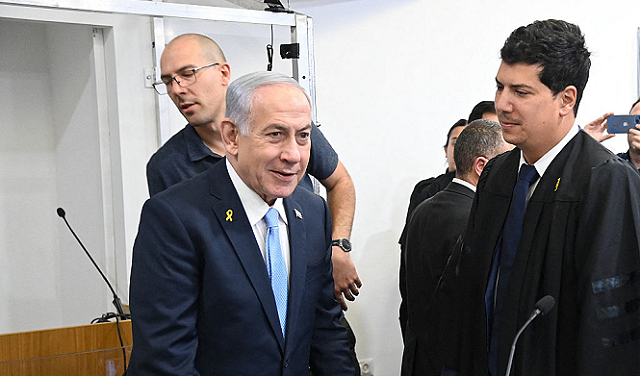
Fiqi called on the Israeli government to withdraw its recognition of what he called the "separatist region," stressing that Prime Minister Benjamin Netanyahu has no legal or legitimate right to grant legitimacy to an entity within a sovereign state.

The minister explained, during an interview with the "Al-Masa'iya" program, that the Israeli move represents a direct aggression against the territorial integrity of Somalia, noting that Israel is exploiting separatist leaders, even though nearly half of the areas that were known as "Somaliland" have announced their joining the Federal Republic of Somalia in the past two years.

Fiqi revealed that Israel also seeks to establish a military base in the region due to its strategic location near the Bab al-Mandab Strait, the Red Sea, and the Arabian Sea, warning that this aims to destabilize and divide countries.

He affirmed that his country will resort to all diplomatic and legal means to reject what he described as the Israeli violation, pointing out that the African Union realizes the seriousness of this precedent for the stability of the continent.

The minister praised the positions of a number of Arab and regional countries, including Saudi Arabia, Qatar, Egypt, and Turkey, in addition to the Arab League and the Gulf Cooperation Council, in supporting Somalia's unity. He also appreciated the position of US President Donald Trump's administration in not recognizing the so-called "Somaliland" region.

PALESTINE

Sat 10 Jan 2026 9:23 pm - Jerusalem Time

Hamas leader: The movement affirmed its readiness to hand over its duties in the Gaza Strip to a "technocrat" committee

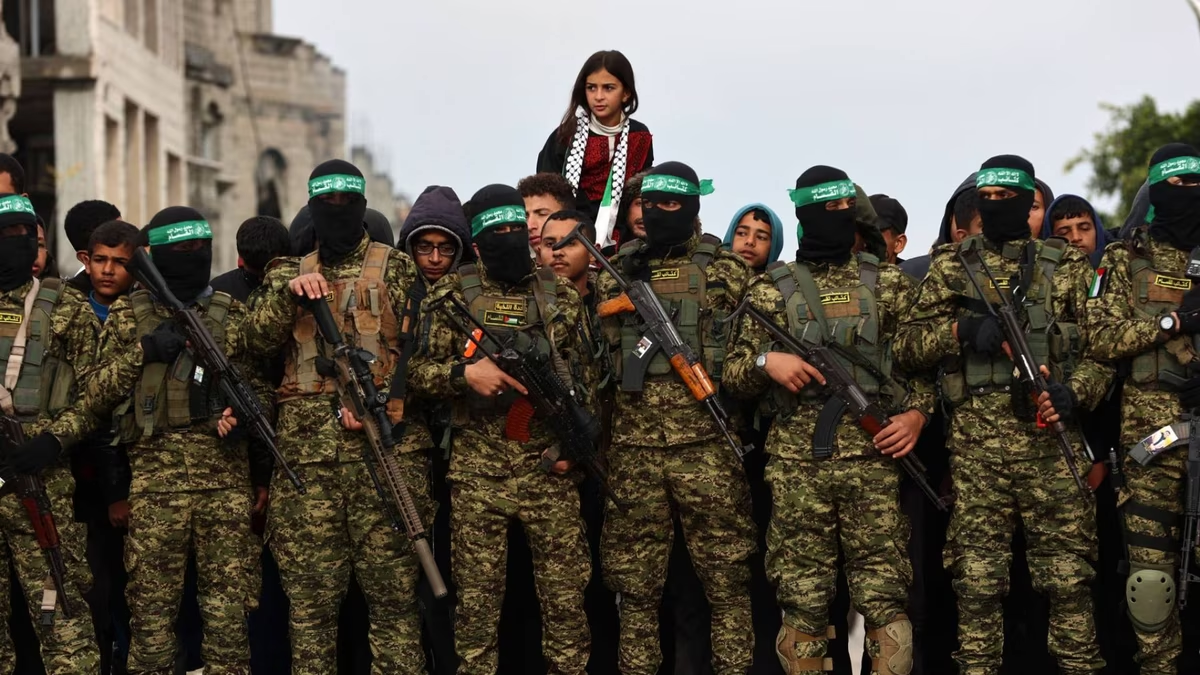
Hamas spokesman Hazem Qassem announced on Saturday evening a clear decision taken by the movement to dissolve the governmental bodies currently managing affairs in the Gaza Strip, should an agreed-upon technocrat committee be formed.

Qassem affirmed in a press statement that the movement is ready to hand over all duties to a "technocrat" committee, stressing Hamas's commitment to facilitating all procedures to ensure the committee's success in performing its tasks. He also called for accelerating the formation of this body to begin its responsibilities towards the Strip.

This announcement coincided with statements by the movement's leader, Basem Naim, in which he affirmed that the ceasefire plan proposed by US President Donald Trump, and adopted by the Security Council in Resolution 2803, is facing clear difficulties.

Naim attributed this difficulty to what he described as the evasion of his commitments by the occupation's Prime Minister Benjamin Netanyahu, accusing him of working to escalate the situation and sabotage the agreement to return to war in search of saving his political future.

Naim highlighted the continuous violations by the occupation, pointing to the martyrdom of 13 Palestinians yesterday, Friday, in various areas under what he described as fabricated pretexts. He reiterated the following points:

Read also: Sisi and "Class" call for full implementation of the Gaza agreement and anticipation for Washington's announcement of the features of the second phase

Resistance's Commitment: He affirmed that the resistance has committed to all its obligations according to the agreement, as testified by mediators and the United States. Readiness for the Second Phase: He stressed the movement's readiness to deal positively with the second phase, including the immediate formation of a Palestinian body to administer Gaza and Hamas's withdrawal from the governmental scene. Basic Demands: He linked the success of the plan to the full opening of crossings in both directions and the implementation of the remaining clauses clarified to the mediators. Leader Basem Naim warned that the continued escalation and the catastrophic humanitarian situation in Gaza put the credibility of the mediators and the American guarantor at stake.

He concluded by emphasizing that this situation is unsustainable and could lead to an expansion of the conflict in the region, which Netanyahu appears to be seeking to avoid his inevitable political fate.

PALESTINE

Sat 10 Jan 2026 7:09 pm - Jerusalem Time

Anonymous text messages terrorize settlers: 'We are coming, look at the sky at midnight'

Despite the confusion it caused, the army, Shin Bet, and police did not issue any statements warning of a real security threat.

The past few hours have witnessed a state of tension and anxiety among settlers in the occupation entity, after a large number of them received anonymous short text messages (SMS) on their mobile phones.

Channel 12 reported that the messages were in English with a threatening tone: "We are coming, look at the sky at midnight," which led to widespread circulation and noticeable confusion amid the charged security atmosphere in the region.

A military source confirmed to the occupation army radio (Gal Tzahal) that many people received these reports, as it became clear that the messages were sent via foreign numbers or low-cost bulk broadcasting services.

Read also: "Kidnapping the groom".. A wedding night in occupied Jerusalem turns into a field of repression with occupation bullets.. Video

Despite the confusion it caused, the army, Shin Bet, and police did not issue any statements warning of a real, tangible security threat based on these texts, which reinforces the hypothesis of "psychological warfare."

Security experts so far tend to classify this campaign as a "mass intimidation operation" or a "digital hoax" exploiting the current tension, rather than an indicator of an imminent military operation.

Despite speculations linking these movements to entities supporting Iran, these analyses remain without conclusive evidence and fall within the framework of initial conclusions about the situation.

Most analyses agree that the campaign succeeded digitally in creating a stir, but it remains within the scope of "cheap terror" that is not based on significant technical or operational capabilities, with calls for the public to exercise caution when dealing with such misleading messages.

PALESTINE

Sat 10 Jan 2026 5:08 pm - Jerusalem Time

Sisi and "Kallas" call for full implementation of Gaza agreement and anticipation of Washington's announcement of the features of the second phase

These arrangements aim to provide basic services to citizens and initiate early recovery projects, which are a prelude to comprehensive reconstruction.

Egyptian President Abdel Fattah El-Sisi, during his meeting with the European Union's High Representative for Foreign Affairs, Kaja Kallas, stressed the necessity of full implementation of the ceasefire agreement in the Gaza Strip.

This meeting coincided with reports indicating the imminent transition to the second phase of the agreement, amid Egyptian assurances that the United States will soon announce the entitlements associated with this phase, which is led by the vision of US President Donald Trump.

The Egyptian and European sides affirmed a set of crucial constants to ensure the sustainability of de-escalation in the Strip. Emphasis was placed on ensuring the regular and unrestricted flow of humanitarian aid, with an absolute rejection of any attempts to displace Palestinians from their lands.

President Sisi and Kallas also reiterated their call for accelerating the start of the second phase and launching the reconstruction process, in conjunction with resuming the political track to achieve a just and comprehensive peace based on the two-state solution.

Egyptian Foreign Minister Badr Abdel Atty clarified that the plan associated with President "Trump" includes essential details that will be announced soon by Washington.

The critical importance of this phase lies in the security and service umbrella it will provide, including the deployment of an international stabilization force and the empowerment of the Palestinian Administrative Committee on the ground.

These arrangements aim to provide basic services to citizens and initiate early recovery projects, which are a prelude to comprehensive reconstruction.

The meeting was not limited to the Palestinian issue, as Sisi and Kallas discussed a range of pressing issues affecting global security.

Discussions included the situations in Libya, Sudan, Syria, Lebanon, and Iran, leading up to the Ukrainian crisis.

The two sides agreed on the inevitability of settling these conflicts through peaceful means to preserve the unity and integrity of states, warning that any additional military escalation would have dire consequences affecting the interests of all parties without exception.

PALESTINE

Sat 10 Jan 2026 4:49 pm - Jerusalem Time

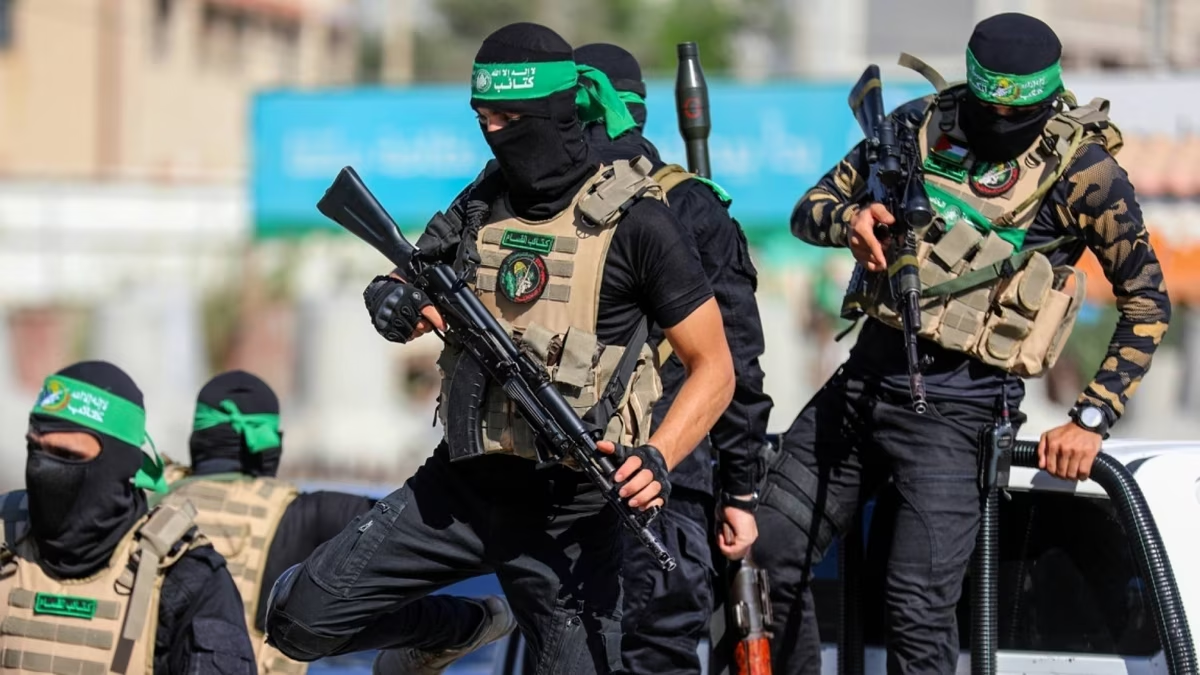
US media: Conditions for disarmament by "Israel" may reignite clashes with Hamas

An official in the occupation army affirmed that disarming the movement is inevitable, and if it is not done voluntarily, "it will be forced."

The American newspaper "Wall Street Journal" revealed field preparations by both the occupation forces and the Hamas movement for the possibility of renewed military confrontations between them.

This tension comes amid the movement's insistence on not fully disarming, a condition that "America" and the occupation adhere to as a fundamental pillar for any progress in the anticipated political path.

"America" and the occupation demand that Hamas relinquish its weapons as part of its commitment to a ceasefire agreement.

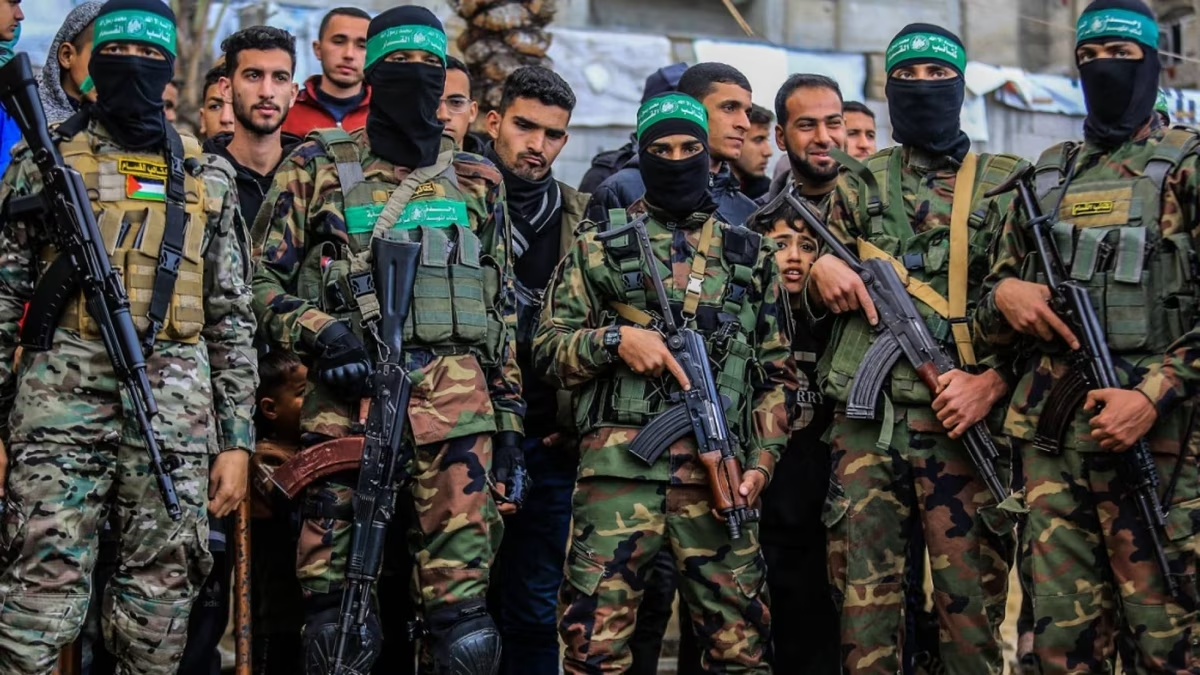
While the movement shows readiness to abandon what remains of "heavy weapons," it categorically refuses to surrender light weapons, as occupation reports estimate that Hamas has about 60,000 rifles and 20,000 fighters.

On the other hand, the movement is focusing on restoring its damaged military capabilities, especially the tunnel network. The newspaper also quoted Arab and Israeli officials as saying that Hamas received new financial flows that enabled it to resume paying its fighters regularly.

In the context of these movements, the occupation army has prepared plans for a new ground operation targeting areas controlled by Hamas.

The Chief of Staff of the occupation army, Eyal Zamir, stated last November the necessity of preparing for a "wide attack" behind the lines of engagement.

Despite these plans, officials confirm that there is no immediate intention for field entry, as Tel Aviv is giving time for the American plan to proceed, while emphasizing that the timing of the operation remains in the hands of the political leadership.

For his part, "Trump" had issued a stern warning to the movement in December, threatening that "hell" would break out if it did not give up its weapons.

An official in the occupation army affirmed that disarming the movement is inevitable, and if it is not done voluntarily, "it will be forced."

The readiness is not limited to the Gaza Strip; the occupation forces are also considering the possibility of a new round with Hezbollah, believing that a new operation may be necessary to help the Lebanese army disarm the party, while the latter asserts its ability to do so alone.

Tel Aviv is also closely monitoring Tehran's efforts to rebuild its ballistic missile program after the June war, with warnings of strikes to prevent this.

Donald "Trump" reiterated his support for any military action against Tehran if it rebuilds its missile or nuclear programs.

The intersection of disarmament demands with Hamas's insistence on retaining its capabilities gives the coming period a critical character, as strict American warnings and field movements indicate that the option of war remains strongly present if diplomacy falters.

PALESTINE

Sat 10 Jan 2026 3:40 pm - Jerusalem Time

Netanyahu and the Inverted Propaganda: When Genocide is Justified and the World is Accused

Washington - Said Arikat


Political Analysis

In a historical moment where blood intertwines with politics, and destruction with propaganda, Benjamin Netanyahu appeared in an extended interview with "The Economist" magazine, published on Friday, January 9, attempting to re-market himself and his leadership, not only to Israelis ahead of new general elections, but to a world that now views Israel as a morally ostracized state rather than a "besieged democracy," as he insists on calling it.

Netanyahu, who is preparing to run in elections for the twelfth time and aspires to solidify his record as the longest-serving prime minister in Israel's history, appeared in the interview captive to a single narrative that he repeats with remarkable persistence: that Israel's international isolation is not the result of a war of extermination in Gaza, nor the outcome of military occupation and racist settlement in the West Bank and Jerusalem, but rather the result of a "propaganda war" and "slander" led by hostile forces, driven – according to his logic – by an ancient hatred of Jews.

This discourse, which reduces an unprecedented human tragedy to a public relations issue, reveals a deep disconnect from reality. The world has not witnessed "propaganda," but rather cities wiped off the map, hospitals bombed, and children pulled from under rubble. More than seventy thousand dead in Gaza are not a hypothetical narrative or the product of electronic "Bots," but a documented reality reported by international press cameras, United Nations organizations, and relief teams.

Nevertheless, Netanyahu insists that Israel is fighting an unequal battle in the "war of consciousness," using ironic analogies when he says that his country is fighting "with knights against F-35 aircraft" in the media arena. This description does not express media injustice, but rather a moral crisis: the state that possesses one of the most powerful armies in the world, and extensive Western political and military support, assumes the role of a victim because it has failed to justify the killing of civilians.

More dangerously, Netanyahu repeatedly resorts to the "anti-Semitism" card whenever his arguments run thin. In the interview, he reproduced a historical narrative about the persecution of Jews in Central Europe, concluding that the criticisms directed at Israel today are merely an extension of that hatred. This deliberate conflation of Jews as a religious or cultural group with a state that practices occupation and military force not only distorts the truth but also harms the victims of anti-Semitism themselves, when their suffering is exploited to justify contemporary crimes.

Global criticism of Israel today is not based on religious hatred, but on political and legal facts: a long-term occupation, a systematic discriminatory regime, illegal settlement expansion, and a war that has destroyed an entire sector. Turning this criticism into "incitement against Jews" is not a defense, but an evasion of accountability.

Netanyahu also complains about what he calls "impossible standards" imposed on Israel, invoking Winston Churchill and World War II. But this comparison ignores a fundamental truth: Gaza is not a battlefield between equal armies, but a besieged area where more than two million people live without protection. The comparison here is not only wrong but scandalous in its disregard for civilian lives.

Netanyahu believes that a ceasefire will alleviate international pressure, because "media focus will fade." This gamble reflects his firm conviction that global memory is short, and that crimes expire with media obsolescence. But he ignores that what happened in Gaza is no longer just a news event, but has become a symbol of the collapse of the moral system that Israel has long claimed to belong to.

In another context, Netanyahu tries to appear capable of resetting the relationship with the United States, even if it requires reducing American military aid in the future. However, this proposal seems closer to an electoral maneuver than a real strategic shift, especially given the increasing criticism within American public opinion itself of Israel's policies, including within the base that was traditionally considered supportive of it.

As for his talk about Israel "defending Western civilization" in the face of "savage" forces, it is a continuation of an old orientalist discourse, re-dividing the world into a civilized camp and a savage one, and giving Israel an open certificate of innocence no matter what it commits. This discourse loses what remains of its credibility when compared to images of hunger, destruction, and mass graves in Gaza.

The contradiction becomes sharper when Netanyahu shifts from addressing the West to the Israeli interior. Settlement expansion in the occupied West Bank has reached unprecedented levels during his terms in office, and settler violence has escalated under army protection, while ministers in his government openly speak of annexation. Nevertheless, Netanyahu downplays the importance of the Palestinian issue, claiming that Arab leaders "do not care" about it, a reading that reflects contempt for Arab public opinion and the political reality in the region.

The failure of October 7, 2023, remains a black mark haunting Netanyahu. The man who does not hesitate to attribute successes to himself refuses to bear political responsibility for the biggest security failure in Israel's history. He talks about postponed investigation committees, and distributes blame to agencies and institutions, but he avoids one word: responsibility.

In conclusion, Netanyahu's interview with "The Economist" reveals not a rescue plan for Israel, but a crisis of a leader who refuses to acknowledge that the isolation his state faces is not the result of propaganda, conspiracy, or religious hatred, but a natural consequence of policies of violence, occupation, and extermination. Today's world is no longer content with narratives, but judges actions, and Netanyahu, no matter how loud he raises his voice, is now unable to escape this judgment.

PALESTINE

Sat 10 Jan 2026 3:36 pm - Jerusalem Time

Three dead and wounded in occupation shelling on Gaza Strip

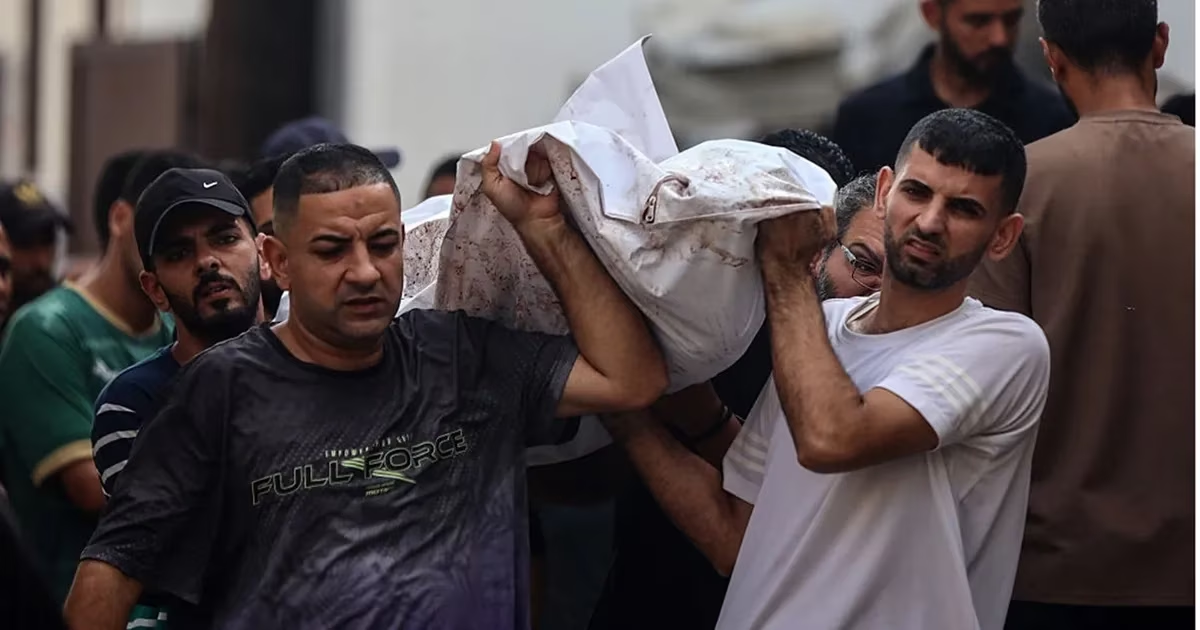
Three Palestinians were martyred and others were injured on Saturday in occupation shelling that targeted areas in the Gaza Strip, as part of a long series of ceasefire violations.

Medical sources reported the martyrdom of one Palestinian and the injury of another in a drone strike by the occupation near the Bani Suheila roundabout, in the center of Khan Yunis city. They also confirmed that two martyrs fell as a result of being shot by occupation vehicles east of the Zeitoun neighborhood.

The sources indicated that a number of citizens were injured in the occupation's shelling of the entrance to the Maghazi camp in the central Strip, while it continued

PALESTINE

Sat 10 Jan 2026 3:32 pm - Jerusalem Time

Infant dies due to extreme cold in Deir al-Balah, central Gaza Strip

An infant, not more than 7 days old, died in the city of Deir al-Balah, central Gaza Strip, on Saturday, due to the extreme cold, according to hospitals in the Strip, in a new tragedy that reveals the extent of the escalating humanitarian suffering.

Heavy rains that fell during the past hours caused the flooding of a large number of displaced persons' tents in various areas of the Gaza Strip, especially in low-lying areas; which exacerbated the suffering of thousands of families living in extremely difficult humanitarian conditions, amidst harsh weather conditions and the continued repercussions of the aggression, according to medical sources.

The Director-General of the Ministry of Health in Gaza, Munir al-Barsh, had previously warned of the increased risk of death for children, the elderly, and the sick; as a result of the sharp drop in temperatures inside the displaced persons' tents that were submerged by rainwater.

Al-Barsh explained that humidity and water leakage into the tents create a suitable environment for the spread of respiratory diseases among the displaced, at a time when patients are unable to obtain the necessary healthcare, due to the deteriorating humanitarian conditions and the lack of resources in the Strip.

PALESTINE

Sat 10 Jan 2026 11:10 am - Jerusalem Time

Occupation raids and artillery shelling on Gaza despite ceasefire agreement

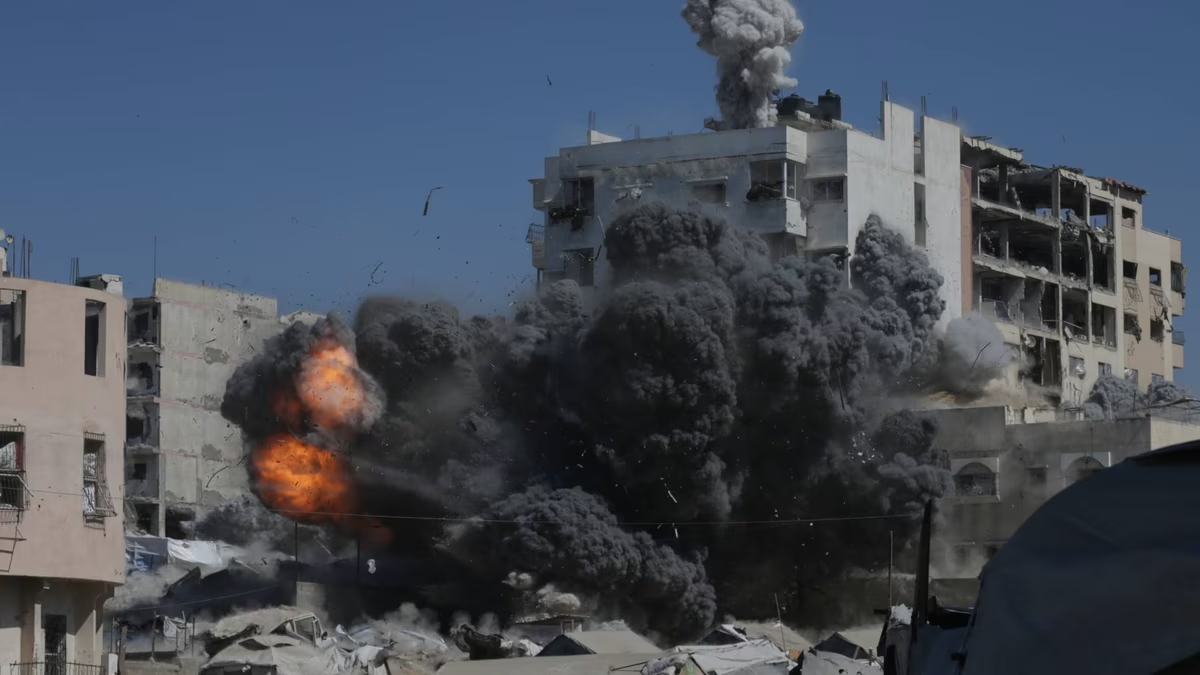
On Saturday, occupation forces launched airstrikes and artillery shelling on various areas of the Gaza Strip, including areas within their control according to the ceasefire agreement.

This comes as part of the continuous violations by the occupation of the agreement, which came into effect on October 10, 2025.

Palestinian sources reported that the occupation artillery shelled the eastern areas of Gaza City, located within the areas of control according to the agreement.

The sources added that occupation warplanes launched an airstrike on a target in the northern Strip, coinciding with a helicopter firing towards the eastern areas of Jabalia town in northern Gaza.

In the southern Strip, occupation aircraft targeted the city of Rafah with an airstrike, coinciding with occupation vehicles firing north of the city, which is completely under its control.

Since the ceasefire agreement came into effect, the occupation has committed hundreds of violations through shelling and firing; which has resulted, since last October 11, in the martyrdom of 439 Palestinians and the injury of 1223 others.

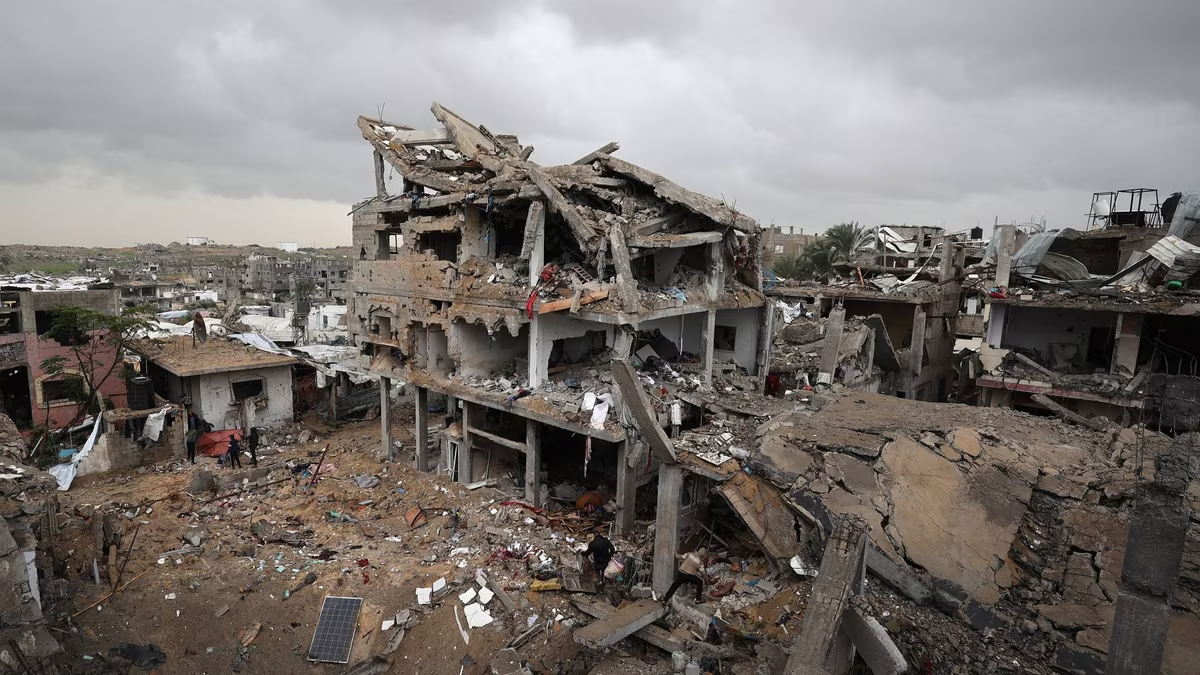
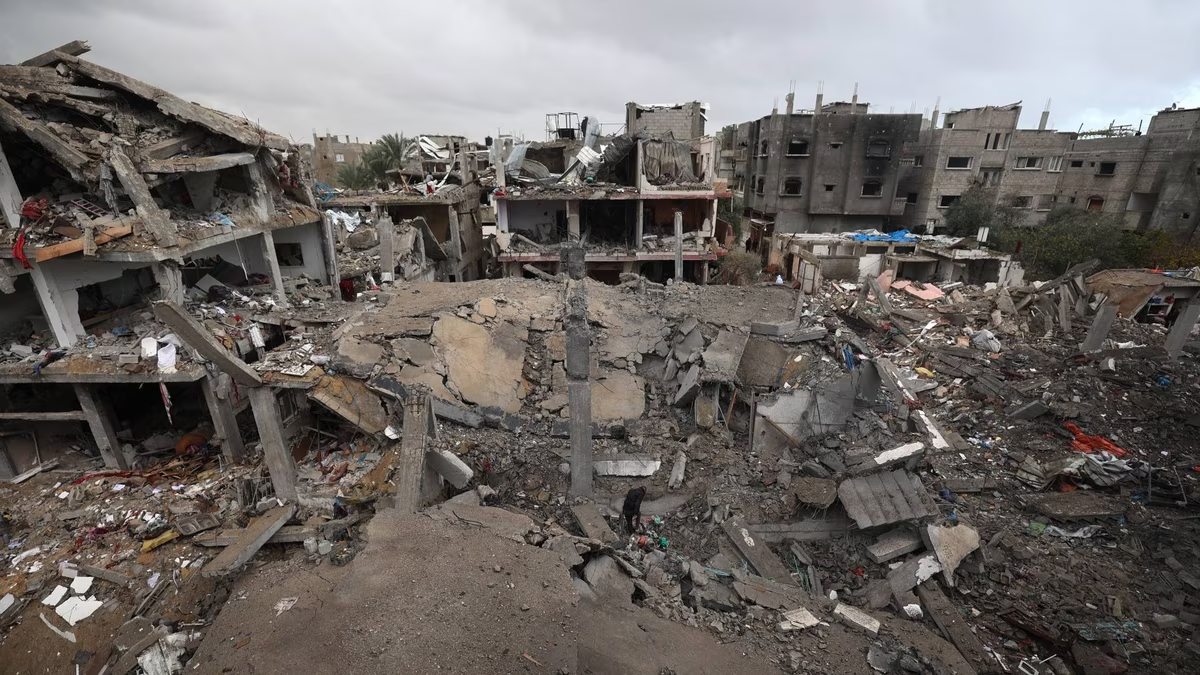
The agreement had ended a genocide war launched by the occupation on October 8, 2023, and lasted for two years, resulting in the martyrdom of more than 71,000 Palestinians and the injury of about 171,000 others, most of whom were children and women, in addition to widespread destruction that affected about 90% of the civilian infrastructure in the Strip.

OPINIONS

Sat 10 Jan 2026 10:58 am - Jerusalem Time

Revisiting Oslo: Between Challenges and Strategies in the Palestinian-Israeli Conflict

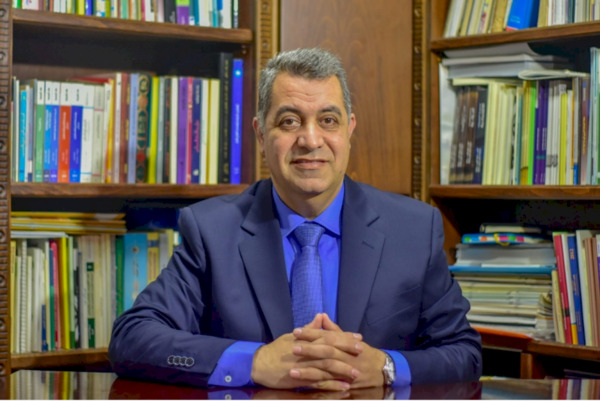
Dr. Ibrahim Na'irat

Dr. Ibrahim Na'irat

Opinion Writer

At a time when hardly a day passes without hearing Palestinian, Arab, and even international voices criticizing the Oslo Accords, there remains another aspect that we must shed light on, an aspect often not brought up in daily discussions about the failure or success of these agreements. While some believe that Oslo was a disaster for the Palestinians, the truth reveals that these agreements were more than just a step towards peace; they were, in fact, a strategic step in favor of the Palestinians, which is indirectly reflected in the strong opposition of the Israeli right-wing to them. If we look closely at the reason for this Israeli attack, we will discover that Israel was well aware that Oslo was a threat to its existence more than ever before.

Since the signing of the Oslo Accords in 1993, Israeli reactions, especially from the right-wing, have been angry and sharp. There was a recurring statement from right-wing leaders saying that Oslo was a "betrayal" or a "strategic mistake." Although some critics in the Arab and Palestinian world believed that the Palestinians did not get what they deserved in those agreements, the Israeli hostility to Oslo should draw our attention to something deeper. The Israeli right-wing's opposition to Oslo was not due to the weakness of the agreement or Israel losing its interests, but rather due to a strong conviction that this agreement could pose a direct threat to Israel's future, and meant a gradual erosion of Israeli hegemony over the land. The Israeli right-wing feared that Palestinian recognition of Israel and the move towards a two-state solution might pave the way for the reduction of settlements and the return of Palestinian rights, and this constituted a real political nightmare for them.

But Oslo was not only a message from the Palestinians to Israel, but also a strong message to the whole world. A message of the Palestinians' understanding of the dimensions of global and regional power balances at that time, and a message that they are aware of the concepts of strength and weakness in the international arena, and that they seek peace and good neighborliness peacefully. In a reality where the Israeli occupation imposed a harsh reality on the Palestinians, Oslo was a step towards reaching a just settlement that recognizes Palestinian rights, but at the same time, it was a call to the world to pay attention to the Palestinian issue as a legitimate issue that needs a political solution that recognizes the demands and aspirations of the Palestinian people.

Although Oslo was an important strategic step, both Palestinians and Israelis did not manage these agreements as they should have. Some elements of Oslo, whether in their drafting or implementation, were missed or obstructed by internal parties on both sides, leading to a series of failures that significantly affected the outcomes of these agreements. While Oslo opened the doors for dialogue and understanding, effective implementation mechanisms were absent, and the concerned parties did not manage the agreement's outcomes in a way that ensured its progress in the hoped-for direction. There was a clear problem in the non-implementation of the commitments of both parties, especially regarding the cessation of Israeli settlement in the occupied territories, as well as the failure to address key issues such as Jerusalem and refugees. On the Palestinian side, internal divisions among factions represented a major obstacle, while the Israeli side suffered from the absence of political will among some of its leaders to fully implement what had been agreed upon.

Over time, Oslo turned into an incomplete agreement, and the result was that the conflict continued to rage, and its complexities even increased. The foundations upon which the agreement was built were not fully respected by both parties, leading to an accumulation of frustrations on both sides. Palestinians felt that what they got from Oslo was not enough, while Israelis felt that the concessions they made did not translate into positive political results. Oslo was supposed to open the way towards a two-state solution, but over time, many obstacles emerged that made this goal seem distant.

But most importantly, it was the extremist forces on both sides, whether in Israel or Palestine, that emptied Oslo of its political content and threatened to destroy any chance for peace. On the Palestinian side, there were radical resistance movements that refused to recognize Israel in any way, and even considered any agreement with Israel a betrayal of the Palestinian cause. In contrast, on the Israeli side, there was a strong current of the extreme right that believed that any concession to the Palestinians was an existential threat to Israel. These extremists were fighting an ideological battle in an "either us or them" struggle, a vision that transformed the Palestinian-Israeli conflict from a mere political dispute into a state of mutual nihilism. Over time, extremists on both sides used their utmost tools to undermine Oslo, trying to destroy any chance for peace. These used political and military violence in an attempt to undermine the peace process and impose reality by force.

This escalatory trend culminated in many wars and military operations, most notably the Gaza War, which crowned these efforts. Military escalation, whether by Palestinian groups or by the Israeli army, reflected a determination to maintain the stalemate or continue the escalation, instead of seeking a lasting settlement. Thus, the extremist forces on both sides had succeeded in transforming Oslo from an opportunity for peace into a series of failures that not only hindered peace but led to further destruction and suffering.

Over time, Palestinians, despite all challenges, began to build demographic and political power within the occupied territories, which today has become one of the main factors in the balance of power between the two sides. After the signing of Oslo, Palestinians in the West Bank and Gaza Strip became more capable of influencing political equations in the region. Although this power did not fully achieve the dream of a Palestinian state, this is the beginning of the path towards Palestinian self-assertion in the international arena. But at the same time, extremist forces on both sides of the Palestinian-Israeli conflict are increasing their influence on daily politics. Those who reject any kind of settlement continue to fight for the continuation of the conflict, while the vast majority of Palestinians and Israelis seek compromises that can put an end to this ongoing conflict. In light of this, it is important to understand that Oslo, despite the concessions it entailed, was a step towards creating the conditions that could lead to fundamental transformations in a conflict that has lasted for decades, especially since it meant imposing Palestinians at the negotiating table as a political party, which was one of the greater goals of the Palestinian revolution.

In the end, Oslo remains a strategic turning point in the Palestinian-Israeli conflict, where some forces failed to recognize its historical benefits in securing a place for Palestinians on the international stage. And when we understand the motives of extremists in fighting Oslo, we can clearly see that these agreements were not just a weak endeavor, but a mature step towards achieving political balance and Palestinian existence in the face of Israeli hegemonic forces.


OPINIONS

Sat 10 Jan 2026 10:45 am - Jerusalem Time

My friend... taught Maduro

Jihad Harb

Jihad Harb

Opinion Writer

My friend, who usually dislikes phone calls or social media conversations, called me, uncharacteristically angry about the kidnapping of Venezuelan President "Nicolas Maduro" by American military forces in a swift operation "that didn't last an hour." I told him, "Hold on, my friend; the United States has immense military and intelligence power, capable of reaching anyone, whenever and wherever it wants. Its forces are stationed in the ocean waters near the country, and its intelligence eyes and hands have been in the heart of the capital, "Caracas," for years." My friend's voice rose in anger, as if my answer had provoked him, saying, "This operation doesn't rely on the United States' power and weapons; it's betrayal, my friend." I said in a calm voice, or rather, I was careful to be calm, "It's illogical for it to be betrayal; the regime is behind him, the masses were surrounding him days ago, he has been at the head of power for many years, and he formed the government, bringing close those he trusted and distancing those he didn't trust among professionals. He has security forces in every neighborhood, if not every house, throughout Venezuela." My friend said, "Betrayal only comes from 'trusted people'; they are unprofessional, and their interests are above the country's interests, and their personal survival is more important than the survival of the leader or the country and its people. So, my friend, we haven't seen any serious movement from the Venezuelan government as a serious reaction to the kidnapping, and the armed forces haven't moved to defend the president, even though they are already on high alert due to continuous threats over recent months. It's illogical for helicopters to enter the capital without a reaction that hinders their operation, as if a planned matter had been orchestrated by all corners of his government." I told him, "Things are still unclear and shrouded in mystery, and judgments cannot be made. In my opinion, days will reveal the hidden truths, whether it's a conspiracy, or an understanding between the Venezuelan president and the American administration to get out of the escalating crisis to avoid a war that would devastate what remains of the country's resources, or sacrificing him for the sake of the regime's survival and the country's safety, or weak military capabilities, are behind this matter." My friend continued, saying - meanwhile, my friend's breath calmed, and his voice became less sharp, and he regained a tone of wisdom to build a rational conclusion, it seemed - "Maduro's lesson, regardless of the kidnapping operation and the colonial intentions of the American administration and its dominance over the western hemisphere and the theft of the resources of the peoples in Latin America, for leaders in Latin America and the Arab world indicates that the ruler needs popular support for his program and approach, and the public's trust in the people and titles of power, and citizens' satisfaction with the performance of government institutions, and that this triangle of 'support, trust, and satisfaction' is not possible to achieve under the dominance of power by specific and limited individuals for many years, and the spread of corruption in the ruling political class, and the spread of poverty and unemployment, and the lack of opportunities for youth to engage in public work, and the prevention of participation in policymaking and the weakening of public ownership, and the failure of programs to meet people's needs; even if the president comes from the bottom of society, years of rule, its pomp, and its privileges make him forget the needs of his peers and those who came after him, the necessities of life." I stopped my friend, saying, "The Palestinian people have lost a leader who supported their cause." He interrupted me, anger evident in his voice; "The Palestinian people need leaders who believe in human rights in their countries, and who secure a dignified life for their peoples, and who invest their countries' wealth to fortify their societies, and to strengthen their nations, and the prosperity of their countries to contribute to global civilization, and they do not need leaders who squander their peoples' money and wealth in external shouting without caring about the country's internal issues." He concluded his speech, "If the Venezuelan people had accepted him, they would have come out en masse to defend the president, but the situation is apparently the opposite, as we did not see any movement at the necessary moments and hour of need; as the popular saying goes, 'He who is covered by other than the people is naked,' and this is the case of one who did not make the people his ally, and the warmth of his group and their pockets at the expense of the people, and tightened the grip of security on the necks of the people, and did not realize that national dignity among peoples does not mean clinging to the leader and his group, but in preserving the homeland and the safety of the country.


PALESTINE

Sat 10 Jan 2026 10:39 am - Jerusalem Time

Israel Escalates Aggression in Gaza: Killing as a Tool to Disrupt the American Path Towards Phase Two

Over the past twenty-four hours, Israel has escalated the pace of its aggressive military attacks on the Gaza Strip, resulting in the martyrdom of at least 15 Palestinians, including a number of children, according to medical sources and civil defense teams in the Strip. This escalation comes at a politically sensitive time, coinciding with American preparations to announce the transition to "Phase Two" of arrangements related to Gaza, which US President Donald Trump is expected to announce during his participation in the World Economic Forum in Davos, held between January 19 and 23.

However, this escalation cannot be separated from its broader political context, nor from a recurring Israeli pattern that employs military force as a tool to manage critical political moments. The recent attacks, which targeted densely populated residential areas in the central and southern parts of the Strip, as well as sites housing displaced persons, not only resulted in civilian casualties but also deepened the feeling that Israel deliberately seeks to re-impose the logic of the field whenever a political path that does not fully align with its security calculations appears on the horizon.

According to the Ministry of Health in Gaza, the majority of the victims are civilians, including children and women, at a time when ambulance and civil defense teams faced great difficulties in reaching the bombing sites, due to widespread destruction and lack of resources. These field realities clearly contradict the official Israeli narrative that repeatedly speaks of "striking precise targets," while targeting patterns indicate excessive and disproportionate use of force in one of the most densely populated areas in the world.

As in previous rounds, the Israeli occupation army was quick to justify its operations under the pretext of "preventing imminent security threats," reiterating its accusations against Palestinian factions of using civilians as human shields. However, these pretexts have become widely questioned by international human rights organizations, which confirm that Israel treats Gaza as an open military space, where there is no room for considerations of international humanitarian law or the principle of protecting civilians, especially children.

Most indicative in this context is the timing of the escalation itself. The American administration, according to diplomatic leaks, intended to use the Davos Forum platform to announce the transition to "Phase Two" of its plan for Gaza, a phase that is supposed to include new security and administrative arrangements, and perhaps initial indicators of reconstruction and a transitional governance framework for the Strip, without requiring the disarmament of Hamas as a prerequisite. This is viewed in Israel as a risky path, as it limits its ability to unilaterally control the future of the Strip.

From this perspective, analysts believe that the Israeli military escalation aims to disrupt this announcement or empty it of its content, by reproducing a scene of security chaos and sending a message that field conditions do not allow for any organized political transition. It is also not excluded that the goal is to exert indirect pressure on the American administration to push it to adopt a more hardline approach, consistent with the Israeli vision based on the priority of military force over any political path.

In contrast, international and American pressure on Israel appears to have limited effect. Despite the escalating calls to protect civilians and stop targeting children, these positions have so far not gone beyond statements and declarations. This reality is reinforced by the fact that the occupation army has violated the ceasefire in Gaza more than 500 times since its entry into force on October 10, 2025, without any meaningful political or legal accountability resulting from it.

Humanitarianly, the latest escalation exacerbates the tragedy of the residents of the Gaza Strip, who have lived for years under a suffocating siege and harsh living conditions. The infrastructure is almost collapsed, hospitals are operating beyond their capacity, while hundreds of thousands suffer from severe shortages of food, clean water, and safe shelter. Aid agencies warn that any new escalation, no matter how "limited" it may seem, will have devastating effects on civilians, who always pay the highest price.

In conclusion, Israeli behavior reflects a determination to reproduce an old, proven-to-be-failed equation, based on the belief that military force can impose permanent political realities. However, repeated experience in Gaza shows that this approach only leads to successive cycles of violence, without achieving sustainable security or real stability, neither for Palestinians nor even for Israel itself. Aborting any political path in its infancy, under the pretext of "security necessities," only means deepening the roots of the conflict and prolonging its duration.

The American administration finds itself once again facing a difficult test between its declared rhetoric of de-escalation and stability, and the practices of its Israeli ally on the ground. The inability to curb the escalation threatens to undermine the credibility of any upcoming American initiative, whether announced in Davos or elsewhere, and warns that the promised "Phase Two" may turn into a mere political cover for managing the crisis, rather than a serious step towards resolving it.

PALESTINE

Fri 09 Jan 2026 11:42 pm - Jerusalem Time

Bahbah: Peace Council to be announced next week, technocratic committee to manage Gaza on the horizon

Bahbah pointed to Israeli moves aimed at withdrawing recognition from a number of international relief organizations operating in Gaza, under the pretext of their hostility to the occupation.

Bishara Bahbah, head of the American-Arab Council for Peace, revealed a series of anticipated political developments aimed at shaping a new administration for the Gaza Strip and initiating reconstruction efforts.

These moves include the imminent announcement of the formation of the "Gaza Strip Peace Council" next week, with its first official meeting to be held on the sidelines of the "Davos" forum in the third week of this month.

Concurrently with this step, the Egyptian capital, Cairo, is expected to host a meeting of Palestinian factions next week to discuss the implications of the announcement of the Peace Council.

Read also: American media: Trump expects to announce next week the establishment of a peace council and the transition to the second phase in Gaza

This meeting is expected to be dedicated to announcing the names of the "Independent Technocratic Committee" tasked with managing the affairs of the Strip, which will include twelve members.

The anticipated timeline also includes the formation of the main bodies responsible for managing the comprehensive reconstruction file within thirty days.

In another context, Bahbah pointed to "Israeli" moves aimed at withdrawing recognition from a number of international relief organizations operating in Gaza, under the pretext of their hostility to the occupation, which may lead to the adoption of new mechanisms for distributing aid under the supervision of private companies owned by individuals.

Regarding movement at the crossings, the Jerusalemite academic linked the opening of the Rafah crossing to the handover of the last body held by the Palestinian side, considering that this step would remove any pretext for the occupation to continue the closure.

Bahbah concluded his message to the people of the Strip by expressing his understanding of the extent of suffering resulting from food shortages, lack of healthcare, and homelessness.

He expressed his hope that this year would be a radical turning point towards restoring the elements of a dignified life and improving living conditions in Gaza, in a way that meets the country's progress towards stability.

ARAB AND WORLD

Fri 09 Jan 2026 11:08 pm - Jerusalem Time

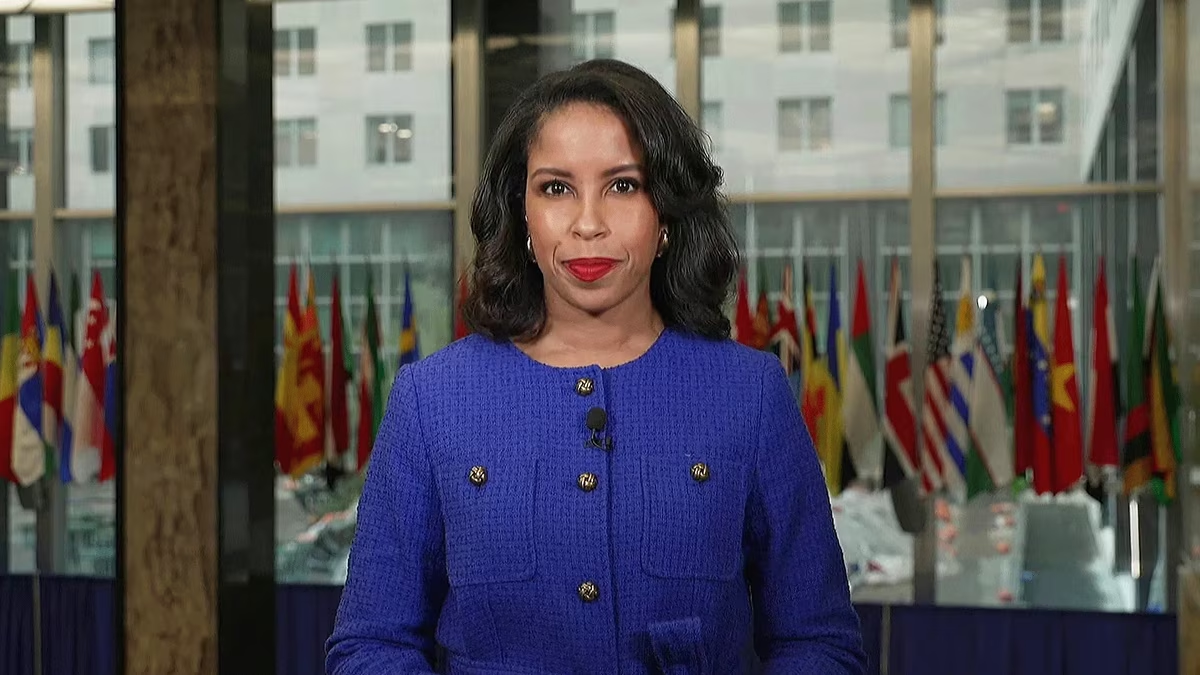
Deputy Spokesperson for the US State Department: Washington is closely monitoring the situation in Iran and is ready to support the Iranian people

Mignon Houston, Deputy Spokesperson for the US Department of State, said that the recent protests in Iran reflect the Iranian people's dissatisfaction with the lack of food, energy, and basic services, noting that the US government wishes to see Iran abandon its support for enemies and its nuclear and missile programs, and achieve a better life for its people.

She affirmed that Washington is closely monitoring the situation and is ready to support the Iranian people in achieving stability and a dignified life.

Houston clarified that the US administration's policy on all Middle East issues is "clear and transparent," emphasizing that the United States will remain committed to protecting its interests, working for regional stability, and achieving a secure and prosperous future for the concerned Arab peoples, while closely monitoring all field and political developments.

She added that the United States' policy towards Syria focuses on stability, prosperity, territorial integrity, and respect for minority rights, stressing the importance of preventing the use of Syrian territory as a safe haven for terrorist organizations or a source of threat to American and regional security.

She explained that the US administration seeks to ensure that the Syrian government uses its resources to support and protect the Syrian people, while calling for comprehensive dialogue among all Syrian parties to achieve the interests of the country and its people, affirming that Syria's future will be promising if the government and politicians commit to paths of cooperation and constructive solutions.

Regarding the American balance between the Syrian government and the Syrian Democratic Forces (SDF), Houston said that the absolute priority is American national security, and that Washington is working with its regional partners to ensure that Syria does not become a haven for terrorist threats, noting that the United States expects the Syrian government to implement its security and political commitments within the framework of comprehensive solutions for the region.

Concerning the second phase of the US-sponsored peace plan in Gaza, Houston affirmed that the plan aims to end suffering and achieve stability for both Palestinians and Israelis, explaining that tangible progress has been made in the humanitarian and relief file since the agreement was signed, with thousands of trucks and humanitarian aid entering the sector, but she noted the necessity for the Hamas movement to adhere to the terms of the agreement, including disarmament and not obstructing reconstruction, to ensure the transition to the second phase of the plan.

She mentioned that the United States is working to form a Palestinian technocratic committee under the supervision of the Peace Council to ensure stable governance in Gaza, while monitoring the effectiveness of security and the stabilization force, affirming that the success of this phase is linked to the commitment of all concerned parties to the preconditions for the full completion of the transition.

PALESTINE

Fri 09 Jan 2026 11:08 pm - Jerusalem Time

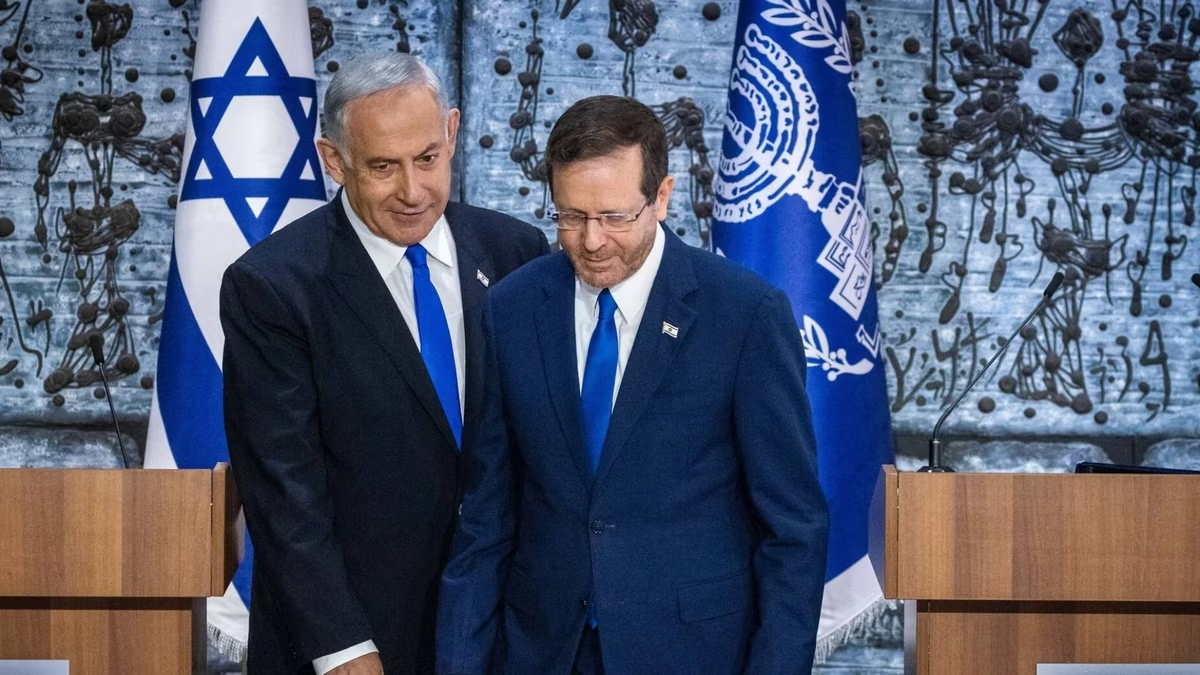
Leaks about a "secret deal" between Netanyahu and Herzog.. a businessman talks about "amnesty" in exchange for the presidency

Herzog feared Netanyahu would nominate another Likud party figure who enjoyed right-wing support.

The "Israeli" businessman and strategic consultant, Moti Sander, dropped a heavy political bombshell by revealing the existence of a "secret deal" concluded five years ago between the president of the occupation state, Isaac Herzog, and Prime Minister Benjamin Netanyahu.

According to Sander's claim, this deal stipulated Netanyahu's support for Herzog's election as president in exchange for the latter granting Netanyahu a presidential pardon that would prevent his prosecution in the corruption cases attributed to him.

Moti Sander is an influential figure in the political circles of the occupation, having led successful election campaigns for prominent figures such as Ehud Barak, and has close ties with both Netanyahu and Herzog.

The revelation of this information came in an interview with Hebrew media, where Sander confirmed that he was Herzog's messenger to Netanyahu to propose this offer.

According to the details provided by Sander, Netanyahu and his wife Sara faced significant pressure to accept the deal to avoid imprisonment.

Sander recounted a moving scene in which Sara Netanyahu cried before her husband convinced her that this move was in their best interest.

Herzog feared that Netanyahu would nominate another Likud party figure who enjoyed right-wing support, or that Netanyahu himself would run for president to stop his prosecution process according to the law.

Sander explained that he decided to reveal this "scandal" now because Herzog went too far in trying to appease Netanyahu with a pardon that does not include admitting guilt or waiving the sentence, which Sander considered a crime against the purity of governance.

He affirmed that he is in favor of granting a pardon and stopping the trial that harms Israel, but on the condition that Netanyahu admits his guilt and completely retires from political life.

For its part, President Herzog's office strongly denied these allegations, emphasizing key points:

Denial of the deal: There was no agreement or understanding, whether explicit or implicit, linking the presidential elections to Netanyahu's legal files.

Pardon request: Any pardon request will only be processed according to the law and with the recommendation of the Pardon Department in the Ministry of Justice.

Sander's refutation: Herzog expressed his regret for what his friend Sander said, and rejected his claims, describing them as false and defamatory.

In contrast, the Likud party accused Sander of lying, while the latter responded that the attempt by Herzog's men to question his mental faculties under the pretext of "Alzheimer's" is a despicable attempt to tarnish his reputation and hide the truth.

These leaks place the presidency and the government in an embarrassing position before public opinion and the judiciary.

With the widening gap of mutual denial, the question remains about the extent of the impact of these allegations on the course of Netanyahu's cases pending before the courts, and whether they will lead to new investigations into suspicions of abuse of influence to immunize officials from legal accountability.

PALESTINE

Fri 09 Jan 2026 9:48 pm - Jerusalem Time

"Hamas" accuses Washington of providing "cover" for occupation raids.. and confirms: Netanyahu obstructs "second phase"

At least 13 people, including five children, were killed, according to Gaza Civil Defense data.

Hamas accused the United States on Friday of providing "cover" and a green light for the Israeli occupation army to carry out new raids on the Gaza Strip.

These accusations come after strikes carried out by the occupation on Thursday, which resulted in the death of at least 13 people, including five children, according to the Civil Defense data in the Strip, despite the ongoing ceasefire agreement.

Basem Naim, a member of the movement's political bureau, stated via "Telegram" that the calm plan is faltering due to the insistence of the head of the Israeli occupation government, Benjamin Netanyahu, on "evading his commitments" and escalating militarily to sabotage the agreement and return to a state of comprehensive war.

Naim affirmed that the movement "has fulfilled all its obligations" and is ready to deal positively with the "second phase" of the plan, despite the Israeli occupation's conditions for disarmament.

On the ground, sources in the movement revealed the resumption of search operations for the detainee's body after a halt due to bad weather conditions, a file that the occupation clings to before moving on to the next negotiations.

Since the truce came into effect on October 10, significant violations have been recorded, leading to the death of more than 425 Palestinians, while the occupation army announced the killing of three of its soldiers during the same period, which puts the future of the agreement at stake.

PALESTINE

Fri 09 Jan 2026 8:52 pm - Jerusalem Time

The occupation army claims to target Hamas leaders specializing in anti-tank warfare and weapons manufacturing

These claims coincided with reports of sharp discrepancies in estimates between army commanders and the political leadership of the occupation regarding the feasibility of moving to the second phase of the plan.

The occupation army, in cooperation with the General Security Service, claimed to have assassinated prominent Hamas officials during attacks launched in the northern and southern Gaza Strip.

While the occupation claimed that these operations came in response to the firing of a rocket towards its controlled areas, the Palestinian resistance denied the narrative, considering these assassinations deliberate violations aimed at thwarting "Trump's plan" to stop the war, which is supported by an international resolution.

These developments come after Hebrew reports claimed that the occupation army is preparing for a partial withdrawal from the city of Rafah to establish gatherings for displaced persons.

These claims coincided with reports of sharp discrepancies in estimates between army commanders and the political leadership of the occupation regarding the feasibility of moving to the second phase of the plan.

According to the occupation army, the recent operations targeted infrastructure and leaders in Hamas, where it published a statement including some names to confirm the success of its claims, including:

Kamal Abdul Rahman Mohammed Awad: whom the occupation army claimed heads the anti-tank department in Hamas.

Ahmed Thabet: who was described, according to their claim, as the head of a workshop for weapons production.

In contrast, the Hamas movement rejected these allegations, assuring mediators that the occupation is using "fabricated and false" pretexts to carry out field assassinations.

The movement's leader, Basem Naim, explained that the occupation's prime minister, Benjamin Netanyahu, is working to sabotage the agreement to save himself politically after failing to achieve his goals.

Movement sources stressed that the resistance adhered to all commitments, while the occupation continues its violations, which led to the death and injury of hundreds after the announcement of the ceasefire understandings.

The movement also warned that these "violations" cannot occur without American cover or a "green light."

These conflicting statements and claims put "Trump's plan" at risk, as Netanyahu appears to be seeking to prolong the conflict to avoid a miserable political fate.

In light of the catastrophic humanitarian conditions, the question remains about the ability of mediators and the American guarantor to curb these actions and prevent a wider escalation of the situation.

PALESTINE

Fri 09 Jan 2026 8:08 pm - Jerusalem Time

Warnings against undermining the de-escalation path.. Hamas accuses Netanyahu of escalation to thwart the internationally supported "Trump plan"

Naeem criticized the continued American cover for Netanyahu's actions, considering that the continuation of the "occupation" in killing and destruction operations cannot happen without a "green light" from Washington.

Basem Naeem, a leader in the Hamas movement, warned of the seriousness of the intransigence shown by the occupation government towards completing the terms of the ceasefire agreement, pointing out that Prime Minister Benjamin Netanyahu deliberately sabotages the plan proposed by US President Donald Trump, which received international adoption through the Security Council, for personal political purposes aimed at escaping field failure.

These statements come at a sensitive time after the issuance of international resolution No. 2803, which transformed the American initiative to stop the war in the Gaza Strip into an internationally binding roadmap, aimed at ending military operations and reconstruction.

Despite the state of optimism that prevailed after President Trump announced his vision for peace, the field still witnesses continuous violations, as the parties exchange accusations regarding obstructing implementation, while popular and international pressures escalate to stop the humanitarian bleeding in the sector, which suffers from catastrophic conditions.

Naeem explained that Netanyahu is systematically working to escalate the field situation to abort the agreement and divert attention from his inability to achieve the declared war goals.

The Hamas leader pointed out that Thursday witnessed the martyrdom of 13 Palestinians in various areas under pretexts he described as "fabricated," stressing that hundreds of victims fell after the announcement of the initial understandings, which puts the credibility of the "American guarantor" to the test.

Basem Naeem said, in clarification of the movement's position: "The resistance has adhered to all its commitments, as testified by the mediators and America itself, and we are ready to deal constructively with the second phase of the plan."

He added that this phase includes Hamas's complete withdrawal from the governmental scene, the formation of an immediate Palestinian body to administer the Gaza Strip, with the opening of all crossings in both directions to ensure the flow of aid.

Naeem also criticized the continued American cover for Netanyahu's actions, considering that the continuation of the "occupation" in killing and destruction operations cannot happen without a "green light" from Washington, which reinforces doubts about the true desire to end the conflict.

These developments put the region before open scenarios, as observers warn that the failure of the Trump plan could lead to a wider explosion whose effects are not limited to the borders of the Strip.

The coming days will reveal the extent of the international mediators' ability to curb the escalation and compel all parties to what was agreed upon under the umbrella of the United Nations, to avoid the region sliding into a comprehensive war sought by the far-right in the occupation government.

PALESTINE

Fri 09 Jan 2026 7:54 pm - Jerusalem Time

Moves to activate the "Peace Council": Hussein Al-Sheikh discusses with Mladenov the path to settlement in the Gaza Strip

Palestinian Deputy President, Hussein Al-Sheikh, met on Friday in Ramallah with former UN envoy Nikolay Mladenov, who is nominated to assume the position of coordinator of the international "Peace Council."

This meeting comes at a sensitive time, as diplomatic efforts are escalating to move to the second phase of US President Donald Trump's plan to end the war in the Gaza Strip, amidst anticipation for the formation of the transitional body that will oversee the administration of the Strip away from factional disputes.

The visit of Bulgarian diplomat Nikolay Mladenov to Ramallah comes a day after a series of talks he held in Tel Aviv with occupation Prime Minister Benjamin Netanyahu and President Isaac Herzog.

Mladenov, who served as the UN envoy for the peace process between 2015 and 2020, is a pivotal figure accepted by international parties, which enhances his chances of coordinating the "Peace Council" personally headed by Trump.

The American plan, approved by the UN Security Council last November under Resolution No. 2803, is based on managing Gaza through a temporary Palestinian technocratic committee, operating under the supervision of the International Council to ensure disarmament and the start of reconstruction operations.

In a statement on the "X" platform, Hussein Al-Sheikh explained that the meeting involved an extensive discussion of field and political developments. The talks focused on three main axes:

Implementation of Trump's plan: Discussing mechanisms for transitioning to the second phase, which includes a gradual withdrawal of occupation forces from Gaza in exchange for Hamas laying down its weapons.

International force: The two sides discussed the deployment of an international force to stabilize the afflicted Strip and prevent the resumption of hostilities.

Settler escalation: The West Bank issue was not absent from the table, as warnings were made about the escalation of settler attacks against Palestinian citizens, which could undermine comprehensive peace opportunities.

Despite the success of the ceasefire agreement in ending two years of fighting, White House officials expressed concern about the "slowness" of the parties in implementing the commitments of the second phase, which explains Mladenov's role as the "driver" of this phase.

Mladenov's moves place the region on a serious executive path for Trump's 2026 plan.

The success of the "Peace Council" in imposing its authority largely depends on the extent of cooperation from the Palestinian leadership in Ramallah and the acceptance of field forces in Gaza to relinquish their weapons.

While the West Bank remains an open arena for tension due to settlers, Mladenov's appointment - if officially approved - will represent a starting point for the anticipated technocratic rule, in a final international attempt to rescue the Strip from the rubble and place it on the map of regional stability.

ARAB AND WORLD

Fri 09 Jan 2026 7:08 pm - Jerusalem Time

On the Brink of Explosion: The Logic of Force in the Trump Administration and the Intersection of American-Israeli Calculations with Iran

Washington – Said Arikat


News Analysis

US President Donald Trump did not hesitate on Thursday to renew his public threats of retaliation against Iran if Iranian authorities target protesters who have taken to the streets over the past two weeks. However, the danger of this statement lies not only in its direct content but also in its reflection of a political mindset that views force as a legitimate tool in itself, and treats American military influence as an open mandate for intervention, deterrence, and punishment, with little regard for geographical or legal boundaries. In this logic, sovereignty is no longer an obstacle, and international law does not constitute a regulating framework; rather, it becomes a detail that can be bypassed when its provisions conflict with the will of power.

As of early 2026, the Middle East region is entering a highly critical phase, where military data intertwines with political precedents, and deterrence calculations mix with direct coercion signals. Amid escalating talk of a potential confrontation between the United States and Israel on one side, and Iran on the other, the features of a recurring American behavior are crystallizing, based on expanding the definition of threat, solidifying the logic of pre-emptive strike, and bypassing international legal frameworks. This approach, no longer exclusive to the Middle East but recently manifested in Latin America, is now clearly reflected in Washington's approach to the Iranian file.

The military confrontation between Israel and Iran in June 2025 marked a turning point in the conflict. Although it did not escalate to an all-out war, it broke the unwritten rules of engagement that had governed the relationship between the two parties for years. The widespread Israeli strikes deep inside Iranian territory, politically and militarily supported by the United States, established a new reality based on an open, unsettled conflict, fragile deterrence, and an almost complete lack of trust. No party emerged decisively victorious, but the message was clear: the ceiling of prohibitions had lowered, and the next phase would be more dangerous.

In Tehran, this conviction translated into a reorganization of the security decision-making system, through the establishment of a Supreme Defense Council that explicitly announced that Iran would not wait for the first strike if it detected what it described as an "imminent threat." This shift was not merely a change in rhetoric but reflected a growing realization that the strategic environment was no longer governed by traditional rules. When presumed intentions become the basis for military action, waiting turns into an existential risk, and pre-emption, from the decision-makers' perspective, becomes a defensive option.

In contrast, Israel continued to solidify its security doctrine based on preventing any strategic shift that might undermine its superiority, especially concerning the Iranian nuclear program. Despite the absence of conclusive indications of an immediate decision to launch an attack, Israeli political and security discourse has not receded. The repeated talk of the "last moment," the hinting at unexpected options, and the leaking of intelligence assessments are all pressure tools aimed at keeping Iran under constant threat, and psychologically and politically exhausting it.

Some experts believe that Washington appears to be walking a tightrope between escalation and containment. Trump's statements reflect a willingness to use force, whether under the pretext of the nuclear program or through vague headings such as "protecting civilians" and "preventing chaos." At the same time, American institutions are keen to suggest that there is no imminent decision to engage in war. This contradiction does not inspire reassurance as much as it exacerbates anxiety, especially in light of recent experiences.

Venezuela stands out as a revealing model for understanding this behavior. The storming of Caracas and the arrest of President Nicolás Maduro and his wife constituted a dangerous precedent in violating the sovereignty of an independent state, without international authorization or a declared legal process. Regardless of the justifications marketed, the message picked up by Washington's adversaries was clear: force has replaced legitimacy, and action precedes justification. In this context, it becomes difficult to convince Tehran that American-Israeli threats do not go beyond the framework of deterrence.

The Iranian nuclear program remains at the heart of the conflict, but at the same time, it is transforming into a flexible and adaptable pretext. Even in the absence of conclusive evidence of a transition to the weapon production phase, technical progress or deliberate ambiguity is sufficient to keep the option of attack on the table. This logic closes the door to interim solutions and pushes towards a zero-sum equation: either full compliance or confrontation.

This equation is reinforced by internal Iranian factors, foremost among them economic pressures, protests, and social tension. These elements make the leadership more sensitive to any external threat and more inclined to adopt a discourse of steadfastness and defiance. In such an environment, the risk of miscalculation doubles, not necessarily as a result of deliberate impulsiveness, but due to the blockage of alternatives.

The summary of the scene is that the available indicators do not confirm an imminent American-Israeli decision to attack Iran. However, the rush towards this option is fueled by an Israeli conviction that time is not on its side, an American behavior characterized by a decline in commitment to international restrictions, and a growing Iranian realization that waiting could be fatally costly. In a world where rules are being redefined by the logic of force, the line between deterrence and aggression erodes, and war becomes a cumulative result of an escalating trajectory, not a declared decision.

PALESTINE

Fri 09 Jan 2026 5:44 pm - Jerusalem Time

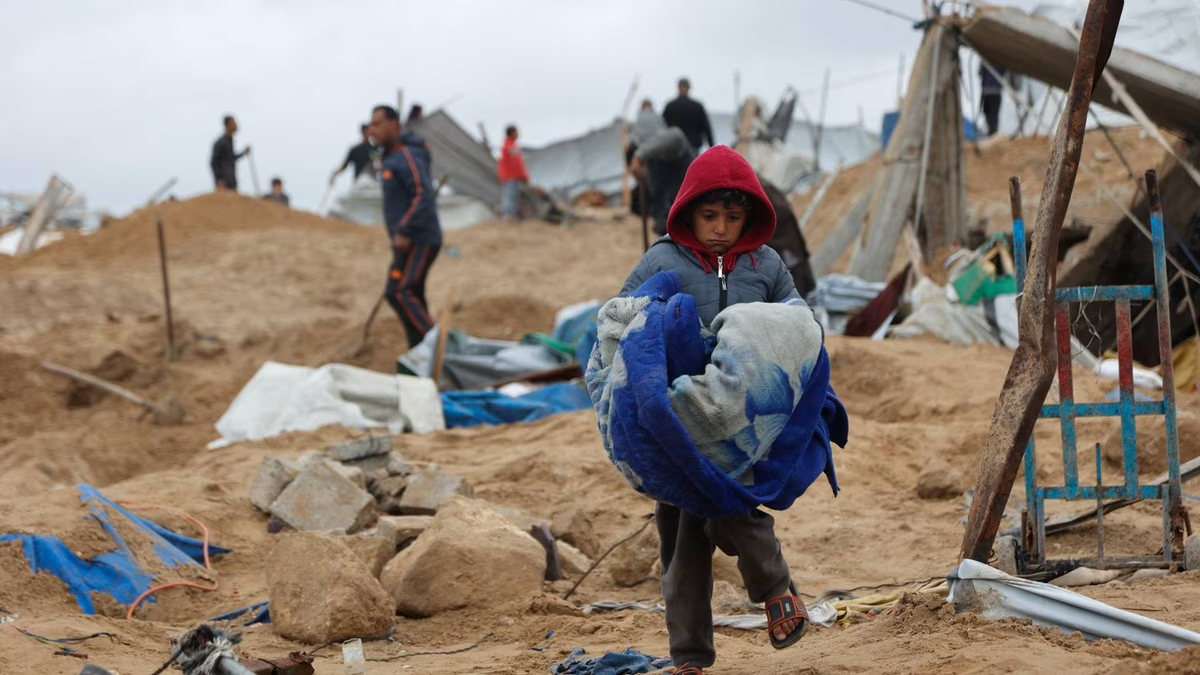
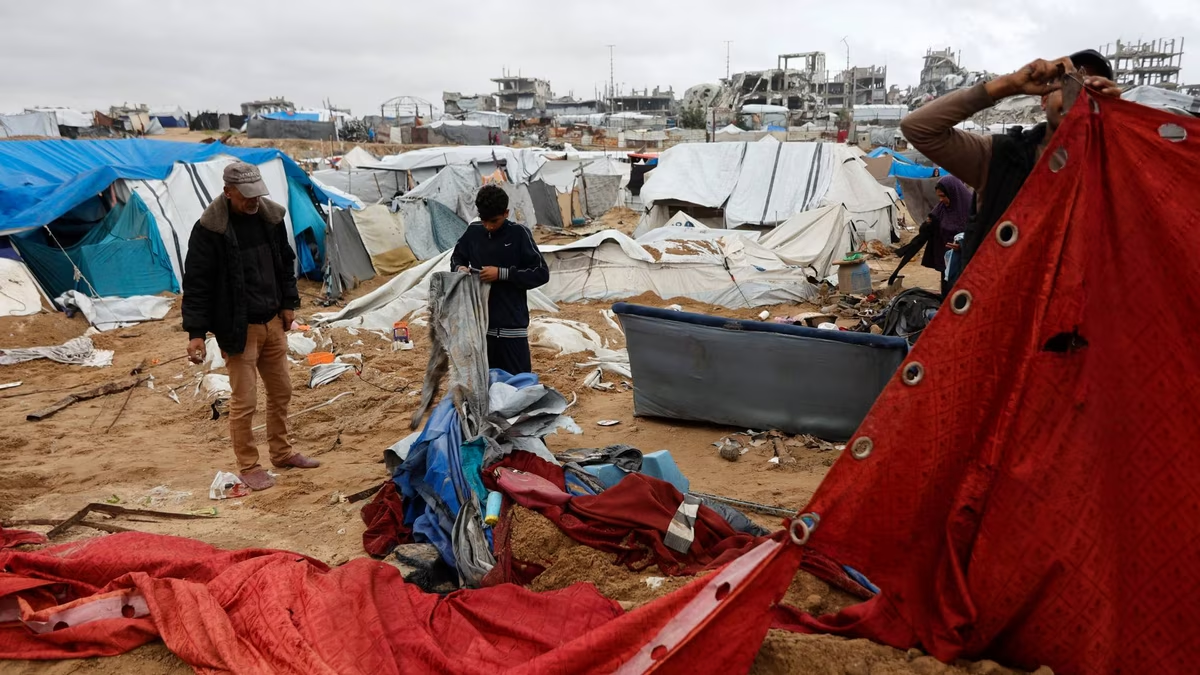
Winter hunts Gaza: Tents drown in rain.. and bitter cold gnaws at the bodies of the displaced

As the winter atmospheric depression deepens over Palestine, the rain showers, which the world awaits as good tidings, have turned into a nightmare haunting hundreds of thousands of displaced people in the Gaza Strip.

The fires of war are no longer the only threat; they have been joined by a "silent" and harsh enemy, represented by waves of bitter cold and strong winds that find no strong barrier other than worn-out fabrics and thin nylon sheets.

In the town of Beit Lahia, north of the Strip, the tragedy manifested in its worst forms; a child was injured when a cracked wall collapsed on him due to the strong winds accompanying the depression.

This incident reflects the bitter reality of thousands of families who were forced to remain in dilapidated buildings, after the occupation army destroyed their homes and prevented the entry of any building materials or even mobile homes (caravans).

As for the playgrounds and public squares, heavy rains have turned these areas into watery swamps that submerged tents, while winds uprooted others, forcing hundreds of families to go out into the open in very cold weather, searching for a dry refuge that does not exist.

Tents made of nylon and thin fabric lack the minimum elements of protection; they do not prevent water from flowing through them, nor do they ward off the bitter cold of winter that seeps into the frail bodies of children.

The absence of fuel and energy deepens the crisis; families are unable to secure any means of heating, making scarce firewood the only way to survive the night.

The continued prevention of entry of shelter materials and the deliberate abandonment of hundreds of thousands without material or health cover portends an inevitable humanitarian catastrophe.

Winter in Gaza is no longer a season for rain, but has become a season for death by hunger and cold under a roof that has no roof. The question remains in the mind of every child trembling with fear and cold: "How long will winter remain another enemy threatening what is left of our lives?"

PALESTINE

Fri 09 Jan 2026 3:26 pm - Jerusalem Time

Clarification to the Occupation regarding the "Egyptian Ship Incident".. Warning Shots and Confirmation of "Continued Coordination"

The Israeli occupation army issued an official statement commenting on the shooting incident off the coast of Gaza on Thursday evening, confirming that its naval forces "acted according to established procedures."

The statement clarified that naval units intervened after detecting an Egyptian warship entering a prohibited area, where they fired "warning shots in the air" after the ship failed to respond to initial requests to stop, which prompted it to change its course and return to Egyptian waters.

In a notable development to de-escalate the crisis, the Hebrew channel "i24NEWS" reported that Egyptian authorities expressed regret for the incident, described as "unusual," and confirmed their responsibility for it within the framework of mutual keenness to prevent escalation.

The Israeli army stressed in its statement that Egypt remains "a key partner in the peace agreement," confirming that security coordination between Cairo and Tel Aviv continues as usual and was not affected by this field friction.

The "Walla News" website indicated that the Israeli navy's handling prevented the ship from reaching the shores of the Gaza Strip.

The Israeli army confirmed that the incident did not result in any human casualties or material damage on either side, which reinforces the hypothesis of a "technical or navigational error" that was quickly addressed through military channels to ensure the preservation of maritime stability in this sensitive region.

PALESTINE

Fri 09 Jan 2026 2:23 pm - Jerusalem Time

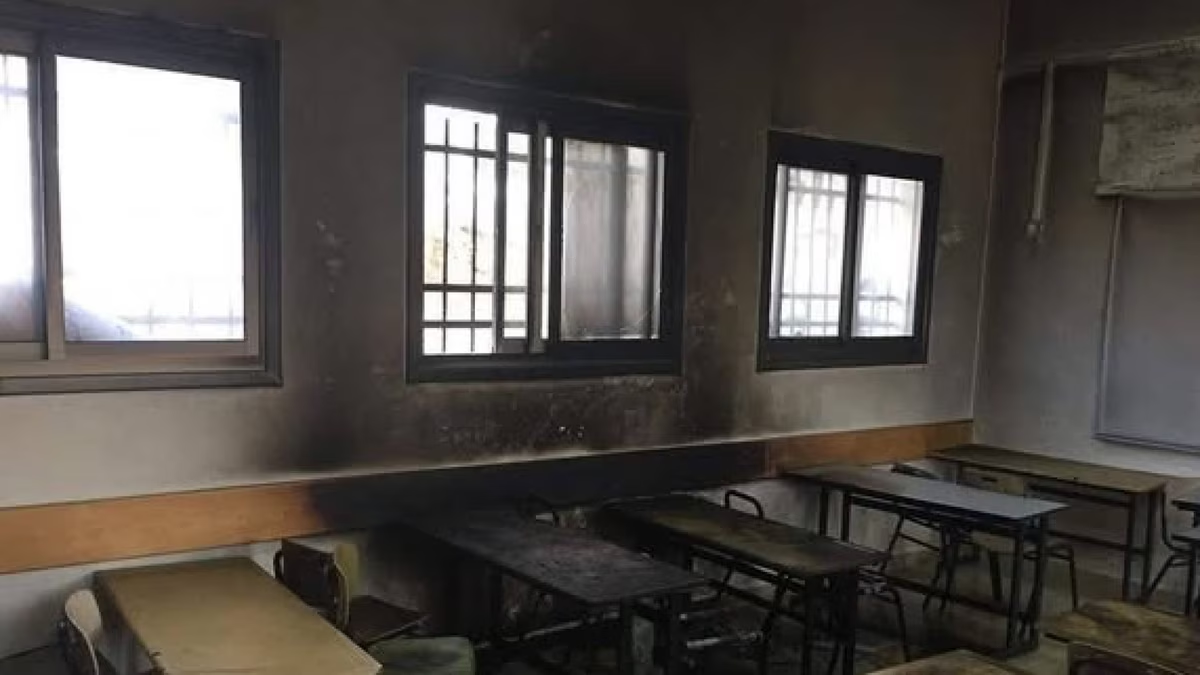
Settlers burn a classroom in Jalud school and write racist slogans

A group of settlers launched a racist attack in the early hours of Friday morning targeting the Jalud Mixed Secondary School, located south of Nablus city in the occupied West Bank. They deliberately set fire to one of the classrooms and vandalized school facilities, in a dangerous escalation targeting Palestinian educational institutions.

Infiltration, Arson, and Intimidation Field details indicated that the settlers secretly infiltrated the school campus, taking advantage of the dawn quiet, and set fire inside a classroom, which led to the complete burning of its contents and caused severe material damage to the building.

The matter did not stop at material sabotage; the attackers also wrote racist and hostile slogans on the school walls before withdrawing, in a move clearly aimed at spreading fear, terror, and intimidation among students and educational staff.

Read also: Settlers carry out a series of attacks in the West Bank

Official Condemnation and Calls for Intervention For his part, the Director-General of Education, Mr. Samer Al-Jamal, condemned this brutal attack, considering it a "direct and explicit targeting of the educational process" and a blatant violation of students' right to safe and stable education away from danger.

Al-Jamal issued an urgent appeal to all human rights organizations and relevant international bodies, calling on them to intervene immediately to put an end to these repeated attacks and provide the necessary protection for Palestinian schools.

Continuous Targeting It is worth noting that Jalud Secondary School is not immune to such attacks; it is continuously and semi-periodically subjected to settler attacks, due to its location in a friction zone suffering from continuous settlement ambitions, which poses a constant threat to the educational process there.

OPINIONS

Fri 09 Jan 2026 1:02 pm - Jerusalem Time

Universities as a Military Target

Baha Rahal

Baha Rahal

Opinion Writer

The repeated incursions into Birzeit University are clear and blatant evidence that Palestinian universities bother and anger them, because they are beacons of knowledge and learning, national strongholds that carry the country's ideology, and raise its intellectual and scientific banners in the world in the name of Palestine. They compete and excel in many fields, achieve important ranks, and provide knowledge in the fields of science, development, and artificial intelligence, supplying Palestinian society with creative energies and innovations in various fields. For this reason, we find the occupation raiding universities, wreaking havoc on property, intellectual and educational tools, and classrooms, arresting students, and firing bullets and poisonous gas bombs at students and professors, in revenge against the educational institutions that build the Palestinian individual, refine them with science, knowledge, and experience, and push them to be a worthy builder for the present and future.

And it is not far-fetched, as Gaza's universities were bombed by warplanes, some of them completely destroyed, and no college, institute, or university was spared, just as schools and kindergartens were not spared from bombing, burning, and destruction.

The incident of raiding Birzeit University two days ago is not the first, nor is it the only university against which such tampering and sabotage are practiced. All universities are subjected to such heinous aggressions, which the occupation sees as national strongholds, and they are indeed fortified with science, knowledge, and human development. This drives the occupation to repeatedly raid all universities and engage in deliberate sabotage, and it goes beyond that to even more absurd acts, with abuse and beating of students, professors, and all staff working at the university.

A few days before the raid on Birzeit University, Al-Quds University witnessed a similar raid, and convoys of military tanks and soldiers heavily armed with equipment and weapons entered the university campus. The university squares turned into a military barracks, and the soldiers practiced intimidation as they indulged in their hobby of firing bullets, gas, and smoke bombs. In every university in the homeland that is raided, the scene turns into something resembling a battlefield, with heavily armed soldiers and unarmed students and academic professors.

These incursions have no justification other than being the doctrine of the army that continues its rampage against everything Palestinian, in the university as in the field and factory, and on the roads and through retaliatory military checkpoints that abuse people and disrupt their lives. In light of all this, and in the absence of serious international intervention to protect the Palestinian people from this brutal arrogance, Palestinians must face their destiny and confront these policies aimed at disturbing people's lives with repressive and humiliating measures, where no one is safe from these practices, and the evidence is daily and repeated, across the entire land with its cities, villages, and camps.

PALESTINE

Fri 09 Jan 2026 12:24 pm - Jerusalem Time

American basketball star Kyrie Irving wears a shirt with a picture of Palestinian journalist and athlete Saleh Al-Jaafrawi

Social media platforms circulated - in the past hours - a video clip showing American basketball star Kyrie Irving wearing a shirt with a picture of Palestinian journalist and athlete Saleh Al-Jaafrawi, in a gesture that received wide interaction and brought renewed attention to Al-Jaafrawi's biography after his martyrdom.

Saleh Al-Jaafrawi is known as a young Palestinian journalist, in addition to his athletic career, as he was a table tennis champion and represented Palestine in several international competitions.

After his martyrdom, photos of him participating in sports tournaments spread, showing him carrying the Palestinian flag, in scenes that reintroduced him to the public not only as a journalist but as an athlete who carried his cause to the arenas of competition.

The circulated footage showed Irving wearing the shirt with Al-Jaafrawi's picture during a tournament, in a move that followers considered a message of solidarity and tribute to the memory of the Palestinian sports journalist, and an affirmation of his human and athletic presence, far from being reduced to just a name on the lists of martyrs.

On October 12, 2025, days after the announcement of the cessation of the war in Gaza; Palestinian sources reported the martyrdom of Al-Jaafrawi by bullets from armed men collaborating with the occupation in the Tal al-Hawa neighborhood south of Gaza City, while he was documenting scenes of destruction with his camera.

PALESTINE

Fri 09 Jan 2026 12:23 pm - Jerusalem Time

Occupation arrests widow of Yahya Ayyash in West Bank

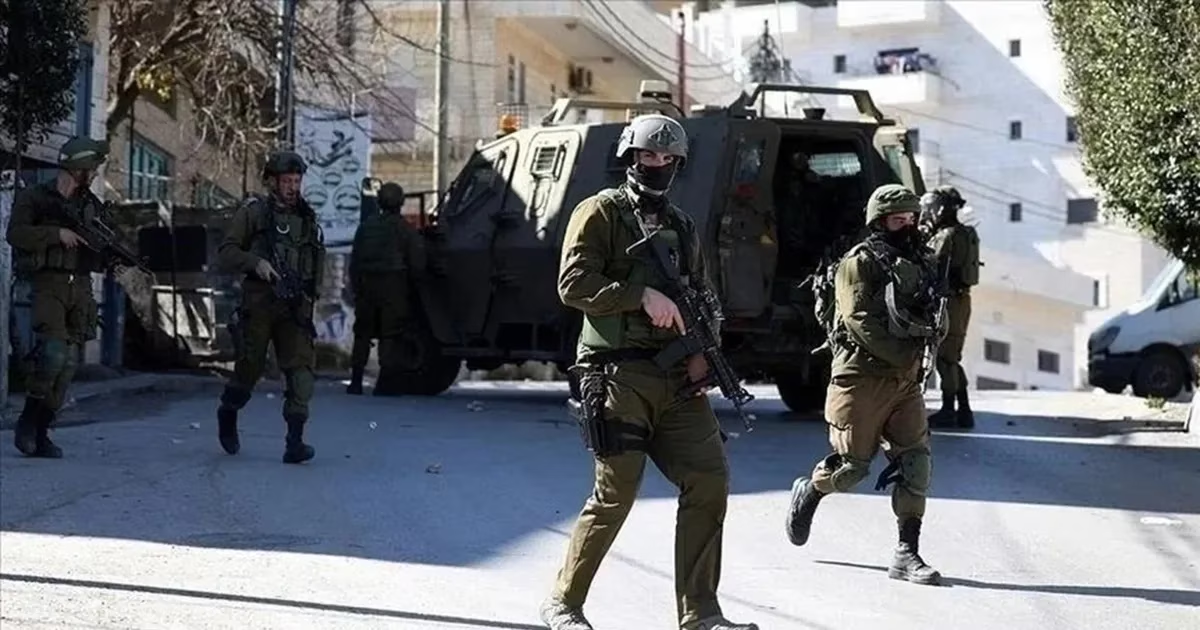
On Friday, Israeli occupation forces launched a wide arrest campaign in various areas of the West Bank, targeting the widow of the martyr engineer Yahya Ayyash, on charges of incitement via the Internet.

Palestinian sources stated that the occupation army stormed neighborhoods in Nablus, including the northern mountain area, raided and searched a number of citizens' homes, before arresting the Palestinian Hiyam Ayyash.

The sources added that the army hung a sign at the entrance to Ayyash's house after her arrest, which read: "Umm Al-Baraa was arrested for incitement on the Internet," accompanied by a picture of a post attributed to her on "Facebook."

Yahya Ayyash is considered one of the most prominent leaders of the "Al-Qassam Brigades," the armed wing of the "Hamas" movement. He was assassinated by the occupation forces in the Gaza Strip on January 5, 1996, with an explosive device planted in a mobile phone.

Today's arrest is part of campaigns carried out by the Israeli occupation army in cities and towns of the West Bank, for multiple reasons, including what the Israeli authorities describe as "incitement" through social media.

Meanwhile, the occupation forces arrested two Palestinians and detained dozens during a raid on a number of homes during their storming of several areas in the Hebron governorate, south of the West Bank.

Security sources reported that the occupation forces stormed the towns of Taffuh, Tarqumiya, Deir Samit, and Beit Ummar in the Hebron governorate, raided and searched a number of citizens' homes and tampered with their contents, before arresting citizens Bakr Khalil Ghraib and Muhammad Hussein Awad.

It indicated that the Israeli occupation forces, with a large number of their military vehicles, stormed the town of Yatta, spread in several neighborhoods of the town and around citizens' homes, raided a number of them, and detained dozens of them for long hours in the Al-Maidan area in the center of the town, including ambulance crews, and subjected them to field interrogation.

PALESTINE

Fri 09 Jan 2026 12:22 pm - Jerusalem Time

UNRWA's Decision to Dismiss Hundreds of Employees from Gaza: A Crime and a Death Sentence

With sadness and anger, Ismail Ayash describes the decision by the United Nations Relief and Works Agency for Palestine Refugees (UNRWA) to dismiss him and hundreds of other employees located outside the Gaza Strip as "a crime and a death sentence for us and our families."

Ayash, speaking by phone from Cairo, was overcome with tears more than once as he talked about the decision's impact on his family of 7, including 3 university students, who have no source of income other than his job. He explained that he has worked as a teacher for 30 years in UNRWA schools in Gaza.

"Is this how I am rewarded after dedicating my life and youth as a teacher in the organization?" asks Ayash (54), who was forced to travel with his family in February 2024 to escape the Israeli war.

On January 6th, the UNRWA Commissioner-General, Philippe Lazzarini, decided to terminate the contracts of employees located outside the Strip, after about a year of placing them on exceptional unpaid leave. Specialized committees for refugee affairs informed me that this decision affects 622 male and female employees who left Gaza during the war for various destinations, including approximately 580 in Egypt, the majority of whom are female employees, and most of them work in education.

In March 2025, UNRWA placed its employees abroad on exceptional leave for 12 months, ending next February 28th, justifying it with a financial crisis. In a message sent to those affected by the decision, it stated that it "continued to make every possible effort to provide and secure the necessary funds to support current programs and meet obligations related to staff salaries without being able to do so."

The message, which it considered an official notice of immediate termination of services, concluded by saying, "We express our sincere appreciation for your service and valuable contributions to the Agency's work for Palestine refugees."

Ayash wondered, "Is this how our services are appreciated? Is not the miserable life we have been living without salaries for about a year enough? Our dignity as employees has been violated as we chase aid packages, and many of us cannot afford the rent for the house where we live with our families." He affirmed, "We are also displaced, and we did not leave Gaza for luxury or tourism, but to escape death and extermination. We lost our loved ones and our homes, and now the Agency's decision to dismiss us comes to destroy us and our children's future."

He explained, "In the first week of the war, the Agency warned us to evacuate the northern Strip and head south, and later no decision was issued preventing employees from traveling outside Gaza to save themselves and their families."

On the first day Ayash and his family sought refuge in the home of his niece, Lina Mohammed Ayash, in Deir al-Balah city in the central Strip, a massive explosion occurred due to a raid targeting a neighboring house. Lina (30) was martyred while praying Fajr, leaving behind 4 children, and 4 others were injured among about 25 people, most of whom were displaced in that house.

Ayash continued, "We survived death, but my mother, who insisted on staying in her home in Gaza City, did not survive a similar raid and was martyred, as was Engineer Tawfiq, Lina's brother, due to an airstrike while he was walking in the street. I had no choice but to save my family."

Ayash was among those UNRWA placed on exceptional leave and whose monthly salaries have not been paid since then. He said that debts accumulated on him and that "many employees who were generous in their jobs and homes are now living on aid and donations from benefactors."

He and his fellow male and female teachers received the decision while they were working remotely to teach students in educational points and schools managed by the Agency in Gaza, following the massive destruction of hundreds of schools due to the war. Ayash was waiting for the reopening of the Rafah crossing to return to the Strip, and he explained his current feeling by saying, "I feel paralyzed and unable to think. What will I do? And why should I return when I have lost my job and my livelihood, and my home is destroyed?"

An UNRWA official contacted refused to comment on the decision, merely stating, "Unfortunately, we are prohibited from discussing this decision."

In turn, Basil Al-Wahidi, a member of the "Joint Committee for Refugees," who worked as an UNRWA employee for about 40 years, described the decision as a "massacre" against hundreds of male and female employees and consistent with displacement plans and the liquidation of the refugee issue. He rejected UNRWA's justification that it was due to a financial crisis, and said that the agency is awaiting responses from various concerned parties and host countries to proceed with similar decisions, which may not be limited to Gaza alone, and include other areas of its operations.

According to him, 100 employees in Lebanon are currently threatened with dismissal, while UNRWA suspended 20 security guards in Jordan and replaced them with a private security company "that costs more than their salaries," asking, "Where is the justification for the financial crisis when it uses a private security company? Why does the termination decision focus on male and female teachers who were working remotely?"

Al-Wahidi added that "these employees did not leave Gaza for luxury or a picnic, but to escape certain death, bombing, and starvation. Most of them are sick or accompanying sick people, and instead of being treated fairly and protected, they are punished with dismissal and expulsion, as if saving one's life has become a crime that deserves punishment."

He held the UNRWA Commissioner-General responsible, stating that "he is at the end of his term, with only a few weeks left, to leave the institution with a black record titled 'dismissal of teachers and employees, and starvation of refugee families.'" He considered that this decision "dangerously aligns with the occupation's policies aimed at breaking Palestinian society, undermining its stability, and dismantling its social, food, and employment security."

For its part, the Department of Refugee Affairs in the Palestine Liberation Organization said that "the UN agency is taking decisions and measures that go beyond the funding crisis and amount to systematic administrative execution."

The head of the department, Ahmed Abu Houli, considered in a statement that the 20% reduction in salaries of Gaza and West Bank employees, the termination of contracts of hundreds of Gaza cadres abroad, and the suspension of UNRWA headquarters security guards in Jordan in favor of a private security company, represents "a stab in the back of employees who formed a safety valve for the agency and provided 382 martyrs from their best cadres under direct Israeli shelling."

For its part, the Islamic Resistance Movement (Hamas), in a statement, described the decision as "unjust and violates the fundamental rights of employees who are prevented by the conditions of the war of extermination, and the fascist occupation's closure of the Rafah crossing, from returning to the Gaza Strip."

The "Democratic Gathering of Teachers," in a statement, considered that the decision "largely aligns with the occupation's plans aimed at targeting UNRWA and undermining its historical and legal role," and expressed its categorical rejection that "workers pay the price for the measures and harassment the agency is subjected to by the occupation; for the employee is the first line of defense for the institution and not a scapegoat for its financial or political failure."


ARAB AND WORLD

Fri 09 Jan 2026 10:47 am - Jerusalem Time

Steny Hoyer Retires from Congress After Decades of Pro-Israel Influence and Loyalty to AIPAC

News Analysis

Veteran Democratic Congressman from Maryland, Steny Hoyer, announced on Thursday his intention to retire after more than four decades in the U.S. Congress. Hoyer's retirement from the House of Representatives not only marks the end of a long political career but also opens a wide door for a re-evaluation of the role of one of the most prominent architects of the special relationship between the United States and Israel within the American legislative institution. Hoyer, who held high leadership positions in the House of Representatives and was known as AIPAC's primary man, was for many years a symbol of what is known as the "pro-Israel consensus" within the Democratic Party, and a central link between the party leadership and pro-Tel Aviv lobbying groups, foremost among them AIPAC.

Since his election in 1981, Hoyer established himself as a pragmatic, centrist politician, but on the issue of Israel, he adopted a firm and unequivocal stance: unconditional support for military aid, and providing political and diplomatic cover for Israeli policies, even when they clearly contradicted international law or the stated American discourse on the two-state solution. This steadfastness was not merely an ideological position, but part of an integrated structure of influence, in which Hoyer used his leadership position to guide internal party debate and contain critical voices, especially with the rise of the progressive wing.

One of the most significant manifestations of this influence was his repeated leadership of congressional delegations to Israel, trips that were organized and funded through the "American Israel Education Foundation" (AIEF), an arm associated with the AIPAC lobby. These trips, often held every two years during parliamentary recesses, became a semi-institutional political ritual, involving a large number of newly elected representatives in each election cycle (usually in August of every other year).

These trips were not merely protocol visits; they were carefully designed to shape the mindset of new representatives regarding "Israel's security" and "regional threats," through field tours and meetings with military leaders and Israeli officials, in contrast to a limited – or symbolic – presence of the Palestinian narrative. Under Hoyer's leadership, these delegations acquired an organized partisan character, as they were seen as part of the process of integrating new representatives into the "traditional parliamentary consensus" on supporting everything Israel does, including the Israeli war of annihilation.

Here lies the fundamental problem: while these trips are presented as legitimate educational activities, observers see them as a form of effective soft influence exercised by lobbying groups, especially when targeting legislators early in their political careers, before their independent positions are solidified. In this context, Hoyer played the role of "political guarantor" of this process, leveraging his organizational weight and his close ties with pro-Israel campaign donors.

However, recent years have witnessed a clear crack in this model. With the escalation of criticism within the Democratic Party of Israeli policies in Gaza and the West Bank, and with increasing talk about settlements and human rights, the number of new representatives participating in these trips has begun to decline. Some Democrats have also openly declared their refusal to accept AIPAC support, indicating a gradual shift in party sentiment, especially among young people and progressive voters.

Hoyer's departure, at this particular time, carries deep symbolic significance. It not only means the exit of an influential figure but also indicates the decline of an entire political generation that viewed supporting Israel as a matter beyond partisan debate. With his absence, the debate within the Democratic Party is expected to intensify regarding the conditions of military aid, the limits of the relationship with the Israeli government, and the role of lobbying groups in shaping American foreign policy.

The model of funded trips (for new representatives and their families) to Israel demonstrates how political influence can be exercised without direct legislation or pressure. Personal experience, when carefully crafted and presented at an early political moment, becomes an effective tool for reproducing long-term political positions. Hoyer's role here was not only organizational but also educational in its political sense, as he contributed to "forming" generations of legislators with a single vision of the conflict.

It should be noted that the shift within the Democratic Party does not necessarily mean a break with Israel, but rather reflects a growing desire to redefine the relationship away from blind alignment. Resistance to this shift by traditional leaders like Hoyer delayed the debate, but did not stop it. With his exit from the scene, critical voices may find more space to link American support to human rights values and international law.

The most important aspect of Hoyer's retirement is not what has ended, but what may begin. The question now is: will new leaders fill the void and reproduce the same model, or does the political moment allow for a genuine review of the role of lobbies in guiding foreign policy? The answer will determine the future of the American debate on Israel, and perhaps redraw the boundaries of the "consensus" that governed Washington for decades.

OPINIONS

Fri 09 Jan 2026 10:40 am - Jerusalem Time

Political Awareness and the Possible in the Palestinian Mind Today

Yazan Sammaro

Yazan Sammaro

Opinion Writer

At a Palestinian moment burdened by complex crises, where occupation intertwines with division, and politics recedes before the management of daily crises, political awareness emerges as an urgent and undeniable need. However, the fundamental question is no longer: Do we need awareness? Rather, what kind of awareness do we want, and for what political mind is it intended? Between an excess of discourse and a scarcity of critical thinking, the paradox appears stark in the current Palestinian scene.

Political awareness, in its deep meaning, is not a transfer of information nor a reproduction of slogans, but a critical practice aimed at rebuilding the relationship between reality and the possibilities of changing it. However, what is often presented today does not go beyond describing the predicament or adapting to it, without radical questioning of its causes or serious thought about ways out of it. Here lies the flaw: when awareness turns into a repetitive explanation of what we already know, it loses its ability to make a real impact on collective consciousness.

In the Palestinian context, political awareness cannot be separated from its responsibility to expose the mechanisms of producing helplessness, whether imposed from outside or accumulated internally. Insisting on attributing every imbalance solely to the external factor, despite its centrality, exempts local political and social structures from any accountability, and weakens society's ability to honestly review its experience. And consciousness that does not practice self-criticism quickly turns into defensive consciousness, justifying more than it changes.

As for the Palestinian intellectual, they find themselves facing a delicate equation: how to maintain their intellectual independence in a highly polarized environment, without their criticism turning into a position of isolation or misunderstanding? However, the gravity of the stage dictates that the critical mind should not be content with balanced analysis, but should contribute to expanding the horizon of public debate, and restore the importance of a culture of questioning and accountability, as two essential conditions for any conscious political action.

From here, talking about the “possible” becomes an intellectual necessity, not a theoretical luxury. The Palestinian possible is not what we wish for, nor what the moment alone allows, but what can be gradually built through a precise understanding of the balance of power, and an accumulation of social awareness capable of transforming knowledge into action. It is a possible that takes shape when we realize the limits of power and the limits of discourse together, and when we distinguish between political realism and surrender disguised in the language of rationality.

The biggest challenge facing political awareness today lies not in the scarcity of platforms, but in the narrow ceiling within which thought is allowed to move. When political discussion is reduced to improving the conditions of the existing reality, without raising fundamental questions about its alternatives, consciousness becomes a tool of control, not a tool of liberation. And awareness that does not disturb assumptions or stimulate different thinking risks becoming part of the problem it seeks to address.

The Palestinian possible begins with restoring confidence in the mind, and in its ability to understand and influence, and with reconnecting knowledge with political and social action. When a Palestinian understands their position in the conflict, and comprehends its complexities without exaggeration or simplification, they become more capable of resisting misinformation, and less susceptible to being drawn behind emotional or simplistic discourse.

In conclusion, political awareness is not an elitist discourse delivered from above, but an interactive process that accumulates consciousness and restores the importance of collective action. In a time when questions multiply and ready answers narrow, the reliance remains on a critical mind that sees thinking itself as a form of resistance, and in expanding the horizon of the possible as a condition for any viable national liberation project.

PALESTINE

Fri 09 Jan 2026 9:27 am - Jerusalem Time

The Occupation launches air and ground attacks on Hamas sites in the Gaza Strip

The Israeli army and the Shin Bet General Security Service announced, in a joint statement issued on Friday, the implementation of a series of air and ground attacks targeting sites of the "Hamas" movement in the Gaza Strip, in response to what the statement described as a "failed launch operation" carried out on Thursday towards Tel Aviv.

The occupation army's statement clarified that the attacks targeted "armed elements and infrastructure" belonging to the Hamas movement in both the southern and northern Gaza Strip.

The target bank - according to the occupation's narrative - included targeting a number of the movement's activists, in addition to bombing rocket launch sites and additional military infrastructure.

In a sharp political message, the occupation army considered the firing of rockets from Gaza to constitute a "flagrant violation of the existing ceasefire agreement," holding Palestinian factions responsible for this breach.

The statement stressed that the Israeli security establishment views any violation of the agreement "with extreme seriousness," vowing that the army and Shin Bet "will continue to act against any attempt by organizations in Gaza to carry out plans against army forces and citizens of Israel."