PALESTINE

Tue 27 Jan 2026 5:18 pm - Jerusalem Time

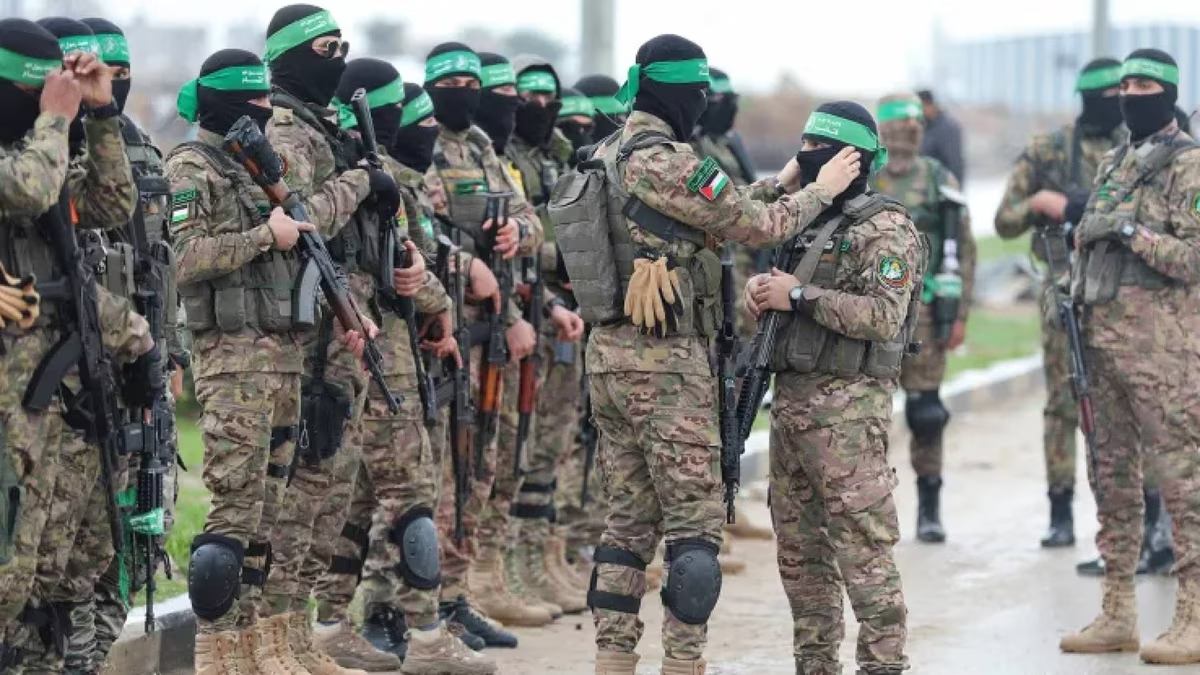
The integration obstacle.. Hamas seeks to include 10,000 policemen in the "Gaza administration" and Tel Aviv insists on disarmament

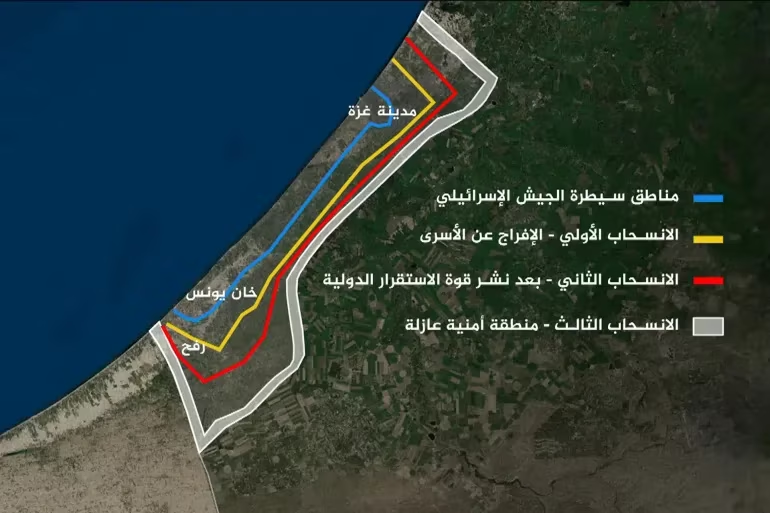
The plan aims to integrate these elements into what is known as the "National Committee for the Administration of Gaza" in a move that may complicate the arrangements for the post-war period. Sources revealed that the Hamas movement seeks to integrate about 10,000 of its police officers into the new administrative structure that is scheduled to replace the organization in the administration of the Gaza Strip.

The plan aims to integrate these elements into what is known as the "National Committee for the Administration of Gaza," or the entity referred to as the "technocrat government."

This step is expected to face strong opposition from Israel, given its continuous and conditional demand for the complete disarmament of Hamas before any political arrangements.

Meanwhile, during a press conference held in the Kazakh capital, Astana, after meeting his counterpart Yermek Kosherbayev, Israeli Foreign Minister Gideon Sa'ar outlined the current Israeli position: Support for American efforts: Sa'ar stated that "the occupation supports US President Donald Trump's plan to end the war in the Gaza Strip." The basic condition: He stressed that achieving this plan requires "disarming Hamas and demilitarizing the Strip."

The occupation minister explained that stability in the region depends on dismantling what he described as "Iran's sponsoring states in the Middle East," listing them as: Hamas in Gaza, Hezbollah in Lebanon, and the Houthi group in Yemen, considering this dismantling as "the goal" to ensure regional security.

PALESTINE

Tue 27 Jan 2026 5:08 pm - Jerusalem Time

Trump praises Hamas for enthusiastically helping to recover Israeli captive's body, pushes for its disarmament

Said Erikat

Opinion Writer


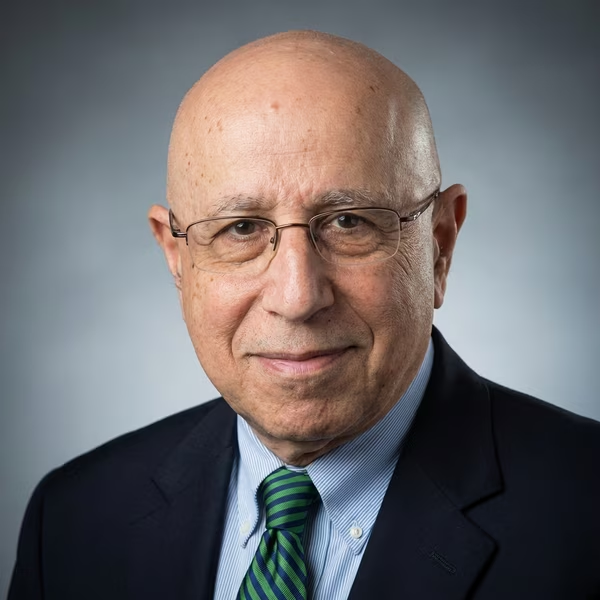
US President Donald Trump said on Monday that Hamas played a direct role in helping Israel locate and recover the body of the last Israeli hostage held in the Gaza Strip, a remarkable statement that broke the traditional pattern of American rhetoric towards the movement, and came loaded with political messages that went beyond the humanitarian event itself. Trump considered this cooperation, which he described as "rare," proof that communication with adversaries is possible when interests intersect, but at the same time stressed that this step must be completed by disarming Hamas as a crucial condition for any future for Gaza.

In an interview with the American website Axios, Trump said that Hamas "worked hard" to facilitate the recovery of the remains, indicating direct or indirect coordination between it and the Israeli side. He added that this incident constitutes practical evidence that the movement is capable of adhering to specific understandings when it wishes to do so, before linking this behavior to the necessity of moving to what he described as the "next stage," meaning the dismantling of the movement's military structure. Trump said in a firm tone: "Now is the time for disarmament, as they promised."

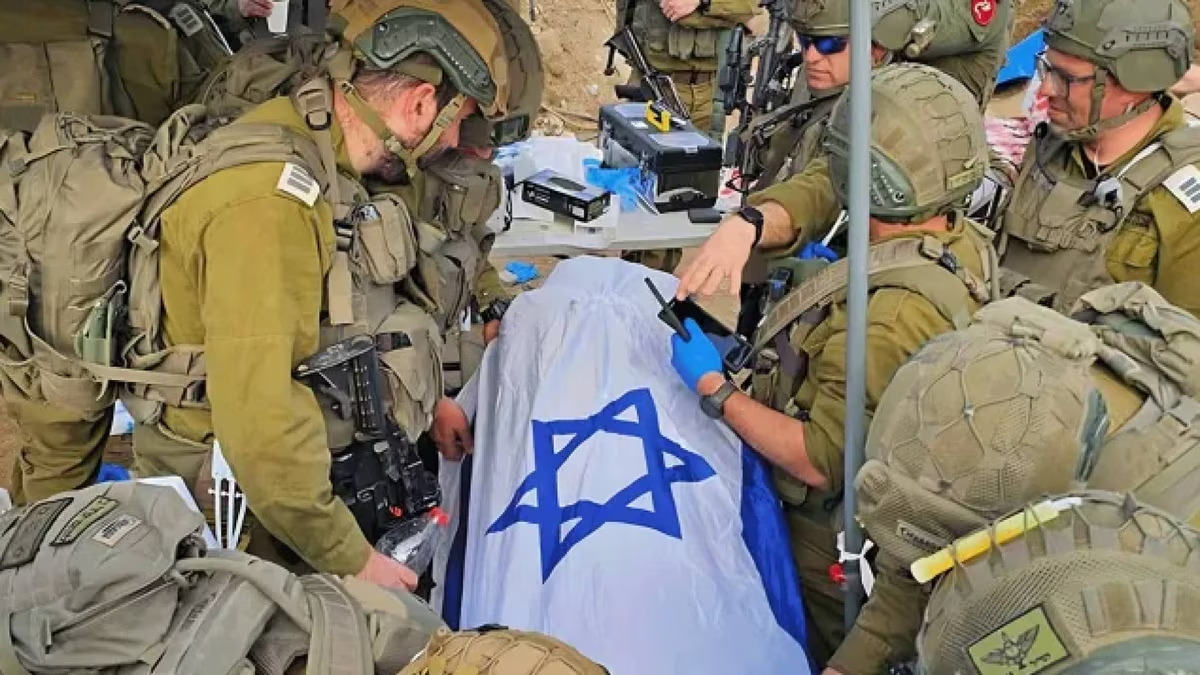
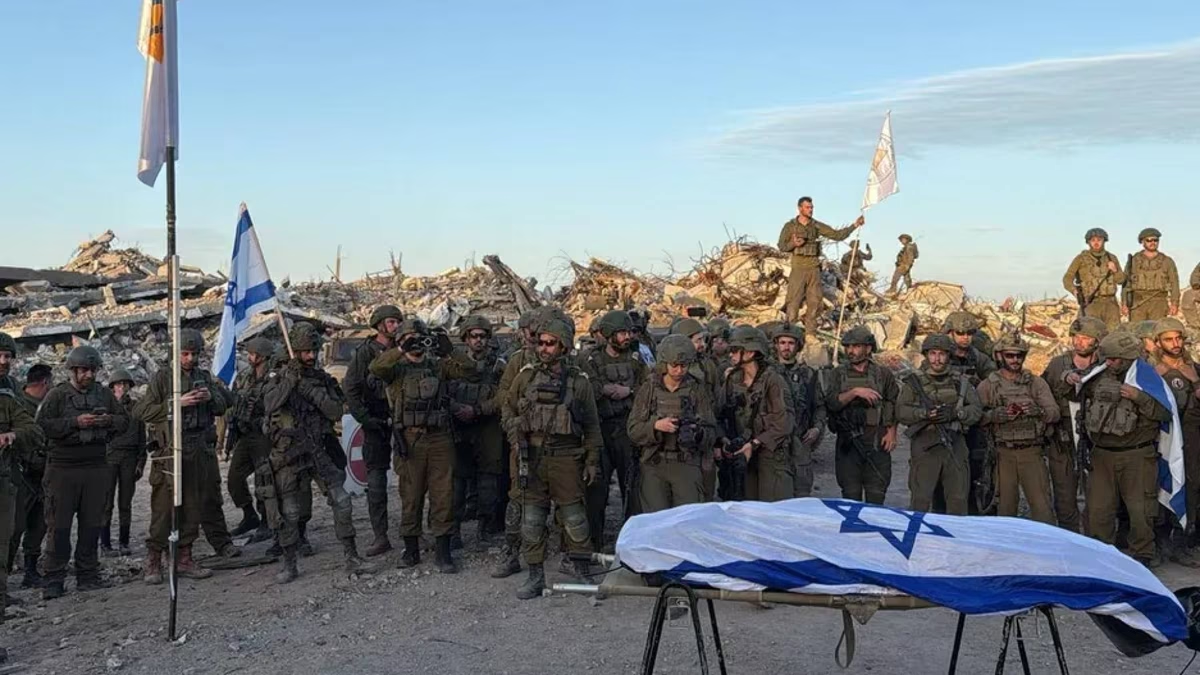
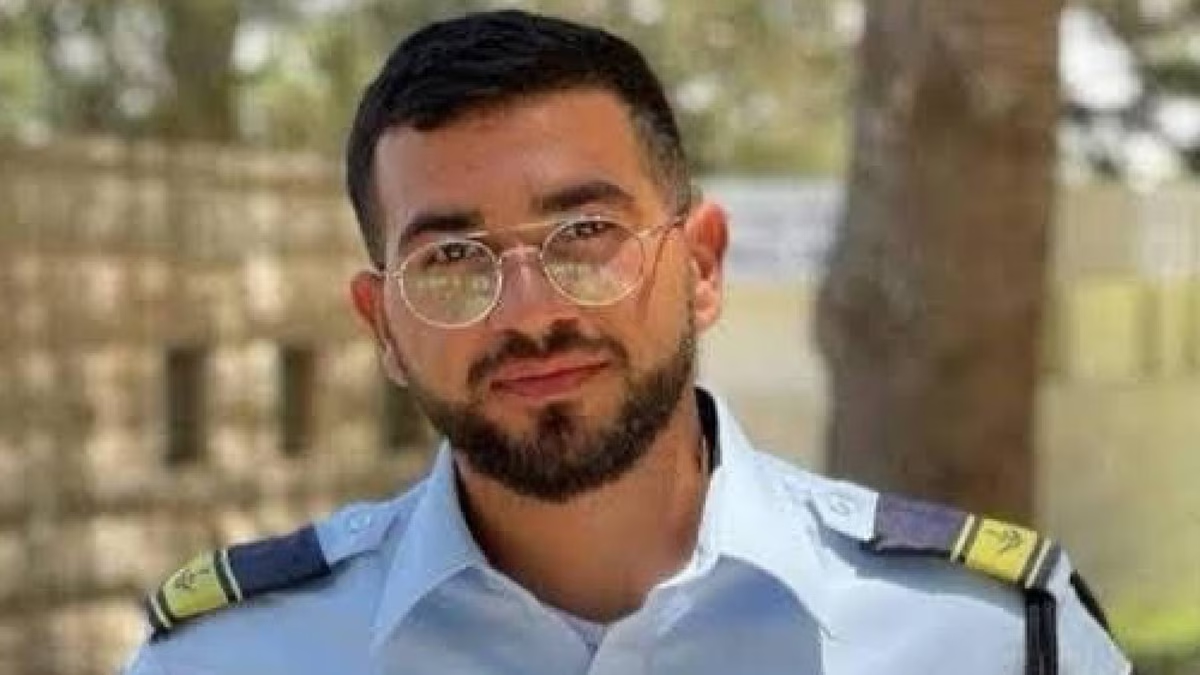
Trump's statements came after the Israeli army announced the recovery of the remains of Israeli police Staff Sergeant Ran Gvili, during a special operation carried out in Gaza City based on recent intelligence information. While official Israeli statements focused on military and intelligence efforts, Trump's statements seemed different in tone, as he unusually highlighted Hamas's role in facilitating the operation, which observers considered an attempt to reframe the political scene surrounding the post-ceasefire phase.

In a subsequent briefing, a senior American official reinforced President Trump's narrative, confirming that Hamas was "very cooperative" during the recovery operation, and that it adhered to arrangements agreed upon within the framework of the ceasefire. The official criticized what he described as the "political hysteria" that surrounded the hostage file, considering that field cooperation, however limited, led to tangible results that cannot be denied.

The official explained that the recovery operation took place through a "coordination cell" supported by the United States, established at the beginning of the ceasefire in October 2025, and included Israel and regional mediators, including Egypt, Qatar, and Turkey. The Trump administration presented this mechanism as a model of "hard pragmatism" that allows for the achievement of specific goals even in the midst of open conflicts.

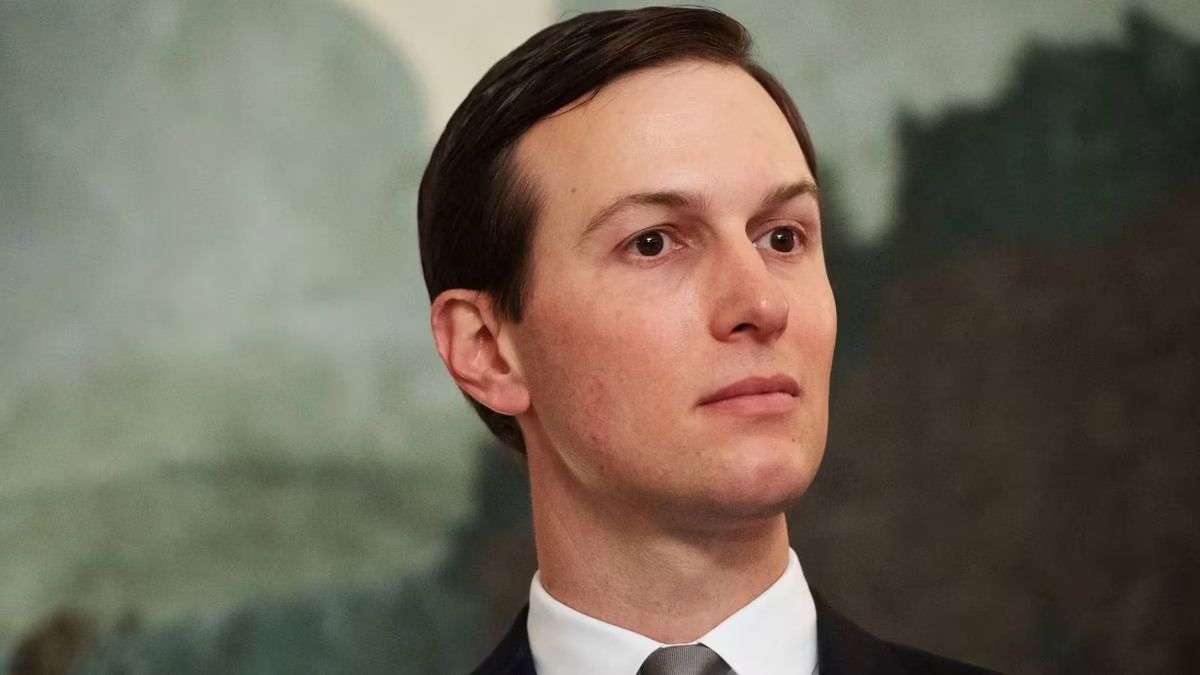
Jared Kushner, Trump's son-in-law and senior advisor, also pointed to the multinational nature of this coordination, praising the role of the United States, Israel, and regional countries, in addition to what he called "the cooperation of local residents in Gaza," in facilitating the return of the bodies of all deceased hostages. American officials considered the operation a diplomatic and logistical success, despite the secrecy surrounding its details.

The American administration acknowledged that it was not certain of the possibility of recovering all hostages, and that it was prepared to move forward with Trump's broader plan for Gaza even if some remained missing. An American official said that the recent success spared the administration highly sensitive political and moral decisions.

However, the core of Trump's discourse, according to officials, revolves around disarming Hamas. The administration has repeatedly affirmed that the reconstruction and stability of Gaza are conditional on the dismantling of armed groups. An American official indicated that the twenty-point American plan includes the possibility of granting amnesty to Hamas fighters who agree to disarm.

The Israeli occupation government welcomed the principle of "amnesty for disarmament," despite the internal criticism it provoked, while Hamas reiterated its public rejection of any harm to its weapons. However, American officials confirm that the movement signed broader understandings that include this clause, warning that Trump may resort to "other measures" if there is no compliance.

The American administration says it is working with Israel and regional mediators, including Turkey, on an organized disarmament program, in parallel with arrangements to reopen the Rafah crossing, support the formation of a local Palestinian security force, and activate the Peace Council recently launched by Trump to oversee post-war arrangements.

According to informed sources, the recovery of the last hostage's remains was not just the end of a thorny humanitarian file for Trump, but rather turned into a political card in which he sees evidence that pressure can yield cooperation, provided that it ultimately leads to a radical change in Gaza's security reality.

Trump's statements reveal a new American approach based on investing any pragmatic behavior by Hamas to transform it into a broader political entry point, not as recognition of the movement, but as an additional pressure tool. Focusing on Hamas's cooperation in a sensitive humanitarian file gives Washington room to justify more stringent demands later, foremost among them disarmament, while presenting this to public opinion as a logical and gradual path, not as a unilateral imposition.

In contrast, this discourse raises questions about the limits of American pragmatism, and whether Washington is overstating a limited incident as an indicator of Hamas's readiness for strategic change. The recent history of the conflict suggests that tactical cooperation does not necessarily mean a deep political transformation, which makes Trump's bet on disarmament a real test of the ability of American pressure to re-engineer the scene in Gaza.

PALESTINE

Tue 27 Jan 2026 3:33 pm - Jerusalem Time

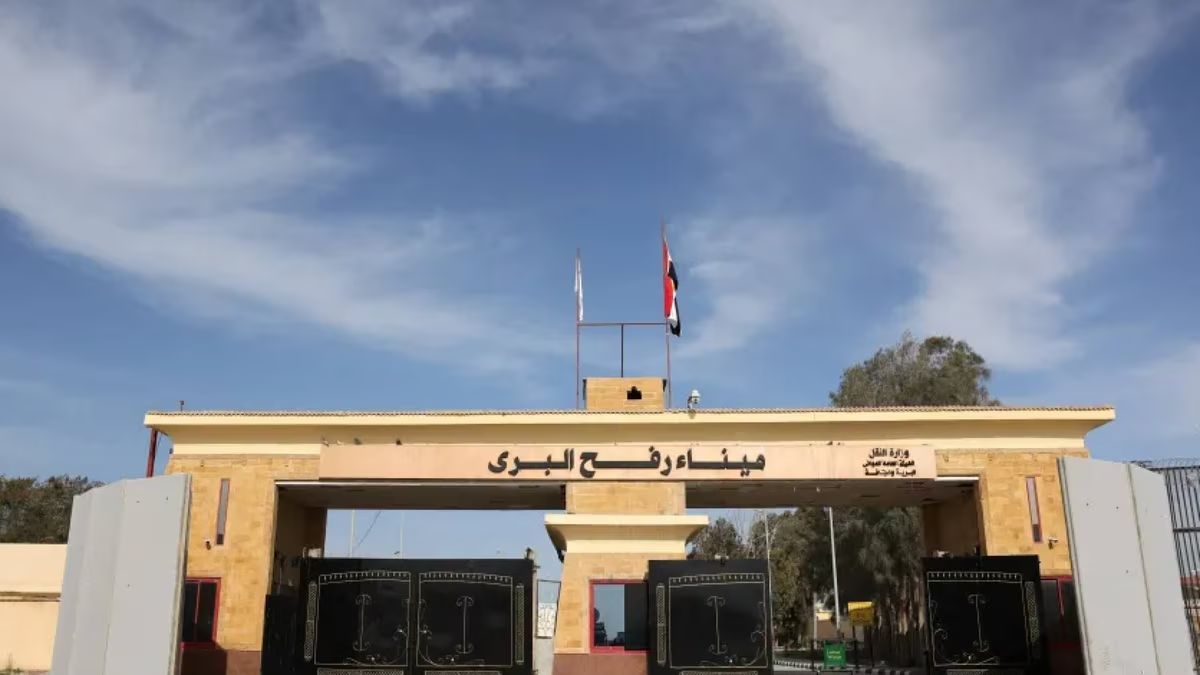
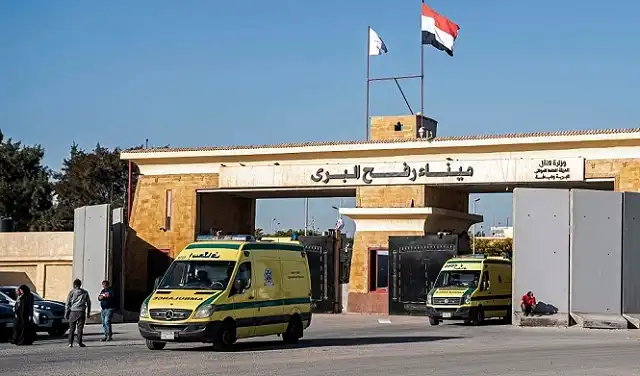
Hebrew media: Estimates of Rafah crossing opening on Wednesday or Thursday

Hebrew media sources reported estimates of the reopening of the Rafah border crossing, which is considered the main lifeline for the Gaza Strip. These movements come amidst technical and field data indicating the imminent resumption of work at the crossing, following new international arrangements aimed at regulating and ensuring the continuity of movement.

Reports from Hebrew media outlets stated that there are serious estimates indicating the possibility of opening the crossing to traffic next Wednesday and Thursday.

According to these sources, the relevant authorities of the "Occupation" are closely monitoring the security and logistical preparations that have been made between international parties, as this return is expected to be governed by strict control measures.

PALESTINE

Tue 27 Jan 2026 2:33 pm - Jerusalem Time

The paradox of death in Gaza.. an entire army to recover a body for the occupation and 10,000 martyrs under the rubble without graves

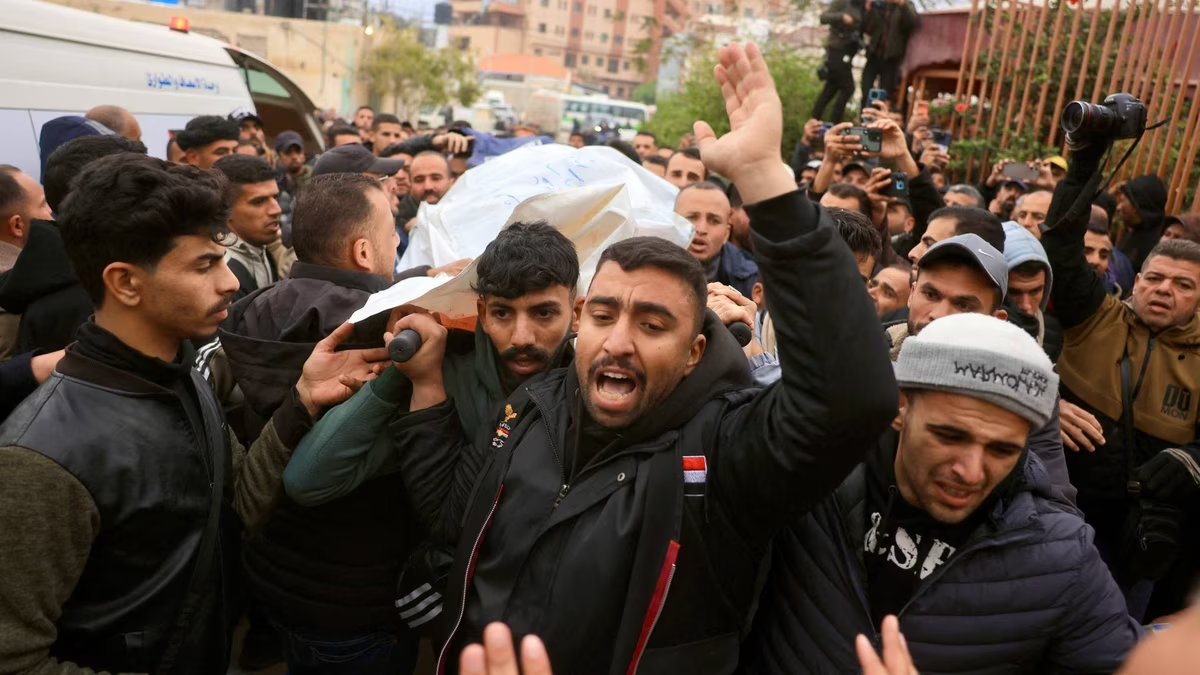
A paradox that reveals a "disparity in the value of a human being" even in their death, in a scene that summarizes the peak of moral and humanitarian contradiction in the Gaza war, the occupation mobilized its massive military machinery for two full days, committing a blatant violation of the sanctity of the dead by exhuming and bulldozing more than 250 graves in the "Al-Batsh" cemetery in the Al-Tuffah neighborhood, east of Gaza. All this destruction and mobilization had only one goal: to find the body of one soldier, "Ran Gvili," who has been missing since October 2023. This operation, celebrated by Tel Aviv as an "unprecedented achievement," in contrast, exposed a painful truth and an undeniable paradox, raising a resounding question: What about the dignity of more than 10,000 Palestinian martyrs who are still buried under the rubble for months, without the world moving a finger to honor them with a proper burial?

Violation of 250 Palestinian graves.. and the world remains silent. Under heavy fire, the occupation forces did not hesitate to bulldoze hundreds of graves containing the remains of Palestinian martyrs and dead, in a behavior described by human rights activists as a blatant assault on human dignity even after death. While the occupation exerts enormous intelligence and military efforts to recover the remains of its dead, the bodies of thousands of Palestinians, including women and children, are left to decompose under the rubble of destroyed buildings, amid an international inability to impose a humanitarian truce that would allow their extraction. This is a paradox that reveals a "disparity in the value of a human being" even in their death, where one body becomes a national and military priority, while tens of thousands of victims on the other side are neglected.

The dead as political bargaining chips. The paradox did not stop at the military implementation; reports revealed political complicity within Benjamin Netanyahu's government. Despite accurate information about the location of Gvili's body being available for weeks – information provided by the resistance to mediators – the political level of the occupation delayed the "green light" for the operation. Analysts indicate that this delay was deliberate to link the issue of the body to other political bargains, such as obstructing the opening of the Rafah crossing or manipulating the exchange deal file, which transformed the issue from its alleged humanitarian dimension into a cheap political pressure tool.

The illusion of "military pressure." While the occupation tries to market this operation as evidence of the effectiveness of "military pressure" in recovering prisoners, the numbers belie this claim. The military option has only saved 8 living prisoners since the beginning of the war, while it led to the death of 41 other Israeli prisoners, some by their own army's fire. In contrast, negotiations and mediations succeeded in recovering 126 prisoners, which confirms that military operations, such as the exhumation of the Al-Tuffah cemetery, are often more performative and destructive than life-saving. The image of the bulldozed cemetery in Gaza remains a testament to a time when even the right of the dead to eternal rest is subject to double standards and ruthless political calculations.

Testimonies from the heart of the tragedy. Ahmed Al-Masry (50 years old), a resident of Al-Tuffah neighborhood, says with words of pain, "I came to check on the graves of my brother and children.. I couldn't even get close, everything is destroyed and ashes, I can't believe how there can be such a huge effort to find the body of a soldier, while our relatives and loved ones are under the rubble. I saw the graves shattered as if death no longer respects itself.. every memory erased, this is an indescribable feeling, pain, sadness, and anger at the same time, where is the dignity of the dead?"

He adds, after a sigh that describes the extent of oppression, "My children are buried in Al-Batsh cemetery, east of Gaza City. I found their graves completely excavated and demolished. I felt helpless and let down. The world watches and remains silent while our souls are treated as if they are nothing. How can an entire army be dedicated to one body while thousands of dead are left without any respect? The sounds of shelling and dust remind us that death in Gaza has no limits."

The pain is not much different for citizen Maysoun Ibrahim, who expresses: "My mother was buried in Al-Batsh cemetery years ago, and we were surprised that her grave was completely destroyed and we found no trace, as if memory itself had been erased. I feel a lump in my throat that never leaves my heart, as her loss has become heavier amidst this destruction."

"The exhumation, bulldozers, and destruction made me feel completely helpless, as if our whole lives are treated as if they are nothing, for the dead need dignity even after their departure."

OPINIONS

Tue 27 Jan 2026 2:28 pm - Jerusalem Time

Denial of the Palestinian State and the Dilemma of Open Conflict

Dr. Ibrahim Nairat

Opinion Writer

While the Israeli right declares its pursuit to kill the idea of a Palestinian state in the name of security, it overlooks a dangerous paradox: denying this state not only threatens Palestinians but also leaves Israel's own existence without historical closure, suspended in an open conflict with no clear end.

In repeated statements from the leaders of the ruling Israeli right, a discourse is entrenched that explicitly rejects any political horizon leading to the establishment of a Palestinian state, portraying this option as an existential and security threat to Israel. This discourse, which links preventing a Palestinian state with promoting settlements as a “security belt,” invokes the Gaza experience as a model used to justify the complete closure of any future settlement. However, what appears on the surface to be an expression of security resolve, in its essence reveals a mixture of ideological deviation and strategic shortsightedness, as it reflects a conscious desire to erase any political horizon for Palestinians, without realizing that this path does not provide security, but rather keeps Israel in a state of constant anxiety and an incomplete political and historical existence.

After more than seventy years of conflict, the existence of Palestinians has become a political and historical reality that cannot be bypassed or erased from the equation. Just as the idea of a Jewish state, which seemed like a surreal dream at the beginning of the last century, became a reality due to international transformations and political power, the idea of a Palestinian state, in turn, is no longer a slogan or an illusion, but has become a reality that is entrenched despite all attempts at denial. Denying this reality does not abolish it, but rather increases its complexity and postpones the moment of explosion.

What the Israeli right is proposing today in the West Bank does not represent a security project or conflict management, but rather an open recipe for endless conflicts. The image it seeks to entrench is based on settlements scattered among Palestinian cities and villages, which over decades transform into adjacent and intertwined population centers, requiring continuous and exhausting security measures. This model does not produce stability, but rather generates constant friction, making every street and village a potential flashpoint. It is a continuous fuel for a low-intensity but long-term conflict that drains everyone and does not lead to a decisive outcome.

Insisting on denying the Palestinian state is like trying to burn the only bridge to a stable future. Refusing to recognize Palestinian national rights does not achieve security, nor does it end the conflict; rather, it guarantees its continuation for additional decades. Palestinians exist on the ground, and their continued presence is part of the geographical and historical reality, and any attempt to cancel this reality means a long-term drain on Israel itself, transforming it into an incomplete entity, suspended on the whims of history, and vulnerable to political and demographic fluctuations.

The great paradox lies in the fact that rejecting a Palestinian state is, in essence, a rejection of solidifying the occupation state itself. Recognizing a Palestinian state could have constituted a moment of historical closure for the conflict file, and a final seal on the issue of existence and legitimacy. As for keeping the issue open, it keeps the state itself open to doubt and questioning, as if it has not yet succeeded in transitioning from a project of power to a stable, definitive state, despite the gains it has made in land, support, and international recognition. Political greed, and the desire for more, turns what has been achieved into a burden, and makes the entire project seem doomed to failure not because of loss, but because of the inability to be content.

At the heart of this dilemma, the issue is not about the Palestinian state as a security or political “concession,” but as an indispensable moment of historical closure. States are not measured only by their ability to impose power, but by their ability to end their foundational conflicts and establish their legitimacy within a final and recognized framework. A state that refuses to end its conflict and keeps its existence suspended on managing an open dispute remains, in reality, an incomplete project, not a stable state. From this perspective, denying the Palestinian state not only postpones the resolution of the conflict but also postpones the completion of the Israeli state itself, keeping it in a constant state of testing legitimacy and existence, instead of moving to the stage of a historically closed, definitive state.

The pretext of “security” is often raised to justify this rejection, a pretext almost all political factions in Israel agree upon. However, this claim loses much of its validity when subjected to cold political logic. Security can be ensured, to a high degree, through the establishment of a fully demilitarized Palestinian state, subject to strict international oversight and clear security conditions. Such a solution is neither imaginary nor out of reach; it is within grasp, and Israel possesses the military and technological capabilities to prevent the Palestinian state from becoming any threat. Moreover, any future violation could then be dealt with within a specific legal and political framework, and might be used as a pretext for occupation or annexation measures, instead of remaining in a state of open conflict with no horizon.

I will not try to convince Israelis with this logic, as a wide segment of them adopted it in previous stages, seeing it as the safest way to end the conflict, which led to agreements like Oslo. As for the right, it chose to entrench itself in extremism that leads to the unknown and gambles with its future. History has often deceived the powerful; overconfidence in power, and a feeling of permanent superiority, often lead to ruin. With the increasing complexity of the conflict over time, it has become clear that nothing is guaranteed, especially in light of the rapid changes in the international scene, which portend structural shifts in the global order, foremost among them unconventional American behavior, which increases the fragility of unilateral bets.

The discourse of the ruling Israeli right, which appears on the surface to be an expression of strength and confidence, reveals in its essence the absurdity of a thought that believes security is built by oppression, and that the future can be secured by killing the Palestinian dream. Reality says the exact opposite. Every attempt to eliminate Palestinians means prolonging the conflict, and at the same time means keeping the occupation state suspended, incomplete, as if it is still in the experimental stage and not in the stage of final stability. In the end, it seems that whoever tries to kill the dream of Palestinians is shooting himself in the foot, and in the future of his state, and history does not forgive those who refuse to acknowledge reality when it becomes inevitable.


PALESTINE

Tue 27 Jan 2026 12:13 pm - Jerusalem Time

Palestinian Behind UpScrolled App, a Rising TikTok Alternative

The "UpScrolled" app is currently emerging as one of the most popular TikTok alternatives globally, especially amidst concerns about TikTok's new US privacy terms.             

"UpScrolled" was founded by Issam Hijazi, a Palestinian-Australian tech expert and CEO of "Recursive Methods Pty," the app's developer, based in Australia.

Launched in 2025, "UpScrolled" is currently gaining increasing attention as a potential alternative to mainstream social media platforms. The discussion about the app is not limited to TikTok's change of ownership in the United States, but also includes its distinguished position and the interest of early users, according to a report by the American magazine "Newsweek," reviewed by "Al Arabiya Business."

The app was developed with the support of the "Tech for Palestine" incubator and private funding from Hijazi and a small group of investors.

Hijazi stated in a press release: "UpScrolled is the foundation for a digital ecosystem that puts control back into the hands of the people – not corporations."

He added: "It's more than just an alternative to Meta, X, or TikTok – it's a reimagining of what social media should be: a space where creators, communities, and businesses thrive independently, with real control, transparency, and accountability."

Before founding "Recursive Methods," Hijazi worked as a consultant for "Loyal" fund, an investment fund based in Toronto, Canada. Prior to that, he served as Head of Data Management Solutions at "Quantexa," a company based in London, according to his LinkedIn profile.

The current interest in the "UpScrolled" app is reflected in its app store rankings; it currently ranks sixth among social media apps, surpassing platforms like Discord, indicating a large number of downloads and early user engagement.


"UpScrolled" states on its website: "It's time to scroll differently. Shadow-banned elsewhere? Not here. UpScrolled is the social platform where every voice gets equal power. No hidden bans. No algorithmic games. No favoritism for those who pay."

The app's homepage includes options for posting text, images, and videos.

On the X platform, users are announcing their move to "UpScrolled" in protest against the control of major tech companies.

PALESTINE

Tue 27 Jan 2026 10:54 am - Jerusalem Time

Gaza Health: Closure of crossings threatens the lives of 20,000 patients and causes the death of hundreds awaiting treatment

The Ministry of Health in Gaza confirmed on Tuesday that the continued closure of border crossings poses a severe and direct threat to the lives of thousands of injured and sick people, amid a complete collapse of the medical system within the Strip.

The ministry explained in a press statement that this continuous closure threatens the lives of about 20,000 patients and injured people who are eagerly awaiting to travel abroad for treatment, after losing hope of receiving the necessary care locally.

Official data issued by the ministry revealed a shocking death toll; 1,268 patients have died since the beginning of the crisis, all of whom were awaiting permits to leave, but the occupation's intransigence in closing the crossings prevented this.

Medical reports indicate that there are 440 cases currently classified as very critical, falling under the category of immediate "life-saving" cases that do not have the luxury of waiting for additional days.

According to the ministry's records, the most affected groups include a significant burden on travel lists, with 4,000 cancer patients fighting for their lives, in addition to 4,500 children registered on emergency lists who require specialized medical intervention that is currently unavailable.

This comes at a time when the collapse of medical infrastructure and the severe shortage of medicines and supplies have led to the cessation of all specialized services, leaving hospitals operating at their lowest capacities.

Regarding movement out of the Strip, only 3,100 patients have been able to leave since the closure of the Rafah crossing in May 2024, a very small percentage that does not match the scale of the disaster.

The ministry reiterated its future warnings of an unprecedented rise in patient deaths unless the crossings are immediately opened and medical supplies are secured, appealing to the international community to intervene urgently to stop this humanitarian tragedy.

PALESTINE

Tue 27 Jan 2026 10:54 am - Jerusalem Time

4 Palestinian dead Amidst Escalating Occupation Violations in Gaza

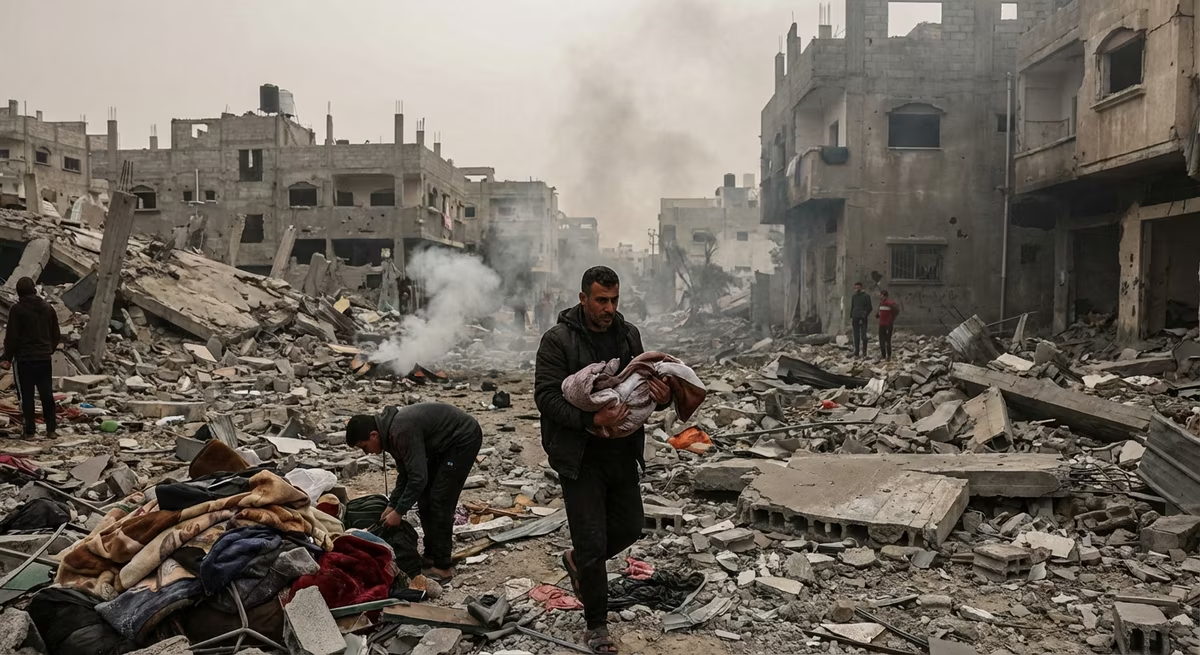
Coinciding with intensive aerial reconnaissance and heavy gunfire from military vehicles west of Gaza, 4 Palestinians were martyred on Tuesday by bullets and shelling from Israeli occupation forces in the Al-Tuffah neighborhood, east of Gaza City, amidst the occupation's continued violation of the ceasefire and truce agreement for the 109th consecutive day in various areas of the Gaza Strip, accompanied by the destruction of homes and residential and civilian facilities.

Palestinian medical sources reported that the martyrs fell outside the areas of military deployment of the occupation forces, while three other citizens were injured as a result of the same assault.

According to the same sources, the martyrs fell as a result of occupation shelling targeting Al-Batsh cemetery in the Al-Tuffah neighborhood, northeast of Gaza City. They are: Mahmoud Ahmed Lolo, Abdul Qader Abu Khader, Abdul Karim Ghabayen, and Youssef Al-Rifi. Earlier, the body of another martyr was recovered, who succumbed to injuries from occupation shelling that targeted the neighborhood days ago.

Escalation in Al-Bureij and Khan Younis In a related context, occupation helicopters fired towards the eastern areas of Al-Bureij refugee camp in the central Gaza Strip, while occupation warships attacked Palestinian fishermen's boats in the sea off Khan Younis city, south of the Strip, using bullets and shells.

Raids on Rafah and artillery shelling Occupation warplanes launched several airstrikes during the early hours of dawn on Rafah city, south of the Strip, coinciding with intensive aerial reconnaissance and heavy gunfire from military vehicles west of the city. Occupation artillery also targeted the eastern areas of Khan Younis city at dawn today, while occupation artillery shelled areas east of Gaza City on Tuesday.

20 violations in 24 hours On Monday, occupation forces escalated their artillery shelling operations towards the eastern areas of the Gaza Strip, which constitute about 58% of its area, targeting areas in Khan Younis to the south, Deir al-Balah, and Al-Bureij refugee camp in the central governorate.

Over the past twenty-four hours, the occupation committed more than 20 violations of the truce in the Gaza Strip, resulting in the martyrdom of 3 citizens and the injury of about 7 others with varying degrees of wounds.

PALESTINE

Tue 27 Jan 2026 10:54 am - Jerusalem Time

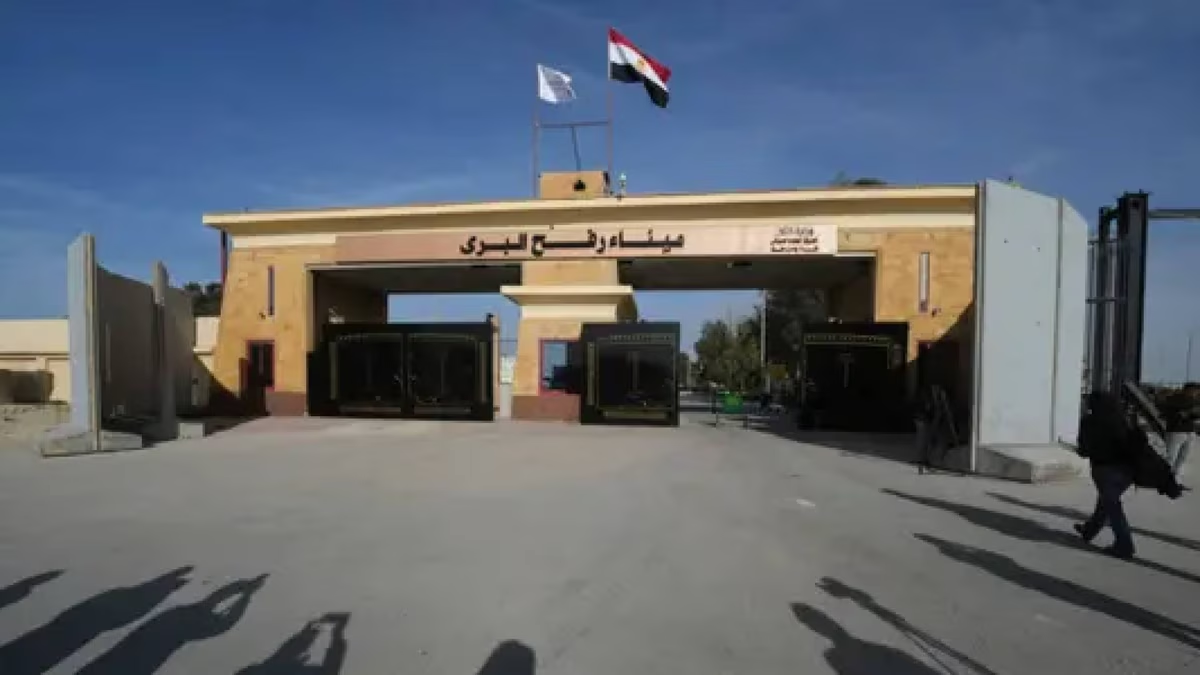
Hebrew media: Mechanism for operating Rafah crossing settled, expected to open within days

Israeli sources reported on Tuesday that the mechanism for operating the Rafah border crossing has been settled after a long period of anticipation.

The report confirmed that the concerned parties reached final and comprehensive understandings in this regard, primarily aimed at reopening the crossing for traffic during the current week. This step is considered an important development for regulating the movement of individuals and goods through this vital crossing.

This decision comes after a statement issued by the occupation army on Monday, announcing the completion of procedures to identify the body of "Ran Gvili" (24 years old), a member of the police's special patrol unit (Yassam), who was killed during the battles of October 7, 2023.

Gvili's body had been recovered from the Gaza Strip after extensive excavation operations that included cemeteries in the northern part of the Strip and the Al-Zaytoun neighborhood, where the identity was confirmed in cooperation with the "Abu Kabir" Forensic Institute and the Military Rabbinate.

With the recovery of Gvili's body, whose fate had been the subject of intelligence search for more than two years, the army statement indicated the official closure of the file, as all detainees (alive and dead) who were inside the Strip have been returned.

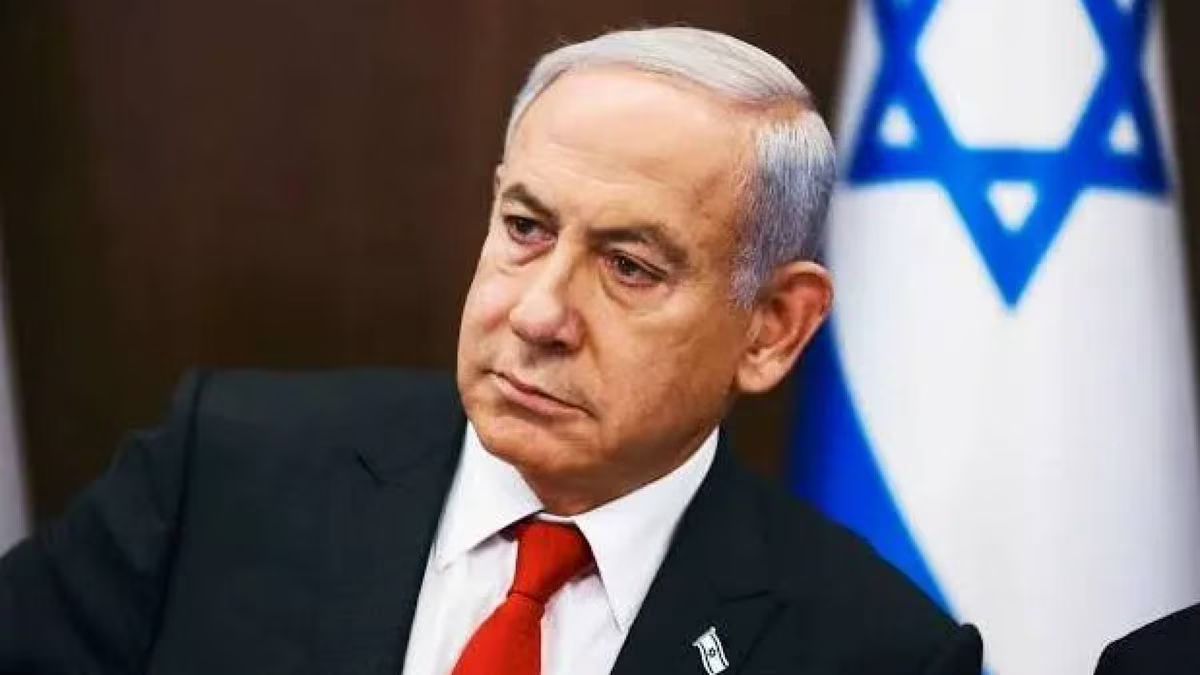
This moment represents a turning point in the political and military path, especially since Prime Minister Benjamin Netanyahu had linked the opening of the Rafah crossing to the completion of the mission of recovering the detainees specifically.

ARAB AND WORLD

Tue 27 Jan 2026 10:01 am - Jerusalem Time

The Middle East on the Brink of Explosion: How the US and Israel are Redesigning Regional Chaos

Said Erikat

Opinion Writer

News Analysis

Researcher Mitchell Plitnick, writing in the progressive "Mondoweiss" website, indicated that the Middle East today stands at an extremely dangerous historical crossroads, where chronic crises intersect with international policies that only exacerbate them. While global political and economic elites were preoccupied with the Davos Economic Forum, the region was silently sliding towards a boiling point that could redraw its political and security maps. Behind the American rhetoric of "isolation" and reduced foreign engagement, Washington continues to play the main driver of crises, often in partnership with Israel, and at the expense of the stability and future of the region's peoples.

From Palestine to Syria, and from Iran to Yemen and Sudan, conflicts are no longer separate or geographically confined. They are a single network of intertwined tensions, fueled by erratic American intervention, systematic Israeli aggression, and an international inability to impose any just political horizon. In this scenario, the question becomes not whether the situation will explode, but where and when the biggest explosion will occur, according to the author.

Palestine: "Peace" Without Palestinians

In Davos, Donald Trump presided over the launch of what was called the "Peace Council," in a move that seemed more like a political maneuver than a genuine initiative. The council's founding charter made no mention of Gaza, Palestine, or even Israel, reflecting the nature of the project: redefining the conflict by ignoring it, not resolving it. Practically, the council became a tool to provide political cover for attempts to impose coercive arrangements on Gaza, under the guise of an "executive administration" overseeing the subjugation of the population and the looting of land.

Jared Kushner's vision for Gaza, presented in Davos, reduces the strip to a luxury real estate project for the wealthy, with no regard for the national identity or political rights of Palestinians. Despite the absence of an announced plan for displacement, it is difficult to imagine a place for Palestinians other than as a marginal workforce in their homeland. At the same time, Israel continues its preparations for a new military operation in Gaza, awaiting the American green light, benefiting from the absence of any serious negotiation path on fundamental issues, foremost among them disarmament in exchange for a real political horizon.

In the occupied West Bank, the scene is complemented by a widespread Israeli attack on Hebron, the largest since the Second Intifada. This attack aims not only to tighten security control but also to re-engineer settler violence by "institutionalizing" it and transferring it from settler chaos to official security frameworks. This coincides with dangerous religious provocations, from the Ibrahimi Mosque to the Al-Aqsa Mosque, suggesting a deliberate attempt to provoke a comprehensive Palestinian response that justifies a wider wave of repression.

Iran: Playing with Fire

On the other side of the region, eyes are turning to Iran, where the risk of an internal explosion with catastrophic regional repercussions looms. Recent protests, violently suppressed, opened the door to mutual accusations of foreign interference, especially from the United States and Israel. Despite the difficulty of verifying these narratives amid information blackouts, recent history confirms Israel's extensive intelligence network within Iran and its capacity for subversive action.

According to the author, the paradox is that the overthrow of the Islamic Republic, if it occurs, will not necessarily lead to a more stable or Western-aligned system. On the contrary, a scenario of vacuum and chaos—similar to Libya or Syria—seems more likely, given the absence of organized political forces capable of filling the void. This partly explains the reservations of some Arab leaders about Netanyahu's rush towards a comprehensive confrontation with Tehran, as they recognize the cost of an Iranian collapse for the entire region.

Syria: Unification by Force and Underlying Fragility

In Syria, the new government is making progress in regaining control of territory, with implicit support from Washington, and at the expense of the Syrian Democratic Forces. This shift has left the Kurds in shock, after years of partnership with the United States in fighting ISIS. Although Damascus has issued decrees to reassure the Kurds and protect their cultural rights, the loss of Rojava represents a devastating blow to the project of self-rule and puts the fragile ceasefire at risk.

In the south, the Israeli occupation stands out as a primary disruptive factor to any Syrian stability. Israel does not hide its opposition to a unified and strong Syria, but it tries to manage this rejection cautiously, through political pressure in Washington, or through calculated military movements that could ignite new fronts.

Intertwined Conflicts: One Region, Multiple Crises

The repercussions of these crises also extend to Iraq, where any escalation in Syria or Iran raises immediate concerns, especially in Kurdish areas. The fate of thousands of ISIS detainees in northern Syria remains a ticking time bomb, which could explode if current security arrangements collapse. In the south, tensions between Saudi Arabia and the UAE in Yemen and Sudan reflect how Gulf proxy wars can destroy entire countries, amid international silence or complicity.

What is happening in the Middle East today is not a series of separate crises, but a logical consequence of a regional system governed by force, not law, and by deals, not justice. The United States, despite its hesitant rhetoric, remains the most influential player in igniting or extinguishing fires, but it often chooses the former option, either out of incapacity or self-interest. And Israel, the immediate beneficiary of the chaos, ignores the fact that the collapse of states around it will not create lasting security. The continuation of this path threatens not only the region but also portends a global cost, as the Middle East once again becomes the spark that ignites crises far beyond its borders.

ARAB AND WORLD

Tue 27 Jan 2026 10:00 am - Jerusalem Time

American buildup against Iran amidst regional alignment fractures

Said Erikat

Opinion Writer

In a new indication of escalating tensions in the Middle East, an Israeli report revealed that both Jordan and the UAE are prepared to provide political and logistical support for any potential American attack on Iran, at a time when American military and diplomatic movements in the region are accelerating. This leak comes amidst ambiguity surrounding the positions of other Western allies, most notably Britain, which appeared to be far from any clear commitment, especially after statements by US President Donald Trump downplaying the role of allies during the war in Afghanistan, raising questions about the future of Washington's traditional alliances.

The Israeli report in the newspaper "Israel Hayom," owned by Miriam Adelson, a supporter of US President Donald Trump who backed him with $100 million in his last election campaign, coincided with the arrival of the commander of the US Central Command (CENTCOM), Admiral Brad Cooper, in Israel, where he held intensive meetings with senior Israeli security officials. According to Israeli security sources, the level of military coordination between the two sides reached an unprecedented degree, including plans for exchanging highly sensitive intelligence information, enhancing logistical cooperation, and linking air defense systems in preparation for confronting what is described as the "Iranian threat."

However, this escalatory scene does not receive regional consensus. Several Arab sources, including an Arab diplomat and a Gulf official, expressed grave concern about the repercussions of any American-Israeli strike on Iran. Gulf countries fear that their territories and military bases could become direct targets if a widespread confrontation erupts, especially in light of Tehran's explicit pledge to target American bases and Israel if attacked.

In this context, Saudi Arabia, Oman, and Qatar led intensive diplomatic efforts to dissuade Washington from pursuing the option of war, realizing that any military escalation could spiral out of control and redraw the map of fragile stability in the Gulf. The UAE's position remains ambiguous, as signals from Emirati officials and experts contradict between public caution and undeclared involvement in security arrangements led by Washington.

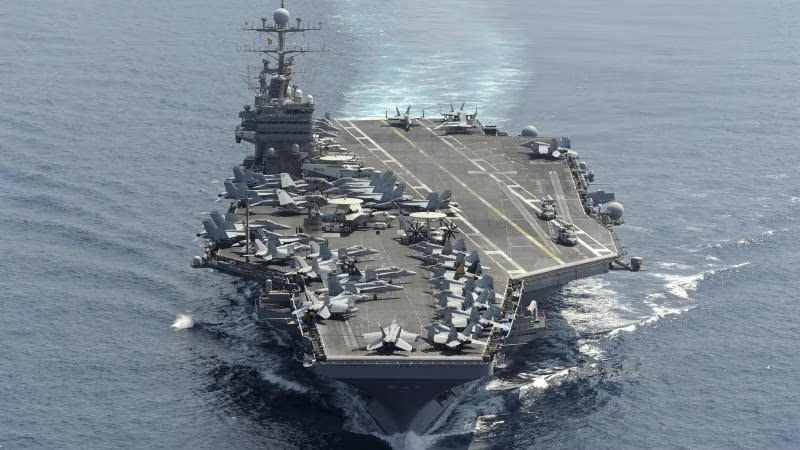
The escalation was not limited to political and military coordination but was practically translated by President Trump's decision to amass a large military force in the Middle East. In striking statements, Trump said that "a large force is heading towards Iran," emphasizing that its purpose is to prepare "for any contingency," without ruling out the option of using it. This buildup includes the aircraft carrier group "USS Abraham Lincoln," a squadron of F-15 fighters, in addition to advanced air defense systems.

This buildup brings to mind the scenario of last June, when Trump ordered the deployment of similar military assets before Israel launched a widespread war against Iran. Although the US military was, according to informed sources, on high alert to carry out direct strikes against Iran earlier this month, Trump backed down from issuing the order, after a growing conviction—reinforced by Israeli Prime Minister Benjamin Netanyahu—that the strike would not lead to the overthrow of the Iranian regime and could drag Washington into a long and complex confrontation.

Nevertheless, strengthening the military presence gives the US administration broader options, whether to launch a more comprehensive attack or to contain any potential Iranian response. Washington realizes that any confrontation will not be without cost, especially given Iran's missile capabilities, which proved effective during the recent escalation, when several missiles fell inside Israel.

In parallel with the military escalation, the White House continues its economic war against Tehran. The US Treasury Department announced new sanctions on nine ships suspected of transporting sanctioned Iranian oil, in a move aimed at choking off vital revenue sources for the Islamic Republic. Washington also expanded its measures to include the seizure of Venezuelan oil tankers, sending a clear message that sanctions have become a parallel tool of war to weapons.

This American escalation reflects a mixture of deterrence and showmanship, more than it reflects a clear strategy. Washington is amassing power to send a political message to Iran and its allies, but at the same time, it recognizes the limits of military force in overthrowing entrenched regimes. This contradiction reproduces the policy of "brinkmanship," which may achieve short-term tactical gains but leaves the region hostage to miscalculation and unintended slide into a comprehensive war.

Experts believe that the most dangerous aspect of the current scene is the fragility and contradiction of regional positions. While some countries are pushed towards a security alignment with Washington, others are working to curb escalation for fear of an explosion. This division weakens any collective effort to contain the crisis and turns the region into a testing ground for conflicting international wills, where the security of small and medium-sized countries becomes merely a detail in the calculations of major powers.

OPINIONS

Tue 27 Jan 2026 9:58 am - Jerusalem Time

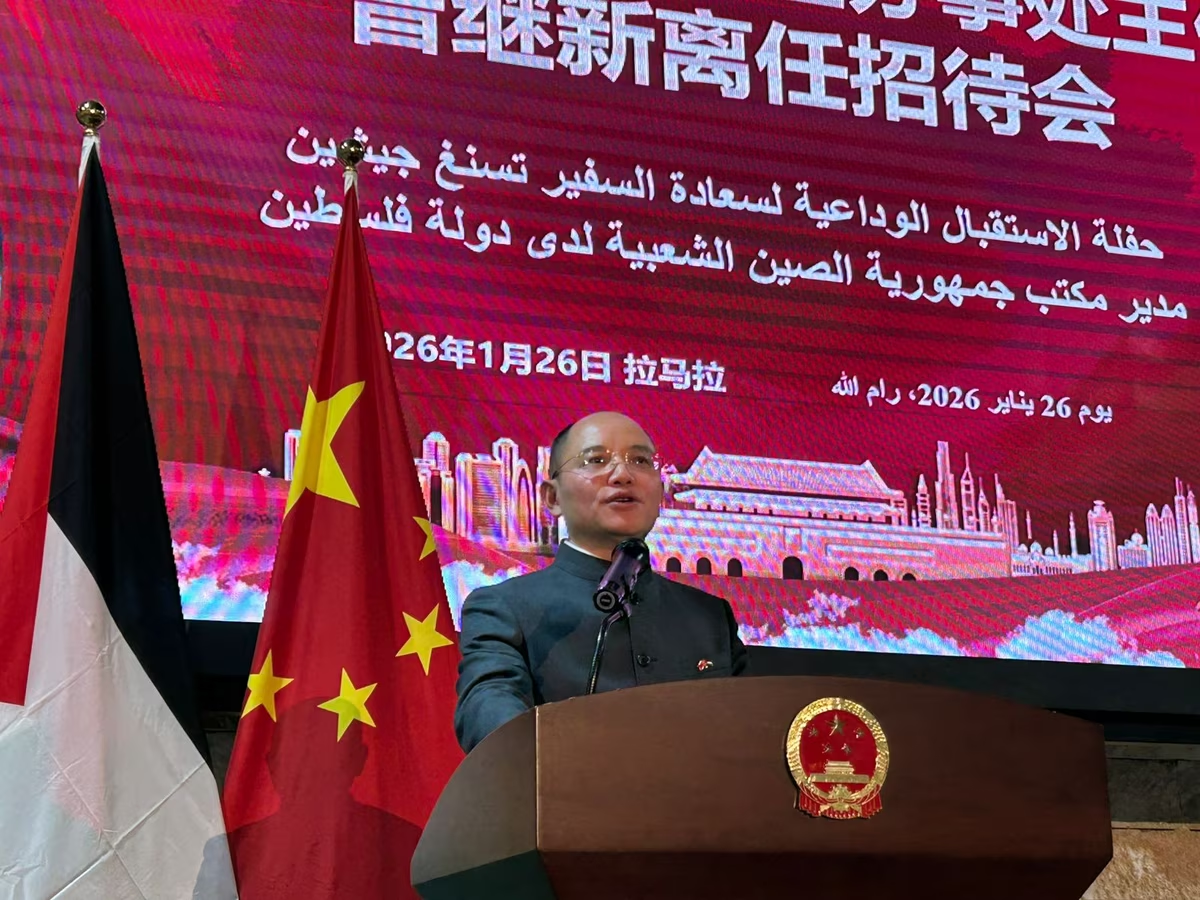
Speech by Chinese Ambassador Zeng Jishin at the Farewell Ceremony

His Excellency Brother Azzam Al-Ahmad, Secretary of the Executive Committee of the Palestine Liberation Organization,
Distinguished members of the Executive Committee of the Palestine Liberation Organization,
Respected leaders of Fatah movement and Palestinian factions,
Honorable advisors to the President, government ministers, and security force leaders of the State of Palestine,
Your Excellencies and Dignitaries,
Distinguished Guests,
Ladies and Gentlemen,
Welcome all! At this moment, my heart overflows with emotions and attachment, as the scenes of our first meetings are still vivid before my eyes. On this occasion, I am honored to express my sincere thanks and gratitude for dedicating your precious time to attend this ceremony, and I extend my sincerest appreciation for your continuous efforts, diligent attention, and unwavering support in strengthening and developing Chinese-Palestinian relations.
        During the three years I worked in Palestine, I witnessed with you the historic moment of establishing Chinese-Palestinian strategic partnership relations, while I went through with you the longest and largest Palestinian-Israeli conflict in history in terms of casualties. I also personally felt the suffering and injustice endured by the Palestinian people under an occupation unparalleled in today's world, and I witnessed with my own eyes your steadfastness, resilience, and determination to struggle.
  Reviewing the past three years, what we are most proud of is the deepening and practical direction of Chinese-Palestinian strategic partnership relations under the strategic leadership of His Excellency President Xi Jinping and His Excellency President Mahmoud Abbas, and thanks to our joint efforts, this partnership has yielded rich and tangible results. The two countries have consistently supported each other on issues affecting their core interests and fundamental concerns. The State of Palestine has repeatedly and publicly affirmed its unwavering commitment to the One-China principle and welcomed the four global initiatives proposed by His Excellency President Xi Jinping. His Excellency President Xi Jinping pays great attention to the Palestinian cause, and has expressed China's supportive stance on many occasions and put forward its initiatives, firmly defending legitimate Palestinian rights and the values of justice in international forums.
        At the same time, exchange and cooperation between China and Palestine continue to deepen and develop in various fields, with a number of prominent projects successfully completed, including the Chinese-Palestinian Friendship Square and the second phase of Beijing Street. The Chinese-Palestinian Friendship and Development Building project has also been officially approved, which will provide specialized rehabilitative medical services to the Palestinian people and contribute to human resource development and sustainable development upon completion. China has provided several batches of humanitarian aid to the Gaza Strip through UN agencies, Egypt, Jordan, and other channels. In the West Bank and East Jerusalem, the Chinese side implemented projects to improve livelihoods under the concept of "small and beautiful," including well rehabilitation, road paving, student funding, and distribution of supplies. More than 1,300 Palestinian cadres from various sectors have traveled to China for training. I am pleased to see the Chinese footprint throughout Palestine and that the traditional friendship between China and Palestine continues and grows stronger.
        Reviewing those three years, one of the most difficult and important achievements was the meeting of the fourteen Palestinian factions in Beijing in July 2024, where you adhered to the spirit of supreme national responsibility and jointly signed the "Beijing Declaration," taking a historic and pivotal step on the path of national reconciliation and Palestinian unity. The importance of the Beijing dialogue and the Beijing Declaration lies in the clear and strong message they sent to the world, stating that the Palestinian people will not abandon their pursuit of national unity and will not allow internal division to continue.
In the current situation, international support for the just Palestinian cause is increasing and accumulating, and the demands of the Palestinian people for their legitimate rights are gaining more understanding and attention internationally. At this critical moment, if there is no internal unity, it will be difficult to translate external support into tangible results, and it will be difficult for the national cause to advance by benefiting from the current momentum. I am always confident that the united Palestinian people will certainly hold the future in their hands, despite obstacles to progress, and any attempt to liquidate the Palestinian cause will inevitably fail. There is an ancient Chinese saying that "strength is in the unity of brothers." The Beijing dialogue is not the end of Palestinian national reconciliation, and I trust that you will move forward with unwavering determination and resolve.
What I cherish most during the past three years are my memories with Palestine, its people and land. I visited all eleven governorates of the West Bank, walked through the streets of the Old City in Jerusalem and Ramallah, strolled through the fields of the Jordan Valley and Jericho, visited the refugee camps of Jenin, Tulkarm, and Tubas, and saw the traditional handicrafts of pottery and glass in Hebron. This land will always remain dear in my heart, and I will never forget the smell of Mansaf, the sweetness of Knafeh, the hustle and bustle of Al-Tira Street, and the diligence, wisdom, and dignity of the Palestinian people.
Ladies and Gentlemen,
At this moment of farewell, I would like to reiterate my sincere thanks and gratitude to all friends from various circles for your support and assistance that facilitated my performance of my duties. I would like to thank all members of the Chinese community in Palestine for your joint efforts to lay another brick in building Chinese-Palestinian friendship. I also express my special appreciation to my colleagues at the Office of the People's Republic of China to the State of Palestine, who have always worked side by side with me, and I am proud of this organized, united, and distinguished team.
As a line from a Chinese poem says: "Let us strive, each on his path, pursuing the same goal despite the distances." Wherever I may be in the future, Palestine will remain in my heart forever, and I always look forward to the day when I hear the good news of the national liberation of the united Palestinian people.
Finally, with the Chinese Spring Festival approaching, I wish everyone a happy and healthy holiday. Long live Chinese-Palestinian friendship!
Thank you!


PALESTINE

Tue 27 Jan 2026 9:56 am - Jerusalem Time

Chinese Ambassador Zeng Jishin speaks to "Al-Quds" before the end of his mission in Palestine

The two-state solution is the only way out for the Palestinian issue.
The Gaza Strip is an integral part of the Palestinian territories.
I will not forget the smell of Mansaf, the sweetness of Knafeh, and the hustle and bustle of Al-Tira Street.
I echo the Chinese poet's saying: Let us all strive towards the goal, despite the distances.
Wherever I am in the future, Palestine will remain in my heart forever.


Ramallah - Exclusive to "Al-Quds" - At the farewell reception for the Ambassador of the People's Republic of China to Palestine, Zeng Jishin, held yesterday in Akka Hall at the Carmel Hotel in Ramallah, discussions focused on the constants of the Chinese position on the Palestinian issue, and that the two-state solution remains the only way out, with emphasis on Palestinian unity being a crucial condition for any viable political path, and that Gaza is an integral part of Palestinian land according to the principle of "Palestinians govern Palestine."
While Palestinian leaders, in private conversations with "Al-Quds," recalled historical milestones in relations with Beijing and the accompanying political, material, and structural support, an approach was also put forward that sees the world moving towards greater pluralism, and that what is required is to transform partnerships with China from slogans into action plans, economically, technically, and culturally, thereby enhancing the presence of international law and preventing the decline of the United Nations system.
In an exclusive interview with "Al-Quds," the Chinese Ambassador affirmed that the biggest obstacle, in his view, to transforming the two-state solution into a viable path does not negate the fact that it has become one of the common constants of the international community, stressing that despite the current challenges and difficulties, he believes that the two-state solution will "certainly" be achieved, and that it is the only way out for the Palestinian issue, expressing his full confidence in its possibility of achievement in the future.
Regarding China's next international step, the Ambassador explained that international interest and support for Palestine are increasing, citing what was reflected in the recent international conference on the two-state solution, adding that the crucial condition for achieving the two-state solution and establishing an independent Palestinian state is to strengthen internal Palestinian unity, and in this context, he said that the Chinese side has made intensive efforts.
Regarding the principle of "Palestinians govern Palestine," Zeng Jishin stressed that the Gaza Strip is an integral part of the Palestinian territories, and that any plan related to the administration of the Strip must be consistent with the principle of Palestine being governed by Palestinians, affirming that China is making efforts to implement this principle.
At the end of his speech, the Ambassador extended his warm greetings to the readers of "Al-Quds" newspaper, and said that he had visited all eleven governorates of the West Bank, and felt good and genuine feelings from the Palestinian people towards the Chinese people, expressing his wishes for the Palestinian people for unity and the achievement of national liberation.


Extended support from revolution to state
For his part, Azzam Al-Ahmad, Secretary of the Executive Committee and member of the Central Committee of the Fatah movement, said that his assessment of "China's effectiveness" as a mediator or political guarantor stems from a firm conviction that China, "when it is a friend, is fair in its friendship," stressing that Palestinian-Chinese relations preceded even the start of the Palestinian revolution, as the Fatah movement began building relations with Beijing before the revolution, and then deepened after the establishment of the Palestine Liberation Organization, when the late President of the Organization, Ahmed Al-Shukeiri, visited China, after which a wave of broad support for the Palestinian revolution began, including military, political, and material assistance.
Al-Ahmad explained that this relationship was not interrupted, but rather developed continuously with the development of events, pointing out that the first embassy opened for the PLO, and the first office for the Fatah movement, was in China even before Arab countries. He added that China has today become one of the most prominent supporters of the Palestinian Authority and the State of Palestine, affirming that it provides assistance that exceeds what other countries provide, both materially and in terms of supporting the building of infrastructure for the Palestinian state. In this context, he pointed out that the "latest donation" made by China to the Gaza Strip amounted to 100 million dollars, considering this a precedent that reflects the nature of Chinese assistance to its friends.
Regarding China's transition from hosting meetings to supporting implementation mechanisms and guarantees for reconciliation or for stabilizing a political path linked to the two-state solution, Al-Ahmad highlighted that Beijing hosted Palestinian factions three times with the aim of urging them to achieve national unity within the framework of the Palestine Liberation Organization, based on a Chinese conviction that unity "shortens the path towards achieving freedom and ending the occupation," a conclusion that China says it has learned from its experience. He concluded by emphasizing the continuation of communication with China, expressing pride in the Palestinian-Chinese relationship and friendship.


Beijing's initiatives intersect with international legitimacy and reliance on support in forums
In the same context, Dr. Ahmed Majdalani, member of the Executive Committee of the Palestine Liberation Organization, said that the Palestinian follow-up of the Chinese file stems from a conviction that the People's Republic of China, under the leadership of its president, has put forward more than one initiative at the international level to address the Palestinian issue. He explained that Chinese initiatives, especially what he described as the "four points" which include Israeli withdrawal, the establishment of a Palestinian state, and guaranteeing security for all parties, essentially intersect with the Arab Peace Initiative and relevant international legitimacy resolutions, pointing out that Palestinian-Chinese coordination is taking place at the highest levels, and that there is continuous political consultation, in parallel with a remarkable development in bilateral relations between the two countries.
Majdalani affirmed that relations with China are "historical, strong, and deep," noting that Beijing was one of the first countries to recognize the Palestine Liberation Organization, and then recognized the Palestinian state, which is reflected in various aspects of the relationship between the two parties. Regarding the Beijing dialogue and Chinese efforts in the reconciliation file, he said that the Palestinian leadership thanked China for its efforts, and considered them "sincere" efforts, but he stressed that the results do not depend on the Chinese side as much as they are related to the internal Palestinian situation.
In this context, Majdalani pointed out that the Hamas movement, in his estimation, did not want a comprehensive Palestinian-Palestinian dialogue, as much as it tended towards a bilateral dialogue between it and China, which made him believe that it was not concerned with the results or their implementation. He concluded by emphasizing that the main Palestinian demand from China focuses on continuing its international efforts to support the Palestinian cause and Palestinian rights in various international forums, in addition to continuing coordination with the Palestinian side at all levels.


Qualitative cooperation and the gateway through field assessment then projects in communications, education, and health
On the practical cooperation front, Dr. Sabri Saidam, member of the Central Committee of the Fatah movement, said that expanding cooperation with China in technology, artificial intelligence, and clean energy should begin with a practical step agreed upon with the government of the People's Republic of China, which is to organize an evaluation visit for a Chinese delegation to observe the reality of technology in Palestine and the possibilities of cooperation. He explained that this visit is supposed to take place through the embassy, and in coordination with the working teams in the relevant Palestinian ministries, with the aim of identifying "intervention projects" capable of making a clear impact in the next stage.
Saidam stressed that the Palestinian leadership is accelerating its steps to encourage this type of cooperation, considering it qualitative cooperation, especially since China, as he described it, has entered the "second generation" of the world of artificial intelligence. Regarding the projects that can be implemented during 2026, he said that the realistic focus should be on three main tracks that China believes it has made great strides in, namely communications, education, and health, considering that the selection of projects within these axes must be done in coordination with the Palestinian government, and in a way that ensures their alignment with the Palestinian situation and their transformation from scattered initiatives into a sustainable institutional work program.


International pluralism, a louder Chinese voice, and an action plan for the strategic relationship
In a broader reading of the international scene, Dr. Muhammad Shtayyeh, member of the Central Committee of the Fatah movement and former Prime Minister, said that the ongoing transformations in the international system have become clear, as he believes that the world is moving from a unipolar system and American hegemony towards greater pluralism, citing what the Canadian Prime Minister said at the Davos Forum as an indicator of a "turning point" in international politics, and considering that the United States has lost even some of its closest allies, such as Canada and parties in Europe.
Based on this diagnosis, Shtayyeh considered that China is required today to "fill some of the vacuum" that the decline of the unipolar system will leave, and to continue to play its role with a "loud and clear voice" in the United Nations in support of the Palestinian cause and Arab issues. At the same time, he called for developing Arab-Chinese relations to go beyond trade towards investment, then to the fields of culture, cultural exchange, joint delegations, and technical issues, leading to investment in technology, thereby creating a deeper and broader partnership.
Specifically on the Palestinian-Chinese issue, Shtayyeh referred to President Mahmoud Abbas's recent visit to China, and the Chinese President's announcement of the desire to establish a strategic relationship between China and Palestine, stressing that what is required from the Palestinian side is to move this relationship from the level of a slogan to implementation through a clear "action plan," based on dialogue about the soundest and most correct foundations for building this strategy. He stressed that Palestine needs China as a "friend and ally" and a "voice" in the United Nations, within a broader vision to preserve a multipolar world order.
In the context of his vision for the role of the United Nations, Shtayyeh attacked what he called the "Peace Council" and considered it a "lie" and described it as a "war council against the world," saying that there is a tendency to use Gaza to produce an alternative system to the United Nations and create a new world order, which he rejects. He affirmed his adherence to the continued existence of the United Nations as a platform for pluralism and a protector of international law and international legitimacy, warning against the "erosion" of international law and the harm it causes to the world, and stressing that international law is the champion of the weak, and that he does not want a world ruled by the strong because "the strong do not know justice," while justice, according to him, is the law.


A global center of gravity is needed to protect international law and effectively support Palestine
In an approach that aligns with this concern for pluralism, Dr. Hanan Ashrawi, Chair of the Board of Trustees of Birzeit University and former Executive Committee member, said that the challenge facing China and the rest of the world lies in attempts to "eliminate the existing system of pluralism," referring to what she described as clear American attempts, led by the Trump administration, to target the United Nations with its institutions and branches, and to seek a return to the logic of a unipolar world.
Based on this, Ashrawi stressed that what is required from China and countries that are not within the orbit of the United States is to strive to create a "center of gravity" and power capable of confronting these developments, which she described as dangerous, and the accompanying decline in human rights and international law. She added that the expected role of China at this stage is to provide "real" support to targeted countries, foremost among them Palestine, affirming that China has a long history of supporting the Palestinian cause.
Ashrawi believed that tangible political impact is not achieved merely through positions, but through pushing for the formation of this international "bloc" that prevents the world from sliding towards a unipolar world where there is no place for respect for international law or the rights of the victim, but rather where only power, control, and hegemony prevail. She concluded by affirming that she sees steps already underway to form this bloc, through the development of a global program and action plan.


Brotherhood embodied in the street and a ring road crossing Area "C"
On the municipal and tangible projects front, Issa Qassis, Mayor of Ramallah, said that the relationship with China is not limited to a specific project, but rather it is an "old, new, renewed" relationship, affirming that China has been a constant supporter through projects he described as affecting the destiny of the Palestinian people. He considered that the relationship of the Ramallah municipality with China is a relationship of brotherhood embodied in symbolic and field milestones, including the "Palestinian-Chinese Friendship Square" with the approval of President Mahmoud Abbas and the Chinese President, in addition to China's funding for infrastructure projects, schools, and other projects whose impact citizens feel in the street.
Qassis explained that the municipality recently completed with China the opening of the second section of the connecting road, and that the next project is the third section, a project presented to the Chinese Ambassador whom the municipality is bidding farewell to today and thanking for his support and understanding, along with his technical team, government, and the Chinese people. He added that there is an ongoing project that they hope will be approved, as it is part of a ring road connecting the city of Ramallah with the Palestinian countryside and surrounding cities, thereby enhancing the movement of citizens and goods, pointing out that this road passes through vital and dangerous areas classified as "C," but he said that the street "pierces through them with the pride and vigor of China."
Regarding the obstacle of areas classified as "C" and their impact on the implementation of internationally funded projects, Qassis affirmed that the municipality operates on the principle of "imposing a fait accompli," explaining that it does not view the classifications "A," "B," and "C" as a reference in its work, and that it does not want to see Palestinian geography according to this classification.


Jerusalem under the test of facts, and China's bet on steadfastness in international legitimacy
From Jerusalem, Dr. Ratiba Al-Natsheh, member of the political bureau of the Fida Party and member of the National Action Body in occupied Jerusalem, said that the most urgent Chinese step to protect Jerusalem and its institutions and stop the change of reality on the ground is to adhere firmly to the principles of justice and international integrity, and to push for the enforcement of United Nations resolutions and international legitimacy, especially with regard to the Palestinian issue and Jerusalem in particular. She considered that this approach constitutes protection in the face of what she described as Israeli attempts to impose new facts to change the geopolitical reality in the region, including Jerusalem, and thereby affect the solution of the Palestinian issue, pointing out that Israel, through the United States, is trying to circumvent United Nations mechanisms through what she called the "Peace Council."
Al-Natsheh added that the presence of a strong international player with firm positions like China is capable of protecting the legitimate rights of Palestinians, including Jerusalem as the capital of the independent Palestinian state.
Regarding Beijing's role in supporting Palestinian unity, Al-Natsheh explained that China does not interfere in internal Palestinian affairs in the sense of exerting pressure to impose a specific Palestinian project, but at the same time, it is one of the countries keen on the Palestinian national project, and has made several attempts to reconcile views between Palestinian parties. She affirmed that Beijing respects Palestinian legitimacy and emphasizes the importance of internal dialogue, considering that its primary role is to maintain consistency between protecting legitimacy and its title, and assisting in managing differences in a way that makes Palestinians stronger.


PALESTINE

Tue 27 Jan 2026 9:54 am - Jerusalem Time

Rafah Crossing... Will Netanyahu back down from his stance in the face of American will?

Mohammed Hawash: Netanyahu still treats the crossing as a potential gateway for displacement, not as an entry point for new political arrangements, and thus holds onto it as a pressure card.
Talal Awkal: An undeclared settlement might be implemented, enabling Israel to control the movement at the crossing in exchange for an American commitment to work on implementing displacement plans.
Fayez Abbas: Netanyahu's government will not dare to reject the American request, but it will seek to obstruct the opening of the crossing by imposing unacceptable Palestinian conditions.
Mohammed Joudeh: The Rafah crossing has become the gateway to the conflict over Gaza's future in a stage between post-battle and pre-decision, a decision that has not yet been settled.
Hani Abu Al-Siba': The timing of the crossing's opening coincides with Israeli and American preparations to open other fronts because ending the Gaza issue has become a necessity.
Nihad Abu Ghosh: Israel is formally responding to moving to the second phase and will try to reduce it to a disarmament clause while seeking to control the crossing.


Ramallah - Exclusive to "Al-Quds"-
The Rafah crossing is once again at the forefront of political and diplomatic activity related to the Gaza Strip, amidst escalating talk of its opening, coinciding with intensive American movements and visits by American envoys to Israel, to pressure Israeli Prime Minister Benjamin Netanyahu to open it.
Writers, political analysts, and specialists confirm in separate conversations with "Al-Quds" that this momentum regarding the opening of the Rafah crossing comes amidst widespread questions about the nature of the anticipated opening, and whether it will constitute an actual entry point for moving to the second phase of the ceasefire agreement in the Gaza Strip, or merely a formal step that keeps the existing reality as it is.
Writers and specialists point out that the Rafah crossing issue has become a central point of contention between the American vision seeking to launch the second phase of arrangements, and the Israeli position that tries to redefine the concept of "opening" to ensure continued security control and control over the movement of individuals and goods at the crossing.
They emphasize that these developments coincide with a catastrophic humanitarian reality in the Gaza Strip, and increasing international pressure to halt the deterioration, making the Rafah crossing more than just a border gate, but rather a symbol of the conflict over the future of the Strip.


An American attempt to bridge the gap

Writer and political analyst Mohammed Hawash explains that the intensive political and diplomatic activity around the Rafah crossing, including the arrival of American envoys Witkoff and Kushner in Israel, reflects a serious American attempt to bridge the gap between US President Donald Trump's announced initiatives and the existing political and security reality, amidst Israeli insistence on supervising, directly or indirectly, any crossing opened south of the Gaza Strip.
Hawash believes that what is currently happening cannot be separated from Israel's endeavor to establish its own side of the Rafah crossing, which it supervises securely, stressing that the Israeli reality clearly states that Tel Aviv is committed to controlling entry and exit, and rejects the return of the crossing to its full Palestinian status as it was before the Israeli invasion of the Gaza Strip.
Hawash points out that all Israeli perceptions and proposals, despite their differences, intersect at this fundamental point.

Netanyahu's attempts to evade

Hawash explains that the head of the occupation government, Benjamin Netanyahu, is trying to evade American pressure by claiming that opening the crossing is not possible at the current stage, noting that the Israeli Ministerial Security Cabinet is holding a meeting to discuss this file, in an attempt by Netanyahu to say that the decision is not personal, but rather stems from an institutional position within the Israeli government.
Hawash clarifies that the opening of the Rafah crossing practically means entering the second phase, a phase that Netanyahu does not want to begin, because it carries broad political and security dimensions, including agreeing on withdrawal dates from the Gaza Strip, opening crossings, and starting reconstruction operations, in addition to commencing the work of the Palestinian National Committee to manage the Strip in understanding with international institutions stemming from UN Security Council and International Executive Council resolutions.

Multiple pretexts to obstruct the second phase

Hawash points out that Israel is putting forward multiple pretexts to obstruct this phase, including conditioning the return of the last Israeli body of prisoners killed in Gaza, in addition to raising the issue of disarming Hamas.
Hawash considers that this last condition is nothing more than a political pretext, stressing that Hamas today does not possess weapons that pose a strategic threat to Israel's security, and that what remains are individual weapons or remnants of rockets unsuitable for military use, in addition to training sites that have lost their combat value.
Hawash emphasizes that the Israeli conditions related to opening the crossing, whether one-way or through the establishment of two parallel crossings, primarily aim to prevent the return of Palestinians to the Gaza Strip, and to transform transitional issues into permanent realities, in the context of a known Israeli policy based on transforming the temporary into the eternal.
Hawash explains that the visit of American envoys Witkoff and Kushner to Israel to discuss the opening of the Rafah crossing carries a clear message to Netanyahu that he cannot obstruct or openly oppose President Trump's plans, noting that Washington is determined to move forward with the opening of the second phase, even if it faces subsequent setbacks.

Netanyahu and the crossing gateway to displacement

Hawash stresses that Netanyahu still treats the Rafah crossing as a potential gateway for displacement, not as an entry point for new political arrangements, and therefore the crossing remains a pressure card that Netanyahu holds, emphasizing that the idea of forced displacement and ethnic cleansing is still deeply rooted in the mind of the current Israeli government, and there is no one within it who rejects this approach, but rather it is wrapped in Talmudic religious ideas that consider Gaza part of the "complete land of Israel."
Hawash affirms that Netanyahu, despite being presented as the most liberal within his government, engages in political maneuvers aimed at pleasing the far-right and the societal base that has become more extreme, amidst the shift of Israeli society towards the right, even within opposition parties that do not fundamentally differ from the government in managing the conflict with the Palestinians.
Hawash believes that Netanyahu's options are limited, and he is likely to eventually agree to open the Rafah crossing, in exchange for tightening other files such as disarmament and setting a timeline for it, to satisfy the right, and at the same time comply with American plans.
Hawash warns that these plans are of an investment real estate nature, and do not take into account the rights of Palestinians, their culture, and their way of life in the Gaza Strip.

Continuing the siege with different tools

Writer and political analyst Talal Awkal believes that the circulating Israeli statements regarding dealing with the Rafah crossing, whether in its old form or through a new crossing that Israel intends to establish, clearly reveal two fixed paths in Israeli policy: first, the continuation of the displacement approach, and second, the insistence on not backing down from imposing full security control over the Gaza Strip.
Awkal explains that Israel seeks absolute control over the movement of individuals and goods to and from the Strip, which practically means continuing the siege with different tools, even if the opening of the crossing is announced. Awkal points out that the American administration seems willing to open the Rafah crossing as an entry point for moving to the second phase of political arrangements, but it clashes with the Israeli position that rejects any opening that does not guarantee security hegemony.
Awkal suggests that developments will lead to an undeclared settlement, whereby Israel obtains continued control over the movement at the crossing, in exchange for an American commitment to work on implementing displacement plans according to different approaches and methods, which establishes a new reality that keeps Gaza under the same restrictions with a change in form, not in essence.

Moving towards implementing Trump's plan

Fayez Abbas, a writer specializing in Israeli affairs, believes that the escalating American activity regarding the opening of the Rafah crossing portends a clear crisis and tension between the American administration and Benjamin Netanyahu's government, noting that current indicators point to real differences within Israel regarding the American decision, especially given the composition of the far-right government.
Abbas explains that the occupation government was surprised by the announcement of the intention to open the Rafah crossing, especially after the announcement was made by the head of the Palestinian National Committee tasked with managing the Gaza Strip, Dr. Ali Shaath, during his participation in the Davos Forum, considering that Shaath would not have announced this without direct American confirmation and support, which reinforced the conviction within Israel that the decision was made in Washington without prior coordination with Netanyahu's government.
Abbas points out that the Israeli War Cabinet is scheduled to meet to discuss the repercussions of opening the crossing, coinciding with the arrival of American envoys Witkoff and Kushner in Israel to meet with Netanyahu, explaining that the purpose of the visit is to begin implementing the second phase of US President Donald Trump's plan for the Gaza Strip.
Abbas clarifies that Netanyahu's government, despite its objections, will not dare to explicitly reject the American request, but it will seek to obstruct the opening of the crossing by imposing strict and unacceptable Palestinian conditions. Among these conditions, according to Abbas, is preventing the return of Gaza residents who left the Strip since the beginning of the war, with the exception of humanitarian cases only, in addition to Israel's demand to establish an Israeli checkpoint inside the crossing, under the pretext of preventing the smuggling of weapons and people into the Strip.
Abbas believes that the American administration is moving forward with implementing Trump's plan in Gaza, considering that this constitutes a major political achievement for any American president seeking to create an opportunity for a Palestinian-Israeli agreement, despite strong opposition from fascist right-wing ministers in the Israeli government, who are pushing for the re-establishment of Jewish settlements in the Gaza Strip.
Abbas believes that the American administration will not allow the Ben Gvir and Netanyahu government to thwart the path to reaching an agreement, expecting Netanyahu to pressure his ministers to prevent the issuance of statements opposing the American decision, at a time when Witkoff and Kushner are likely to succeed in convincing Netanyahu, or even politically threatening him, not to obstruct American efforts to implement the second phase of Trump's plan.

The future of the Strip and its administration's identity

Writer and political analyst Mohammed Joudeh believes that the escalating debate about opening the Rafah crossing, coinciding with the arrival of American envoys Steve Witkoff and Jared Kushner in Israel to discuss the file with the head of the occupation government, Benjamin Netanyahu, cannot be read as an isolated humanitarian or technical issue, but rather as an intense title for a broader political battle related to the future of the Gaza Strip and the identity of the party that will manage it and decide its fate in the next stage.
Joudeh explains that the current talk about opening the crossing does not start from Rafah and does not end there, noting that the cessation of widespread military operations does not mean the end of the war politically.

The stage of conflict over "the day after"

Gaza, according to Joudeh, has entered a new stage titled "the day after" conflict, amidst the absence of a real consensus on who holds the decision and legitimacy in the Strip.
Joudeh believes that the timing of presenting the names of American envoys, such as Witkoff and Kushner, is not accidental, but rather reflects increasing American concern about losing control over the course of events.
Israel, according to Joudeh, has exhausted a large part of its military power without achieving a decisive victory, while international pressure is escalating and the humanitarian catastrophe is worsening, turning into a political and moral burden even on Tel Aviv's allies, which pushes Washington to act not out of humanitarian motives, but out of fear that the closure of Rafah will become a permanent indictment.

Redefining the concept of "opening the crossing"

Joudeh points out that Israel does not want to open the crossing in its previous form, because that would mean an implicit acknowledgment of its failure to change the equation, so it seeks to redefine the concept of "opening the crossing" itself, by proposing alternatives that include a crossing without sovereignty, movement without freedom, and an incomplete Palestinian decision.
Joudeh notes that the talk about alternative crossings, additional checkpoints, or advanced inspection mechanisms does not have an engineering dimension as much as it reflects a political vision aimed at transferring control from the ground to the security system.
Joudeh clarifies that the proposed model is based on the apparent absence of the Israeli soldier from the gate, in exchange for tightening control through direct or indirect security surveillance systems, so that the crossing appears open to cameras, but is actually closed in its essence.
Joudeh points out that the United States is trying to market this proposal as a compromise that alleviates the siege, satisfies the international community, and reassures Israel without direct confrontation with Egypt, but in reality, it postpones the explosion and does not address the roots of the crisis.
Joudeh emphasizes that Gaza is currently experiencing a stage of "no solution," where there is neither comprehensive war nor peace, but rather a long management of the crisis based on a fragile calm, partial opening, and limited reconstruction, with the specter of escalation remaining present due to the political deadlock.
Joudeh believes that the Rafah crossing has become the gateway to the conflict over Gaza's future, in a stage between post-battle and pre-decision, a decision that has not yet been settled.

On the verge of the imminent opening phase

Writer, political analyst, and specialist in Israeli affairs Hani Abu Al-Siba' believes that the Rafah crossing, which constitutes the only lifeline for the Gaza Strip to the outside world, is on the verge of a very imminent opening, in a development that carries political, security, and humanitarian dimensions beyond being a technical procedure. Abu Al-Siba' points out that this development is based on the statements of the head of the Palestinian National Authority for managing the Gaza Strip (Technocrat Committee), Dr. Ali Shaath, during his participation in the Davos Forum, where he announced that the crossing would open next week, which Shaath would not have announced without American support.
Abu Al-Siba' explains that the Hebrew media has begun to speak directly about opening the Rafah crossing in both directions, which the Israeli government previously rejected, as it had planned to open it in one direction only for Palestinians to leave the Gaza Strip without allowing them to return.
Abu Al-Siba' confirms that the Egyptian government's insistence on opening the crossing in both directions, along with continuous European pressure, led to a change in the Israeli position, as there is now talk of a meeting of the Israeli cabinet to approve the decision, not to discuss it, after reaching prior understandings with the American administration during talks between Benjamin Netanyahu and Washington.
Abu Al-Siba' clarifies that the arrival of Kushner and Witkoff to the region and their meeting with Netanyahu came to finalize the mechanism for opening the crossing.

Israeli conditions met with pressure

Abu Al-Siba' points out that the Israeli government stipulates that those leaving the Gaza Strip undergo a security check, by gathering them at a specific point before reaching the crossing, which is supposed to be managed according to the 2005 agreement model, as it was with the participation of the Palestinian police and presidential guard, and with the presence of European observers, while Egyptian security forces handle the Egyptian side of the crossing, without Israeli intervention.
Abu Al-Siba' indicates that international pressure, along with the American administration's desire to close this file, is pushing towards opening the crossing, noting that US President Donald Trump had previously presented the cessation of the war in Gaza as one of his political achievements in international forums.
Abu Al-Siba' warns of the possibility of Netanyahu reneging on the agreement, based on his known record of violating understandings, explaining that the Israeli government still conditions the return of the last body of an Israeli officer killed in Gaza to open the crossing, but the American administration seems determined to open it even without this condition being met.

Strong indications for opening the crossing

Abu Al-Siba' points to strong indications confirming that the opening of the crossing has become irreversible, including statements by Israeli Foreign Minister Gideon Sa'ar about reaching an agreement with the "Smolland" government to receive militias working with Israel in the event of the Israeli army's withdrawal from its areas of control, with the provision of safe places for them and their families, which reflects an Israeli readiness for widespread field changes.
Abu Al-Siba' believes that the Rafah crossing represents the only lifeline for the residents of the Gaza Strip, given the closure of the Erez crossing since the beginning of the war, noting the presence of thousands of stranded students, tens of thousands of wounded and sick, including cancer patients, in addition to fragmented families and residents in urgent need of travel.
Abu Al-Siba' believes that the permanent opening of the crossing will pave the way for the start of the reconstruction phase and the commencement of the Gaza Strip's administration, although Netanyahu does not wish this and continues the policy of destruction, citing the complete destruction of the Shuja'iyya neighborhood and the continued targeting of infrastructure.

American and Israeli focus on other fronts

Abu Al-Siba' links the timing of the talk about opening the crossing to Israeli and American preparations to open other fronts in the region, whether with Iran or Hezbollah, considering that ending the Gaza issue has become a necessity for arranging broader regional priorities.
Abu Al-Siba' indicates that the American administration seeks to hand over the file to the Peace Council in preparation for the start of reconstruction, leading to the issue of disarming Hamas, warning that rejecting this could lead to a scenario similar to what is happening in Lebanon.
Abu Al-Siba' emphasizes that the opening of the Rafah crossing constitutes a dismal failure for the Israeli government in implementing the project of displacing Palestinians from the Gaza Strip, stressing that the Palestinians' steadfastness on their land, even living in tents, has thwarted all attempts at coercion and pressure, and reaffirmed that this people cannot be uprooted from their land no matter how severe the aggression.

Opening the crossing amidst Israeli violations

Writer, political analyst, and specialist in Israeli affairs Nihad Abu Ghosh confirms that the renewed talk about opening the Rafah crossing, coinciding with the arrival of American envoys Witkoff and Kushner in Israel, comes more than one hundred days after the ceasefire agreement in the Gaza Strip, during which the first phase of the agreement witnessed systematic Israeli obstruction of its provisions, through the use of multiple pretexts, real and artificial, aimed at emptying the agreement of its content.
Abu Ghosh explains that Israel, throughout this period, resorted to claiming Palestinian violations, and imposed additional conditions such as handing over all bodies, and tried to reduce the agreement to one item, which is the recovery of Israeli prisoners, without adhering to the rest of the commitments explicitly stated, foremost among them the opening of the Rafah crossing in both directions, withdrawal from the "Yellow Line," the entry of humanitarian aid, and the cessation of military violations.
Abu Ghosh emphasizes that all of this happened in full view and hearing of the international community, amidst explicit positions from mediating countries, especially Egypt, Qatar, and Turkey, which openly demanded Israel to implement its commitments.
Abu Ghosh points out that the official American position, despite this, remained supportive of Israel and adopted its narrative, referring to US President Donald Trump's statements during a joint press conference with Benjamin Netanyahu, when he said that Israel had fulfilled its commitments one hundred percent, linking this with direct threats to Hamas and the Palestinians, and re-waving the option of displacement.

Global repercussions of what is happening

Abu Ghosh believes that this behavior undermines Trump's credibility and his peace plan, especially given the US President's boasting of ending "eight wars," while Gaza remains the most important test of his administration's credibility.
Abu Ghosh clarifies that the continuation of catastrophic conditions in the Gaza Strip, from famine and epidemics to deteriorating living conditions, along with continuous Israeli violations, led to the reluctance of Arab, Islamic, and European countries to participate in the stabilization force or in the "Peace Council" formed by Trump, which negatively affected American strategic plans in the region, and weakened the chances of expanding the "Abraham Accords."
Abu Ghosh points out that the American administration's insistence on moving to the second phase and opening the crossing came as a result of these repercussions.

Emptying the opening of the crossing of its content

Abu Ghosh explains that Israel, in contrast, seeks to transform the step of opening the Rafah crossing into a formal procedure that changes nothing on the ground, so that the opening of the crossing becomes without actual value given the strict conditions on the movement of individuals, the continuation of the humanitarian tragedy, and the attempt to reduce the second phase to one item, which is the disarmament of the resistance without any Israeli withdrawal or cessation of violations, but rather with the initiation of selective reconstruction in areas under occupation control and devoid of Palestinian residents.
Abu Ghosh points out that Israel is formally responding to moving to the second phase, and will try to reduce it to a disarmament clause while seeking to control the crossing.

The option of Palestinian steadfastness for confrontation

Abu Ghosh believes that the upcoming scenarios are complex and open to multiple possibilities, stressing that the equation is no longer confined to Israel and the Palestinians only, and that Israel is no longer able to monopolize Gaza despite American support and Arab weakness, amidst the shaking of the international system based on rules and laws.
Abu Ghosh points out that Israel's image in the world is the worst in its history, which imposes on the Palestinian people and their resistance the option of steadfastness and continuing to confront the war of extermination and displacement.
Abu Ghosh emphasizes that the Palestinian issue has entered a new phase that requires comprehensive Palestinian unity, considering that the absence of unity is the biggest flaw in this long battle, and that a unified position would enhance the role of mediating countries and limit the impact of Israeli pressure on the Trump administration, while warning of the possibility of Israel reneging on the entire process in the event of regional escalation with Iran or Lebanon, or moving towards early Israeli elections.


OPINIONS

Tue 27 Jan 2026 9:51 am - Jerusalem Time

Reconstruction of Gaza… A Battle Between Guardianship and Blackmail

The sounds of shelling had barely subsided in a false truce when political and administrative challenges emerged as the biggest obstacle to the launch of Gaza's reconstruction process. This time, the battle is not merely about building stones, but a battle of wills and interests where many parties intersect, each with its own agenda and vision for the post-war period. Reconstruction, which is supposed to be a symbol of mercy and human solidarity, has turned into a new arena of conflict between competing projects for Gaza's future: between those who want it to rise with its resistant people, and those who seek to reshape it to serve the security and strategic interests of the occupation.
From the first day of the ceasefire announcement, "politics first" was the rule that major powers wanted to impose on the reconstruction process. Western countries speak of their commitment to rebuilding, but they link this to political and security conditions that ensure monitoring of funding, restricting the flow of materials, and opening the door to direct or indirect supervision by international parties, in a clear attempt to diminish the role of the resistance and weaken its influence in the post-war phase. As for Israel, it sees the reconstruction file as a golden opportunity to re-establish its control through civilian and economic means, after failing to achieve a decisive military victory. It seeks to turn reconstruction into a tool of political blackmail, through which it imposes its indirect guardianship over Gaza by controlling the entry of building materials, the distribution of aid, and the identification of implementing parties, ensuring that the siege remains in a "soft" form that cloaks the occupation in the guise of humanitarian assistance.
In contrast, the Palestinian resistance affirms that the reconstruction of Gaza is a legitimate right that is non-negotiable, and that any attempt to link reconstruction to disarmament or the relinquishment of national rights represents unacceptable and exposed blackmail. Reconstruction is not a favor from anyone, but a continuation of the battle of steadfastness fought by the people, and an extension of the will to live that has not been broken despite the siege, bombing, and starvation. From this perspective, the ongoing conflict over who manages, funds, and supervises reconstruction is not a technical or administrative conflict, but essentially a battle over Gaza's political identity, and an attempt to impose new power balances under a humanitarian title.
Many countries have rushed to announce their readiness to participate in rebuilding, but the path to implementation is still fraught with obstacles. Israel imposes complex conditions that prevent the entry of materials it considers "dual-use," and controls crossings and passages in a way that makes any effort subject to its prior security approval. Amidst this complexity, the Arab position finds itself facing a real test: does it have the political will to overcome Israeli and international restrictions, or will it be content with the role of a conditional financier who adheres to plans drawn up in Tel Aviv and Washington more than in Arab capitals?
European countries, in turn, while showing readiness to participate in limited projects, do not hide their security and political concerns, and link their aid to ensuring that "armed factions do not benefit" from reconstruction funds, while the United States focuses on imposing strict control over every dollar entering the Strip, as if dealing with an accused community that must be held accountable before being helped. Here lies the blatant moral paradox: the West, which speaks of the "right to life" while legitimizing the killing of civilians, then dictates to the victims how they should rebuild their homes.
The battle for reconstruction in Gaza is essentially not just a race to rebuild what the war destroyed, but a real test of international and Arab will, and an examination of the sincerity of the slogans raised in the name of humanity. It is a battle to determine who holds the decision in Gaza, and who shapes its future features: Is it the resistant Gaza that rose from under the rubble to continue defending its right and dignity, or the "reconstructed" Gaza under the conditions of the occupier, constrained by aid and international guardianship?
In the end, it can be said that the reconstruction of Gaza will not be merely an engineering process to repair what was destroyed, but a new chapter in the Palestinian struggle for existence, a battle between those who want Gaza to remain a symbol of freedom and steadfastness, and those who seek to transform it into a fragile economic model, stripped of will, living on crumbs of aid and under the ceiling of security surveillance. Between these two options, the reliance will remain on the awareness of the Palestinian people and their ability to protect their national project, so that reconstruction remains a tool for advancement, not a means of taming and blackmail.


OPINIONS

Tue 27 Jan 2026 9:50 am - Jerusalem Time

Equation: Did Witkoff ask Netanyahu for the prison key? It's no use wearing the agal and shoes together

In the midst of what is called the second phase of US President Donald Trump's plan, and the announcement in Davos of the names of the members of the so-called Peace Council, also headed by Trump, his most important envoys, "Witkoff and Kushner," are sent to Israel for the Rafah crossing.
   Not for Gaza, emerging from the smoke of genocide, hunger, wounds, and the bitter and deadly cold, nor for Rafah, which has almost been razed to the ground, and after its invasion has become as if it were a large cemetery with "Here was Rafah" written on its gate.
   We delude ourselves greatly and for a long time that we are, in the aforementioned context, in front of the Rafah crossing, only to discover, without embellishment, that we are not in front of the crossing, but in front of the "opening" of the crossing; how many hours a day, how many are allowed to leave and how many are allowed to enter – it is certain that the number of entrants will be less than the number of those leaving, who will be in charge of it from the Palestinian side and from the other side, who will allow those departing to leave and those arriving to enter, who will inspect the bags, their number and the allowed kilograms, and who will conduct the investigations and sometimes arrests, do you have a relationship or kinship with names of resistance leaders, and what is the stamp that will be used to stamp the travel document, and who is the authority authorized to issue or renew it, and how much money is allowed to be brought in, including jewelry, ornaments, and gold, the fees and their amount, and how much Israel will charge for its "services," as it does nothing for free, where will the arrival go, does he have a place to stay, does he have a tent, is his address inside the yellow, green, or red line, when does Israel have the right to close the crossing, except for its holidays, or is this procedure exclusive to it and no one has the right to know it, as with the "Karama" Bridge crossing, which its crossers say has no dignity at all.
  It is certain that Witkoff and Kushner did not discuss all of these details, as these will be left to technicians and technocrats, but they also did not discuss how Israel will stop treating Rafah and the rest of the Strip as a large prison, and more than two million people as permanent terrorist prisoners, and the crossing as a gate to this prison. And for Witkoff and Kushner to have done something of this sort, they must then take the key to the crossing from Netanyahu and hand it over to Ali Shaath.
   A Bedouin tribal elder from Jordan told me that after the Oslo peace, he decided to visit his relatives in Beersheba for the first time since its occupation. At the Karama Bridge, the female soldier asked him to take off his shoes and agal. He told her that it is not permissible to put the agal and shoes in one container together, but she insisted on the necessity of the security check, so he decided to cancel the visit and return, with an early realization that this peace was a farce.
===========================
We delude ourselves greatly and for a long time that we are, in the aforementioned context, in front of the Rafah crossing, only to discover, without embellishment, that we are not in front of the crossing, but in front of the "opening" of the crossing; how many hours a day, how many are allowed to leave and how many are allowed to enter  


OPINIONS

Tue 27 Jan 2026 9:44 am - Jerusalem Time

Trump's "Peace" Council and the National Destiny

The failure of international law to ensure justice for Palestinians does not justify its abolition, nor is it a pretext for replacing it with new political arrangements marketed under the title of "peace." The flaw that afflicted the international system, and at its heart the United Nations, was not the result of purely legal shortcomings or neutral institutional dysfunction, but rather the result of repeated political obstruction when it came to Palestine. However, the growing danger today is not limited to the continuation of this obstruction, but extends to an attempt to bypass the justice system itself, and to redefine peace as conflict management rather than a solution, and a security settlement rather than a response to the right of self-determination.

Gaza: From an Open Tragedy to a Political Fulcrum

In this context, what is known as the "Trump Peace Council" falls within a political approach that seeks to bypass the existing international legal framework, based on the reality imposed by the devastating war on the Gaza Strip. Instead of dealing with what happened as a tragedy that requires accountability and the restoration of international law, the results of the destruction are being used as a starting point for reformulating a political approach to the Palestinian issue, managed outside the references of international legitimacy, and far from inalienable national rights.
The distinction here is fundamental between the faltering application of justice and turning this faltering into a justification for its exclusion, and between the international system's inability to do justice to Palestinians and exploiting this inability to redefine the concept of peace itself, in a way that empties it of its human rights content.
In this perception, Gaza is invoked not as an open wound in the international conscience, but as an existing reality upon which new arrangements are built. The Palestinian issue is reduced to a humanitarian dimension, while reconstruction is separated from the context of occupation, and the relationship between land and people is reformulated on the basis of administration, not sovereignty, and stability, not liberation.

Peace Without Rights: Managing Conflict Instead of Solving It

What is presented under the title of "peace" in this approach does not amount to a just historical settlement, as much as it reflects an endeavor to readjust the conflict in a way that takes into account the existing balance of power. The Palestinian is gradually excluded as a political actor, and re-included as a humanitarian file, while the occupying power is given the role of judge and guarantor at the same time. Thus, international law is not only bypassed, but emptied of its content and turned into a selective reference.

Gaza Administrative Committee: Temporary Necessity or Permanent Entry Point?

In parallel, the idea of forming an administrative committee to manage the Gaza Strip came as a practical response to a deep administrative and humanitarian vacuum left by the war. However, this formula, despite its temporary necessity, entails real challenges if it is not controlled by a clear political and national ceiling. Administration, when separated from the political horizon, may turn from an emergency tool into a disguised alternative, and from a temporary measure into a permanent reality, in which life's affairs are managed under occupation instead of working to end it.
These risks increase if the committee turns into a channel through which political arrangements outside national consensus, or "peace" formulas that are less confrontational in form and more marketable internationally, are passed without addressing the roots of the conflict.

Recognition of Palestine: From Symbolism to Action

In contrast, countries that have recognized the State of Palestine face a practical test of the credibility of this recognition. Theoretical recognition of the right to self-determination, if not translated into clear policies that reject circumventing it, remains limited in effect. Moreover, merely expressing reservations or concerns about projects that bypass Palestinians, without practical steps to obstruct them, opens the door for their consolidation as a fait accompli.

Global Popular Momentum and the Requirements for Revitalizing It

The war on Gaza revealed a remarkable shift in global public awareness, manifested in a wide wave of solidarity within Western societies and beyond. However, this momentum, despite its importance, remains fragile unless it transforms into an organized political force capable of influencing decision-making centers. This equation becomes more complex in the Palestinian case due to the absence of a unified political authority capable of addressing this public opinion in the language of rights and law.
What is being presented today under the name of "peace" reflects, in essence, a trend to manage the results of the conflict, not to address its causes, and to consolidate a reality imposed by force, not to dismantle it. In Gaza, not only the fate of Palestinians is being tested, but also the future of the international system itself: either the restoration of justice as a condition for any sustainable peace, or the entrenchment of the logic of hegemony with its permanent susceptibility to reproducing violence.
Nevertheless, the imbalance of power, however chronic it may seem, does not negate the ability of peoples to regain the initiative when they possess clarity of vision and tools for action. Palestinians, despite attempts at exclusion and marginalization, still possess latent strengths that go beyond traditional weaponry: the legitimacy of a cause deeply rooted in international law, a renewed moral presence in global consciousness, and the ability to rebuild their national narrative as a cause of liberation and rights, not a fleeting humanitarian file. Transforming this asset into organized political action, through genuine national unity, activating the tools of international law, and linking the Palestinian struggle to the ongoing transformations within Western societies themselves, is capable of re-imposing the Palestinian issue on the international agenda as a matter that cannot be erased or ignored. History was never written solely by the logic of power, but also by the persistence of those who refused to have their future defined by their enemies.

OPINIONS

Tue 27 Jan 2026 9:43 am - Jerusalem Time

One Economy on Paper… Two Economies on the Ground

The question today is no longer whether the Palestinian economy is in crisis, but rather which Palestinian economy are we referring to? The economy of the West Bank, which is still operating at its minimum, or the economy of Gaza, which, due to war and destruction, has transformed into a paralyzed economy outside the normal financial timeline. Between these two paths, one of the most dangerous structural problems is revealed: a presumed economic unity on paper, but effectively divided at the level of money, liquidity, and the banking system.
Theoretically, the West Bank and Gaza Strip are subject to the same economic framework, in terms of the absence of monetary sovereignty, reliance on the shekel, the dominance of the clearing system, and Israeli restrictions on the movement of funds. However, reality reveals that the impact of these restrictions is not equal. While the West Bank still possesses a minimum financial operational capacity, Gaza is currently experiencing a near-complete collapse of its organized monetary cycle, making talk of a “unified Palestinian economy” closer to an administrative description than an existing economic reality.
This collapse in Gaza is not only due to the enormous physical destruction but also to the paralysis of the financial infrastructure itself. With the destruction of bank branches, power and communication outages, and the inability to access bank accounts, the financial system has exited the equation, replaced by a forced cash economy, based on limited, worn-out, and unregulated cash. In this context, cash is no longer a natural medium of exchange but has become a tool of economic strangulation.
Here, the liquidity crisis appears as a symptom of a deeper problem. The shortage of cash is not just a matter of banknotes but a direct result of the absence of pumping channels, the cessation of banks' normal role, and the impossibility of introducing sufficient quantities of currency. Over time, transactions have been disrupted, the cost of buying and selling has increased, and the informal economy has expanded, while prices have lost any logical reference to people's ability to pay.
In contrast, despite all political and economic challenges, the West Bank still relatively benefits from the existence of a functioning banking system and a wider spread of electronic payment tools and bank transfers, which allows economic activity to continue within manageable and controllable limits. This monetary and financial gap between the two regions does not reflect a difference in economic culture or financial behavior but a forced disparity in the ability to access the same financial system.
This gap becomes strikingly clear when looking at the distribution of bank deposits. Banking estimates indicate that the total deposits of banks operating in Palestine today are close to $21 billion, calculated in various currencies, with the West Bank accounting for the overwhelming majority. In the Gaza Strip, although nominal deposits increased during the war to exceed $4 billion, the greater part of them remained stagnant and trapped deposits, unable to transform into actual liquidity in the market. For comparison, the volume of operational deposits circulating in Gaza before the war was in the range of only $1.5 to $2 billion. This paradox clearly reveals that the problem in Gaza is not a lack of money itself, but the absence of the ability to use it economically.
The picture becomes more complex when considering the issue of bank accounts and financial inclusion. While the percentage of bank account ownership and actual use is higher in the West Bank, thousands of accounts in Gaza have been forcibly disabled. This is not due to a lack of financial awareness, but rather to the collapse of the banking operational environment itself, which has transformed the bank account from an economic empowerment tool into a rigid, functionless number.
Despite the bleakness of the scene, this gap holds an opportunity. The existence of an existing, albeit disabled, banking account base can serve as an entry point for rebuilding the financial cycle, if the banking system is reactivated within an exceptional approach that is consistent with the post-destruction reality and treats Gaza as an economy in an emergency state, not a traditional market.
From here, the role of banks in Gaza becomes central, not only as a financial intermediary but as a tool for economic recovery. Reconstruction cannot begin in an economy that operates only with cash, nor can aid continue to flow outside organized channels without becoming an additional burden. What is needed is a different, more flexible banking role, based on reactivating accounts and linking them to simplified digital payment tools capable of operating in low-connectivity environments, and in parallel with managing aid and transfers within a banking framework that ensures transparency and limits monetary chaos.
Palestinian banks possess the technical expertise and institutional accumulation that qualify them to play this role, but they need clear regulatory cover and international partnerships that reduce risks and allow them to operate outside the traditional credit-based model. Recovery in Gaza will not begin with large loans, but with small, phased financing targeting food chains, essential services, and micro-enterprises that restart the economic engine from the bottom up.
However, any real recovery will remain incomplete if the financial separation between Gaza and the West Bank continues. What is needed is not only the reconstruction of Gaza but its financial reintegration into the Palestinian economy as a whole, through unified operational policies, common payment platforms, and organized liquidity flows. The continuation of this separation will turn Gaza into a permanent relief economy and, in turn, increase pressure on the West Bank, which will find itself forced to absorb imbalances beyond its capacity.
In conclusion, the crisis of Gaza's economy is not just a crisis of destruction, but a crisis of absent financial integration. And the cash crisis is not fate, but the result of the absence of an urgent and comprehensive financial vision. Empowering banks, developing alternative payment tools, and linking Gaza to the West Bank through a unified financial path is not a technical option, but a fundamental condition for any real and sustainable economic recovery.
 * International Economic Advisor, Board Member of International Digital Transformation


OPINIONS

Tue 27 Jan 2026 9:41 am - Jerusalem Time

The Wolf Enters the Taming Pen!

Dr. Ibrahim Melhem

Editor-in-Chief

This is not the Netanyahu we know, with his cunning and arrogance, his lies and deceit, his snares and pretexts. Yesterday, he seemed like an AI-generated version, stripped of his will, submitting to the American demand to open the Rafah crossing, after his pretext of finding the last body was withdrawn. He could only remove the yellow pin from his coat and stop shedding crocodile tears over the remaining body.
Removing the yellow pin was the first soft step of taming, to be followed by steps that contradict his previous statements, with Turkey and Qatar joining the anticipated stabilization force, and what will follow from Shaath and his team entering the Strip after he almost swore the strongest oaths not to allow them to enter, and that the crossing would only be for exit, and that he had no partner in sovereignty over it, and that the authority would not return to the crossing, only to discover that his 'no's were not to be spent.
The sudden discovery of the body and the convening of the mini-council two days prior were not mere coincidences; rather, they seem like an "emergency exit" prepared by the black rooms to bring down the Likud wolf from the high escalation tree without breaking his political neck, and so that there would be no "atonement" for his oath, which he uttered in a moment of fleeting euphoria.
When Dr. Ali Shaath announced the date for opening the Rafah crossing, I felt sorry for the man for his haste, fearing that the date would come and he would lose his bet against the evasions of the wolf, whose tricks he could not match. We then discovered that Netanyahu's summoning of the mini-council was not for opposition or discussion, but to ratify a decision that had been taken in "Washington" in advance. That meeting was merely a protocol "solution" to save face and implement what Trump wanted in the language of deals that brook no delay.
Perhaps the lesson that emerges from the folds of this drama is that whenever American will is available, everything proceeds smoothly and without procrastination, and that the "Likud wolf" who rebelled against international decisions and escaped criminal prosecution only needed a "tamer" who knew where to pull out the yellow pins.

PALESTINE

Tue 27 Jan 2026 7:32 am - Jerusalem Time

3 dead by Occupation Fire in Areas of the Gaza Strip

A Palestinian was martyred today, Monday, by occupation forces' bullets outside their deployment areas north of the Gaza Strip, raising the death toll for the day to 3 due to Israeli targeting of various areas of the Strip.

Medical sources reported the martyrdom of young man Muhammad Abed by occupation bullets near Halawa refugee camp, outside their control areas in the town of Jabalia, north of the Gaza Strip.

Israeli forces also targeted young man Abdul Aziz Muhammad Marzouq (30 years old) in Yafa Street, outside their control areas in Al-Tuffah neighborhood, east of Gaza City, according to the same sources.

Earlier today, medical sources said that Palestinian Majdi Muhammad Nawfal (52 years old) was martyred in an Israeli shelling of Al-Bureij refugee camp in the central Strip.

Eyewitnesses said that the army's artillery shelled square "12" east of Al-Bureij camp, an area located adjacent to the deployment and control areas of the occupation army according to the ceasefire agreement.

Also martyred earlier today was Muhammad Khaled Abed by Israeli bullets to the head in the Al-Zarqa area in Al-Tuffah neighborhood, according to the medical source.

Eyewitnesses said that the Al-Zarqa area had previously been withdrawn from by the army according to the ceasefire agreement.

In a separate incident, the medical source said that child Badriya Essam Saqr was injured by Israeli bullets in the Al-Mawasi area west of Khan Yunis city, south of the Strip.

Since dawn on Monday, the Israeli army has been launching airstrikes and artillery shelling on various areas of the Strip, coinciding with its indiscriminate firing in different places.

These developments come within the framework of continuous Israeli violations of the ceasefire agreement in effect since October 10, 2025.

Since the agreement came into effect, continuous Israeli violations have resulted in the martyrdom of 484 Palestinians and the injury of 1321 others.

The agreement ended a genocide war started by Israel on October 8, 2023, which lasted two years, and left more than 71,000 martyrs and over 171,000 injured, and massive destruction affecting 90% of civilian infrastructure at a reconstruction cost estimated by the United Nations at about 70 billion dollars.

PALESTINE

Tue 27 Jan 2026 1:27 am - Jerusalem Time

US Official: Disarming Hamas Will Be Accompanied by a Type of Amnesty

A US official said yesterday, Monday, that the United States believes that disarming the Islamic Resistance Movement (Hamas) in the Gaza Strip "will be accompanied by a type of amnesty for the movement," while two senior US administration officials said that Hamas was "very cooperative and fulfilled its obligations regarding the delivery of the body of the last Israeli captive."

Sources stated that the US official spoke to reporters, on condition of anonymity, on the occasion of the return of the body of the last Israeli captive in Gaza, at a time when Israel and the United States are pressuring Hamas to lay down its arms as part of a plan for the reconstruction of Gaza.

The US official stated that there is a conviction among US officials that Hamas will lay down its arms, adding, "We hear many of its members talking about laying down arms. We believe they will do so. If they do not lay down their arms, they are violating the agreement. We believe that laying down arms is accompanied by a type of amnesty."

The US official spoke about a "very good program" in Washington for disarming Hamas. Under US President Donald Trump's 20-point plan, Hamas members who commit to peaceful coexistence and lay down their weapons will be pardoned once all Israeli captives are returned.

The plan also stipulates providing safe passage for Hamas members who wish to leave Gaza to countries that will receive them.

In contrast, Hussam Badran, a member of Hamas's political bureau, stressed in a statement during the Al-Masa'iya program that the movement is committed to dealing with the issue of Palestinian weapons within national determinants and international laws, affirming that Palestinian weapons are a natural right for self-defense, and are managed internally according to the will of the Palestinian people, and not in response to the demands of the occupation or external pressures.

In a related context, two senior US administration officials said that the United States wants to reach the stage of reconstructing Gaza as soon as possible, after disarming Hamas. The officials warned the movement that US President Donald Trump "will take action against it if it wants to manipulate," according to them.

Israeli Channel 13 reported that Washington is preparing a document that includes principles for disarming Hamas, and that the document will be presented soon and will include a timeline for disarming Hamas.

Following the announcement yesterday, Monday, of the recovery of the body of the last Israeli captive in Gaza, Israeli Prime Minister Benjamin Netanyahu said that the second phase of the Gaza agreement is not for reconstruction, but rather for disarming the Hamas movement, indicating that it is in Israel's interest to accelerate that phase, not delay it.

On the other hand, a source in the Turkish Ministry of Foreign Affairs said that Minister Hakan Fidan met yesterday, Monday, with officials of the Hamas movement in the Turkish capital Ankara, and they discussed the second phase of the ceasefire agreement in the Gaza Strip and the humanitarian situation in the Strip.

The source added that Fidan briefed Hamas officials on Turkey's efforts in international forums, including the "Peace Council" headed by the US President to protect the rights of Gaza residents.

PALESTINE

Tue 27 Jan 2026 12:36 am - Jerusalem Time

Berlin cancels Palestinian cultural festival due to "red triangle" and freezes funding for organizing association

The "Salam" association issued a formal apology, blaming an "external organizer" for designing the publications without granting them final review rights.

German capital Berlin authorities canceled the "Palestine in Berlin" cultural festival, which was scheduled for January 24 and 25, 2026, following intervention from the occupation embassy, which objected to the use of symbols it considered "linked to the Hamas movement."

The cancellation decision came after "inverted red triangles" were spotted on the festival's promotional materials.

Although the red triangle is an integral part of the Palestinian flag, German security agencies recently classified it as a symbol of the Hamas movement, after its use in combat videos to identify occupation soldiers' targets.

Berlin had banned the public use of this symbol in late 2024.

The occupation embassy in Berlin condemned the festival via social media, considering that using public funds for an event bearing these symbols is "incompatible with integration principles."

Consequently, the municipality withdrew the event's license and placed the annual funding of 85,000 euros for the organizing association "Salam e.V." under official review.

For its part, the "Salam" association issued a formal apology, blaming an "external organizer" for designing the publications without granting them final review rights, and affirmed the association's disavowal of Hamas's objectives.

Despite this, authorities maintained the festival ban, as part of what observers see as a broad campaign by the Berlin government to restrict activities and symbols associated with the Palestinian cause.

PALESTINE

Tue 27 Jan 2026 12:02 am - Jerusalem Time

Hebrew media: America prepares to present a document on Hamas disarmament as part of a comprehensive plan

The rehabilitation task will be entrusted to the "Peace Council" proposed by President Donald Trump, which includes Turkey and Qatar as members.

Hebrew sources reported on Monday evening that the United States will deliver, in the coming days, an official document detailing the mechanism for disarming factions in the Gaza Strip, as part of a comprehensive plan to rearrange security and civilian conditions after intense American pressure.

Disarmament of factions in exchange for reconstruction and crossings

The proposed document stipulates granting the factions a grace period of several weeks to hand over their weapons to a "multinational force."

In return, the occupation will allow the opening of crossings, including the Rafah crossing in both directions, and the commencement of reconstruction of the Strip. The plan warned that if the deadline is not met, a green light will be given for military action without restrictions.

Shrinking the "buffer zone" and moving the yellow line

One of the most prominent features of the new plan is the gradual movement of what is known as the "yellow line" (the border between the Strip and the occupation) eastward, which means reducing the buffer zone within Gaza. This measure is part of understandings aimed at easing geographical restrictions once the disarmament process begins.
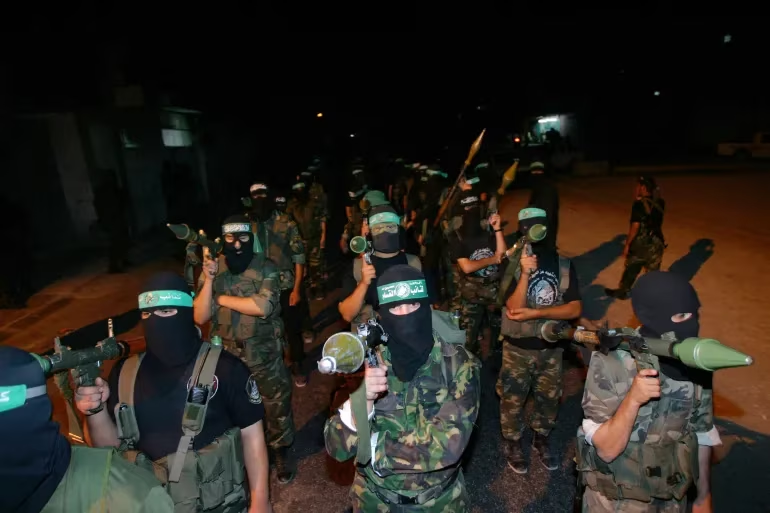
Supervision by the "Peace Council" and a technocratic government

On the civilian level, the rehabilitation task will be entrusted to the "Peace Council" proposed by President Donald Trump, which includes Turkey and Qatar as members. This council will oversee a Palestinian "technocratic" government to which civilian powers will be transferred to manage the affairs of the population in the Strip.
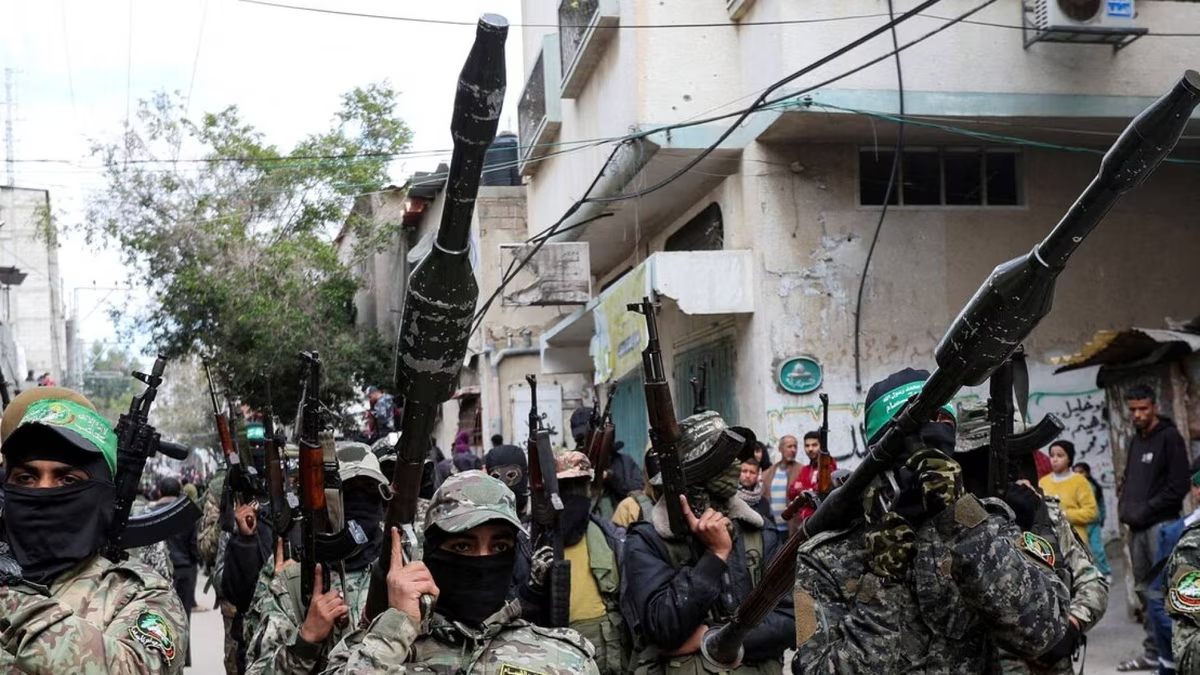
PALESTINE

Mon 26 Jan 2026 11:47 pm - Jerusalem Time

Agreement without withdrawal.. Israel redefines the Gaza war ceasefire on the ground

Developments in the Gaza war ceasefire agreement reveal a widening gap between what was stipulated in its provisions and what was actually implemented on the ground, as Israel transitioned from treating the agreement as a framework for de-escalation to a tool for re-establishing new field and security realities. According to the text of the agreement, Israeli forces were supposed to withdraw to the "Yellow Line" inside the Gaza Strip, as a sole line of contact where military operations would cease and the battlefield would be frozen behind it, in preparation for a subsequent phase including prisoner exchange, partial opening of crossings, gradual return of civilians, and the start of reconstruction.

However, this withdrawal was practically coupled with Israel maintaining control over more than half of the Strip's area, and linking any subsequent withdrawals to the disarmament of the Palestinian resistance and long-term security arrangements. On the ground, Israel did not treat the Yellow Line as a fixed withdrawal line, but rather as a starting point for redrawing the boundaries and depth of its control within Gaza, according to a report broadcast by sources.

Journalistic investigations supported by satellite images showed that concrete barriers were first placed at the location of the line as drawn on maps, before being pushed hundreds of meters inward into residential neighborhoods, after the destruction of dozens of buildings located between the lines. Demolition operations did not stop with the entry into force of the truce, but continued to clear entire areas around army positions and turn them into security belts devoid of residents.

During what was called a "ceasefire," hundreds of Palestinians were killed by direct Israeli fire, either by soldiers' bullets, drones, or shelling of inhabited homes, under the pretext of targeting wanted individuals or dealing with field threats. UN reports confirm that these operations occurred within areas supposedly covered by the truce, and that the Yellow Line itself was not fixed.

Regarding the crossings, the Rafah crossing emerged as a stark example of the gap between text and application. While the first phase spoke of a gradual opening of the crossing for humanitarian cases and movement of individuals, the crossing remained subject to strict restrictions, which transformed it from a supposed humanitarian lifeline into an additional pressure tool. In parallel, the occupation army announced during the truce the destruction of tunnels 4 kilometers long inside the Strip, considering that this was done "according to the agreement" because it was behind the Yellow Line.

With the announced transition to the second phase, the Yellow Line is no longer presented as a temporary ceasefire line, but is being established as a new security boundary, similar to what is known as the "Blue Line," which the United Nations drew in 2000 to confirm Israel's withdrawal from southern Lebanon. The Chief of Staff of the occupation army, Eyal Zamir, explicitly described the "Yellow Line" as a "new border line," and a line of defense and attack at the same time, in reference to a military approach that treats it as a permanent demarcation, not a transitional phase.

This reality leaves Israel in control of about 53% of the Gaza Strip, awaiting progress in the disarmament process, the deployment of an international force, and the completion of "technocratic governance" arrangements and reconstruction according to the American vision. In contrast, the United Nations affirmed its rejection of any change in the Strip's borders, considering that turning the Yellow Line into a new boundary contradicts the letter and spirit of the ceasefire agreement.

PALESTINE

Mon 26 Jan 2026 11:07 pm - Jerusalem Time

Trump: Hamas helped locate the body of the last detainee.. and now we must disarm it

US President Donald Trump, in statements to American media, revealed new and sensitive details related to closing the file of detainees in the Gaza Strip, pointing to a field role for "Hamas movement" in this process, and at the same time emphasizing the transition to new political and military entitlements.

Trump confirmed that the process of searching for and identifying the body of the "Israeli" police officer "Ran Gvili" was "extremely difficult."

He explained that the Hamas movement made great efforts alongside the occupation to find the body, indicating that the movement actively helped locate the body of the last detainee who was inside the Strip.

In a step reflecting the features of the next stage after ending the detainee file, Trump stated: "Now we must disarm Hamas as the movement promised."

These statements place the issue of Palestinian weapons at the top of the American administration's priorities in the context of discussing "post-war" arrangements in the Gaza Strip.

PALESTINE

Mon 26 Jan 2026 11:07 pm - Jerusalem Time

The Occupation Reveals the Inside Story of Recovering the Body of the Last Detainee from a Cemetery in the Gaza Strip

Military officials from the occupation acknowledged that the location of the body had been monitored among 4 possibilities for some time. On Monday, the occupation army revealed details of the military operation that led to the recovery of the body of the detainee "Ran Guili," who had been held by Hamas since October 7th.

The operation was carried out in the Shuja'iyya area north of the Gaza Strip in cooperation between the Southern Command and the "Yahalom" combat engineering unit. The statement claimed that the operation was based on intelligence gathered over two years, including interrogations of detainees from Gaza.

More than 20 dentists participated in the operation, examining approximately 250 bodies inside the cemetery within 24 hours using DNA samples and dental records to match identity.

For his part, US President Donald Trump told the "Axios" website that Hamas made "tremendous efforts" and coordinated with the occupation to help find the body of the last detainee.

Trump described the mission as "arduous and difficult," emphasizing that Hamas elements "were working with the occupation forces" to search for the body among hundreds of bodies in the area.

Trump stressed that this cooperation must be followed by practical steps, saying: "Hamas helped find the body of the last detainee, and now they must disarm as they promised."

Military officials from the occupation acknowledged that the location of the body had been monitored among 4 possibilities for some time, but the political leadership preferred to wait to give negotiations a chance before deciding on a field raid.

PALESTINE

Mon 26 Jan 2026 9:08 pm - Jerusalem Time

Kushner: Return of Officer 'Gvili's' Body Ends Gaza Detainee File and Establishes a New Phase

Jared Kushner, advisor to US President Donald Trump, stated that the recovery of the body of the "Israeli" police officer "Ran Gvili" from the Gaza Strip represents the end of one of the darkest chapters in the Middle East conflict. Kushner affirmed that for the first time since 2014, there are no longer any Israeli hostages held within the Strip.

Kushner clarified that all 20 living detainees, in addition to the bodies of 28 held hostages, described this development as an achievement that was previously considered "impossible."

He attributed this success to President Trump's leadership and intensive coordination between the US State Department's peace mission team, the Central Intelligence Agency (CIA), and occupation Prime Minister Benjamin Netanyahu, in cooperation with the Egyptian General Intelligence Service, Turkey, and Qatar, in addition to collaborators from within Gaza.

Kushner noted that this cooperation built unprecedented levels of trust, considering the mission to help Gaza residents start a new chapter free from what he described as the "tyranny of Hamas" crucial to preventing further destruction for both the occupation and Palestinians.

He believed that achieving this would contribute to ending the hotbed of tension exploited to fuel antisemitism and division.

Kushner concluded his statements by emphasizing that the US administration is trying new approaches to achieve different results, saying: "This is an end, but it is also a new beginning," in reference to the direction towards redrawing the features of stability in the region.

ARAB AND WORLD

Mon 26 Jan 2026 8:36 pm - Jerusalem Time

Iranian readiness and Israeli alert.. USS Lincoln enters the Middle East

The US military announced today, Monday, that the aircraft carrier "USS Abraham Lincoln" and its group have arrived in the Middle East, significantly enhancing its firepower in the region amid escalating tensions with Iran. The US Central Command (CENTCOM) said in a post on the "X" platform that the aircraft carrier Lincoln and its strike group are "currently deployed in the Middle East to enhance regional security and stability."

For its part, the American newspaper "Wall Street Journal" quoted an American defense source and official data that the United States deployed F-15E fighter jets to a base in Jordan, while moving "Patriot" and "THAAD" air defense systems to the region to enhance the protection of American facilities and its allies from any potential counterattacks from Iran. The American official indicated that some equipment has already arrived, and more is expected within one to two weeks.

In this context, sources in Washington explained that this carrier includes various types of "F-16" and "F-15" aircraft, in addition to three destroyers that entered the Middle East operational area from the South China Sea about five days ago and have moved towards the Central Command's operational area in the Red and Mediterranean Seas.

Sources explained that this situation, according to observers, gives President Donald Trump wider options in dealing with Iran, as the lack of sufficient military assets in the region was one of the reasons that led the president to delay a strike on Iran. However, sources said that Trump, according to observers, sent the equipment but wants to give himself room to negotiate with the Iranians, pointing to ongoing negotiations, at least with Russia, in an attempt to impose something on the Iranians under the threat of battleships, and if these negotiations fail, Trump may resort to the second option.

Iranian readiness for all scenarios

In Iran, sources quoted Iran's permanent representative to international organizations, Ali Bahreini, as saying that Tehran is ready for all scenarios, as the policies of the current US administration cannot be predicted. He stressed that his country's military readiness has returned to what it was before the 12-day war, adding that his country has increased its capabilities in terms of its defense systems. The Iranian Ministry of Defense also confirmed this morning, Monday, that Tehran is today in full readiness and preparedness on the defensive front.

Alert in Israel

In Israel, sources in Jerusalem reported that the Israeli home front has raised its alert level to the maximum in recent weeks by deploying Iron Dome batteries and other military assets. He pointed out that the alert status has also moved to the civilian level, as Israeli authorities issued instructions to the education sector on the need to prepare for the possibility of transitioning to an emergency situation, and this applied to the health sector, hospitals, ambulance crews, civil defense, and firefighting. However, he noted at the same time that these preparations do not indicate a zero hour or an Israeli belief that an American attack on Iran is imminent, at least in the next few hours.

UAE refuses to allow its territory to be used

In addition, the UAE affirmed that it will not allow any attacks on Iran from its territory. The UAE Ministry of Foreign Affairs said in a statement that "the United Arab Emirates is committed to not allowing its airspace, territory, or waters to be used for any hostile military actions against Iran, and to not provide any logistical support in this regard." The Ministry of Foreign Affairs stressed "the UAE's belief that enhancing dialogue, de-escalation, adherence to international laws, and respect for the sovereignty of states represent the optimal foundations for addressing current crises." The UAE hosts thousands of American soldiers at Al Dhafra Air Base near the capital Abu Dhabi, which is one of several American military sites in the Gulf.

PALESTINE

Mon 26 Jan 2026 7:54 pm - Jerusalem Time

Netanyahu: "We brought everyone back" by recovering "Guili's" body.. The next stage in Gaza is "disarmament" not "reconstruction"

The Prime Minister of the Israeli occupation, Benjamin Netanyahu, on Monday, outlined the features of the next stage for dealing with the Gaza Strip after closing the file of detainees, unequivocally announcing that the top priority in the "second stage" will not be for reconstruction operations as the international community anticipates, but will be entirely focused on "disarming Hamas" and transforming the Strip into a completely demilitarized zone; to ensure no future threat.

Netanyahu's statements came after his official announcement of finding the body of "Ran Guili", the last of the detainees they were searching for in the Gaza Strip.

Netanyahu said that the central goal now is to strip the Hamas movement and other factions in the Gaza Strip of their remaining military capabilities, and impose a new reality that makes Gaza a safe, demilitarized zone, before talking about any development or reconstruction plans.

PALESTINE

Mon 26 Jan 2026 5:20 pm - Jerusalem Time

Occupation army announces return of the last detainee's body in Gaza Strip

The Israeli occupation army announced the completion of the identification procedures for the body of "Ran Gvili" in a military statement issued on Monday. The Israeli occupation army announced the completion of the identification procedures for the body of "Ran Gvili", whose body was recovered from the Gaza Strip after an extensive excavation operation that included cemeteries in the northern part of the Strip and the Al-Zaytoun neighborhood.

The statement, issued in cooperation with the National Center for Forensic Medicine and the Military Rabbinate, clarified the following facts about the body: Identity: Ran Gvili (24 years old), a member of the police's special patrol unit (Yassam). Gvili was killed during the battles that took place on the morning of October 7, 2023. His body was transferred to the Gaza Strip since that date, and the fate of his body remained the subject of intensive intelligence research for more than two years.

With the announcement of the recovery of Gvili's body, the statement indicated that all detainees who were inside the Gaza Strip (whether alive or dead) have been returned.

This moment is a turning point in the political and military course, as Israeli Prime Minister Benjamin Netanyahu had linked the opening of the Rafah crossing to the completion of this specific mission.