OPINIONS

Fri 06 Mar 2026 8:33 pm - Jerusalem Time

The Illusion of Iran's Fall and Israel's Rise: A Reading of the Hegemony Narrative in the Middle East

Every time the confrontation between Israel and Iran escalates, an old political and media discourse resurfaces: if Iran falls or its power declines, Israel will become the dominant power in the Middle East. This idea seems logical at first glance, given Israel's military and technological superiority, and the strategic support it receives from the United States. However, a closer look at the structure of the regional system reveals that this narrative is closer to a political illusion than a realistic reading of the balance of power.

Historically, the Middle East has not been a region that allows a single power to dominate for a long time. Since the end of the Cold War, the region has been shaped by shifting balances between several regional powers, most notably Iran, Turkey, Saudi Arabia, and Israel. These powers differ in their tools: some rely on economic and religious weight, others on military power or geopolitical influence, but none has been able to impose comprehensive hegemony over the region.

In this context, Iran represents a special case. Iranian power is not based solely on traditional military capabilities or its missile and nuclear program, but also on a regional network of influence extending through local allies in several arenas. Therefore, talking about the "fall of Iran" as a rapid military event ignores the nature of Iranian power itself, which has been built over decades through a mix of politics, alliances, and the ability to operate in turbulent regional environments.

In contrast, there is no doubt that Israel possesses a qualitative superiority in military technology, intelligence, and air force, in addition to its deep alliance with the United States. The diplomatic shifts witnessed in the region in recent years, especially after the normalization agreements with some Arab countries, have also strengthened Israel's political and economic presence in the Middle East. However, this relative rise does not necessarily mean the region's transition to an Israeli-led regional system.

There are structural constraints that prevent this. First, Israel, despite its military strength, remains a relatively small country in terms of area and population compared to the countries of the region. Second, the political environment in the Middle East remains highly sensitive to the idea of external hegemony, making any project for regional control fraught with political and popular resistance. Third, other regional powers, especially Turkey and Saudi Arabia, will not easily accept a strategic vacuum that allows a single power to control regional balances.

Even in the hypothetical scenario where Iran loses the war and exits its position as a regional pole, the legacy of its influence will not automatically transfer to a single party. On the contrary, this legacy is likely to become an arena of competition among several regional powers. Countries that have built their security policies over the past decades on confronting Iran's rise – such as Israel, Turkey, Egypt, and Saudi Arabia – will find themselves with a wider space for strategic repositioning and strengthening their presence in arenas where Tehran was a key player.

This is because a large part of these countries' focus and resources were directed towards containing or balancing Iranian influence. If this balance is disrupted by Iran's exit or decline, all these powers will reap a kind of strategic credit: military and political resources that were allocated for confrontation may be redirected to enhance regional standing, and relatively closed spheres of influence may turn into new arenas of competition among them.

However, the most important factor in this landscape may not be only regional, but also international. Despite repeated talk in recent years about the possibility of a gradual US withdrawal from the Middle East, broader strategic data indicate that Washington may not easily leave the region. The challenge facing the United States is no longer limited to Iran or to managing traditional conflicts in the Middle East, but is also linked to the rapid rise of China as a competing global power.

From this perspective, the region may once again become an important arena in the competition between major powers. The presence of huge energy resources, strategic maritime passages, and massive financial and investment markets makes the Middle East an important part of the geopolitical calculations associated with China's rise.

Therefore, the United States is likely to seek to reshape its presence in the region not through withdrawal, but by building a wider network of regional alliances. This alliance framework may be mostly Arab, and perhaps Sunni in its political structure, relying on the significant economic weight of the Gulf states and major Arab countries to balance growing Chinese influence.

In this context, the Middle East may become a stage for the intersection of several levels of competition: regional competition among the major powers in the region, and international competition between the United States and China, with a Russian presence that also seeks to consolidate its position in the equation.

Hence, portraying any potential war against Iran as the path to an "Israeli-led Middle East" reflects in part a political or propaganda discourse more than it reflects a strategic reality. Even if Iran suffers severe blows or its military capability declines, this will most likely lead to a redistribution of influence among several parties, rather than the emergence of a single dominant power.

The Middle East, by virtue of its history and its political and demographic composition, always tends towards complex balances rather than absolute hegemony. Therefore, talking about the fall of Iran and the rise of Israel as a dominant power in the region may seem attractive in media headlines, but it remains closer to a political illusion than to a realistic analysis of the region's future.

PALESTINE

Fri 06 Mar 2026 7:57 pm - Jerusalem Time

The Killing of Nasrallah Abu Siam Reopens Accountability File: Senate Pressure on Trump Administration to Investigate

Said Erikat

Opinion Writer

Washington – Said Arikat – 3/6/2026

News Analysis

The killing of Palestinian-American youth Nasrallah Abu Siam in the occupied West Bank has reopened an old and renewed debate within Washington about the limits of US protection for its citizens abroad, and about its readiness to hold its allies accountable when they are accused in cases affecting the lives of Americans. The latest incident is not read as an isolated event, but as a new link in a series of similar incidents that have accumulated over the past few years and raised increasing questions within Congress and American policy circles.

In this context, more than thirty senators signed an official letter demanding that President Donald Trump's administration open an independent investigation into the killing of the 19-year-old, who was shot dead on February 18 in the village of Mukhamas, north of Jerusalem. The case, according to lawmakers, represents a clear example of a recurring pattern of American citizens being killed in the West Bank without investigations leading to criminal accountability.

The letter indicates that Abu Siam's killing is the ninth case of an American citizen killed in the West Bank since 2022 by Israeli soldiers or settlers, without any of these cases leading to a criminal conviction so far. The signatories believe that this accumulated record raises fundamental questions about the seriousness of investigations conducted in such incidents, as well as about the role the American government should play when the victims are its citizens.

The letter was led by Democratic Senator Chris Van Hollen of Maryland and addressed to Secretary of State Marco Rubio, Attorney General Pam Bondi, and US Ambassador to Israel Mike Huckabee. Lawmakers demanded a US-led investigation, in addition to a comprehensive report covering all nine cases, with a detailed briefing to Congress on the circumstances of Abu Siam's killing before April 5.

The letter stated that what is happening in the West Bank indicates a disturbing pattern, where Americans are killed by settlers or Israeli soldiers without justice being achieved, despite repeated promises from American officials to follow up on these cases. Lawmakers stressed that the absence of accountability undermines public trust in the United States' ability to protect its citizens abroad.

The Guardian was the first to reveal the letter, which was signed by 31 senators, including prominent figures in the Democratic Party such as Patty Murray, Dick Durbin, and Jack Reed, in addition to independent Senator Bernie Sanders. This number of signatories reflects the widening circle of concern within Congress regarding the official handling of these incidents.

However, what was striking at the same time was the absence of the signatures of Pennsylvania Senators, Democrat John Fetterman and Republican Dave McCormick, despite the victim being born in Philadelphia. Fetterman has been one of Israel's most prominent defenders in the Senate in recent years, and he has not issued any public comment on the incident, a silence that has drawn criticism in some political circles.

Abu Siam, born in Philadelphia, was killed when a group of masked settlers attacked Palestinian farmers near the village of Mukhamas. According to eyewitnesses, Israeli soldiers were present at the scene at the time of the attack, but they did not intervene to stop the assault, nor did they provide first aid to the injured or arrest any of the attackers.

The Israeli occupation army did not issue an immediate comment on the incident. The US State Department merely confirmed the death of an American citizen in the West Bank that day and said it expected a full and transparent investigation, noting that the US Embassy in Jerusalem was in contact with the victim's family. However, the statement did not include any reference to direct American involvement in the investigation.

This is not the first time that Congress has raised this issue. In July 2025, Van Hollen led a similar letter demanding clarification from the administration regarding the killing of American youth Saifullah Maslat from Florida, who was beaten to death by settlers in the West Bank. At the time, the US State Department merely called for accountability without announcing an independent investigation.

The list of victims in recent years includes prominent names, most notably Palestinian-American journalist Shireen Abu Akleh, who was shot in the head in 2022 while covering an Israeli military operation in Jenin, despite wearing a clear press vest. The case then sparked a wide wave of international criticism and calls for an independent investigation.

American activist Aysunur Ezgi Ege, a 26-year-old woman from Seattle, was also shot in the head during protests in the West Bank in 2024. In another incident, elderly Palestinian-American Omar Assad died after Israeli soldiers tied him up, blindfolded him, and left him in harsh conditions that led to a heart attack.

The incidents also included the death of Khamis Al-Ayada, a Palestinian-American in his forties, who suffocated from smoke after settlers set fire to his village. Three of the nine victims were minors, including a 14-year-old boy from New Jersey and two 17-year-old youths.

This issue comes amid an unprecedented escalation in settler violence in the West Bank over the past two years. Repeated attacks have forced dozens of small Palestinian communities to evacuate their homes, amid human rights reports indicating that many of these assaults occur in the presence of or under the protection of Israeli forces.

These tensions increased after President Trump's decision last January to revoke an executive order issued by former President Joe Biden, which imposed sanctions on settlers and organizations accused of involvement in violence against Palestinians. The decision led to the removal of sanctions on 33 individuals and organizations at once.

Critics of the decision believe that this step weakened the few remaining American pressure tools on extremist settler groups. Some lawmakers also believe that the political message sent by the decision contributed to an increased sense of impunity, which was reflected in a significant rise in the number of attacks.

At the end of their letter, lawmakers posed a question that reflects the extent of frustration within some congressional circles: How many Americans must die in the West Bank before the US government takes serious steps to ensure accountability?

This issue reveals increasing tension within American politics between the traditional commitment to supporting Israel and the growing pressure from within Congress and public opinion to demand real accountability when American citizens are harmed. As incidents continue without clear legal outcomes, some officials fear that this will undermine the credibility of the United States when it speaks of the rule of law and human rights in the world.

PALESTINE

Fri 06 Mar 2026 7:57 pm - Jerusalem Time

'Scorched Earth' Plan: Occupation Seeks to Expand Control 8 Kilometers Deep into Lebanon

The features of a new phase of Israeli military escalation on Lebanese territories are unfolding, as the occupation army has deployed two additional military divisions to reinforce its field operations. These movements aim to impose a new geographical reality that goes beyond previous deployments, seeking to expand the scope of influence and control deep within Lebanese territory.

Reports from informed sources indicate that the current Israeli plan aims to control areas extending up to eight kilometers at some points. Through this distance, the occupation seeks to secure complete freedom of movement for its forces and prevent any direct threats that might target border settlements in the north.

The Israeli strategy relies on what is known as the 'scorched earth' policy, which aims to transform border villages and towns into a buffer zone completely devoid of residents and buildings. Occupation forces are using heavy 'D9' bulldozers to destroy infrastructure and what remains of Hezbollah facilities in those areas.

In the context of field operations, sources reported that the occupation has already established five fixed military positions inside Lebanese territory to secure its defensive and offensive lines. This step aims to enable forces to confront anti-tank missiles and provide direct lines of sight and fire towards any hostile movements.

On the intelligence front, occupation estimates indicate that a few hundred 'Radwan Force' fighters are still deployed in the border area. These estimates confirm that these fighters operate individually without clear central command, making them rely on ambush tactics and surprise attacks.

As part of psychological and military pressure, the occupation army issued evacuation orders for residents of Beirut's southern suburb before carrying out intensive airstrikes. These strikes, according to media sources, aim to send pressing political and military messages rather than seeking a direct and comprehensive military decisive action at present.

On the joint diplomatic and military track, eight American officers met with Israeli army leaders at a northern military base to coordinate positions. These officers belong to a specialized unit established to monitor ceasefire agreements, and their duties are distributed between Beirut and Galilee under the supervision of the US Central Command.

Sources clarified that the American side expressed support for Israeli operations against Hezbollah's infrastructure, while placing strict reservations regarding harming the Lebanese state. Clear messages were conveyed to the Lebanese army about the necessity of evacuating some of its positions near the border to avoid engaging in direct confrontations.

For his part, Israeli Security Minister Yisrael Katz affirmed that military operations will continue and expand to additional points until their final objectives are achieved. Katz stressed the necessity for residents of northern settlements to remain in their homes, considering that reinforcing forces inside Lebanon is the only guarantee to change the security reality.

In contrast, Hezbollah did not stand idly by, issuing urgent warnings to residents of Israeli settlements within a five-kilometer range about the necessity of immediate evacuation. These mutual warnings reflect the escalating tension and the desire to impose new deterrence equations on both sides of the Lebanese-Palestinian border.

The plan aims to create a new type of security strip, without local residents or homes, to turn the area into a scorched earth.

PALESTINE

Fri 06 Mar 2026 7:56 pm - Jerusalem Time

Inspired by Gaza's steadfastness.. A Spanish youth embraces Islam and recounts details of his journey from Barcelona to Istanbul

In a story reflecting the deep moral impact of Palestinian steadfastness on the international stage, Spanish youth Ardea Clavel announced his embrace of the Islamic religion, explaining that his journey began in the streets of Barcelona and ended in the minarets of Istanbul. Clavel affirmed that his involvement in demonstrations condemning Israeli aggression and demanding Palestinian rights generated in him an overwhelming desire to understand the faith from which the people of Gaza derive their strength and steadfastness.

Sources reported that Clavel, who chose to spend Ramadan in Turkey, stressed that scientific research and reading are the only weapons to confront the smear campaigns that link Islam to violence in Western societies. He pointed out that his experience with Muslim communities and his direct exposure to Quranic texts revealed to him the falsity of the negative stereotypes prevalent in Spain, Europe, and Latin America.

Regarding his future plans, the Spanish youth affirmed his determination to work to spread awareness and correct misconceptions upon his return to his country, considering his personal experience as proof that knowledge is the true antidote to fanaticism. Clavel described the Ramadan atmosphere he is currently experiencing as a unique spiritual experience that reinforced his conviction in the beauty of the new religion he chose.

What cures fanaticism is knowledge, so I advise everyone to read and research more; for when you read the Quran, you find the exact opposite of what the West promotes.

ISRAELI AFFAIRS

Fri 06 Mar 2026 7:56 pm - Jerusalem Time

Strict Israeli Security Measures Around Diplomatic Missions Worldwide to Counter Aerial Threats

The Israeli Ministry of Foreign Affairs announced today, Friday, the commencement of a series of intensive security enhancements for its diplomatic missions spread around the world. Sources clarified that these measures vary between overt and covert, specifically targeting representations located in the Middle East, Europe, and Africa, due to security assessments indicating an elevated risk level.

A statement issued by the Foreign Ministry confirmed that the General Security Service (Shin Bet) is directly overseeing this updated global security system. The plan includes integrating advanced technological techniques dedicated to monitoring and identifying potential threats before they occur, as part of a proactive strategy to counter any attempts to target Israeli interests abroad.

Based on current security situation assessments, field security teams have raised their operational readiness level in recent weeks. This move came in close coordination with local security authorities in host countries, to ensure the protection of Israeli targets and provide a tight security cover around diplomatic buildings and staff residences.

The new measures included developing rapid response protocols and dealing with emergency scenarios, including immediate evacuation plans in crisis situations. These steps aim to enhance the ability of field teams to efficiently address sudden security incidents, while reducing response time to any tangible threat that may arise on the international stage.

Sources indicated that the reinforcements were not limited to buildings only, but also included diplomats, official delegations, and sites related to air traffic. Special emphasis was placed on confronting aerial threats, which have recently escalated in intensity, with sensitive locations being equipped with advanced monitoring tools capable of dealing with drones and various aerial offensive means.

In a related context, it was decided to increase security presence in areas where Israelis gather around the world, especially in airports and waiting areas near flights operated by Israeli airlines. This step comes as a precautionary measure to secure passenger movement and ensure their safety amid the tense regional conditions in the region.

These security movements coincide with a widespread military escalation that began last February, with the arena witnessing an exchange of missile and aerial attacks between Israel and the United States on one hand, and Iran on the other. These confrontations have resulted in casualties and damage to vital civilian facilities, prompting Western and Israeli diplomatic missions to take the utmost precautions.

On the diplomatic front, the Iranian ambassador to Saudi Arabia denied accusations against his country regarding the targeting of the US Embassy compound in Riyadh by drones. This denial came at a time when international pressure on Tehran is increasing, amid accusations of launching attacks affecting international interests and civilian facilities in several Arab and Gulf countries.

Amid the continued tensions for the seventh consecutive day, the British Embassy in Manama announced its decision to withdraw part of its staff from Bahrain as a precautionary measure. This decision reflects the extent of international concern about the expansion of the conflict and its direct impact on the security of diplomatic missions in the region, necessitating a comprehensive review of all adopted security measures.

Advanced technological measures for threat detection were integrated, with the operational readiness level of security teams raised through dedicated activities.

ANALYSIS

Fri 06 Mar 2026 7:56 pm - Jerusalem Time

The Predicament of the Arab State: When Historical Ambition Turns into Mere Security Management

Contemporary Arab history is passing through a phase characterized by an extreme speed resembling the launch of rockets, while the Arab individual stands by as a spectator, unable to influence the course of events. Since the retreat of American forces from Vietnam, the Middle East has become a permanent arena for successive wars and international agendas that have drained human and material resources.

The current situation necessitates a return to Khaldunian lessons to understand the trajectories of the modern Arab state, specifically the Tunisian model, which embodies the theory of the ages of states. This perspective suggests that a state passes through three successive generations, beginning with construction and strength, and ending with decay and prosperity that kills the spirit of initiative and ambition.

The first generation, led by Habib Bourguiba, laid the foundations of the national state based on the legitimacy of the struggle for independence, sovereignty, and the aspiring spirit of the nation. Despite success in establishing an intellectual elite and a welfare state, this generation planted the 'germ of dictatorship' within the state's body, which paved the way for its subsequent demise.

With the second generation, represented by the era of Zine El Abidine Ben Ali, the state transitioned from a phase of national ambition to a phase of material satiety and consumer prosperity. In this phase, citizens replaced their political aspirations with consumer loans and false social appearances, leading to the erosion of strong neural and social ties.

This era witnessed a radical shift in values, where quick pleasures and individualistic tendencies overshadowed public interest and national cohesion. The gap between social classes widened, between those enjoying Parisian luxury and those suffering in forgotten rural areas, paving the way for a social explosion known as the Arab Spring.

The revolution came as a cry for help and a nervous movement attempting to restore the lost balance between the center and the peripheries, but it quickly lost its compass. Instead of producing a new national project, the revolution handed its leadership to old elites who reproduced the crisis in different political molds.

In the current phase, we find the state transformed into a mere bureaucratic administration that organizes the daily survival of the population without any symbolic horizon or future project. The grand national narrative that characterized the state's beginnings has faded, replaced by a system that sanctifies security calm at the expense of bothersome freedoms.

The transformation from a 'state of ambition' to an 'administrative state' reflects the collapse of the balance between the elite and the public, where institutions are unable to produce a unifying identity. This political and moral disintegration represents the core of the third generation's crisis, which lives in a state of inability to self-renew or establish a new historical path.

The crisis is clearly evident in the absence of a historical vision, where maintaining administrative stability becomes the supreme and sole goal of authority. In this context, the role of elites in inventing symbols or defending major causes declines, preferring self-isolation and observing global events as spectators.

The systematic focus on bureaucratic organization has weakened the capacity for political imagination, making security precede freedom in the hierarchy of priorities. This path inevitably led to the fading of the motivating 'asabiyyah' (group solidarity) that pushed society towards achieving tangible civilizational accomplishments.

When the national narrative is absent, the state transforms into a formal structure lacking a real popular base that protects it in major crises. Today, we see a state existing with its institutions, but without a soul or a project that connects individuals to a national identity transcending narrow material interests.

The signs of early political demise are evident in the exhaustion of intermediary systems and the cessation of elite imagination in providing solutions to accumulated crises. The situation has ended in a 'presidential' state lacking a historical narrative, making the state vulnerable to fluctuating political winds without internal immunity.

In this reality, elites evade their moral responsibilities towards fateful issues, such as the Palestinian cause or confronting international hegemony. These elites content themselves with inventing phrases of political evasion, considering issues like Gaza to be on another planet that does not concern them amidst their preoccupation with managing daily life.

In conclusion, it appears that the 'germ of dictatorship' has worked with high efficiency in destroying the foundations of the modern Arab state from within. Security management, no matter how precise, cannot be a substitute for a true state that builds ambition for its people and preserves their dignity and history.

The absence of a state project or historical vision is what kills the state more than luxury; a third generation manifests as a sign of an early and rapid political end.

ARAB AND WORLD

Fri 06 Mar 2026 7:56 pm - Jerusalem Time

Merz warns of consequences of Iranian state collapse and calls for preservation of its territorial integrity

German Chancellor Friedrich Merz stressed the need to preserve Iran's unity and territorial integrity, warning against sliding into scenarios of chaos. Merz explained during statements he made in the city of Munich that the stability of state institutions in Tehran is an international necessity, considering that the absence of public order there will create crises that transcend the region's borders, with direct repercussions reaching the European continent.

The German Chancellor indicated that Berlin is making intensive diplomatic efforts with its international partners to reach a common formula aimed at stopping the ongoing hostilities. He emphasized the importance of the Iranian state continuing to provide basic services to its citizens and ensuring the flow of vital needs, in order to avoid a comprehensive economic collapse that could lead to uncontrolled waves of migration towards Western countries.

In the context of political solutions, Merz noted that the international community might move towards lifting economic sanctions imposed on Tehran and providing technical and financial aid packages. The German Chancellor stipulated that for this to happen, the Iranian side must meet a set of necessary conditions that ensure de-escalation and adherence to international standards, thereby contributing to defusing a comprehensive explosion in the Middle East.

These German warnings come amidst an unprecedented military escalation that began since the end of last February, following attacks launched by Israel and the United States, which resulted in significant human losses, including senior leaders in the Iranian political hierarchy. This development has led the region into a spiral of mutual military responses, with Tehran using missiles and drones to target various locations.

On the regional level, the Gulf Cooperation Council countries expressed their grave concern about the accelerating events, condemning the attacks that targeted civilian facilities and vital installations in the region. The Gulf capitals called for the utmost restraint and an immediate halt to military escalation, to avoid the region sliding into a comprehensive war that threatens energy security and international navigation.

The collapse of the Iranian state or the outbreak of proxy conflicts on its territory is in no one's interest, and such scenarios could have far-reaching consequences for Europe.

PALESTINE

Fri 06 Mar 2026 7:56 pm - Jerusalem Time

Three Scenarios for Iran's Future: Will the US-Israeli Military Gamble Succeed?

The US-Israeli aggression against Iran entered its seventh day amidst unprecedented military escalation that encompassed vast geographical areas extending from the Arabian Gulf to the Indian Ocean. These developments come amid field confirmations of the martyrdom of Supreme Leader Ali Khamenei and Commander Mohammad Pakpour during the initial raids, placing the Iranian regime before its most difficult existential test in decades. In response, Tehran targeted American bases in the region and bombed vital installations with thousands of drones and missiles.

Amidst this complex scene, fundamental questions arise about the ability of military pressure to achieve real political change, especially recalling previous American experiences in Iraq and Afghanistan that ended in strategic failure. Analytical estimates suggest that history will not judge President Donald Trump's decision based on the accuracy of the airstrikes, but rather on the nature of the regime that will succeed the current chaos, and the extent of Washington's ability to contain the repercussions that have begun to shake the foundations of the global economy.

The first proposed scenario is to reach a political settlement in the 'Venezuelan style,' where the current structure of the regime is maintained through back channels but in a weakened and disarmed form. This path aims to reduce Iran's nuclear ambitions and curb the influence of its allies in the region in exchange for guarantees of continued power, an option that some may prefer to avoid a complete collapse that could lead to a permanent disruption of global energy supplies.

The second scenario warns of the Iranian state sliding into widespread internal chaos and a bitter power struggle following the collapse of central institutions. In this case, observers believe that the Iranian Revolutionary Guard will fill the security and political vacuum, transforming the country into a pure military dictatorship that adopts a more radical approach, which could open the door to long-term wars of attrition that extend beyond the Middle East, with their sparks reaching Europe and the Indian Ocean.

The third scenario, an orderly transition of power, remains theoretically the best option and the most difficult to implement on the ground. It requires the formation of an interim authority with international support and the redrafting of the constitution, with the army remaining aloof from political struggles. However, this path faces the obstacle of 'long-term commitment' from the United States, a commitment that successive American administrations lack, making it difficult to bet on building a stable democratic state amidst the rubble of war.

On the ground, the effects of the war have begun to clearly reflect on the international economy, with oil and gas prices jumping by 25% due to direct threats in the Strait of Hormuz, while the Israeli occupation's losses reached approximately 9.4 billion shekels weekly. In contrast, international divisions are growing over the utility of this war, with European countries such as Spain and Portugal refusing the use of their military bases, while Britain preferred the negotiating path, warning against being drawn into Netanyahu's escalatory goals.

On the diplomatic front, Russia, through its officials, warned of severe consequences for global stability due to NATO's involvement in this conflict, describing the attacks as an unjustified war that will lead to economic disasters. With the expansion of the confrontation to include targeting gas tankers and vital installations, the question remains as to how far this war can go, and whether the region will emerge with a new regional order or sink into decades of turmoil and destruction.

The most dangerous question today is not whether the military strikes will succeed in achieving their immediate objectives, but rather how this conflict will end and what will happen the day after the shells fall?

ARAB AND WORLD

Fri 06 Mar 2026 7:56 pm - Jerusalem Time

The Kremlin's Cold Calculations: Why Tehran's Fall Might Not Trouble Moscow?

There is a traditional conviction that Russia would be the biggest loser if the Iranian regime collapsed, but a careful reading of Kremlin policies reveals pragmatic calculations that transcend emotions. Moscow views the current confrontation between Washington and Tel Aviv on one hand, and Tehran on the other, as a complex equation of geopolitical gains and losses.

One of the primary opportunities lies in the possibility of diverting international attention from the Ukrainian front, which has drained Western resources for years. With the United States engaging in a new and costly theater of operations in the Middle East, the priority of the Kyiv file will automatically recede in global decision-making circles and major media coverage.

Observers believe that the American administration's preoccupation with a widespread regional crisis will necessarily lead to a slowdown in the pace of military and financial aid to Ukraine. This shift will make it difficult for the White House to pass new support packages amid a heated internal debate over the costs of engaging in multi-front conflicts.

In terms of energy, the war emerges as a catalyst for the growth of Russian revenues despite the severe sanctions imposed on it. The mere threat of disrupting navigation in the Strait of Hormuz or targeting oil facilities is enough to raise global crude oil prices, providing the Russian treasury with significant financial breathing room that compensates for price discounts.

Moscow mathematically benefits from every additional dollar in the price of a barrel of oil, as the global increase reduces the impact of Western restrictions on its exports. Thus, a geopolitical shock in the Gulf region could turn into a massive financial resource supporting the Russian war effort in other areas.

As for the third opportunity, it relates to European unity and the cohesion of NATO, as wars in the Middle East reactivate old fault lines. European countries' positions vary between those who see the need to contain escalation to avoid new waves of migration, and those who lean towards security hardening behind Washington.

These cracks within the Western camp weaken the ability to make unified and decisive decisions against Russia in the near future. The more European division increases over the cost of energy and the legitimacy of external interventions, the more Moscow finds an international environment that is less rigid and less willing to coordinate escalation against its interests.

Regarding regional influence, Russia is betting on the decline of US credibility as a guarantor of stability in the Arab region. The widening scope of confrontation under the American umbrella raises doubts among Arab capitals about the utility of complete reliance on Washington to secure navigation and energy.

This climate of doubt opens wide margins for maneuver for Russian diplomacy to present itself as an alternative or a reliable mediator who speaks with all parties. Moscow does not necessarily seek to completely displace Washington, but rather to seize the vacuums left by erratic American policies in the region.

The fall of the regime in Tehran, despite the risks of chaos it carries on the Caspian Sea borders, may give Russia an opportunity to redistribute strategic cards. An Iranian ally exhausted by sanctions may become a burden at some point, while regional chaos provides opportunities for Russian intervention in new forms.

Reports indicate that Moscow may invest in new arms deals and security partnerships with countries that were historically within the American sphere of influence. This shift in loyalties and alliances strengthens Russia's position as an international player that cannot be overlooked in future regional security arrangements.

For the Kremlin, prolonging the conflict in the Middle East serves its strategy of draining the political and military energy of the West. The more allies get bogged down in the details of the Iranian crisis, the less able they are to impose their terms in settlements related to Eastern Europe.

Ultimately, Russia does not view the collapse of its allies in terms of absolute loss, but in terms of alternative opportunities generated by radical change. It is the grand chess game in which Moscow excels at moving its pieces, exploiting every tremor in the global order to strengthen its position.

Thus, Russia's stance on escalation against Iran remains governed by a cold pragmatism that balances preserving its partner with capitalizing on its fall. It is a strategy of 'seizing gains' from the heart of crises, where the existential threats of others turn into golden opportunities to enhance Russian influence.

Moscow does not bet on Iran's collapse as a victory, but rather treats it as an event that rearranges international priorities, prices, and alliances.

ARAB AND WORLD

Fri 06 Mar 2026 7:55 pm - Jerusalem Time

The Arab Predicament Worsens as War on Iran Enters its Seventh Day, Targeting US Bases in the Gulf

The direct military confrontation between Iran and the American-Israeli alliance entered its seventh day, amidst unprecedented field escalation that included targeting US bases in the Gulf region with ballistic missiles and drones. Sources reported that the Gulf Cooperation Council countries, in conjunction with the European Union and Jordan, issued statements condemning what they described as reckless Iranian attacks, while Tehran affirmed that its operations are in response to the aggression that began on February 28th and resulted in the martyrdom of Supreme Leader Ali Khamenei and prominent military commanders.

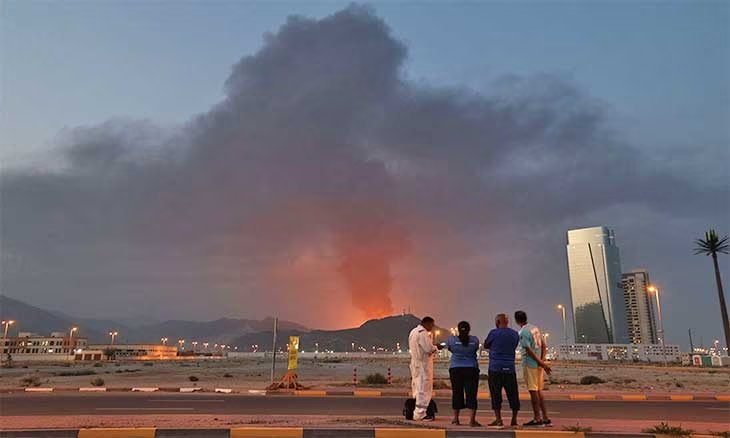
In light of this crisis, Gulf positions emerged reflecting the extent of the geopolitical predicament, as the UAE announced it had been subjected to over a thousand attacks without changing its defensive stance, while Saudi Arabia, Qatar, and Kuwait hinted at taking measures to protect their sovereignty. Observers believe that these countries find themselves in the heart of a conflict they did not seek, where military operations are managed with a logic that prioritizes Israel's security over regional stability, threatening Gulf infrastructure and economies that have become caught in the crossfire between Washington and Tehran.

Internationally, signs of division in the Western camp began to clearly appear, as Spain and Portugal announced their categorical refusal to use their military bases as launchpads for attacks against Iranian territory. British Prime Minister Keir Starmer also favored the diplomatic path over military involvement, at a time when air traffic tracking platforms detected intensive movements of American refueling aircraft heading towards the Middle East via alternative routes in northern Europe.

Economically, the war and navigation disruptions in the Strait of Hormuz caused a massive 25% jump in global energy prices, prompting the Kremlin to announce an increase in demand for Russian energy. The US budget is suffering from severe depletion, costing up to one billion dollars daily, coinciding with massive losses to the Israeli economy estimated at billions of shekels weekly, amidst reports of a gradual depletion of strategic ammunition stockpiles for the occupation forces and the United States.

Analysts believe that the deep objectives of this war go beyond the Iranian nuclear file to an attempt to liquidate the Palestinian issue and subject the region to complete Israeli hegemony. Arab capitals fear that the elimination of the Iranian regime will lead to an imbalance of power that will give Netanyahu's extremist government a green light to expand its geographical and political influence, placing Arab countries before difficult choices between engaging in the conflict or bearing the exorbitant cost of neutrality.

Who gave you permission to turn our region into a battlefield? This war places Israel's security and interests above all other considerations.

PALESTINE

Fri 06 Mar 2026 7:55 pm - Jerusalem Time

For the seventh day.. The occupation continues to close Al-Aqsa and restricts prayer in the Ibrahimi Mosque

For the seventh consecutive day, the Israeli occupation authorities continued to close the blessed Al-Aqsa Mosque to worshipers, preventing them from performing the third Friday prayer of the holy month of Ramadan. Local sources confirmed that the occupation police informed the Islamic Endowments of the continued ban on prayer based on instructions from the Home Front, in an escalatory step not witnessed in the Holy City for many years.

The occupation forces began their repressive measures last Saturday morning, forcing worshipers and those in seclusion to leave the mosque courtyards under threat of arms. These restrictions included preventing the performance of evening and Taraweeh prayers throughout the past week, with intensive military reinforcements deployed in all alleys of the Old City and its main entrances.

In response to this ban, hundreds of Jerusalemites performed Friday prayers in the streets surrounding Bab Al-Amoud and in various neighborhoods of Jerusalem, expressing their adherence to their right to access their mosque. Camera lenses also captured Palestinian women performing prayers on the hills of the Mount of Olives overlooking the Dome of the Rock, in a scene that embodies the extent of deprivation imposed by the occupation.

This closure coincides with the imposition of a comprehensive security cordon on all governorates of the West Bank, following recent military developments and mutual attacks between Israel and Iran. It appears that the occupation seeks to exploit regional circumstances to impose a new reality in occupied Jerusalem, by reducing the Palestinian presence in Al-Aqsa Mosque to its lowest levels.

Historical records indicate that this is the fifth time Al-Aqsa has been closed on a Friday since the occupation of the city in 1967. Previous times were linked to major security events, such as the electronic gates uprising in 2017, or during periods of direct military aggression, which reflects the seriousness of the current stage and its repercussions on the existing situation.

In the city of Hebron, the situation was no better, as the occupation forces imposed strict restrictions on the entry of worshipers to the Ibrahimi Mosque. Official sources reported that the occupation allowed only 60 worshipers to enter, out of thousands who flocked from various villages and towns of Hebron to perform Friday prayers on this blessed day.

The director of the Ibrahimi Mosque, Moataz Abu Suneineh, described these measures as a blatant assault on freedom of worship guaranteed by international conventions. He explained that thousands of citizens remained stranded at the military checkpoints and electronic gates surrounding the sanctuary, without being able to reach the mosque courtyard to perform religious rituals.

Abu Suneineh clarified that the Ibrahimi Mosque suffers from a systematic policy of tightening aimed at Judaizing it completely by controlling the number of worshipers and their entry times. He pointed out that the occupation exploits Islamic religious occasions to increase the pace of repression, in an attempt to impose absolute Israeli sovereignty over the sanctuary and change its pure Islamic identity.

Since 1994, the Ibrahimi Mosque has been subject to an unjust temporal and spatial division, with settlers controlling 63% of its area, while the remaining area is allocated to Muslims. This division came as punishment for worshipers after the horrific massacre carried out by an extremist settler, which led to the martyrdom of 29 Palestinians while prostrating in dawn prayer.

It is worth noting that the occupation does not allow the Ibrahimi Mosque to be fully opened to Muslims except for ten days throughout the year. These days include the Fridays of Ramadan, Laylat al-Qadr, and religious holidays, but the recent measures have proven that even these few days are now threatened with complete prohibition and closure under flimsy security pretexts.

What is happening today is a dangerous precedent that represents a blatant violation of freedom of worship and a direct infringement on the rituals of Islam during the holiest times.

ARAB AND WORLD

Fri 06 Mar 2026 7:55 pm - Jerusalem Time

Rift in the International Coalition: Britain, Spain, and Portugal Refuse Military Involvement Against Iran

British Prime Minister, Keir Starmer, officially announced that the United Kingdom will not participate in ongoing military operations against Iran, emphasizing that his country prioritizes negotiation. Starmer clarified that the best path for Tehran and the international community lies in reaching a comprehensive political solution, provided the Iranian regime completely abandons its nuclear ambitions and capabilities.

These British statements come at a sensitive time when the administration of US President Donald Trump is facing difficulties in mobilizing a broad international coalition to support joint military operations with Israel. London appears to have chosen to distance itself from the initial strikes, despite its continued close cooperation with Washington on other security issues, reflecting a divergence in assessing the current military situation.

In Madrid, the Spanish government took a firm stance, refusing to allow its military bases to be used as launching pads for attacks against Iranian territory. Prime Minister Pedro Sánchez affirmed that defense agreements signed with the United States do not grant the right to use Spanish facilities for offensive purposes in this conflict, calling for diplomacy to prevail over the language of weapons.

Sánchez stressed that his country, despite condemning the repressive policies practiced by the Iranian regime against its citizens, does not see violence as a sustainable solution to international crises. He considered the belief that democracies can be built from under the rubble to be a kind of illusion, affirming that Spain will not be drawn into a military conflict that could lead to catastrophic consequences for global stability.

For its part, Portugal joined its neighbor Spain in closing its airspace and military facilities to offensive operations, with Lisbon refusing the use of the 'Lajes' air base in the Azores. Portuguese Prime Minister, Luís Montenegro, stated that any military action must adhere to the controls of international law in terms of necessity and proportionality, and be directed exclusively towards specific military targets.

These rigid European stances coincide with what 'Flightradar24' observed regarding intensive air movements of American warplanes and refueling aircraft that departed from Spain. This data indicates that Washington is trying to reposition its forces in Northern Europe and the Middle East to circumvent the restrictions imposed by Southern European countries on its bases.

France's position was partially different, as Paris allowed the US military to use military bases located only within French territory. The French General Staff clarified that this authorization does not include French bases deployed in the Gulf region, to avoid direct involvement in offensive operations and to limit support to defending regional partners.

On the ground, reports indicate that Iran managed to carry out a rapid military response following the joint US-Israeli strike launched in late February. The Iranian response included intensive shelling with drones and short-range missiles targeting vital American bases in the Gulf region, including Al Udeid Air Base, just one hour after senior Iranian leaders were targeted.

Field sources confirmed the martyrdom of Iranian Supreme Leader Ali Khamenei and Commander Mohammad Pakpour during the first airstrikes that targeted Tehran. This unprecedented escalation led to a surge in global energy markets, with oil and gas prices jumping by up to 25% due to direct threats to navigation in the strategic Strait of Hormuz.

Economically, the Israeli occupation faces immense pressure, with its weekly losses reaching approximately 9.4 billion shekels, while the United States incurs a billion dollars daily to fund its operations. This crisis is exacerbated by a severe depletion of American and Israeli ammunition stockpiles, which were already affected by the ongoing wars in Ukraine and the Gaza Strip.

Through these operations, the Trump administration seeks to achieve a stated goal of overthrowing the Iranian regime and changing the political map of the region. However, the absence of logistical support from traditional allies such as Britain and Spain weakens the effectiveness of this strategy and increases the military and financial burden on Washington and Tel Aviv in facing Iranian reactions.

Amidst this international division, fears arise of the conflict expanding to include Lebanon and other fronts in the Middle East, which France explicitly warned against. The question remains about the United States' ability to continue this unilateral military confrontation, given the increasing European voices calling for a return to the negotiating table to avoid a comprehensive regional war.

The real naivety is believing that violence is the solution, and that democracies or respect among nations can be born from under the rubble.

PALESTINE

Fri 06 Mar 2026 7:55 pm - Jerusalem Time

Major Humanitarian Emergency: 100,000 Displaced in Lebanon and Rising Casualty Toll Due to Aggression

The United Nations High Commissioner for Refugees (UNHCR) has confirmed that ongoing military operations in the Middle East region have led to a major humanitarian emergency requiring urgent international intervention. Ayaki Ito, the Regional Refugee Coordinator, explained that the escalating scale of the crisis necessitates immediate coordination to address the growing needs of affected populations amidst deteriorating conditions on the ground.\n\nUN data released today, Friday, revealed the displacement of approximately 100,000 citizens within Lebanese territory, fleeing intense shelling and military operations. In a related context, sources observed a reverse movement of tens of thousands of Syrian refugees who left Lebanon for their home country via land borders, seeking safety lost due to the continuous escalation.\n\nOn the ground, the Israeli occupation army continued to issue forced evacuation warnings to residents of large areas in southern Lebanon and the suburbs of the capital, Beirut. These threats coincide with fierce clashes and intense airstrikes, exacerbating the panic among civilians and forcing them to abandon their homes and properties under fire.\n\nRegarding the health situation, Dr. Hanan Balkhy, the Regional Director of the World Health Organization, warned of catastrophic risks threatening displaced persons in shelters. Balkhy indicated that overcrowding, lack of clean water supplies, and sanitation services increase the likelihood of outbreaks of epidemics and infectious diseases spiraling out of control.\n\nIn its latest report, the Lebanese Ministry of Health stated that the toll of the Israeli aggression has risen to 123 martyrs, in addition to 683 injured with varying degrees of severity. Medical teams are working under extremely complex conditions to try and save the injured, amidst direct and indirect targeting of infrastructure and vital facilities in the country.\n\nFor its part, the occupation army announced the resumption of a second round of intense airstrikes on the southern suburb of Beirut, targeting what it described as "incubating environments" and military targets. These raids followed a bloody night that saw intense shelling of residential neighborhoods, leading to widespread destruction of property and an increased pace of displacement from the capital.\n\nThe effects of the conflict were not limited to Lebanon but extended to other countries in the region, with international reports indicating the displacement of about 100,000 people within Iran during the first days of the confrontations. Relief teams receive hundreds of daily calls from citizens requesting urgent assistance to secure their basic needs of food, medicine, and shelter.\n\nUN estimates suggest that the announced displacement figures may be significantly lower than the actual reality, due to the difficulty of accessing some affected areas. International organizations emphasize the need to open safe corridors and provide urgent financial and logistical support to prevent this crisis from turning into an unprecedented humanitarian catastrophe in the region's modern history.\n\nThe escalating crisis in the Middle East calls for an immediate and coordinated response to meet the growing humanitarian needs.

ARAB AND WORLD

Fri 06 Mar 2026 7:55 pm - Jerusalem Time

Kremlin: War in Iran raises demand for Russian energy, international warnings against Europe's dependence on Moscow

Official sources in the Kremlin stated today, Friday, that the ongoing military operations in Iran have directly contributed to an increase in global demand for Russian energy resources. These developments come at a time when oil and gas markets are experiencing severe turmoil due to the closure of the Strait of Hormuz, which is considered the most vital artery for transporting energy supplies around the world.

The Russian statements followed the US Treasury Department's announcement of granting an exceptional 30-day waiver allowing India to receive shipments of Russian oil that were stranded at sea. This American move reflects a temporary retreat in the pressure Washington had exerted on New Delhi to reduce its purchases from Moscow, in order to secure the needs of the global market affected by the conflict.

The military aggression on Iran entered its seventh day, as the targeting of vital facilities and the closure of maritime passages caused a significant disruption in a large part of oil and liquefied natural gas supplies destined for international markets. Kremlin spokesman Dmitry Peskov confirmed that his country is observing a significant increase in demand for its resources, emphasizing that Russia remains a reliable supplier of pipeline gas and LNG.

Peskov indicated in statements to journalists that Moscow is committed to fulfilling all its contractual obligations towards its international partners, despite sanctions and political pressures. The spokesman refused to specify the exact quantities that might flow to India under the new American waiver, merely confirming the continuity of contracted deliveries without interruption.

In contrast, the Executive Director of the International Energy Agency, Fatih Birol, issued strong warnings against European countries returning to reliance on Russian gas. Birol described any such move as a grave economic and political mistake, especially in light of the radical transformations witnessed in the global energy market due to successive crises.

Birol's warnings came after a high-level meeting in Brussels attended by European Commission President Ursula von der Leyen and EU commissioners. Birol explained that the current crisis in the Middle East has raised questions about energy security again, emphasizing that excessive reliance on a single source was one of the biggest historical mistakes of the old continent.

Statistical data indicate a sharp decline in the share of Russian gas in the European market, falling from 40% before 2022 to only about 6% last year. This decline is a result of the European Union's efforts to decouple its energy ties with Moscow following the outbreak of the war in Ukraine, and its search for more stable alternatives.

On the ground, reports indicate that the war, which began with a joint US-Israeli strike on February 28, led to the martyrdom of Iranian Supreme Leader Ali Khamenei. Tehran responded with intensive shelling targeting American bases in the Gulf region, including Al Udeid Air Base, using missiles and drones, which increased tensions in shipping lanes.

These military tensions led to a global jump in oil and gas prices by up to 25%, amid fears of the depletion of American and Israeli ammunition stockpiles. Economic reports also revealed heavy losses incurred by the Israeli economy, estimated at about 9.4 billion shekels per week, while the cost of US military operations amounts to one billion dollars per day.

Russia's state-owned Gazprom faces structural challenges despite the current increase in demand, as its market value has sharply declined over the past two decades. After being the third-largest company globally with a value exceeding 330 billion dollars in 2007, its current value is estimated at only about 40 billion dollars, reflecting the scale of transformations in the global energy sector.

We are witnessing a significant increase in demand for Russian energy resources amid the war in Iran, and Russia has been and remains a reliable supplier of oil and gas.

PALESTINE

Fri 06 Mar 2026 7:55 pm - Jerusalem Time

Palestinian Women in Wartime: A Field Study Documenting Resilience in the Face of Reproductive Genocide

A new book titled 'Palestinian Women in Wartime: Between the Challenges of Humanitarian Reality and the Transformations of Social Role' has recently been published by the Phoenix Center for Research and Field Studies in Gaza. Authored by researchers Mansour Abu Karim and Noura Zaqout, the 290-page book offers an in-depth analytical reading based on a field study that included a wide sample of women in the Gaza Strip during the period between 2023 and 2025.

The book highlights the stark contradiction in international discourse that champions women's rights while turning a blind eye to the tragedy of Palestinian women who are subjected to systematic killing and displacement. The facts presented in the study reveal the ugly face of international law, which fails to protect the right to life, the origin and first of all rights, especially in light of the direct targeting of women and children by the occupation.

The four chapters of the study address war as a structural earthquake that has reshaped social and political roles in Palestinian society. In this context, women emerge as a key actor and guardian of identity and social fabric, especially with the collapse of official institutions, where their bodies and daily lives have become an arena for resistance and survival at the heart of the national conflict.

The book chronicles the militant consciousness of Palestinian women, which began to form since the British Mandate, specifically with the establishment of the first Arab Women's Association in Jerusalem in 1921. This role evolved from traditional charitable work to direct involvement in popular revolutions, culminating in unique militant distinction during the Great Intifada in 1987.

The researchers monitor the effects of the 'Al-Aqsa Flood' operation and the subsequent Israeli aggression, which led to a comprehensive collapse of the economic and social infrastructure in the Gaza Strip. This reality imposed harsh burdens on mothers, who were forced to ration their meals and starve themselves to ensure the survival of their children amidst food insecurity.

The book clearly points to the concept of 'reproductive genocide' practiced by the occupation through the concentrated targeting of women, with the aim of liquidating the Palestinian demographic presence. This suffering has been exacerbated by forced displacement, which stripped women of their property and means of production, and placed them under the burden of unpaid care in overcrowded shelters.

On the health front, the study documented the complete collapse of the medical system, with most hospitals ceasing to provide essential services. This led to an exacerbation of the suffering of pregnant women who were forced to give birth in unsafe health conditions, as well as the spread of skin and infectious diseases due to the lack of safe drinking water and general hygiene.

The study touched upon the psychological aspect, confirming a significant increase in trauma and chronic anxiety disorders among Gazan women. Repeated scenes of destruction and the loss of children have shaken the foundations of psychological balance, in the near-total absence of specialized mental health services and sustained social support during times of bombardment.

The field results of the study, which included 400 women, showed that 86.5% of the participants did not receive adequate healthcare during the war. This large percentage reflects the scale of the humanitarian catastrophe and the collapse of the primary care system, in addition to the negative assessment of the fair distribution of humanitarian aid, which was marred by chaos and lack of oversight.

Regarding the political role, statistics revealed that 69.3% of women feel marginalized in the institutions of the Palestine Liberation Organization and the Palestinian Authority. The researchers attribute this to women's complete preoccupation with managing daily survival requirements and securing a livelihood for their families under harsh and continuous war conditions.

Despite the enormity of the challenges, the study showed a vibrant spirit among women, with 60% of participants expressing a strong desire to enhance their political role after the war ends. This shift indicates a resilient national consciousness seeking effective economic empowerment and the restoration of normal life components and participation in future decision-making.

This book is an important reference document that combines historical grounding and contemporary field analysis of one of the most violent conflicts in the twenty-first century. Its value lies in transforming human suffering into statistical data and structural facts that reveal the systematic targeting of Palestinian women by the Israeli war machine.

At the conclusion of their study, the researchers presented a realistic roadmap for transitioning from emergency relief to sustainable recovery. The recommendations focus on the necessity of integrating women into all reconstruction processes, and providing long-term psychological and economic support to enable them to overcome the devastating effects of the war and restore their leading role.

The book concludes that the resilience of women in Gaza today is an extension of a long legacy of struggle, and it is a cry in the face of a dysfunctional global system and hypocritical moral values. The book places international institutions before their legal responsibilities, emphasizing that the restoration of Palestinian society's well-being begins with the protection and political and social empowerment of women.

What Palestinian women face today is not merely humanitarian suffering; rather, it is an extension of an existential battle, in which women exhaust their energy to bear multiplied burdens for the sake of survival and resistance.

ARAB AND WORLD

Fri 06 Mar 2026 7:55 pm - Jerusalem Time

Risks of Regional Confrontation Escalation: Will Gulf States Be Drawn into War?

The Middle East region is witnessing an unprecedented escalation in military tension, driven by a series of American and Israeli strikes that targeted Iranian territory in recent days. This dramatic shift clearly reflects the transition of active powers from traditional deterrence strategies and crisis containment to a phase of actual and direct engagement in field military operations.

The biggest challenge in this escalation lies in the possibility of military operations expanding to include the Arab Gulf states, which could transform the entire region into an open regional war zone. The nature of the reciprocal targets indicates that the confrontation is no longer confined to specific geographical points but now threatens regional stability as a whole.

Today, the Gulf states find themselves in a highly sensitive and complex position within the current conflict equation, given that they host American military bases and vital strategic facilities. These facilities represent an essential part of the military infrastructure of the Western presence, making them potential targets in any scenario of expanding the scope of Iranian retaliation.

In addition to the military dimension, the geographical location of the Gulf states plays a crucial role in increasing the level of risks, as these countries are located on the direct line of contact with Iran. This proximity makes Gulf territories vulnerable to the direct security repercussions of any large-scale military explosion, whether through missiles or drones.

These facts place Gulf capitals under immense political and security pressure to choose between engaging in the confrontation or taking more severe stances towards Tehran. However, any slide towards military participation could lead to the transformation of Gulf cities and facilities into a direct theater of combat operations, a heavy price these countries seek to avoid.

The risks of dragging the Gulf into war are not limited to military aspects but extend to include existential threats to global economic security. The region is the main artery for energy production and export, and any widespread security disruption will inevitably lead to a paralysis in the flows of oil and gas to international markets.

The Strait of Hormuz stands out as one of the most critical points in this conflict, representing the most important waterway for global trade and energy. Any threat to the security of navigation in this strait would mean the global economy entering a dark tunnel of successive crises and a crazy rise in fuel prices.

Ambitious economic visions of the Gulf states fundamentally depend on sustainable regional stability to attract foreign investments and stimulate trade. Therefore, the outbreak of armed confrontation will erode confidence in the region's investment environment, threatening major development projects that have been planned for years.

By reading Tehran's behavior in recent responses, it is clear that it is still trying to keep the confrontation within calculated and limited rules of engagement. This Iranian strategy aims to send strong deterrence messages to the United States and Israel without fully sliding into an all-out war whose end cannot be predicted.

Under these circumstances, a collective Gulf stance becomes a crucial factor in curbing escalation and preventing the situation from exploding. Adopting policies based on extreme caution and self-restraint in dealing with mutual provocations represents the only safety valve to prevent limited strikes from turning into a major regional war.

Wisely managing the crisis requires the region's countries to strike a delicate balance between their security commitments with international allies and the necessity of preserving their national security. Mutual escalation could open doors to confrontations that are difficult to contain later, making preventive diplomacy an urgent necessity at present.

Wars in this geographical part of the world do not remain confined to military borders but quickly turn into humanitarian and economic crises that cross continents. Therefore, the stability of the Gulf is not just a local matter but a fundamental pillar of international peace and security in light of global economic interdependence.

Analysts confirm that the real danger at the current stage goes beyond mere mutual military strikes between the three main parties. The danger lies in the 'rolling dynamic' that may force other parties to enter the conflict in defense of their interests or territories, thus expanding the circle of fire.

In conclusion, avoiding being drawn into direct confrontation remains the most prominent challenge for leaders in the region to prevent the Middle East from turning into an international conflict arena. The cost of war in the Gulf will be very high at all levels, making de-escalation the only rational path to overcome this critical stage.

The real danger is not only in mutual strikes but in the possibility of the confrontation turning into a comprehensive regional conflict in which the Gulf states find themselves at its heart.

PALESTINE

Fri 06 Mar 2026 7:54 pm - Jerusalem Time

Military and Political Indicators Suggest US-Israeli War Against Iran Will Halt Within Two Weeks

The military confrontation led by the United States and Israel against Iran has entered its second week, amidst field and political indicators suggesting the possibility of operations ceasing within less than two weeks. Despite official statements indicating the parties' readiness for a long-term war of attrition, the data on the ground imposes a different reality that may push for an early end to the fighting.

This round of conflict began on February 28, 2026, and from its very first hours witnessed an unprecedented escalation, including the assassination of senior Iranian leaders, most notably Supreme Leader Ali Khamenei. However, Tehran demonstrated a rapid ability to restore its leadership structure and respond militarily by targeting American bases in the region, which disrupted calculations that had banked on a rapid collapse of the regime.

The political factor associated with US President Donald Trump stands out as one of the most important drivers of potential de-escalation, as Trump tends to declare quick victory to avoid getting bogged down in wars of attrition. The White House has already begun to pave the way for this scenario by claiming that airstrikes have destroyed Iran's missile and nuclear capabilities in a way that will take a decade to rebuild.

On the military front, Israel and its allies in the region face a serious challenge in the severe shortage of air defense system stockpiles, especially 'THAAD' and 'Arrow' systems. Sources reported that the rate of interceptor missile consumption far exceeds the ability of American factories to compensate, leaving the skies vulnerable to penetration if intense Iranian barrages continue.

US Secretary of Defense Beth Hegseth admitted in closed sessions before Congress that Iranian drones, particularly the 'Shahed' model, pose a technical and operational challenge that is difficult to fully contain. This admission coincides with warnings issued by former officials, such as Anthony Blinken, about the risk of depleting the US strategic military arsenal if the confrontation is prolonged.

Economically, the war has caused a severe shock to global markets, with energy prices jumping by 25% due to direct threats to shipping traffic in the Strait of Hormuz. Major international powers such as China, India, and Japan are pressuring Washington to halt military operations, given their complete reliance on Gulf oil, which is now within Iranian firing range.

Domestically, Israel is incurring enormous economic losses estimated at 9.4 billion shekels per week, which places immense pressure on the general budget and the home front. In contrast, the cost of US military operations is approximately one billion dollars per day, a figure that is causing increasing resentment within American public opinion, which rejects foreign military interventions.

Intelligence reports indicate that betting on the collapse of the Iranian regime from within seems remote at present, despite the presence of active opposition. The deep roots of revolutionary supporters and the regime's ability to absorb the initial shocks of assassinations have proven that scenarios of regime change through direct military force face enormous field and social complexities.

Western division is clearly evident in the European stance, with Spain leading a front opposing the war and demanding an immediate halt to military escalation. Even traditional allies like Britain show clear hesitation in direct involvement in combat operations, content with providing logistical and intelligence support, fearing the repercussions of the war on the security of the old continent.

The most terrifying scenario for decision-makers in Washington remains Tehran's resort to the 'Samson Option' if it feels a real existential threat. This scenario involves destroying energy facilities in neighboring countries and burning oil fields, which could lead to an unprecedented global economic crisis whose catastrophic effects would surpass all financial crises witnessed in the current century.

Iran manufactures far more ballistic missiles and drones than the United States can manufacture interceptor missiles.

ARAB AND WORLD

Fri 06 Mar 2026 12:37 pm - Jerusalem Time

'Khaibar Shekan' and 'Khorramshahr-4' Missiles Enter the Front Line: A New Iranian Escalation in Targeting Tel Aviv

The military arena witnessed a remarkable escalation at the end of the first week of confrontations, as Tehran announced the integration of more advanced missile systems into its offensive arsenal. This step comes as part of Iran's continuous response to attacks targeting its interests, indicating a shift in the nature of weapons used and their destructive intensity.

A statement issued by the Iranian Revolutionary Guard, concerning the twenty-first missile wave, confirmed that the city of Tel Aviv was a direct target for 'Khaibar Shekan' missiles. This announcement came just hours after the disclosure of the entry of 'Khorramshahr-4' missiles into active service in ongoing field operations, raising the level of missile threat to the region.

Technical data indicates that the 'Khaibar Shekan' missile, first used last June, has a range of up to 1500 kilometers. This model carries a warhead weighing half a ton, while its speed, exceeding 5,000 kilometers per hour, gives it a high ability to penetrate the atmosphere and reach its targets with extreme accuracy and speed.

As for the 'Khorramshahr-4' missile, it is considered one of the heaviest missiles in the Iranian system, carrying an explosive warhead weighing up to 1500 kilograms. The danger of this missile lies in its ability to reach its targets within only 12 minutes from the moment of launch, which poses serious challenges to enemy detection and air defense systems.

In a related context, Western intelligence reports show that Tehran has succeeded in developing about 14 different types of diverse ballistic missiles. The ranges of these missiles vary between 200 and 2500 kilometers, and among the most prominent are the 'Sejil', 'Shahab', 'Emad', and 'Ghadr' models, which form the backbone of Iran's deterrent force.

Western and Israeli military sources estimate that Iran's missile inventory is no less than 3000 missiles ready for launch at any moment. These figures reflect the scale of logistical and military preparations Iran possesses in facing any comprehensive escalation scenarios in the region in the coming period.

For its part, military sources reported that missile forces have launched approximately 500 various missiles since the beginning of the current round of fighting. These barrages included cruise missiles and hypersonic missiles, in an attempt to bypass the advanced interception systems deployed by American and Israeli forces.

The Khorramshahr-4 missile is characterized by a short flight time not exceeding 12 minutes, which reduces the ability of missile defense systems to detect and deal with it.

ARAB AND WORLD

Fri 06 Mar 2026 12:37 pm - Jerusalem Time

Behind the Scenes of White House Confusion: How Netanyahu Pushed Trump Towards Confronting Iran?

US President Donald Trump's administration faces significant challenges in presenting a coherent and convincing political narrative to the public regarding the ongoing military confrontation with Iran. Press sources reported that conflicting statements within the White House about the reasons and timing of the attacks caused confusion among international allies and within the US alike.

A report prepared by media sources in Washington clarified that Trump needed additional time to market the war option to his 'MAGA' political base, which voted for him based on promises to end foreign military interventions. The prevailing belief in the White House was that convincing this base would require weeks of systematic messaging that might extend until next April.

However, the course of events took a dramatic and sudden turn after a phone call between Israeli Prime Minister Benjamin Netanyahu and Trump on February 23. Netanyahu conveyed intelligence information indicating a rare meeting bringing together Iranian Supreme Leader Ali Khamenei with senior Revolutionary Guard commanders in one building in the capital, Tehran.

Netanyahu, in his conversation with the American president, considered targeting this meeting a 'fleeting opportunity' to eliminate the top leadership of the Iranian regime in one fell swoop. This intelligence offer put the American administration before an urgent military imperative that transcended the political and media plans that had been previously set to justify any potential escalation.

Before this shift, the American administration was sending contradictory signals; while the military fleet was moving towards the region, official statements emphasized the desire for a diplomatic solution. This delicate balance ended as soon as Trump approved the proposal to target the Iranian leadership, making subsequent justifications seem disjointed.

In a speech delivered from Mar-a-Lago, Trump announced the launch of 'Operation Epic Rage,' portraying it as a preemptive defensive step to protect Americans. Trump appeared wearing a white baseball cap, describing the Iranian regime as an 'evil group' posing an imminent threat to US national security.

Secretary of State Marco Rubio's statements further intensified the ambiguity when he indicated that Washington engaged in the war knowing in advance that Israel was prepared to attack unilaterally. Rubio clarified that the initiative to attack was necessary to avoid greater losses among US forces if Iran responded to the Israeli move.

These statements caused a shock in political circles in Washington, as they suggested that Israel had led the United States into war. This later prompted Trump to deny this interpretation, claiming that he might have forced the Israeli side to take certain positions in this conflict.

For his part, House Speaker Mike Johnson defended the military action, asserting that Israel was determined to act in self-defense with or without American support. Johnson indicated that the existential threat faced by Israel left no option but preemptive military action to prevent a widespread Iranian missile attack.

Reports indicate that military preparations were initially incomplete, as the Pentagon suffered in mid-January from a shortage of aircraft carriers and air defense systems in the region. Netanyahu repeatedly requested to postpone military operations until Israeli and American defensive preparations were complete to ensure the repulsion of any Iranian reaction.

By mid-February, the Pentagon had completed equipping a force capable of managing a military campaign lasting several continuous weeks. Meanwhile, Trump's envoys were conducting indirect nuclear talks in Geneva, aimed at preventing Iran from acquiring nuclear weapons or intercontinental ballistic missiles.

The US Central Intelligence Agency confirmed the accuracy of the information provided by the Mossad regarding the meeting of the Iranian leadership, which accelerated the decision-making process in the White House. Despite Trump's desire to wait for the State of the Union address, the pressure of field events imposed itself on the political timeline.

Hours before the confrontation erupted, Tehran presented a proposal for a nuclear agreement that Washington considered insufficient and full of security and technical loopholes. The American negotiating team left Geneva without reaching results, amid intelligence fears of Iran's ability to raise uranium enrichment to military levels within a few weeks.

Observers concluded that Trump found himself facing the most decisive decision of his second term, as the speed of developments confused the official discourse. Instead of gradually building political justifications, the White House was forced to defend a major military strike approved under the pressure of sudden intelligence opportunities.

Our goal is to defend the American people by eliminating imminent threats from the Iranian regime.

OPINIONS

Fri 06 Mar 2026 12:37 pm - Jerusalem Time

Exploiting the War on Iran to Shape the Middle East… with Israel First!

Major wars in the Middle East are not merely fleeting military confrontations, but pivotal moments where the balance of power is reordered and maps of influence are redrawn. The war on Iran – if it expands or prolongs – could turn into a tool for politically and security-wise reshaping the region, placing Israel at the heart of this formation. However, any serious strategic reading cannot ignore the fundamental question: what about the Palestinian people and their cause, the cornerstone of the region's stability or instability?

From an Israeli perspective, the confrontation with Iran represents an opportunity to reshape its surrounding security environment.

Weakening Tehran means reducing its regional influence, re-establishing new deterrence equations, and opening the door for a broader system of alliances that consecrates Israel as a pivotal security partner in the region.

Amidst shared fears of cross-border threats, military and technical cooperation networks could be strengthened, giving Israel an advanced position in any emerging Middle Eastern structure.

But reshaping the region in the wake of war is not just about Iran and Israel.

There is a deeper political dimension represented by the position of the Palestinian issue within this transformation.

The history of the conflict shows that attempts to bypass or jump over this issue have not produced lasting stability, but rather have generated recurring cycles of explosion. Hence, building a new Middle East that ignores ending the occupation and establishing an independent, fully sovereign Palestinian state with Jerusalem as its capital, will only be a reproduction of the same sources of tension in a new form.

Any regional system intended to be stable needs political and moral legitimacy, and this legitimacy cannot be derived from purely security arrangements or fleeting military alliances.

True stability is based on addressing the roots of the conflict, foremost among them the national rights of the Palestinian people according to international legitimacy resolutions and the principle of self-determination.

Otherwise, the state of tension will remain latent beneath the surface, capable of igniting at the first test.

The war on Iran could be used to reorder regional priorities, so that security issues and confronting regional influence take precedence over political solutions.

However, this arrangement, if it marginalizes the Palestinian issue, will carry within it the seeds of instability.

Peoples do not look at alliance maps as much as they look at justice and national dignity, and any regional system that does not take this into account will remain fragile no matter how cohesive it appears on the surface.

Furthermore, Israel itself, despite its efforts to consecrate its military superiority and regional integration, realizes that the unresolved Palestinian conflict keeps it in a state of permanent attrition, security-wise, politically, and morally.

Normalization and alliances cannot substitute for a historical settlement that ends the occupation and establishes a normal relationship between two states living on one land, each with internationally recognized rights.

Hence, the question of the fate of the Palestinian people becomes not an appendix to the analysis, but its center.

If the goal of reshaping the Middle East is to produce a more stable system less prone to wars, then ignoring the Palestinian issue will make this goal elusive.

However, if it is integrated into the core of any new arrangements, as a priority and not a burden, that could constitute a real entry point for a different phase.

Ultimately, Israel may seek to be “first” in the post-war engineering on Iran, but the Middle East will not know lasting stability unless the Palestinian people are an integral part of the solution equation, not a margin within it.

It is either a Middle East based on balanced justice, ending the occupation, and establishing an independent Palestinian state with Jerusalem as its capital, or a Middle East that remains ablaze with successive explosions, bringing everyone back to square one no matter how maps and alliances change.

OPINIONS

Fri 06 Mar 2026 12:37 pm - Jerusalem Time

From Tehran to Gaza: A Reading of the Repercussions of the Regional Conflict

The conflict between the United States and Israel on one hand, and Iran on the other, forms a fundamental axis for understanding the political dynamics in the Middle East. The region is experiencing a state of security and political entanglement that makes it difficult to isolate any development in a pivotal state from its regional surroundings. From this perspective, the Gaza Strip emerges as an important indicator for measuring the impact of regional conflicts on the Palestinian reality, whether at the level of political factions or the economic and social structure of the Strip.

The continuation of the war on Iran, the overthrow of its political regime, or its exposure to significant military and economic attrition will not be a purely internal event. Rather, it will have direct and indirect repercussions on a number of issues, foremost among them the Palestinian issue, and the Gaza Strip in particular. Over the past decades, Tehran has been linked to political, financial, and military support relations with a number of Palestinian factions, especially those that adopt the option of armed struggle. Consequently, any decline in Iran's capabilities or its preoccupation with its internal crises will inevitably lead to a reordering of its external priorities.

In this context, the weakening of Iran may reflect on the nature of the support provided to Gaza, whether in terms of funding or logistical and political backing. This, in turn, may exacerbate the economic crises already experienced by the Strip and place the factions before unprecedented challenges, especially with regard to governance, securing resources, and maintaining the cohesion of their organizational and military structure.

Moreover, the issue of factional weaponry will become more sensitive if regional power balances change. The absence or decline of supportive regional cover may open the door to increasing international and regional pressures to re-raise the issue of disarmament or its reorganization within new political arrangements. Conversely, some parties may seek to strengthen their presence in the Palestinian arena to fill any potential vacuum, adding a new element of complexity to the scene.

Over the past decades, Iran has been linked to multi-dimensional support relations with Palestinian factions, especially those that adopt the option of armed struggle, whether in terms of funding, logistical support, or political and diplomatic backing. Therefore, any weakness in Iran's ability to play its regional role, as a result of internal crises or external conflict, will directly reflect on these factions and their ability to manage the Gaza file internally. A decline in Iranian support may lead to a reduction in the financial and political resources available to the factions, exacerbating economic crises in Gaza, and increasing pressure on the factions to maintain organizational and military cohesion.

The changing balance of power as a result of regional conflicts redraws the maps of influence in the Middle East. In the event of a weakening of Iranian influence, international and regional pressures on Gaza may increase to reorganize the arms file, while other regional parties seek to strengthen their presence in the Palestinian arena and fill any potential vacuum. Since October 7, the region has witnessed a deep reshaping phase that has reshuffled alliances and redefined alignments, placing Palestinian and Islamic movements before a historical test of their ability to adapt to rapid transformations.

Ultimately, Gaza cannot be viewed in isolation from its regional surroundings. Any radical transformation in Iran - whether military or political - will find its echo in the Strip, to varying degrees. The question is no longer whether the results will reflect on Gaza, but how these reflections will manifest, and who will be most capable of adapting to the next phase.

OPINIONS

Fri 06 Mar 2026 12:36 pm - Jerusalem Time

Palestine in the Eye of the Storm… When Fronts Intersect and Space Narrows

The region today is not experiencing a fleeting tension, but stands on the brink of major transformations. The open – or semi-open – confrontation between Iran on one side, and the United States and Israel on the other, is no longer just a matter of mutual deterrence messages, but has become part of reshaping the balance of power in the region.

At the heart of this storm stands Palestine, not a direct party to the conflict of axes, but the first to pay its price. The more the regional engagement expands, the more the space for the Palestinian cause shrinks in international media and politics, transforming it from a central issue to a postponed item on an agenda crowded with wars.

The danger here lies not only in marginalization… but in what can happen under the cover of this marginalization.

When the world is preoccupied… silent projects move forward

Historical experience shows that the occupation excels at exploiting turbulent international moments. Every major crisis in the region has always been an opportunity to rearrange facts on the ground away from the spotlight.

Today, with major capitals preoccupied with calculations of deterrence and military messages, the possibility arises that Gaza could become an arena for settling deferred scores, under the banners of “security” and “fighting terrorism.” In such an atmosphere, the international community’s sensitivity to the scale of human losses diminishes, and political pressure becomes less effective.

As for the West Bank, the scene is more complex and less noisy. There, explosions do not reverberate with the same intensity, but creeping annexation policies steadily advance: settlement expansion, land confiscation, redefinition of administrative powers, and a gradual erosion of any political horizon for an independent state. All of this happens while the world watches missile maps, not the maps of geography being silently redrawn.

The most dangerous aspect of the storm: brainwashing in a time of frustration

Major wars do not only consume geography, but also drain morale. When Palestinians feel that their cause is receding in the international order of priorities, frustration can seep into the collective consciousness. And here, this atmosphere is exploited to push society towards one of two exhausting choices: either uncontrolled anger, or slow surrender to a reality presented as an unchangeable fate.

Regional war affects not only the land, but also the collective psyche.

When Palestinians feel that their cause is receding in the world's priorities, and that their destiny has become hostage to conflicts they do not control, a state of frustration creeps in. And it is precisely here that the most dangerous gamble begins: the gamble of exhausting the will.

“Brainwashing” policies do not require noisy propaganda campaigns; the accumulation of crises, the narrow political horizon, and the pressure of economic reality are enough for the demand for liberation to turn into a demand for “stability at any cost.”

In this sense, international marginalization is not just a diplomatic loss, but a strategic danger to the national spirit itself.

Between the axes… the danger of internal disintegration

Major wars reshape alliances. And the region today is no exception. In moments of sharp polarization, local forces are drawn into positioning themselves within conflicting axes. Here lies the test of Palestinian political maturity: Will the Palestinian arena become an extension of others’ conflicts? Or will it maintain the independence of its national decision?

The disintegration of the internal front, or the deepening of division, is the most precious gift that can be offered to the occupation at such a moment. The national project cannot be managed with the mentality of conflicting regional axes, but with a comprehensive national vision that transcends narrow calculations.

The response should not be emotional, but conscious and gradual:

First: Unity is not a moral slogan, but a necessity for Palestinian national security.

At a moment of regional reshaping, there is no place for division that weakens the Palestinian position or confuses its priorities.

Second: Diplomacy must act as an independent voice, not as an echo of an axis.

Breaking the state of marginalization requires a legal and political discourse that re-emphasizes that Palestine is not a side issue, but a cause of liberation and self-determination according to international law.

Third: Strengthening steadfastness is not a matter of services, but a strategy for survival.

In Gaza as in the West Bank, keeping people on their land, supporting the local economy, protecting education and culture, are all quiet but deeply effective tools of resistance.

Fourth: Protecting the national narrative is a top priority. In a time of misinformation and polarization, preserving a coherent Palestinian narrative becomes a sovereign act par excellence.

We must not be swallowed up in a conflict that is not ours; Palestine is not a margin in a regional equation, but it could become a collateral victim if the moment is not handled well.

The storm may be prolonged, and the axes of conflict may change, but the only constant is that the Palestinian national project cannot be suspended awaiting regional calm.

The question is not: Will the regional war swallow up the dreams of statehood?

The real question is: Do we have enough awareness and unity to prevent its engulfment?

In times of storms, ships do not survive by noise… but by the clarity of their compass.

PALESTINE

Fri 06 Mar 2026 12:36 pm - Jerusalem Time

'False Flag' Operations: Questions About the Occupation's Involvement in Mysterious Attacks in the Region

Recently, fundamental questions have been escalating regarding the nature of the mysterious attacks that targeted sensitive sites in several countries in the region, amidst indications pointing to the potential involvement of the Israeli occupation in these operations. Through these moves, the occupation seeks to fuel regional conflicts and exploit the existing state of tension between Iran and the United States to achieve long-term strategic gains.

In recent hours, Turkey, Azerbaijan, and Cyprus were subjected to sudden shelling by drones and missiles, which initially caused confusion in identifying the perpetrator. Despite speculations that pointed towards Tehran, the Iranian army and the Revolutionary Guard quickly denied any connection to these attacks, reinforcing the hypothesis of a third party seeking to complicate matters.

In a related context, the British Ministry of Defense announced that the drone that targeted one of its bases in Cyprus did not originate from Iranian territory. This announcement places Israel directly under accusation given its geographical proximity and its possession of the necessary technical capabilities to carry out such complex operations away from the spotlight.

The scene was repeated in the Arabian Gulf region, where activists circulated field testimonies about shelling that targeted a seaport in the city of Dubai, confirming that the source of the fire was from within the city and not an external attack. These accounts align with reports indicating attempts at security breaches aimed at destabilizing major economic centers in the region.

For its part, the Iranian Foreign Ministry categorically denied targeting the 'Ras Tanura' field belonging to Saudi Aramco, an attack that military sources described as a classic example of 'false flag' operations. These operations aim to pin the blame on Israel's adversaries to push regional and international powers towards a direct military confrontation with Tehran.

American journalist Tucker Carlson dropped a bombshell when he revealed that Saudi Arabia and Qatar had thwarted sabotage operations planned by agents affiliated with the Mossad. Carlson explained that the purpose of these bombings was to divert the international community's attention from the crimes committed by the occupation within Palestinian territories and deep inside Iran.

Intelligence data indicates that the Port of Fujairah in the UAE may be the next target in a series of potential Israeli sabotage operations. These warnings come at a time when Tel Aviv is seeking to expand the circle of fire to include vital energy facilities in the Gulf, threatening navigation security and global oil supplies.

Israeli history is full of secret operations that were only revealed decades later, such as the attacks that targeted a Jewish synagogue in Baghdad in the early 1950s. Historian Avi Shlaim revealed conclusive evidence proving Zionist involvement in those terrorist bombings, which at the time aimed to push Iraqi Jews towards forced migration to occupied Palestine.

In modern times, new accusations have emerged concerning the crash of the late Iranian President Ebrahim Raisi's helicopter, where navigation systems detected an American military cargo plane in Azerbaijani airspace. Experts suggest that this plane used advanced jamming techniques in coordination with the occupation to cause the Iranian helicopter to crash in a rugged mountainous area.

Israeli operations did not stop at political assassinations but extended to striking nuclear reactors in the Arab and Islamic region to ensure absolute military superiority. Among the most prominent of these operations were the destruction of the Iraqi 'Osirak' reactor in 1981 and the bombing of the Syrian 'Al-Kibar' facility in Deir ez-Zor in 2007 under flimsy security pretexts.

In recent years, Israel has also intensified its cyber and field attacks against Iranian nuclear facilities, including the theft of the nuclear archive and the assassination of scientists. These moves are part of Tel Aviv's 'war between wars' strategy to weaken its adversaries' capabilities without sliding into a comprehensive and declared war.

Targeting oil tankers at sea represents another chapter in Israeli involvement, with 2019 witnessing a series of mysterious attacks with naval mines. Despite initial accusations against Iran, subsequent Western reports revealed an Israeli intelligence and logistical role in orchestrating some of these incidents to justify tightening sanctions on Tehran.

The occupation's recourse to 'dirty operations' reflects a state of strategic anxiety regarding geopolitical shifts in the region and the failure of traditional military options. These mysterious attacks remain an effective tool in the hands of the Mossad to achieve political and military objectives at the lowest possible cost, while ensuring continuous denial of responsibility.

In conclusion, the question remains about the ability of the region's countries to uncover and counter these schemes before it is too late. History proves that Israel does not hesitate to sacrifice the security and stability of its allies or neighbors if it serves its expansionist agenda and ensures its survival as the sole dominant power in the Middle East.

Israel wanted this war to harm the Gulf states, and they succeeded through secret operations aimed at diverting attention from their crimes.

OPINIONS

Fri 06 Mar 2026 12:36 pm - Jerusalem Time

Why is Gaza closed to the international press after the collapse of the Israeli narrative?

In every war it wages, Israel tries to control both the weapon and the image, because control over the field is no longer enough without control over the narrative. From this perspective, the decision to prevent international journalists from entering Gaza cannot be understood as a security measure, but rather as a conscious political choice aimed at concealing the truth and preventing the world from seeing what Israel does not want to be seen.

The ready-made Israeli pretext is security concerns, a phrase that has been overused to the point of losing its meaning. How can a state that claims to possess one of the strongest armies in the world and the latest surveillance and intelligence systems fear an image or a pen that reveals the truth? The fear is not of a security threat, but of a moral and political threat represented by the exposure of the scale of crimes committed against Palestinian civilians, foremost among them comprehensive destruction and open genocide, which has become a declared policy, not merely collateral damage of war.

Preventing the international press from entering Gaza reflects a profound shift in Israel's image and standing in the world. The entity that built its narrative for decades on the idea of self-defense and being the only democracy in the Middle East now realizes that this narrative is no longer marketable in the face of images of murdered children, starving people, destroyed hospitals, and camps that have turned into mass graves, because the image is stronger than any military statement and truer than any official narrative.

Israel has realized that the presence of journalists in Gaza means the battle will move to the arena of global consciousness, where propaganda is useless and convoluted legal language is ineffective. The camera will convey the destruction as it is, and the lens will capture the details of the daily genocide that cannot be justified under any security or military pretext. This explains the insistence on isolation, blackout, and monopolizing the narrative through official spokespersons and biased media platforms.

Israeli fear of the press is a fear of testimony, because a journalist is not just a news conveyor but a historical witness who documents the moment and prevents its obliteration. Hence, preventing journalists becomes part of the crime itself because it is an attempt to kill the truth in parallel with killing people. When the witness is prevented, the door is wide open for committing more atrocities away from the eyes of the world.

What is happening in Gaza today is no longer just a war in the traditional sense, but a real test for the global conscience, for media freedom, and for the ability of truth to stand firm in the face of brute force. Preventing journalists from entering is not proof of Israel's strength, but of the fragility of its narrative and its deep fear after the mask has finally fallen and its true image as an occupying power practicing genocide and fearing that the world will see it for what it truly is has emerged.

Therefore, the battle for journalists to enter Gaza is not just a professional issue, but a political and moral battle related to the right of peoples to have their story told, and the right of victims to have their voices heard, because the most dangerous thing Israel can face today is not only the weapon of resistance but the truth when it is conveyed unfiltered, uncensored, and without fear.

Ultimately, preventing journalists cannot be separated from the broader context of attempting to control history or convey the truth as it is before it is written. When doors are closed to the truth, the goal is not only to protect criminals, but to protect the narrative from collapse, because what is happening on the ground in Gaza is too great to be contained in military statements or justified by security language. Therefore, Israel chooses darkness as a final weapon in the face of light, but darkness does not last long. Truth, even if besieged, always finds its way to the world, and what is prevented from documentation today will tomorrow turn into a fully-fledged condemnation, and into a historical testimony to a period in which the executioner tried to break the mirror, thinking he would hide his face, but he only delayed the moment of exposure.

ARAB AND WORLD

Fri 06 Mar 2026 12:35 pm - Jerusalem Time

US military investigations suggest Washington's responsibility for the girls' school massacre in Iran

US officials revealed initial assessments by military investigators indicating the potential responsibility of US forces for the deadly attack that targeted a girls' school in the city of Minab, southern Iran. The officials clarified that the investigations are still in their early stages and have not reached definitive conclusions regarding the type of ammunition used or the motives behind targeting a civilian educational facility.

The tragic attack occurred last Saturday, coinciding with the launch of joint US and Israeli military operations against Iranian territory. According to statements by Iran's ambassador to the United Nations in Geneva, Ali Bahreini, the bombing resulted in the martyrdom of 150 female students, sparking a widespread international outcry over the level of civilian casualties on the first day of the aggression.

For his part, US Secretary of Defense Pete Hegseth acknowledged the opening of an official investigation into the incident, confirming during a press conference that the US military is reviewing all details related to the strike. Hegseth stressed that his country's military policy does not include civilians among its targets, but a review of the field facts has become an urgent necessity after reports from southern Iran.

In a related context, US Secretary of State Marco Rubio stated that the United States cannot deliberately target a school, noting that the Department of Defense will be responsible for the full investigation. Rubio added that the investigation's results will determine the next steps if US forces are proven to be involved in carrying out this air strike, described as the deadliest.

The US Department of Defense (Pentagon) referred all inquiries related to the incident to the Central Command of the Army, which preferred to remain temporarily silent. The command's spokesman, Timothy Hawkins, said that commenting on the details of the attack would be inappropriate at this time to ensure the integrity and progress of the ongoing military investigations.

At the White House, spokeswoman Caroline Leavitt avoided direct comment on the initial investigation results, merely accusing the Iranian regime of targeting its own people. Leavitt said in a press statement that the Department of Defense is following the matter, but considered that the moral responsibility lies with Tehran to protect civilians during armed conflicts.

Informed sources indicated that the current assessment linking US forces to the attack may change with the emergence of new technical evidence from the bombing site. The sources explained that there are existing possibilities for data to emerge that could exonerate Washington or point to other parties involved in the intense air operations witnessed in the southern region on Saturday.

Regarding military coordination, a senior Israeli official revealed that US and Israeli forces are operating according to a precise geographical target distribution plan within Iran. According to this coordination, Israel is responsible for striking missile platforms in the western sector, while US attacks are concentrated on naval and missile targets in the southern regions, where the targeted school is located.

Internationally, the United Nations High Commissioner for Human Rights intervened in the crisis, demanding a transparent and independent investigation into the massacre. The Commissioner's spokeswoman, Ravina Shamdasani, said that the responsibility for investigation and accountability legally rests with the forces that carried out the attack, without naming a specific party pending clarification of the facts.

Iranian state television broadcast emotional scenes of the students' funerals, where hundreds of small coffins draped in the national flag appeared amidst massive crowds of citizens. A state of overwhelming popular anger prevailed in Minab and other Iranian cities, with calls for accountability for those responsible for targeting educational facilities.

Legal experts warn that if Washington's involvement in this attack is proven, it could constitute a war crime under international humanitarian law, which prohibits targeting schools and hospitals. If the responsibility of US forces is confirmed, this incident will be classified as one of the deadliest military operations against civilians in the history of US interventions in the Middle East.

We have opened an investigation into this matter; we never target civilian objectives, but we are reviewing what happened and conducting an investigation into it.

ARAB AND WORLD

Fri 06 Mar 2026 5:05 am - Jerusalem Time

Widespread Regional Escalation: Gulf States' Defenses Counter Iranian Attacks, Raids Target Civilian Areas in Manama

The Qatari Ministry of Defense announced, early Friday morning, that its air defense systems successfully intercepted an attack carried out by drones targeting Al Udeid Air Base. These developments come amidst unprecedented security tensions in the region, with armed forces in several Gulf states raising their alert levels to maximum to confront the increasing aerial threats.

In Kuwait, the Ministry of Defense confirmed that air defense units effectively dealt with airspace violations carried out by what it described as hostile missiles and drones. Field sources reported fires breaking out in parts of Ali Al Salem Air Base, which hosts American forces, as a result of the attacks targeting the vital military facility.

Reports indicate that eight Arab countries, including Saudi Arabia, the UAE, Jordan, and Iraq, have been subjected to a series of Iranian attacks since early last Saturday. This escalation follows the commencement of widespread military operations launched by Israel and the United States against targets within Iranian territory in recent days.

For its part, Tehran justified these military operations as targeting what it described as 'American interests' in the region, in response to attacks that targeted its leaders and facilities. Some of these strikes resulted in casualties, including dead and wounded, in addition to causing severe damage to civilian assets and commercial ports in several Arab capitals.

In a related context, Tehran continues to launch missile barrages and drones towards Israeli territory, leading to deaths and injuries among settlers. Iran considers these actions a direct response to attacks that led to the deaths of hundreds, including Supreme Leader Ali Khamenei, in previous airstrikes.

On the Saudi front, the Ministry of Defense announced the interception and destruction of three ballistic missiles and two drones in the Kingdom's airspace early today. The ministry clarified that the missiles were directly aimed at Prince Sultan Air Base, before defense systems were able to neutralize the threat and destroy the targets in the air.

Saudi sources also indicated the destruction of a drone in the eastern regions of the Kingdom, in addition to the interception of another aircraft east of Al Kharj Governorate, part of the Riyadh region. These operations confirm the continued military pressure on vital facilities and military bases in various regions of the Kingdom as a result of the current regional escalation.

In Bahrain, the Ministry of Interior reported that airstrikes targeted a hotel and two residential buildings in the capital Manama during Thursday and Friday nights. Bahraini authorities confirmed that the attack caused significant material damage to the targeted sites, but no loss of life among civilians has been recorded so far.

Bahraini civil defense teams managed to control a fire that broke out in one of the residential apartments as a result of the aerial bombardment that hit the buildings. Manama had previously announced that its main oil refinery was subjected to a missile attack that caused a large fire before firefighting teams were able to contain it and prevent its spread.

These successive developments paint a complex picture in the Middle East, where direct confrontations between Iran and Israel intertwine with the targeting of American bases in the Gulf. International fears are growing that the region could slide into a full-scale war that would affect global energy supplies and the regional security of Arab countries participating in countering these attacks.

Air defenses deal with hostile missile and drone attacks that have penetrated regional airspace.

ARAB AND WORLD

Fri 06 Mar 2026 5:05 am - Jerusalem Time

Araghchi: The plan for a quick victory over Iran failed, and we are ready to face a ground invasion

Iranian Foreign Minister Abbas Araghchi stressed that military plans aimed at achieving a swift victory over the Islamic Republic have completely failed. Araghchi explained in media statements that what he described as "Plan A," on which the adversaries relied, did not succeed in achieving its goals, emphasizing that any alternative plans would face a worse fate than their predecessors in light of current Iranian steadfastness.

Regarding strategic shipping lanes, the head of Iranian diplomacy indicated that Tehran currently does not intend to close the Strait of Hormuz, but it is closely monitoring developments. He affirmed that the Iranian armed forces are at the highest levels of combat readiness and are fully prepared to confront any attempt at a ground invasion that American forces might undertake on Iranian territory.

Araghchi strongly criticized the behavior of the American administration, stating that Tehran engaged in negotiations with Washington twice, and in both cases, Iran was subjected to military attacks during the talks. The Iranian minister held the United States fully responsible for the bloodshed and destruction resulting from the ongoing military escalation, describing American and Israeli objectives as illegitimate.

On the ground, sources reported that the Iranian armed forces are operating according to a strategy aimed at turning Iranian territory into a quagmire for any force that chooses to engage in ground warfare. The sources added that the military leadership in Tehran has prepared long-term defensive arrangements to confront the aggression that began last Saturday and targeted prominent facilities and leading figures.

In the context of diplomatic moves, Araghchi revealed that he held a series of intensive contacts with foreign ministers of regional countries, especially in the Arabian Gulf region. These discussions focused on the repercussions of military escalation and the necessity of maintaining regional stability under the current circumstances the region is experiencing due to ongoing attacks.

The Iranian contacts also included coordination with the Republic of Azerbaijan and the presidency of the Kurdistan Region of Iraq, where the activation of joint security agreements was emphasized. The Iranian side stressed the importance of securing borders and preventing any exploitation of neighboring territories in military operations, with a particular focus on border control from the Kurdistan Region.

These statements come at a time when Iran is witnessing a widespread military aggression launched by Israel and the United States, which has resulted in hundreds of casualties. According to field reports, the attacks targeted high-level leadership, while Tehran continues to respond by launching barrages of missiles and drones towards military targets and bases in the region.

For his part, the Secretary of Iran's Supreme National Security Council, Ali Larijani, issued a strong warning to the current US administration led by Donald Trump. Larijani's warning came in response to reports about Washington's intention to deploy thousands of soldiers to participate in ground operations deep inside Iran, describing this step as suicidal.

Larijani vowed that American forces would face fierce resistance from Iranian fighters, emphasizing that they are awaiting any ground movement to inflict heavy losses on the aggressors. He said that history would record thousands of dead and prisoners if Washington committed the folly of entering Iranian territory, stressing that his country would not be an easy place for invaders.

Iranian officials concluded their statements by emphasizing that true victory lies in the ability to resist and thwart the political and military objectives of aggression. They explained that the continuation of attacks on civilian targets and vital facilities would only increase the Iranian people's determination to defend their national sovereignty by all available means.

Plan (A) for a quick and clean military victory has failed, and your alternative plan, Mr. President, will suffer an even greater failure.

PALESTINE

Fri 06 Mar 2026 5:05 am - Jerusalem Time

Smotrich threatens Dahiyeh with Khan Yunis' fate, and the occupation expands its operations in southern Lebanon

Israeli Finance Minister Bezalel Smotrich issued strong threats against Lebanon, vowing that Beirut's southern suburb (Dahiyeh) would suffer a fate similar to the destruction inflicted upon the city of Khan Yunis in the Gaza Strip. These statements came during a field tour conducted by the minister to settlements near the northern border, where he affirmed that the army's strategy has fundamentally changed recently.

Smotrich indicated in his speech that the Israeli army has moved from the phase of evacuating Israeli settlements, which began two years ago, to issuing evacuation orders for Lebanese residents in Dahiyeh and southern Lebanon. He considered that the evacuation notices, which included the areas of Burj al-Barajneh, Haret Hreik, and Chiyah, are a prelude to turning those areas into rubble, in a clear reference to a policy of comprehensive destruction.

In an escalating context, the Israeli minister claimed that Hezbollah had made a strategic mistake that would cost it dearly, emphasizing that military operations target what he described as the 'head of the octopus' in Iran while simultaneously cutting off its arms in the region. He added in a video clip published on his official accounts, addressing the Lebanese: 'You wanted to bring hell to us, so you brought it upon yourselves.'

On the ground, these threats coincided with the occupation army issuing immediate evacuation orders for residents of Dahiyeh and three towns in the Beqaa region of eastern Lebanon, causing widespread panic and displacement. Hebrew reports indicated that the military command issued instructions to deepen the 'control line' along the Lebanese border, signaling the occupation's intention to remain for longer periods within Lebanese territory.

Israeli media quoted security sources confirming that military operations in Lebanon are expanding and becoming more complex, as the army has reinforced its presence at 10 strategic points deep inside Lebanese territory. These moves come as part of an attempt to impose a new reality on the ground that ensures strict security control over border areas and prevents any future threats.

On the diplomatic front, the Lebanese presidency moved urgently to confront the escalating Israeli threats, with Lebanese President Joseph Aoun asking his French counterpart Emmanuel Macron for immediate intervention. Aoun stressed the need for international pressure on Israel to prevent the targeting of the densely populated Dahiyeh, warning of an imminent humanitarian catastrophe.

Informed sources believe that Israel relies heavily on 'forced displacement' as a political and military pressure tool on both Hezbollah and the Lebanese government. This policy aims to create a state of social chaos and undermine the environment supporting the resistance, by forcing hundreds of thousands of civilians into displacement under harsh conditions.

Field sources reported that the current Israeli approach is characterized by a clear retaliatory logic against civilian populations, with infrastructure and residential areas being systematically destroyed. Observers fear that Israel may proceed to destroy thousands of housing units in Dahiyeh, repeating scenarios it carried out in Gaza Strip cities in recent months.

Sources also pointed out that the occupation seeks to change the geographical reality on the ground, as the number of Israeli military strongholds inside Lebanese territory has doubled from 5 to 10 in a short period. This expansion reflects an Israeli desire to turn southern Lebanon into a buffer zone subject to direct fire and field control.

Israel exploits international cover to launch its violent raids under the pretext of targeting military headquarters, while facts confirm that the shelling affects vital residential and commercial areas. This escalation has led to the displacement of nearly one million Lebanese citizens to the streets and shelters, placing the Lebanese state before unprecedented humanitarian and economic challenges.

In conclusion, Israeli threats to turn Dahiyeh into a 'second Khan Yunis' remain a dangerous indicator of the occupation's intention to expand the scope of an all-out war. With continued military buildup on the border, the Lebanese scene remains open to all possibilities, in the absence of any diplomatic horizon to stop the Israeli destruction machine.

Hezbollah made a mistake and will pay a heavy price... You wanted to bring hell to us, so you brought it upon yourselves.

ISRAELI AFFAIRS

Fri 06 Mar 2026 5:05 am - Jerusalem Time

Why is China reluctant to save Tehran? Oil calculations and the summit with Trump govern Beijing's stance

Questions are escalating about the nature of China's stance towards the comprehensive war waged by the United States and Israel against Iran, especially in light of the declared strategic partnership between Beijing and Tehran. Analytical readings confirm that China will not be an active helper for Iran in this confrontation, as the Chinese leadership places its interests in energy security above any ideological considerations or political alliances, preferring to closely monitor the scene without direct involvement.

Beijing's calculations are closely linked to its enormous dependence on energy resources from the Middle East, as China imported about 55% of its oil needs from the region in 2025. Supplies from Iran alone account for about 13% of total Chinese imports, making any disruption to navigation in the Strait of Hormuz a direct threat to the Chinese economy, which still relies on oil to operate its vital sectors.

Despite the signing of a $400 billion strategic cooperation agreement in 2021, the reality indicates that most projects under this agreement have not been implemented. This is due to Tehran's apprehension about Chinese influence, met by Beijing's frustration with the unreliability of the Iranian side, and Chinese assessments that Iranian military and political power is exaggerated compared to the actual size of its economy.

Recent Chinese diplomatic reactions have shown clear coolness towards military escalation, with the Ministry of Foreign Affairs merely issuing typical condemnations of the assassination of Supreme Leader Ali Khamenei without condemning the comprehensive military campaign. Beijing called on all parties, including Iran, to cease military operations, in a clear indication of its desire to maintain balanced relations with Gulf states, Israel, and the United States.

Chinese strategic experts believe that the Iranian regime suffers from a significant gap between its revolutionary ambitions and its limited economic capabilities, as its GDP does not exceed 90% of Israel's. This disparity has led Beijing to doubt Tehran's ability to withstand Western military technology for long, especially after repeated security breaches that enabled Israel to target senior leaders and scientists.

Furthermore, the relationship with Washington stands out as a crucial factor in China's hesitation, as the world anticipates an upcoming summit between Chinese President Xi Jinping and Donald Trump at the end of March. Beijing seeks to avoid any clash that could hinder opportunities to reach a comprehensive agreement ending years of bitter trade and political rivalry between the two great powers, making the sacrifice of Iran a viable option for the sake of stable bilateral relations.

Reports indicate that Beijing has lost confidence in Iran's ability to effectively manage its proxies in the region, especially after the decline in the role of these groups under successive blows. Chinese observers considered the withdrawal of Iranian forces from Yemen in April 2025 as evidence of Iran's weak resolve in protecting its allies, which reinforced China's conviction not to bet on a regime that might collapse internally.

Should the war lead to a regime change in Tehran, Beijing does not see this as the worst-case scenario as long as the new leadership guarantees the continued flow of oil and the protection of Chinese investments. Chinese pragmatism dictates dealing with any authority that emerges after the war, provided it avoids military adventures that threaten the stability of global energy markets, whose prices have risen by 6% since the conflict began.

China currently holds oil reserves estimated at about 1.4 billion barrels, which gives it enough room for maneuver to withstand a short-term supply disruption, but it fears a long war of attrition. If the confrontation continues for an extended period and leads to the closure of the Strait of Hormuz, Beijing may be forced to re-evaluate its position, not in defense of Iran, but to protect its energy-dependent national security.

Political circles in Beijing mock Iran's responses, which they described as 'theatrical' in the face of major assassinations, deepening the trust gap between the two countries. Chinese analysts believe that Iran finds itself caught in a dilemma between its ideological roots and its urgent need to lift Western sanctions, a contradiction that prevents it from making decisive strategic decisions in moments of major confrontation.

Economically, Beijing is monitoring the Israeli economy's losses, which have reached 9.4 billion shekels per week, but it realizes that unlimited American support for Israel fundamentally alters the balance of power. This understanding prompts the Chinese leadership to adhere to a cautious diplomatic path, avoiding entanglement in a proxy war that could drain its resources at a time when it seeks to strengthen its internal growth.

China's current stance reflects a shift in its view of the Middle East, where Beijing no longer sees Iran as a 'spearhead' against Western hegemony, but rather as a troubled economic partner. This shift explains why Beijing refrains from providing qualitative military support, such as drones or advanced technologies, preferring to wait until the features of the region's new political map become clear.

Ultimately, the security of waterways remains the only red line that might prompt China to act, as the closure of the Strait of Hormuz would mean a global energy crisis whose consequences Beijing cannot bear. However, China's primary bet remains on reaching understandings with the new US administration that guarantee its vital interests away from the fires of war raging in Tehran.

Strategic assessments conclude that China, despite its anti-hegemony rhetoric, remains a player seeking profit and economic stability first, which makes it closer to passive neutrality in the Iranian crisis. What matters to Beijing is not who governs in Tehran, but who ensures the safe arrival of oil tankers at Chinese ports, which any future leadership that prioritizes economics over ideology could provide.

China is prepared to work with any leadership that emerges after the strikes, as long as it protects the flow of oil and prioritizes shared economic interests.

ARAB AND WORLD

Fri 06 Mar 2026 5:04 am - Jerusalem Time

Trump Calls on Revolutionary Guard to Surrender, Urges Iranian Diplomats to Defect

Said Erikat

Opinion Writer

Washington – Saeed Erikat – 3/6/2026

In a direct message to Iranian security institutions, US President Donald Trump on Thursday called on members of the Revolutionary Guard, army, and police to lay down their weapons and join what he described as "the Iranian people," warning that they would face only death if they continued to fight against American and Israeli forces. He also called on Iranian diplomats abroad to seek asylum and participate in forming a "new and better Iran," affirming the United States' readiness to grant immunity to security personnel who decide to abandon the fight.

Trump's statements came during an event at the White House to honor the "Inter Miami" team after winning the American Major League Soccer championship, where he entered the East Room accompanied by the team captain and Argentine star Lionel Messi before the sports event turned into a political platform during which the President announced the latest developments in the escalating war against Iran.

Trump said that the United States and Israel continue to carry out extensive military operations against Iran, confirming that recent strikes have destroyed a large part of Iran's missile capabilities. He added that US forces have destroyed twenty-four Iranian ships in the past three days and that operations are proceeding at a faster pace than planned and on an unprecedented scale.

He explained that the strikes focus on dismantling Iran's military structure, including missile launch platforms and drone capabilities, stressing that US forces are destroying these capabilities in a way no one expected. He reiterated that Washington acted because it saw that Tehran was preparing to attack American interests, adding, "If we had not struck them, they would have attacked us," without presenting any evidence.

In an interview with "ABC News," Trump said that US strikes destroyed about 58% of Iran's missile launch platforms, considering that the extent of the destruction would require Tehran nearly ten years to rebuild its military capabilities.

Regarding the future of operations, he said that some observers believe the war has effectively ended, but he added that for him, it has not ended yet and will end when he decides so, affirming that the United States will not allow the emergence of an Iranian leadership that poses a threat to its neighbors or to Washington.

He also indicated that his administration is working on measures to limit the impact of the war on global oil markets and trying to contain the economic turmoil resulting from the military confrontation.

For his part, US Secretary of War Pete Hegseth said that the United States possesses enough ammunition and equipment to continue the war against Iran for a long time, stressing that Iran's bet that Washington will not bear the cost of a prolonged conflict represents a major miscalculation.

He added that US forces are not suffering from a shortage of ammunition and are capable of continuing military operations for a long time if necessary, denying what he described as Iranian propaganda about shooting down an American aircraft.

Politically, Hegseth hinted that Trump might play a role in determining the nature of future Iranian leadership, but he stressed that the United States does not plan to receive refugees from the Middle East, considering that countries in the region are capable of accommodating them.

As for the commander of US Central Command, Admiral Brad Cooper, he said that military operations are progressing rapidly and according to established plans, confirming that US forces have destroyed a large part of Iran's air defense systems.

In Congress, a divergence in political discourse emerged when Republican House Speaker Mike Johnson said that the United States is conducting a "limited operation" over Iran, indicating that it is limited in scope and duration.

Johnson added, after the House voted to reject a war powers resolution aimed at stopping Trump's attacks, that Washington is not at war and does not intend to be so, considering that the military mission is almost accomplished.

He said that the strikes led to a 90% reduction in Iranian ballistic missile launches, and drone use decreased by about 80% as a result of continuous strikes.

Cooper revealed that US forces also destroyed twenty-four Iranian warships and that Trump issued directives to destroy the Iranian naval base to prevent Tehran from rebuilding its fleet, noting that Washington possesses additional undisclosed operational capabilities to counter drones.

Since last Saturday, the United States and Israel have launched a wide-ranging war on Iran, which Tel Aviv named "Lion's Roar" while Washington called it "Epic Fury." The strikes resulted in the death of Supreme Leader Ali Khamenei and a number of senior military and security officials, in addition to civilians, while Tehran responded with a counter-operation named "True Promise 4."

The confrontation continues amid fears of the conflict expanding regionally.

Trump's call for members of the Revolutionary Guard and the Iranian army to surrender reflects a clear attempt to shift the battle from the military to the psychological and political sphere. The message not only aims to weaken Iran's fighting capability but also seeks to dismantle the loyalty of security institutions to the regime. However, such calls rarely achieve quick results, as foreign wars often lead to strengthening internal cohesion rather than dismantling it, especially when soldiers feel that their country is under direct attack from foreign powers.

In contrast, the US administration's rhetoric reveals a great deal of ambiguity regarding the ultimate goal of the war. While Washington talks about destroying Iran's military capabilities, other statements indicate a desire to influence the form of political leadership in Tehran. This overlap between military and political objectives reflects a strategic dilemma that the United States has faced for decades in the Middle East: the ability to destroy armies does not necessarily mean the ability to shape the political systems that will succeed them.

Economically, the estimated cost of the war at about one billion dollars per day raises serious questions within the United States about the feasibility of continuing operations for a long period. Recent history shows that costly wars in the Middle East often turn into a long drain on American resources without achieving decisive objectives. With rising energy prices and the potential for global market disruption, the economic cost could become an internal pressure factor on the US administration, perhaps no less impactful than the military challenges.