







Washington Message
Washington – Said Arikat - 27/7/2026
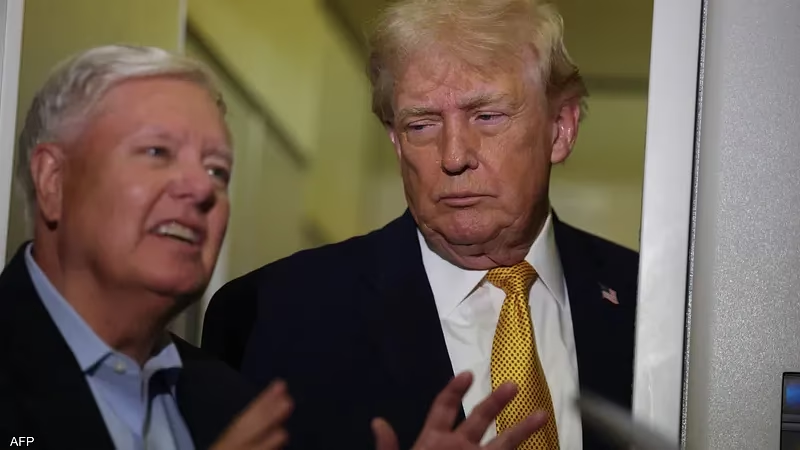
Footage from an as-yet-unpublished documentary film has revealed shocking stances by the late Republican Senator Lindsey Graham, showing his extreme enthusiasm for the outbreak of the American-Israeli war against Iran, and his boasting about what he considered a personal role in convincing US President Donald Trump to participate in the military campaign. This development sheds light on the extent of Graham's influence in foreign policy decision-making circles during the last years of his life.
These recordings, published by British director Alex Holder, come after he was granted extensive access to Graham over the years leading up to his death, providing a rare window into how discussions were managed within Trump's inner circle, and the nature of political coordination with the Israeli leadership before the outbreak of the war.
According to the footage, Graham appeared in a state of euphoria as he spoke about the start of military operations against Iran, saying with a laugh: "Look at what we've done here... I almost cried. How many years have we been pushing in this direction?" referring to the war as a long-sought goal.
Graham did not stop at praising the war, but also revealed that he had spoken with President Trump that morning, confirming that the latter was "very happy" with the military operation. He quoted Trump as saying that he described it as “the best thing I've ever done,” adding that the President “loves blowing things up,” statements that, according to observers, reflect a celebratory atmosphere within some administration circles towards the military option.
The recordings also show Graham attributing to himself a direct role in tipping the scales of war advocates within the US administration. He said that “there were many inside who did not want to do this, and therefore I faced challenges,” indicating the existence of opposition within the White House before the decision to participate in the war was made.
In the same context, Graham likened the relationship between Trump and Israeli Prime Minister Benjamin Netanyahu to that of US President Franklin Roosevelt and British Prime Minister Winston Churchill during World War II, considering that the two men formed an exceptional strategic partnership in confronting Iran.
Holder also published a recording of a phone call in early March between Graham and Netanyahu, during which they discussed military developments in the region. During the call, Graham informed Netanyahu that he was preparing to travel to Florida to meet Trump with the aim of convincing him to join the Israeli military campaign in Lebanon.
However, Netanyahu, according to the recording, dissuaded him from this step, explaining that the Israeli priority at that time was focused on Iran. He said that opening a wide confrontation with Hezbollah at that stage would not serve Israeli interests, because implementing comprehensive threats against the party would push it to respond with its full force, which Israel did not want at that time.
This call, according to observers, reflects the level of close political coordination between Graham and the Israeli leadership, and also reveals that Tel Aviv's priorities revolved around directing military efforts towards Iran before expanding the circle of war to other fronts.
Holder pointed out that Graham's relationship with Netanyahu was exceptional, as he spoke with him constantly and visited Israel frequently. He added that he accompanied Graham on one of his visits to Israel, and noticed that Israeli officials received him “as if he were a prime minister or a king,” a description that reflects his special status within the Israeli political establishment.
Despite his reputation for hawkish foreign policy stances, the recordings showed another side of Graham's personality, as Holder also published a phone call between him and Jake Sullivan, former President Joe Biden's National Security Advisor, indicating that he maintained channels of communication with Democratic officials despite partisan division.
According to the Wall Street Journal, Sullivan asked Graham about his expectations for the duration of the war, to which he replied that the attacking forces would be able, within three or four weeks, to push the Iranians to lose control of some cities, while at the same time calling for more overt involvement of Arab countries in military operations in order to create “momentum that is almost irreversible.”
These recordings reveal that the decision to go to war was not merely a response to field developments or immediate threats, but rather the result of years of pressure exerted by influential figures within the American political establishment, of which Graham was one of the most prominent symbols. More importantly, his talk of “challenges” within the administration suggests a real division between a current that was pushing for military solutions and another that feared the repercussions of engaging in a wide regional war, making the decision to go to war as much a product of internal struggle as it was a response to external factors.
The call between Graham and Netanyahu also reinforces the impression that coordination between some American politicians and the Israeli leadership went beyond traditional consultation, reaching the level of discussion on the timing and priorities of military operations. This raises political questions about the extent of influence exerted by Israeli officials on discussions within Washington, and the degree of independence of American decision-making when it comes to regional crises, especially in matters directly affecting Israeli security.
As for Graham's talk about the necessity of quickly involving Arab countries in the war to create “irreversible momentum,” it reflects an early recognition of the importance of conferring regional legitimacy on military operations. The wider the circle of participants, the more difficult political and military retreat becomes. However, this perception ignores the fact that many Arab countries feared the region sliding into a comprehensive confrontation, and preferred to contain escalation through diplomatic channels, realizing the repercussions that a wide war could have on regional security and stability.
Share your opinion
Unpublished Documentary Reveals Lindsey Graham's Celebration of the Start of the War on Iran and His Role in Pushing Trump Towards Confrontation