







By: Said Arikat
July 17, 2026
News analysis
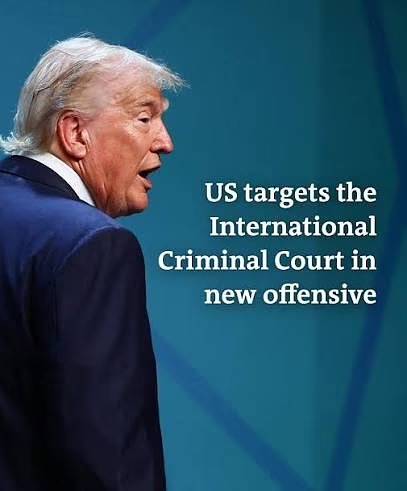
Washington, D.C.- When U.S. Secretary of State Marco Rubio declared on Monday, in the Wall Street Journal that the Trump administration intends to dismantle the International Criminal Court “brick by brick,” he cast the effort as a defense of American sovereignty against an unelected international bureaucracy. Read closely, however, his essay is less a constitutional argument than a political manifesto against international accountability—especially when that accountability reaches America’s closest allies.
Rubio portrays the ICC as an institution determined to place American soldiers, elected officials, and law enforcement officers under the authority of foreign judges. Yet this caricatures the court’s legal mandate. The United States never ratified the Rome Statute, and successive administrations have challenged the ICC’s jurisdiction over Americans. That legal dispute is genuine. Rubio’s argument goes much further: he questions the court’s legitimacy altogether and calls for its dismantlement.
That objective says more about Washington’s political priorities than the ICC’s legal flaws.
The timing is no coincidence. Rubio has been among Israel’s strongest defenders throughout the Gaza war and fiercely condemned the ICC after it sought arrest warrants for Israeli Prime Minister Benjamin Netanyahu and former Defense Minister Yoav Gallant over alleged war crimes and crimes against humanity. Rather than allowing those allegations to be tested before an independent tribunal, he joined a campaign portraying the court itself as the offender.
Nor did this campaign begin with Rubio’s wall Street Journal’s article. It began the moment the ICC showed a willingness to investigate leaders of countries closely aligned with Washington.
For years, American officials embraced international criminal justice when it targeted African dictators, Balkan warlords, or Russian officials. Washington supported the tribunals for Rwanda and Sierra Leone, welcomed the prosecution of Slobodan Milošević, and applauded the ICC’s indictment of Russian President Vladimir Putin. Accountability was celebrated as a cornerstone of the rules-based international order.
That enthusiasm waned once similar legal scrutiny approached American personnel or Israeli officials.
The contrast is difficult to ignore. International justice appears acceptable when directed at geopolitical rivals but intolerable when applied to strategic partners. Such selectivity weakens both American diplomacy and the credibility of the international legal order Washington routinely claims to uphold.
Rubio repeatedly invokes sovereignty, yet sovereignty has never been an absolute shield against allegations of genocide, crimes against humanity, or war crimes. The legal framework established after the Second World War—including the Geneva Conventions and subsequent treaties—was built on the premise that governments cannot always be relied upon to investigate themselves impartially.
The Rome Statute reflects that principle through complementarity, which gives national courts the first opportunity to prosecute alleged crimes. The ICC serves as a court of last resort when domestic authorities prove unwilling or unable genuinely to investigate. Whether the court always applies that principle consistently is open to debate. Rubio, however, largely sidesteps this framework, depicting the ICC instead as an institution eager to override functioning national courts.
His rhetoric is equally revealing.
Rubio describes the ICC as being driven by “leftist nongovernmental organizations,” “smug globalists,” and “hostile Third World governments.” Such language may resonate politically, but it substitutes ideological branding for legal analysis. Courts are challenged through evidence, jurisdiction, and legal reasoning—not by dismissing their supporters as global conspirators.
His reference to “Third World governments” is especially telling. It dismisses many of the countries that have been among the strongest advocates of international accountability precisely because they have endured mass atrocities, military coups, and state violence firsthand.
The irony becomes sharper when viewed alongside remarks attributed to the late Senator Lindsey Graham, another staunch defender of Israel. Graham reportedly told former ICC Prosecutor Karim Khan that the court “was built for Africa and for thugs like Putin,” not for the United States or Israel. Whether intended as blunt diplomacy or political theater, the comment encapsulated a criticism that has long shadowed international justice: accountability is expected of weaker states but resisted when it reaches powerful democracies and their allies.
Rubio’s article effectively elevates that perception into official policy.
The secretary of state also warns that Border Patrol agents, Marines, and federal prosecutors could someday face politically motivated prosecutions. That concern deserves serious consideration. Any international judicial institution must guard against politicization. But dismantling the ICC is an extraordinary remedy for problems that could instead be addressed through procedural reforms, clearer jurisdictional limits, and stronger due-process protections.
Indeed, even many of the ICC’s critics advocate reform rather than abolition. The court has faced legitimate criticism over slow investigations, uneven prosecutions, prosecutorial overreach, and inconsistent evidentiary standards. Those shortcomings warrant improvement, not demolition.
More fundamentally, Rubio’s proposal raises uncomfortable questions about the international order the United States helped build after 1945.
For decades, Washington has argued that respect for international law distinguishes democratic governance from authoritarian rule. American officials regularly condemn Russia, China, Iran, and other rivals for violating international norms. Those criticisms lose moral force if the United States insists that international legal institutions possess authority only when judging others.
Rules applied only to adversaries are not rules. They are instruments of power.
The consequences extend beyond legal theory. America’s allies increasingly find themselves caught between Washington’s rejection of the ICC and their own obligations as states party to the Rome Statute. European governments, in particular, face growing tension between their commitment to NATO and their commitment to international criminal justice.
Rubio frames the debate as a choice between sovereignty and globalism. The real question is whether powerful states should remain subject to independent legal scrutiny when allegations involve the gravest crimes recognized under international law.
The answer will shape far more than the future of the ICC. It will determine whether the rules-based international order remains a universal legal framework or becomes a selective system in which accountability depends less on the gravity of alleged crimes than on the political influence of those accused.
If Washington succeeds in dismantling the ICC, it may shield American and Israeli officials from future prosecutions. But it will also send a clear message to the world: international justice is for the weak, while the powerful answer only to themselves. That is not a defense of sovereignty. It is an affirmation of exceptionalism—one whose cost will be measured not only in legal precedent, but in the erosion of America’s credibility the next time it invokes international law against others.
Share your opinion
The Real Target Isn’t the ICC—It’s Accountability