







Washington's Message
Washington – Said Arikat – 7/14/2026
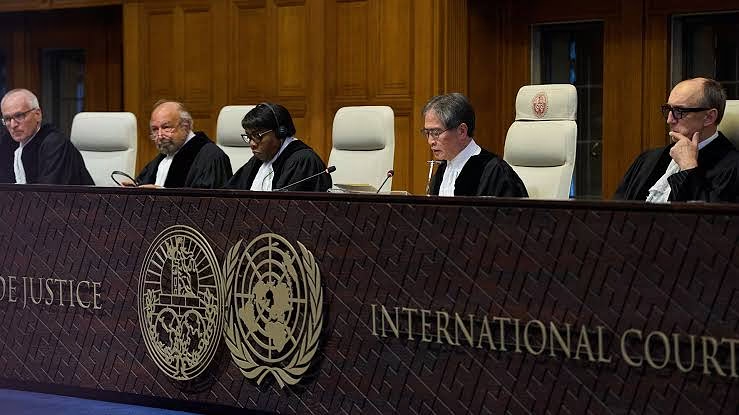
In an unprecedented escalation of its stance on the International Criminal Court (ICC), the US State Department announced the launch of a comprehensive government campaign aimed at undermining the court and isolating it diplomatically, considering it a "direct threat to American sovereignty." This move comes at a time of escalating confrontation between Washington and the court, against the backdrop of the latter's pursuit of American officials and military personnel, as well as its investigations related to US allies, foremost among them Israel.
US State Department spokesperson, Tommy Pigott, stated that the US administration has launched "a broad campaign led by the State Department, with the participation of various government institutions, to dismantle the threat posed by the International Criminal Court to American sovereignty," emphasizing that "all diplomatic, political, and economic options are on the table to ensure that the court cannot target the United States or its citizens."
According to a State Department official who spoke on condition of anonymity, the campaign is not limited to imposing more pressure on the court, but also includes a wide-ranging diplomatic effort targeting member states of the Rome Statute, which established the court, with the aim of persuading them to withdraw from it and cease any financial or political support for the international judicial institution.
The official explained that the Secretary of State, his deputy, US ambassadors, and senior administration officials have already begun intensive contacts with governments around the world to rally international support against the court and work to isolate it politically, thereby preventing it from exercising its jurisdiction over American officials or soldiers.
The US administration, according to the same official, is considering a wide range of escalatory measures, including imposing travel bans and revoking visas for court officials and those working with it, expanding economic sanctions to include institutions and individuals cooperating with it, in addition to exerting direct pressure on governments that continue to support or cooperate with the court.
The official also explained that Washington is calling on non-member states of the court, such as the United States, to use their diplomatic influence to join this campaign, while demanding that countries hosting US military bases or relying on the US security umbrella declare their explicit rejection of the court's jurisdiction to prosecute American officials and military personnel.
The State Department indirectly warned that countries that continue to rely on US security support, while at the same time refusing to oppose the court, may face "increased scrutiny" in their relations with Washington, a reference interpreted by observers as implying the possibility of using political or economic pressure tools to force those countries to reconsider their position.
In statements with an unprecedented tone, Pigott considered the International Criminal Court to be "seeking to transform into a global body above states," accusing it of attempting to impose an "illegitimate legal system" on the United States, and said that his country "does not recognize the authority of international bureaucrats seeking to undermine America's more than 250-year history of self-governance," emphasizing that "American sovereignty is not and will not be negotiable."
This campaign reflects a shift from a policy of defending the American position towards the court to an offensive strategy aimed at reducing its influence and international standing. Instead of merely rejecting the court's jurisdiction, the US administration seeks to weaken it institutionally by reducing its base of supporting countries and drying up its funding sources, which may limit its ability to continue its investigations.
This move comes in the context of escalating tension between Washington and the International Criminal Court, especially after the court issued arrest warrants against high-ranking figures in international conflicts, and the accompanying increase in concerns within the US administration about the possibility of expanding the scope of investigations to include American officials or close allies of the United States.
Diplomats believe that the American campaign may place many European allies in a complex equation, as most of them are members of the International Criminal Court and consider it one of the fundamental pillars of the international legal system, while their security and military relations with the United States are largely dependent, which may make them vulnerable to increased pressure in the coming period.
The American campaign reveals a deeper conflict than just a legal dispute with the International Criminal Court; it reflects a competition between two visions of the international system. The first, adopted by Washington, grants the national state absolute sovereignty over its citizens and institutions, while the second believes that the most serious crimes should not remain immune from international accountability, regardless of the nationality of their perpetrators. Hence, the current confrontation does not target the court alone, but touches upon the future of international criminal justice and the limits of the authority of multilateral institutions in the face of major powers that refuse to submit themselves to independent international justice.
American pressure will not be limited to the court alone, but will extend to a wide network of allies who find themselves caught between their international legal obligations and their strategic interests with Washington. European countries, in particular, have supported the court since its establishment as one of the most important institutions of the international system after the Cold War, while at the same time relying on the American security umbrella. This contradiction is likely to create divisions within the Western bloc and make the court issue a new test for the balance of Western alliances and the future of the rules-based international order.
If Washington succeeds in persuading a significant number of countries to withdraw from the court or reduce their financial and political support for it, this could open the door to a redefinition of the relationship between international law and the balance of power. If the campaign fails, the United States may find itself facing an international institution that has gained greater momentum as a result of the pressures placed upon it. In both cases, the current confrontation appears to be an indicator of a new phase in which the competition between the logic of political power and the logic of international institutions is increasing, amidst growing questions about the future of the global legal system and its ability to withstand geopolitical pressures.
Share your opinion
Washington launches comprehensive campaign to dismantle the International Criminal Court: A new escalation in the battle for sovereignty and international law