






Washington's Message
Washington – Said Arikat – 5/4/2026
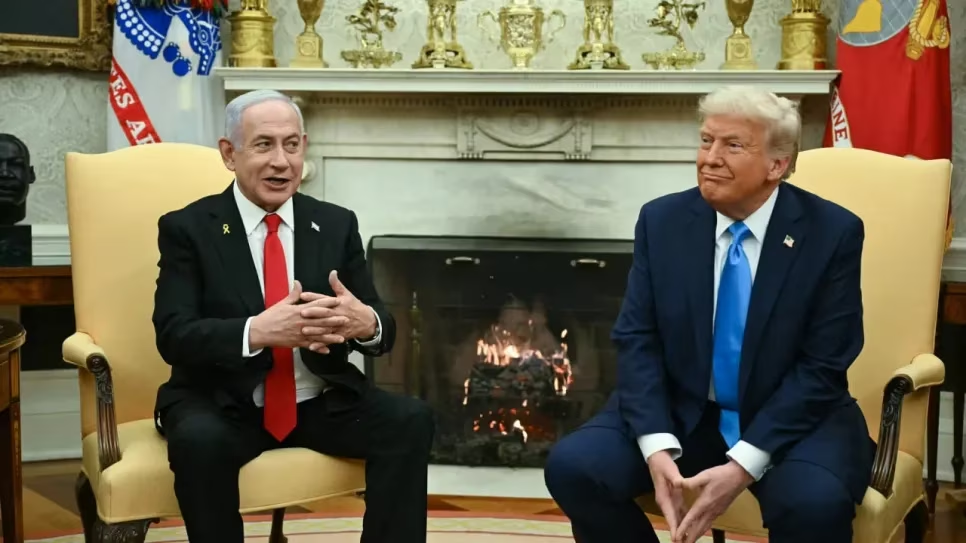
In a statement carrying political dimensions beyond diplomatic courtesy, US President Donald Trump said that Israeli Prime Minister Benjamin Netanyahu "knows who's in charge," ahead of a potential meeting between the two men at the White House next week or the week after, in their first encounter since the controversial meeting in the White House Situation Room on February 11th.
Trump clarified, in a brief phone interview with Axios, that Netanyahu requested a meeting in Washington, adding: "We get along very well… He knows who's in charge," in a remark that seemed aimed at highlighting his leadership position in managing the relationship with Israel, after months that witnessed clear differences between the two sides on sensitive regional issues.
According to an Israeli official, holding the meeting next week might be difficult due to Trump's commitments to the NATO summit in Turkey on July 7th and 8th, suggesting that the meeting might be postponed to the following week.
For his part, the Israeli Prime Minister's office announced that Netanyahu called Trump to congratulate him on the 250th anniversary of US independence, confirming that the two leaders agreed to hold a meeting soon in the United States. The statement added that Netanyahu emphasized during the call that the United States is a "guarantor of global freedom," and that Israel appreciates the depth of the strategic relations between the two countries.
Despite the positive atmosphere surrounding the announcement of the meeting, American sources confirm that the personal and political relations between Trump and Netanyahu are no longer as strong as they once were. Axios quoted an American official saying that a number of Trump's closest advisors are now convinced that "Netanyahu was wrong in all his assessments," a notable shift within the US President's inner circle.
The roots of this divergence date back to what followed their meeting in February, when Netanyahu proposed a plan for a joint war against Iran. However, the subsequent months saw a difference in priorities, after Trump preferred to establish a ceasefire with Tehran, and signed a memorandum of understanding to extend the truce and launch a new round of nuclear negotiations, despite Israeli reservations.
According to Axios, Trump pressured the Israeli government to reduce its military operations in Lebanon, considering that continued escalation hinders the negotiation process with Iran, and advocated for a framework agreement for an initial withdrawal of Israeli forces from southern Lebanon, which was not met with enthusiasm by Netanyahu's government.
These developments reveal a widening gap between American and Israeli calculations. While Trump focuses on achieving a diplomatic breakthrough with Iran that can be marketed as a foreign policy achievement, Netanyahu believes that continued military pressure is the most effective way to weaken Tehran and its allies.
The importance of the upcoming meeting for Netanyahu increases given his preparations for the Israeli elections scheduled for next October, while opinion polls indicate a decline in his popularity. A photo of him with the US President inside the White House would give him political momentum and send a message to the Israeli voter that he still maintains close relations with the American administration.
In a related context, Trump said he was following the funeral ceremonies of former Iranian Supreme Leader Ali Khamenei, who was killed on the first day of the war, according to the account reported by Axios. He added that negotiations with Iran would be temporarily suspended for a week until the end of the funeral ceremonies, confirming that both sides agreed during this period to refrain from any military actions.
The US President claimed that the Iranians are "begging for a deal," but he also indicated that the United States would not exploit the gathering of senior Iranian officials during the funeral ceremonies to launch a new attack, saying that eliminating them "would deprive Washington of negotiating partners." He also expressed surprise at the scenes of grief that accompanied the funeral, wondering if they were "real or artificial tears."
Trump's latest rhetoric reflects his attempt to combine a policy of military deterrence with openness to political settlement, at a time when the relationship with Netanyahu appears more complex than it was in previous years, with increasing differences in priorities between the two allies regarding the future of the war, the Iranian nuclear file, and regional security arrangements.
Trump's phrase "He knows who's in charge" reveals a shift in the nature of the relationship between Washington and Tel Aviv, as the US President no longer treats Netanyahu as a partner who sets the pace, but rather as an ally required to adapt to American priorities. The message is directed to the American domestic audience as much as it is directed to Israel, and its content is that the White House sets the boundaries of political and military action, and that support for Israel no longer means granting its government absolute freedom to formulate regional policies that conflict with American interests.
The potential meeting comes at a highly sensitive time for Netanyahu, who faces difficult elections and a decline in popularity, making any photo of him with the US President of great electoral value. However, the symbolic gain may conceal a different reality, as the American administration seems more determined to impose its agenda, whether concerning Iran or Lebanon. Therefore, the visit, if it takes place, may be an occasion to confirm the continuation of the alliance, but it will not necessarily mean full agreement in visions or a return of the relationship to its former state.
Data indicates that the disagreement between Trump and Netanyahu is no longer a tactical one, but has become linked to a difference in each party's perception of the regional order after the war. While Trump seeks to use the truce and negotiations with Iran to build new security arrangements that would give him a diplomatic achievement, Netanyahu prefers continued military pressure to prevent Tehran from regaining its influence. This disparity may make the relationship between the two men based on common interests, but less harmonious and more prone to tension whenever the political and strategic calculations of the two parties conflict.
Share your opinion
Trump Before Anticipated Meeting with Netanyahu: "He Knows Who's in Charge"