






Urgent: Washington's Message
Washington – Said Arikat – 26/6/2026
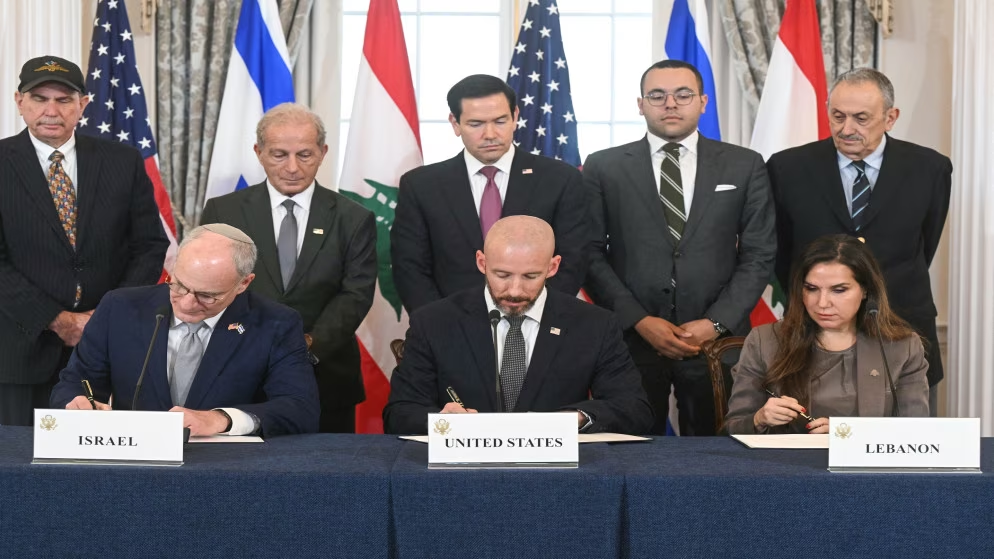
US Secretary of State Marco Rubio announced a "framework agreement" between Lebanon and Israel under the patronage of the United States, considering the agreement to be "the beginning of the beginning" towards lasting peace and stable security between the two countries, in a step he described as the first on a long and complex path to ending decades of conflict and tension on Lebanon's southern border.
The announcement came after talks hosted by Washington with the participation of Lebanese and Israeli delegations, where Rubio affirmed that the agreement lays the necessary foundations for a permanent cessation of hostilities, and aims to enable Lebanese and Israelis to live in security and stability, noting that the success of this phase requires arduous diplomatic and political work in the coming period.
In his speech, Rubio presented the traditional American narrative of the conflict, holding what he described as "external parties" responsible for turning Lebanese territory into a platform for attacking Israel, considering that the Lebanese people have paid a heavy price as a result of these interventions, and that the time has come for Lebanon to restore its prosperity, sovereignty, and stability.
The US Secretary also stressed that the residents of northern Israel deserve to live away from rockets and attacks, affirming that the agreement represents only the first step, and that the path towards lasting peace is still full of challenges.
From the Lebanese side, the Lebanese Ambassador in Washington described the agreement as "a first step" to restore Lebanese sovereignty and territorial integrity, achieve a final cessation of hostilities, and create conditions for the return of residents to their areas, expressing the Lebanese leadership's gratitude to the US administration for sponsoring the negotiations.
However, the American announcement was quickly met with outright rejection from Hezbollah, which affirmed in an official statement that any understanding or agreement with Israel "will not pass without resistance," considering that any arrangements affecting the future of the South, the resistance's weapons, or the rules of engagement cannot be imposed by political decision or external pressures, and that the resistance will deal with any attempt to change facts on the ground as it deems appropriate.
This early rejection reveals the extent of the complexities facing the agreement, as any political understanding between the Lebanese and Israeli governments will remain hostage to internal Lebanese balances, foremost among them Hezbollah's position, which possesses military and political weight that makes the implementation of any security commitments extremely difficult if it is not part of a comprehensive internal consensus.
The American statement also reflects the continuation of the American vision that exclusively links Lebanese stability to ending Hezbollah's military role, while avoiding mention of the continued Israeli occupation of Lebanese border points, daily aerial violations, issues of land border demarcation, prisoners, and reconstruction, which are issues Lebanon considers an essential part of any sustainable settlement.
It is also noted that Washington presents the agreement as a diplomatic achievement for the US administration, as part of its efforts to redraw the regional landscape after years of wars, and links it to a broader project based on expanding regional security arrangements, in line with the American and Israeli vision for a more stable region from the perspective of Western interests.
However, Lebanese experience over the past decades indicates that security agreements do not automatically translate into lasting peace, especially when the fundamental causes of the conflict remain unaddressed, foremost among them the continued occupation, border disputes, the absence of a comprehensive solution to the Arab-Israeli conflict, as well as the internal Lebanese division over the role of the resistance and the future of its weapons.
Thus, the "framework agreement" may represent the beginning of a new negotiation path, but it does not guarantee its success, because the success of any settlement will not depend only on the understandings signed in Washington, but on the ability of all parties to address the fundamental issues that have been the cause of repeated wars throughout the past decades.
The American announcement reveals a clear attempt to launch a political process that goes beyond a mere ceasefire, aiming to reshape the security environment in southern Lebanon in line with the American and Israeli vision. However, ignoring internal power balances, foremost among them Hezbollah's position, makes the agreement closer to a theoretical framework than to an implementable settlement. Previous experiences have proven that any security arrangements that do not enjoy broad Lebanese consensus, and do not address the roots of the conflict with Israel, remain vulnerable to faltering or collapse at the first field or political test.
The American discourse attempts to portray the agreement as a victory for diplomacy, but it adopts a unilateral narrative that focuses on Israel's security, while downplaying the importance of issues that Lebanese consider essential, such as daily Israeli violations, the remaining occupation, the prisoner file, and reconstruction. Without a balanced approach to these issues, it will be difficult to convince Lebanese public opinion that the agreement serves national sovereignty, rather than being merely a mechanism to control borders according to Israeli security priorities, which gives forces opposing the agreement ample space to mobilize the street against it.
Hezbollah's early rejection of the agreement confirms that the Lebanese crisis cannot be reduced to an understanding between two governments, because security decisions in Lebanon are also linked to complex internal and regional balances. Therefore, any peace project or lasting calm requires a more comprehensive approach that addresses the future of the resistance, defense strategy, Israeli occupation, and international guarantees, and not just technical understandings about ceasing hostilities. Otherwise, the agreement may turn into a new political document added to the series of agreements that later clashed with facts on the ground and internal division.
Share your opinion
United States Announces Framework Agreement, Hezbollah Rejects It