







Washington Message
Washington – Said Arikat – 25/6/2026
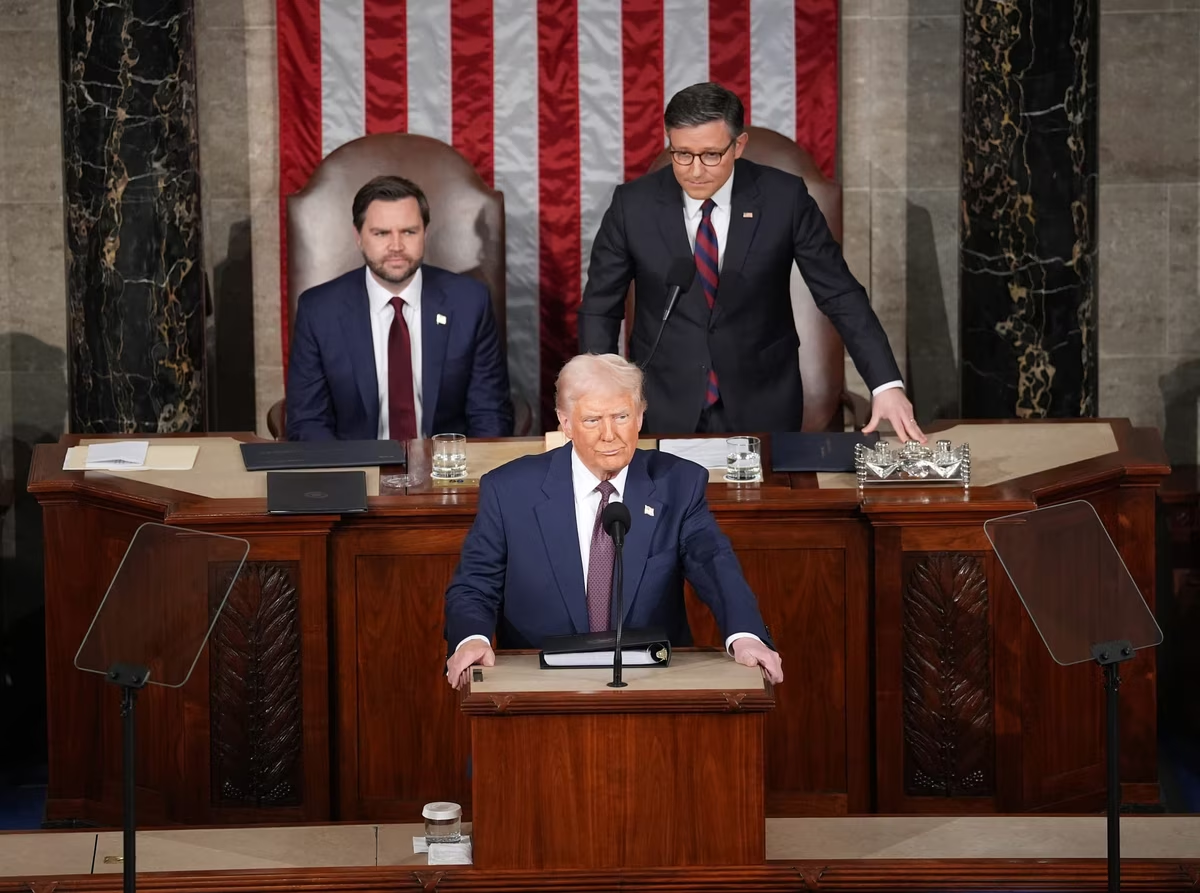
In a move reflecting the growing financial and political burdens of the American war against Iran, US President Donald Trump on Wednesday asked Congress to approve an additional spending package of $87.6 billion during the current year, most of which is allocated to cover military expenses related to operations against Iran, at a time when opposition is escalating within both the Republican and Democratic parties to the continuation of the conflict and its exorbitant costs.
According to the message sent by the US administration to Congress, about $70 billion of the requested amount will go to cover “operational costs” incurred by the US Department of Defense during the war, while the rest of the allocations are distributed to other programs, including $11 billion to support American farmers, and $1.4 billion to combat the Ebola virus outbreak in Central Africa, in addition to $1 billion to complete the modernization of the famous Pennsylvania Station in New York City.
The presidential request reveals a widening gap between the White House and Congress regarding the management of the war, especially after months of criticism directed at the Trump administration for not obtaining clear legislative authorization to continue military operations against Iran.
House Appropriations Committee Chairman Republican Representative Tom Cole, and Defense Subcommittee Chairman Ken Calvert, welcomed the study of the request, stressing that Congress has a constitutional responsibility to provide for national defense requirements and ensure the readiness of the US armed forces to confront various threats.
However, the path for the funding package appears very difficult, especially in the Senate, where its passage requires bipartisan support and at least sixty votes. Most Democrats have announced their rejection of funding the war, considering that the administration has not yet provided sufficient justifications regarding its objectives, cost, or exit strategy.
Democratic Senator Patty Murray, a prominent member of the Appropriations Committee, said that the administration “has failed for months to answer basic questions about the war,” considering that the request is not limited to funding military operations, but includes an attempt to pass additional Pentagon priorities that should have been discussed within the regular annual budget.
The Department of Defense’s request includes allocating $21 billion for the purchase of new ammunition, as well as $4 billion to launch a space program aimed at deploying a constellation of satellites capable of tracking aerial targets from orbit, indicating that the war has pushed Washington to accelerate its military and technological programs related to missile defense and reconnaissance.
The request came in a turbulent political atmosphere within the US capital. Hours before its submission, Trump caused widespread confusion in Congress after he suddenly canceled the signing of a bipartisan housing bill, stipulating the approval of new legislation imposing additional electoral restrictions, including requiring proof of US citizenship to vote and significantly limiting mail-in voting.
At the same time, Republican voices that had supported the president in recent months began to raise increasing questions about the cost, objectives, and possibility of ending the war. In recent weeks, the House and Senate voted on symbolic measures demanding that Trump stop the war or obtain official congressional approval to continue operations, a move that reflected growing doubts about the course of the conflict.
On Tuesday, the Senate witnessed four Republican members break ranks with their party, joining Democrats in voting for a resolution related to war powers, while Republican representatives facing tough elections expressed concern about voting for tens of billions in spending on an unpopular war just months before the midterm elections.
In an attempt to rally support, Defense Secretary Pete Hegseth intensified his closed-door meetings with Republican lawmakers, emphasizing the urgent need for additional funding to purchase weapons and compensate for the depletion of military stockpiles resulting from operations against Iran.
A senior Pentagon official estimated the cost of the war last month at about $29 billion, but this figure does not include future expenses related to repairing more than a dozen US military bases damaged by Iranian attacks, meaning that the final cost could be much higher than current estimates.
Discussions within the corridors of power indicate that the White House and some Republicans are considering resorting to the parliamentary “reconciliation” mechanism, which allows the passage of financial legislation with a simple majority, with the aim of providing up to an additional $350 billion for military spending. However, this option faces political obstacles in turn, given the objection of some Republican conservatives to the proposed record increase in the defense budget, which could reach $1.5 trillion next year.
The US administration also attached a series of other legislative demands to the financial request, including permanently allowing the sale of E15 ethanol fuel year-round, along with allocating $300 million for urgent projects to modernize and replace elevators in more than 45 government buildings nationwide.
Trump’s request to fund the war through an extraordinary spending package reveals that the conflict with Iran has far exceeded the initial estimates provided by the administration at its outset. Modern wars are not only measured by the scale of military operations, but by the ability of governments to bear their long-term economic and political burdens. With the rising US fiscal deficit and increasing internal pressures, the administration faces a dual dilemma: convincing public opinion of the war’s utility on the one hand, and convincing Congress to fund it on the other. This political battle may become more complex than the military confrontation itself.
The divisions within the Republican Party also reflect a significant shift in the American political mood towards foreign military interventions. After years of aligning with the White House on national security issues, an increasing number of Republicans have begun to question the ultimate goals of the war and the amount of resources that should be allocated to it. This shift is particularly important because it comes before the midterm elections, where many representatives fear that supporting the war will become an electoral burden. The continuation of these divisions would weaken the administration’s ability to secure long-term funding for military operations.
The provisions in the request also reveal that the war with Iran is not just about managing an ongoing battle, but about reshaping US defense spending priorities in the coming years. The massive allocations for ammunition and satellite systems indicate that the Pentagon is preparing for a more complex strategic environment where traditional wars intertwine with space technology and intelligence. However, the inclusion of civilian projects and economic policies not directly related to the war raises questions about the use of security crises to pass broader legislative agendas, a matter that has long sparked debate within American political life.
Share your opinion
Trump asks Congress for an additional $88 billion, Iran war funding sparks political confrontation in Washington