







By: Said Arikat
June 20, 2026
News analysis
Washington, D.C- The ceasefire announced between Israel and Hezbollah may have temporarily lowered the temperature along the Lebanese border, but it has done little to obscure the larger political reality emerging from the historic U.S.-Iran agreement signed on June 17, 2026.
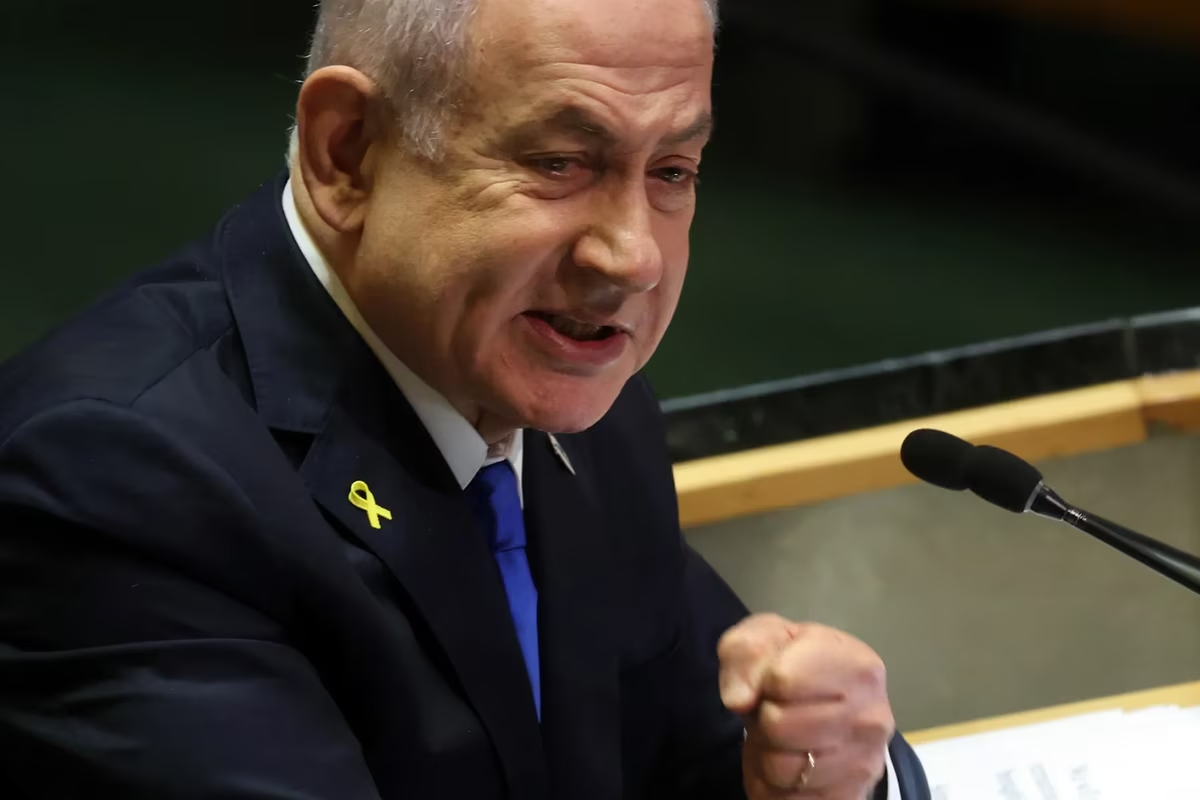
At the center of that reality stands Benjamin Netanyahu—not merely as an opponent of the agreement, but as the latest and perhaps most consequential obstacle in a decades-long pattern of resistance to diplomacy across the Middle East.
The debate surrounding the U.S.-Iran accord is often framed as a disagreement over security policy. In reality, it is something far more fundamental. It is a confrontation between two competing visions of regional order: one built around negotiated accommodation and de-escalation, the other around perpetual confrontation and managed instability. For more than three decades, Netanyahu has been the foremost political champion of the latter.
His record is neither ambiguous nor episodic. From the Oslo process in the 1990s to repeated ceasefire arrangements in Gaza, from negotiations over Palestinian statehood to diplomatic openings with Iran and efforts to stabilize Lebanon, Netanyahu has repeatedly positioned himself against initiatives that sought to replace military confrontation with political compromise. The particulars have varied, but the pattern has remained remarkably consistent: whenever diplomacy threatens to alter the strategic landscape, Netanyahu emerges as one of its most determined adversaries.
That history matters because the war in Lebanon cannot be understood in isolation from it.
As negotiations between Washington and Tehran approached their final stages, Israel expanded military operations in Lebanon, deepened its occupation of Lebanese territory, and intensified warnings about a broader regional confrontation. These actions did not occur in a vacuum. They unfolded precisely when diplomacy was gaining momentum and when the prospect of a transformative U.S.-Iran agreement was becoming increasingly likely.
The result was predictable. Military escalation created political pressure on Washington, heightened regional tensions, and introduced uncertainty into a diplomatic process Netanyahu had opposed from the beginning. Whether viewed through the lens of timing, strategic consequence, or political benefit, the Lebanon campaign functioned as an instrument for complicating and potentially undermining the emerging agreement.
This is not an isolated episode. It is the continuation of a familiar strategy.
Netanyahu’s political career has been built on the premise that the Middle East is ultimately resistant to political solutions and that security can only be achieved through overwhelming force and permanent vigilance. That worldview has not merely informed Israeli policy; it has shaped the political environment that sustains Netanyahu himself. Diplomacy presents a challenge to that framework because successful negotiations inevitably weaken the sense of permanent crisis upon which it depends.
The 2015 nuclear agreement with Iran offers perhaps the clearest precedent. Netanyahu did not simply criticize the accord. He mounted an extraordinary campaign against it, openly lobbying the United States Congress and directly confronting President Barack Obama in an effort to prevent its implementation. Few foreign leaders have gone to such lengths to undermine the foreign policy of a sitting American administration. Yet Netanyahu regarded the agreement as such a threat to his strategic vision that extraordinary measures became politically acceptable.
The current U.S.-Iran agreement presents an even greater challenge. Unlike the 2015 accord, which focused primarily on Iran’s nuclear program, the June 17 agreement seeks to establish a broader framework for reducing regional tensions and managing long-standing disputes between Washington and Tehran. Its success would undermine the central argument that has animated Netanyahu’s regional agenda for decades: that conflict with Iran is both inevitable and permanent.
This helps explain the intensity of his opposition.
A successful American-Iranian rapprochement would reorder regional priorities. It would shift diplomatic attention away from military confrontation and toward negotiated arrangements. It would reduce the political utility of constant warnings about imminent regional catastrophe. Most importantly, it would weaken the argument that Israel’s security requires the perpetual maintenance of regional crises.
For Netanyahu, this is not simply a policy disagreement. It is a challenge to the political architecture upon which much of his career has been constructed.
His critics therefore argue that Netanyahu should not be viewed merely as a skeptic of peace initiatives. He should be understood as a recurring and consequential saboteur of them. The historical record provides substantial support for that assessment. The erosion of the Oslo process, the repeated collapse of ceasefires in Gaza, the expansion of settlement activity in the occupied West Bank, the recurring destabilization of Lebanon, and the sustained campaign against diplomatic engagement with Iran all point in the same direction. Time and again, opportunities for political accommodation have collided with a leadership that derives strategic and political advantage from their failure.
The consequences extend far beyond Israel itself.
Every failed ceasefire, every abandoned negotiation, and every diplomatic collapse increases the likelihood that the United States will once again be drawn into regional crises not of its own making. The pattern has become familiar: diplomacy advances, tensions rise, military escalation follows, and Washington finds itself managing another emergency that diverts attention from long-term solutions.
That is why the central question facing the Trump administration is not whether Iran will comply with the agreement. It is whether Washington is prepared to protect the agreement from those who have a vested interest in its failure.
History suggests that diplomatic breakthroughs in the Middle East often collapse not because they are impossible, but because powerful actors work relentlessly to ensure that they do. Netanyahu’s career offers one of the clearest examples of this phenomenon. He has not merely opposed individual agreements; he has consistently challenged the very notion that diplomacy should replace confrontation as the organizing principle of regional politics.
The ceasefire in Lebanon may hold or it may fail. The U.S.-Iran agreement may ultimately succeed or collapse. But one conclusion is already difficult to escape: if the agreement falters, it will not be because the forces opposing diplomacy were hidden from view. They have been visible for decades.
Benjamin Netanyahu has spent much of his political life warning that peace is dangerous, compromise is naïve, and conflict is unavoidable. The tragedy of the modern Middle East is that his efforts to make those warnings self-fulfilling have too often succeeded.
Share your opinion
Netanyahu’s Last Gamble: The Serial Saboteur of Middle East Peace