







Washington's Message
Washington – Said Arikat – 20/6/2026
The Washington Post revealed on Friday that there are growing concerns within US intelligence circles and the administration that Israeli Prime Minister Benjamin Netanyahu might act in a way that undermines the political understanding signed by the United States and Iran this week, a development that reflects the widening gap between Washington's strategic priorities and the calculations of the Israeli government.
According to current and former US officials, intelligence assessments circulated within the US administration concluded that Israel views the memorandum of understanding signed between Washington and Tehran with suspicion, seeing it as a shift that could weaken the policy of pressure and isolation that Tel Aviv has sought to solidify against Iran for many years.
These assessments come at a time when the administration of President Donald Trump considers the agreement with Iran a cornerstone of a new approach aimed at reducing regional tensions, securing international navigation, and preventing the region from sliding into broader and more costly confrontations. However, this path faces a major obstacle in the continued Israeli war on Lebanon and the possibility of its expansion at any moment.
US intelligence circles believe that one of the essential provisions of the new understanding is to calm the Lebanese arena and halt the spiral of mutual escalation between Israel and Hezbollah. However, recent field indicators suggest the opposite, as Israel has continued its military operations in southern Lebanon, while US warnings have increased that any large-scale Israeli operation could undermine the political foundation on which the agreement with Tehran was built.
These concerns were reinforced after the escalation on the Lebanese front on Friday, when Israel launched raids on targets in southern Lebanon in response to a drone attack attributed to Hezbollah that resulted in the death of four Israeli soldiers. At the same time, a round of US-Iranian talks scheduled in Switzerland was postponed, and Vice President JD Vance's visit, linked to the negotiation process, was also delayed, reflecting the fragility of the transitional phase the agreement is undergoing.
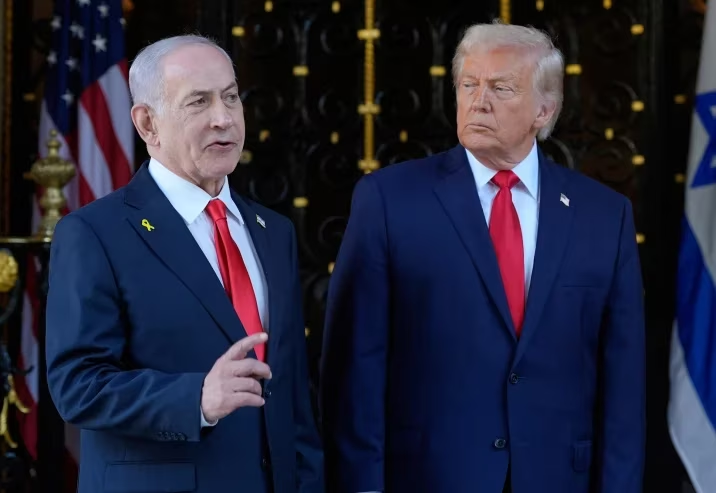
The American reading of events indicates that the danger lies not only in the potential collapse of the understanding with Iran but also in the possibility of a direct political crisis between President Trump and Netanyahu. The US President presented the agreement as a major diplomatic achievement that puts an end to decades of tension with Tehran, while the Israeli government appears less convinced of the utility of this shift and more inclined to continue a policy of confrontation.
Trump himself hinted at a disagreement with Netanyahu regarding Lebanon when he revealed during a press conference in France that he had asked the Israeli Prime Minister to avoid excessive military responses. These statements came at a time when questions were increasing in Washington about the extent of the Israeli government's willingness to adapt to the new political environment created by the agreement with Iran.
US intelligence assessments attribute a significant part of Netanyahu's behavior to purely internal considerations. The man, who faces critical elections, realizes that a large part of his political base views the continuation of military operations as proof of firmness and the ability to impose security realities. Therefore, any withdrawal from the Lebanese territories currently occupied by Israel, or any acceptance of long-term de-escalation arrangements, could be used against him politically as a retreat in the face of Hezbollah.
From this perspective, Washington believes that Israeli electoral calculations could dangerously intersect with US strategic interests. While the US administration seeks to solidify a broader regional understanding with Iran, Netanyahu finds himself driven towards escalatory options that grant him internal political gains, even if they come at the expense of regional stability or relations with Washington.
In contrast, Israel asserts that its military operations aim to prevent threats from Hezbollah and protect the security of its citizens. However, US officials warn that the continued Israeli occupation of parts of southern Lebanon, or the expansion of military operations, could return the region to a cycle of open escalation and undermine US efforts to build a new security and political framework.
Observers believe that the current crisis represents a pivotal moment in the relationship between Washington and Tel Aviv. The agreement with Iran is not just about a bilateral issue between the two countries; it reflects a shift in US foreign policy priorities, from managing conflicts through escalation to containing them through political settlements. This shift places Israel before a different strategic reality than it has been accustomed to in recent years.
Furthermore, the messages issued by Vice President JD Vance, in which he urged the Israeli government not to embarrass or attack its strongest remaining international ally, reflect an unprecedented degree of discomfort within the US administration regarding current Israeli policies, and indicate that Washington is now more prepared to defend its strategic choices even when they conflict with the wishes of the Netanyahu government.
In light of these facts, the coming weeks appear crucial not only for the future of the US-Iranian agreement but also for the shape of the relationship between the Trump administration and the Israeli government. The success of the agreement will largely depend on Washington's ability to prevent an explosion on the Lebanese front, while any major escalation could return the entire region to the square of confrontation that the US administration is trying to exit.
Netanyahu Between Political Survival and the Requirements of Settlement
US intelligence leaks reveal a deeper dilemma than a mere tactical disagreement between Washington and Tel Aviv. Netanyahu faces a critical electoral challenge and finds that his political image in recent years has been linked to a discourse of strength and military expansion. Therefore, any withdrawal from Lebanon or acceptance of long-term de-escalation arrangements could be presented by his opponents as a retreat or defeat. Hence, war, for him, appears to be a tool for managing internal balances as much as it is a tool for achieving security objectives, which explains the growing US concerns about his behavior in the coming period.
The US-Iranian Agreement Changes the Rules of the Game
The importance of the memorandum of understanding between Washington and Tehran is not limited to reducing tension between the two countries but extends to redefining regional security priorities. The United States now believes that the stability of international navigation, energy markets, and preventing the expansion of regional conflicts is a priority that transcends the logic of open confrontation with Iran. This shift places Israel before a new reality it has not been accustomed to in recent years, as the policy of continuous escalation no longer enjoys the same unconditional support within US decision-making circles, which explains the extent of Israeli concern about the agreement.
An Unprecedented Test for the Relationship Between Trump and Netanyahu
The relationship between Trump and Netanyahu has long been presented as one of the most harmonious between a US president and an Israeli prime minister. However, the agreement with Iran revealed the limits of this harmony when the strategic interests of the two parties conflict. The US administration views the agreement as an entry point to ending an economically and militarily costly conflict, while Netanyahu fears that it will strengthen Iran's regional position and weaken the justifications for continuing the war. Therefore, the current crisis could become the first real test of Trump's ability to impose his vision on the Israeli government if it chooses to proceed with escalation.
Share your opinion
US Intelligence Warns: Netanyahu May Seek to Thwart Understanding Between Washington and Tehran