






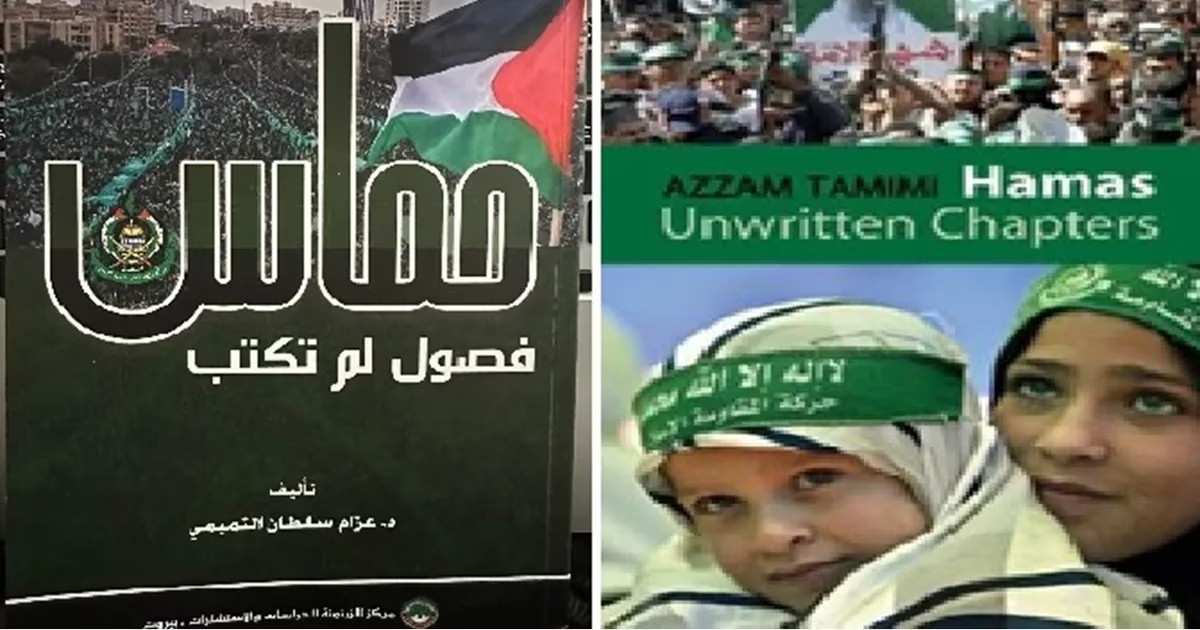
Dr. Azzam Tamimi's book 'Hamas: Unwritten Chapters' is one of the most prominent references that attempted to decipher the code of the Islamic Resistance Movement from within. Through this work, the author seeks to provide a documentary narrative based on primary sources and testimonies of decision-makers within the movement, away from the prevailing Western security readings.
Tamimi's thesis begins by critiquing Western literature that reduced Hamas to its military dimension only, ignoring the historical and social contexts that produced it. He believes that most previous studies drew their information from intelligence sources, which created a gap in understanding the true principles that drive the organization.
The book clarifies that the birth of Hamas in December 1987 was not a coincidence or merely an immediate reaction to the First Intifada. Rather, it was the culmination of a long process of advocacy and educational work led by the Muslim Brotherhood in Palestine over decades, where they focused on building institutions before declaring confrontation.
The author refers to the historic meeting that included Sheikh Ahmed Yassin and six of his companions, where they decided to transform the Brotherhood organization into a resistance movement. This transformation aimed to exercise a direct struggle role based on a broad social base built through mosques and charitable associations.
Sheikh Ahmed Yassin emerges in the book as a pivotal figure who did not aim for mere military action, but rather sought to organize and strengthen Palestinian society. Yassin believed that effective resistance requires a believing and organized individual capable of long-term steadfastness in the face of occupation measures.
Tamimi boldly addresses the Hamas Charter issued in 1988, considering it to have become a political burden on the movement in international forums. The researcher believes that the movement's political practice has demonstrated much greater flexibility than what was stated in the charter's texts, which no longer accurately express the movement's current philosophy.
The book discusses the evolution of the idea of 'truce' in Hamas's thought, showing that it was proposed as a formula for managing the conflict without compromising national constants. This vision reflects the movement's attempt to balance the demands of political reality with its ideology that rejects recognition of the legitimacy of the occupation.
The work also addresses the issue of suicide operations and the controversy they sparked at jurisprudential, political, and international levels. The author places these operations in their temporal context as a military pressure tool used by the movement at certain stages of the conflict with the Israeli occupation.
The book highlights the thorny relationship between Hamas and the Palestine Liberation Organization, describing it as a competition for legitimacy and national representation. This competition intensified with the movement's entry into the official political arena and its participation in elections that shifted the balance of power.
Hamas's victory in the 2006 elections is considered a fundamental turning point that moved the movement from the seats of opposition and resistance to the helm of governance and responsibility. This transition imposed unprecedented challenges on the movement in how to manage people's affairs under siege and international pressure.
The importance of this book lies in its ability to reveal the internal logic of the Hamas movement and how it views itself and the world. It does not merely recount historical events but analyzes the intellectual transformations that have occurred in the movement's discourse and strategies over the past four decades.
Azzam Tamimi's style is characterized by combining academic rigor with engaging narration, making the book a reference for specialists and general readers alike. Despite the author's sympathy for the cause, he opens the door for serious discussions about the movement's documents and positions.
Azzam Tamimi, as a Palestinian researcher based in London, was able to employ his academic tools to present the Palestinian narrative first in English and then in Arabic. His background in political philosophy contributed to giving the book an analytical depth that goes beyond mere traditional historiography of political movements.
In conclusion, the book 'Unwritten Chapters' remains a serious attempt to shift the discussion about Hamas from the realm of ready-made judgments to the space of historical understanding. It is an invitation to the reader to reflect on the complexities of the Palestinian situation and how the resistance identity is formed under exceptional occupation circumstances.
Hamas emerged from the womb of a social project driven by charity and benevolence, and it did not begin with the rifle but with building the Palestinian individual.


Share your opinion
A Reading of Azzam Tamimi's Book: Hamas from Social Roots to Political Power