






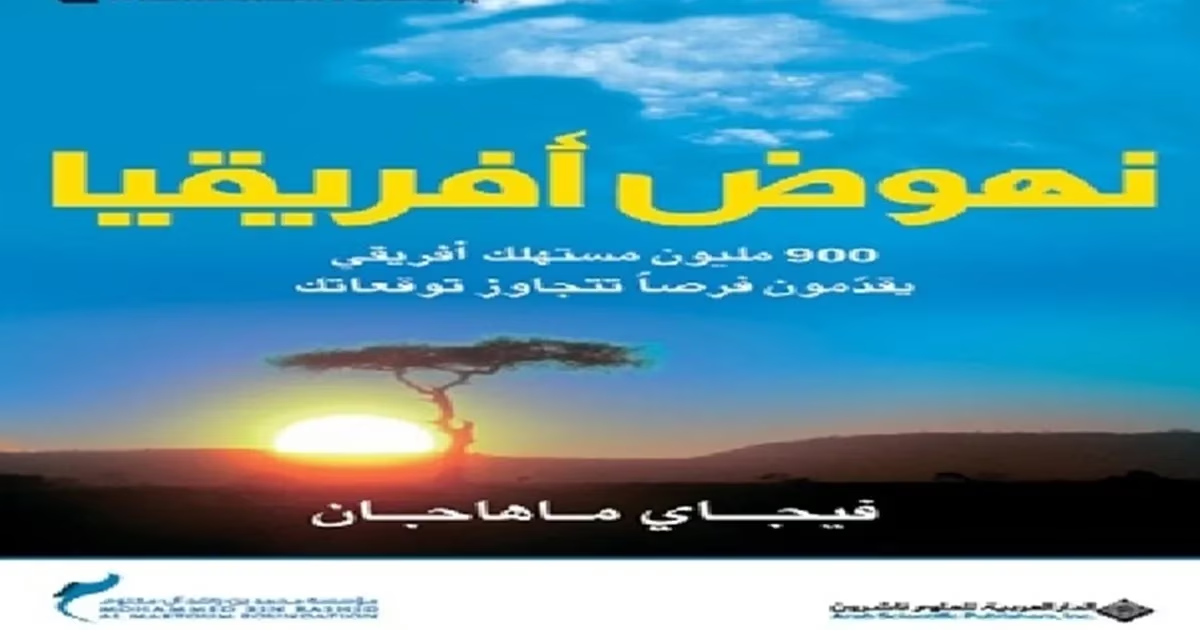
The African continent is rapidly transforming into a major hub for competition among great powers. It is no longer known merely as a source of raw materials but has become a massive consumer market with over 1.2 billion people. Professor Vijay Mahajan, in his book 'Africa Rising,' indicates that the traditional view of the continent as a region of poverty and deficiency has completely changed in the face of an economic reality that strongly asserts itself on the international stage.
The continent is witnessing remarkable demographic growth, with its population expected to double in the next twenty years, making up one-fifth of the world's population. This population explosion is accompanied by rapid growth of the middle class, which now represents one-third of the population, opening up tremendous opportunities for investment in health, education, housing, and modern communications.
China leads the economic scene on the continent with a trade volume exceeding $200 billion, which is double the size of American trade with Africa. This Chinese dominance has prompted Washington to re-evaluate its strategy and attempt to catch up with Beijing by injecting billions of dollars in investments to strengthen its influence in emerging African markets.
Africa possesses vast natural resources that make it a safety valve for global energy, holding about 10% of the world's oil reserves and 15% of its gas reserves. Countries like Nigeria, Angola, and Mozambique stand out as key players in securing energy supplies, especially with Europe's move to reduce reliance on Russian gas and seek stable alternatives.
China's strategy in Africa is characterized by great financial flexibility and the ability to finance massive infrastructure projects through preferential loans and specialized development funds. African leaders see Beijing as a partner who treats them as equals, away from the political pressures that often accompany traditional Western aid and investments.
For its part, Russia seeks to restore its historical influence on the continent through military and political cooperation, leveraging the Soviet Union's legacy of supporting liberation movements. Moscow is currently focused on building strategic partnerships that help it circumvent Western sanctions and open new markets for its military and technological industries.
On the Arab front, Morocco stands out as the largest investor in West African countries, benefiting from its geographical location and political stability to serve as a bridge between the continent and Europe. Egypt also plays a pivotal role in attracting foreign investments thanks to legislative reforms and infrastructure development that have placed it among the leading African nations.
The United Arab Emirates has a strong investment presence outside the continent, reflecting a growing Arab trend towards investing in vital African sectors. However, total Arab investments remain below aspirations compared to the available opportunities and fierce international competition from powers like India, France, and Britain.
Arab-African economic integration represents a historic opportunity to achieve food and water security for both sides, given Africa's vast agricultural lands and enormous fresh water resources. In return, Arab countries possess the expertise, capital, and fertilizer industries necessary to transform these resources into real production that can bridge the food gap in both regions.
Together, Arab and African countries control the most important straits and waterways in the world, giving this alliance a superior ability to influence international trade. Coordination between North Africa, the Gulf states, and the Horn of Africa can establish a geopolitical bloc that controls global power balances.
Africa's mineral wealth is a fundamental pillar of modern technological industries, with the continent producing 80% of the world's platinum and huge quantities of cobalt, gold, and diamonds. These resources make the continent a battleground for technological conflict among major global companies seeking to secure sustainable supply chains for their advanced industries.
Sources reported that the American approach to Africa was historically influenced by the oil lobby, which sought to secure energy needs, especially given the quality of African oil and its low extraction costs. Despite criticisms leveled against successive American administrations, the need to diversify energy sources remains the primary driver of foreign policy on the continent.
Great powers face significant challenges in Africa, including popular rejection of some forms of foreign military presence, as happened with the American 'Africom' project. In contrast, powers that focus on direct economic development and improving the quality of life for local populations succeed in building long-term and stable influence.
In conclusion, Mahajan's book shows that the future of the international system may be drawn in the jungles and deserts of Africa, where economic interests intertwine with geopolitical conflicts. The continent, once described as forgotten, is today 'the land of opportunity' that no global power can ignore if it wants to maintain its position in the 21st century.
I was wrong when I viewed Africa as a case of deficiency and poverty; today it offers market opportunities that exceed expectations.

Share your opinion
Africa at the Heart of Global Competition: A Reading of 'The Rise of the Black Continent' and Promising Investment Opportunities