







Washington's Message
Washington – Said Arikat – 6/9/2026
News Analysis
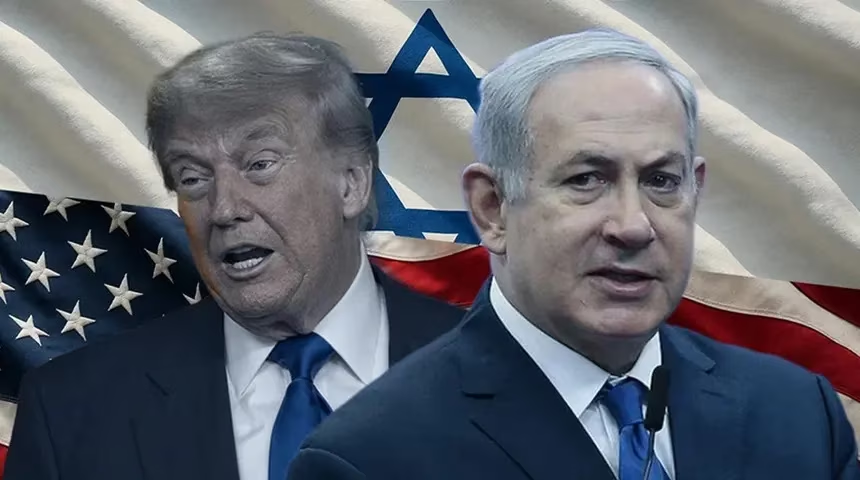
In a new indication of the widening gap between Washington and Tel Aviv regarding how to deal with the Iranian file, US Vice President J.D. Vance affirmed that the ongoing agreement being negotiated between the United States and Iran represents a "major achievement for the American people," whether Israel likes it or not, in a rare statement reflecting the decline in the Benjamin Netanyahu government's ability to impose its security vision on the American administration.
Vance's statements came as US President Donald Trump spoke of an agreement being close to completion within “two or three days,” considering that negotiations had entered their final stages, and emphasizing that the primary American goal is to prevent Iran from acquiring nuclear weapons, not to serve the Israeli agenda or expand the scope of military confrontation in the region.
Vance said in an interview with "Fox News" that the United States and Israel share many interests, but there are also fundamental points of disagreement, explaining that the Trump administration believes that reaching a long-term settlement with Iran serves American interests better than continuing open military confrontation.
He added that the agreement being worked on includes stricter monitoring and inspection mechanisms than the nuclear agreement concluded by former President Barack Obama's administration in 2015, an agreement that Netanyahu worked for years to undermine before succeeding in pushing the first Trump administration to withdraw from it in 2018.
These statements come days after renewed military tension between Israel and Iran, following an Iranian missile attack targeting northern Israel, which followed an Israeli raid on Beirut targeting Tehran's Lebanese ally, despite previous pledges not to target the Lebanese capital.
The Israeli strike on Beirut sparked widespread criticism as another example of the Netanyahu government's disregard for international pressure, and even direct American demands, as it came at a time when Washington was seeking to create conditions for the success of settlement negotiations with Iran and to reduce regional tension.
Despite reports of Trump's anger at the Israeli response and his demand that Netanyahu de-escalate, the US president tried to downplay the extent of the disagreement, affirming that the Israeli prime minister had not defied his directives, and that both parties later reached a mutual ceasefire mediated by the US.
However, the statements from Vance and Trump reveal a different reality: Washington's priorities no longer fully align with the Netanyahu government's calculations, and the American administration views regional stability and nuclear non-proliferation as priorities that supersede the chronic Israeli desire to keep the region in a state of permanent confrontation with Iran.
Failure of the Israeli Intimidation Strategy
Vance's statements clearly reveal that Netanyahu's strategy, based on continuous intimidation regarding Iran, no longer holds the same influence within decision-making circles in Washington. For many years, the Israeli prime minister succeeded in portraying any diplomatic path with Tehran as an existential threat to Israel and the West, but the current American administration seems more convinced that verifiable and controllable agreements are more effective than continuous military escalation. This shift reflects a tangible decline in Netanyahu's ability to direct American policy according to his government's priorities, despite his influence and connections within the United States.
Beirut Pays the Price for Netanyahu's Political Calculations
The targeting of Beirut highlighted the Israeli approach of expanding conflict arenas beyond the Palestinian and Israeli borders. Instead of containing tensions, the Netanyahu government continues to transfer the confrontation to neighboring countries, exposing civilians and infrastructure to serious risks and undermining any diplomatic efforts to de-escalate. It was notable that the strike came despite clear American reservations, which reinforces the impression that Netanyahu uses military operations to achieve internal political gains and protect his political future more than to serve regional security and stability.
Israel's Real Security Crisis
Successive Israeli governments continue to justify their military policies as a guarantee of security, but reality indicates the opposite result. After years of wars, assassinations, and military operations extending from Gaza to Lebanon, Syria, and Iran, Israel has not succeeded in achieving lasting stability or eliminating sources of threat. Rather, these policies have contributed to deepening feelings of hostility and expanding the scope of regional confrontations. Furthermore, the continued occupation and settlement and the deprivation of Palestinians of their basic rights undermine any possibility of building real and sustainable security, and make the entire region hostage to recurring cycles of violence and instability.
Share your opinion
US-Israeli Disagreement Over Iran Exposes Limits of Netanyahu's Influence, Boosts Chances for Settlement