







Washington Message
Washington – Said Arikat – 7/6/2026
News Analysis
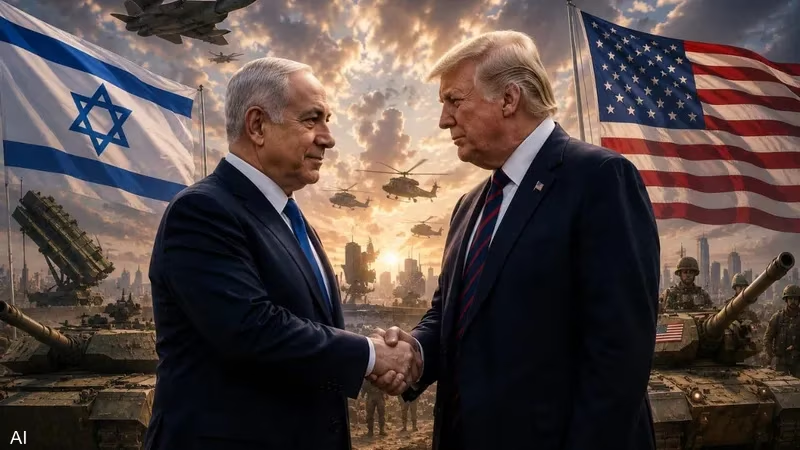
A new legislative clause, included in the National Defense Authorization Act, is escalating controversy within the US Congress. Warnings suggest it could lead to an unprecedented integration of the American and Israeli military industries, giving the security relationship between the two countries a permanent institutional character that goes beyond decades of traditional cooperation.
The dispute centers on Article 224 of the bill, which stipulates expanding military and technical cooperation between the United States and Israel. This includes joint research and development, collaborative weapons production, industrial licensing agreements, and the establishment of joint ventures in advanced defense technology fields.
This direction has drawn objections from lawmakers from both the Republican and Democratic parties, most notably Republican Representative Thomas Massie of Kentucky and Democratic Representative Ro Khanna of California. Both have called for the removal of the article from the defense budget bill, considering that it opens the door to deep institutional entanglement between the two countries without sufficient public debate about its strategic implications.
The controversy comes at a time when opinion polls indicate a significant decline in American public support for Israeli policies, especially in light of the war in Gaza and escalating tensions in Lebanon and the West Bank, in addition to concerns about the potential for a wider regional confrontation with Iran.
A similar project was proposed last February under the name "US-Israel Future Act," a joint initiative by Republican and Democratic representatives and senators. The project received public support from pro-Israel lobby groups and research centers, including the American Israel Public Affairs Committee (AIPAC), the largest and most influential Israeli lobby in the world in American politics, and the Foundation for Defense of Democracies (FDD), an organization launched by the Israeli army in 2001.
Supporters of the project emphasized the importance of leveraging Israeli technological capabilities in artificial intelligence, cyber warfare, anti-drone systems, and quantum computing, considering that this partnership would enhance American military superiority and support the national security of both countries in the face of increasing threats.
However, critics of the project believe that the issue goes beyond mere technology exchange or expanding defense cooperation, warning that the legislation could make the United States more dependent on Israeli technological and military infrastructure, which might restrict American decision-making freedom in Middle East issues in the future.
Experts, including Senator Bernie Sanders, believe it is an attempt by Israeli lobbies to circumvent Congress and receive American weapons and technology without cost.
Observers point out that the language used in Article 224 largely reflects the content of initiatives and proposals previously promoted by pro-Israel think tanks, which call for building a strategic partnership that goes beyond the concept of a traditional alliance towards long-term integration in security, technology, and defense industries.
Proponents of this vision argue that escalating global challenges, whether from Russia, China, or cross-border armed organizations, necessitate building a deeper cooperation system between Washington and Tel Aviv. However, opponents believe that such an approach could lead the United States to become more closely tied to the policies of successive Israeli governments, including controversial policies in the Palestinian territories and the region.
The ongoing battle over Article 224 reveals a significant shift in the nature of American debate regarding Israel. After decades during which support for Israel enjoyed broad consensus within the American political establishment, the relationship itself has become a subject of discussion and review. The debate is no longer limited to the size of military aid or diplomatic support but now includes the nature and limits of shared interests. This reflects the widening gap between the positions of traditional elites and American public opinion, especially among younger generations who are more inclined to evaluate Israeli policies from the perspective of human rights and international law.
This initiative raises deeper questions about the influence of Israeli lobby groups on American foreign policy. The issue is not just about supporting a strategic ally, but about how ideas produced by research centers and lobby organizations transition into official legislative texts within Congress. Critics of the project argue that including clauses of this magnitude within a massive defense bill may reduce opportunities for public debate and political accountability. Hence, the current controversy represents a test of the transparency of the decision-making process in Washington as much as it represents a discussion about Israel itself.
On a strategic level, this project cannot be separated from a long series of initiatives and legislations pushed by pro-Israel lobby groups within Washington, which have continuously innovated new mechanisms to link American interests with Israeli security and military agendas. Instead of the relationship between the two countries being based on a partnership subject to constant review and objective assessment of mutual interests, this approach seeks to transform the American commitment into a semi-automatic one, limiting the ability of decision-makers in Washington to formulate independent policies based primarily on American national interest. Critics fear that this path could increase the likelihood of the United States being drawn into confrontations and conflicts that primarily serve Israeli strategic calculations, while Washington bears their political, military, and economic costs.
From this perspective, the debate over Article 224 extends far beyond the limits of military cooperation between the United States and Israel. It re-raises a fundamental question that has haunted American foreign policy for decades: to what extent should Washington allow organized and influential lobbies to affect war and peace decisions? And to what extent can the continued provision of exceptional levels of support and political and military protection to Israel be justified, despite the repeated wars it wages in the region and the destruction and instability they cause? For opponents, the project represents a new link in a path aimed at integrating American and Israeli interests in a way that makes it difficult to distinguish between them, potentially embroiling the United States in crises and conflicts that do not serve its national security or the priorities of its citizens, while real political accountability is absent for those who constantly push for this approach.
Share your opinion
Draft Law Sparks Controversy in Washington: Are Lobby Groups Seeking to Militarily Integrate American and Israeli Interests?