






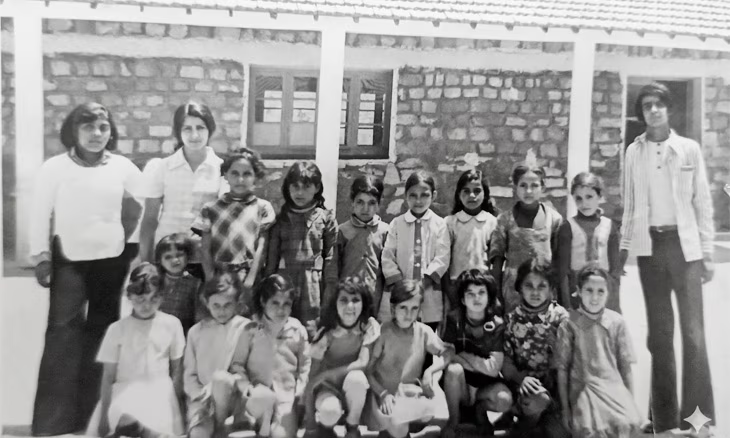
In Algerian gatherings, a tone of nostalgia for what is known as the 'good old days' is escalating, especially among generations who lived through the pre-independence era or the early years of state-building. The phrase 'Where are those times?' is repeated with striking regret, reflecting a desire to restore the values of discipline and order that many believe were the dominant features of daily life in that period.
Old black and white photographs transform into emotional documents that transcend mere personal memory to become a window into a seemingly more stable world. Proponents of this view believe that schools and public squares witnessed moral and educational discipline that is lacking in the present, where the prestige of the teacher and the educational institution formed the cornerstone of national character building.
Analysts believe that this nostalgia does not target the colonial era itself, but rather aspires to the system of values that governed social relations at the time. The issue concerns the appreciation of work and respect for appointments, and a general feeling that every individual in society knew their role and place precisely, away from the hustle and bustle of modern life and its increasing complexities.
In contrast, a current emerges that sees linking beauty to the past as a fallacy resulting from the decline of knowledge in the face of the culture of display in the current era. The Arab and Algerian citizen may yearn for their youth and the clarity of vision in their old society, where long effort was appreciated, before the values of quick profit and social opportunism overshadowed the general scene.
The gap deepens when moving to public affairs, where part of the current frustration is attributed to decades of centralized administration and fluctuating government policies. Critics believe that the distance between official discourse and the actual needs of society has contributed to reinforcing the image of the past as a safe haven from the anxiety of the present and its accelerating economic challenges.
Observers point out that the management style that restricts decision-making to narrow circles has slowed down the process of openness to new ideas and global transformations. At a time when the world is moving towards innovation and scientific research, a segment of Algerians feels that these areas have not yet received the place they deserve in the national priorities.
Social crises and rising prices appear as immediate catalysts for evoking comparisons between yesterday and today in popular discussions. The image of the disciplined student in old classrooms becomes a symbol of an entire generation that had hope, and the school transforms from a mere building into an idea embodying the order and belonging that people seek in their contemporary reality.
It is necessary to read this phenomenon emotionally, not just historically, for nostalgia often expresses what a person feels more than it expresses the reality of a bitter truth. History reminds us that the past was not without difficulties, class disparities, and harsh restrictions, but human memory naturally tends to filter out pains and retain bright moments.
The Algerian case is characterized by a specificity stemming from the profound and rapid transformations the country has undergone, from colonialism to independence and then the building of the national state. Each of these stages left different imprints on the memory of generations, creating a divergence in views on which periods were the most prosperous and stable for the citizen.
Historical sources confirm that the 'good old days' that some praise carried great suffering, as school enrollment rates among Algerians during the colonial era were very low. Moreover, the educational and university infrastructure was very limited and served only a small segment, making the comparison with the achievements of the independent state numerically unequal.
The fundamental question remains whether the past was beautiful for its own sake, or because we look at it from a safe temporal distance that makes us forget its arduous details. Excessive preoccupation with contemplating images of yesterday may hinder the ability to read the future and its challenges, for nations do not live on memories alone, no matter how beautiful or deeply impactful they may be.
Building the future requires transforming the lessons of the past into a driving force for work, knowledge, and innovation, instead of drowning in a sea of nostalgia. The future is the only page that has not yet been photographed, and its creation requires boldness in imagination and the ability to bravely face the open possibilities of the present.
The future is not made by nostalgia, but by knowledge, work, and imagination that dares to see what has not yet appeared in any album.


Share your opinion
The Dialectic of Nostalgia in Algeria: Why Does the 'Good Old Days' Haunt the Memory of Generations?