







By: Said Arikat
May 28, 2026
News analysis
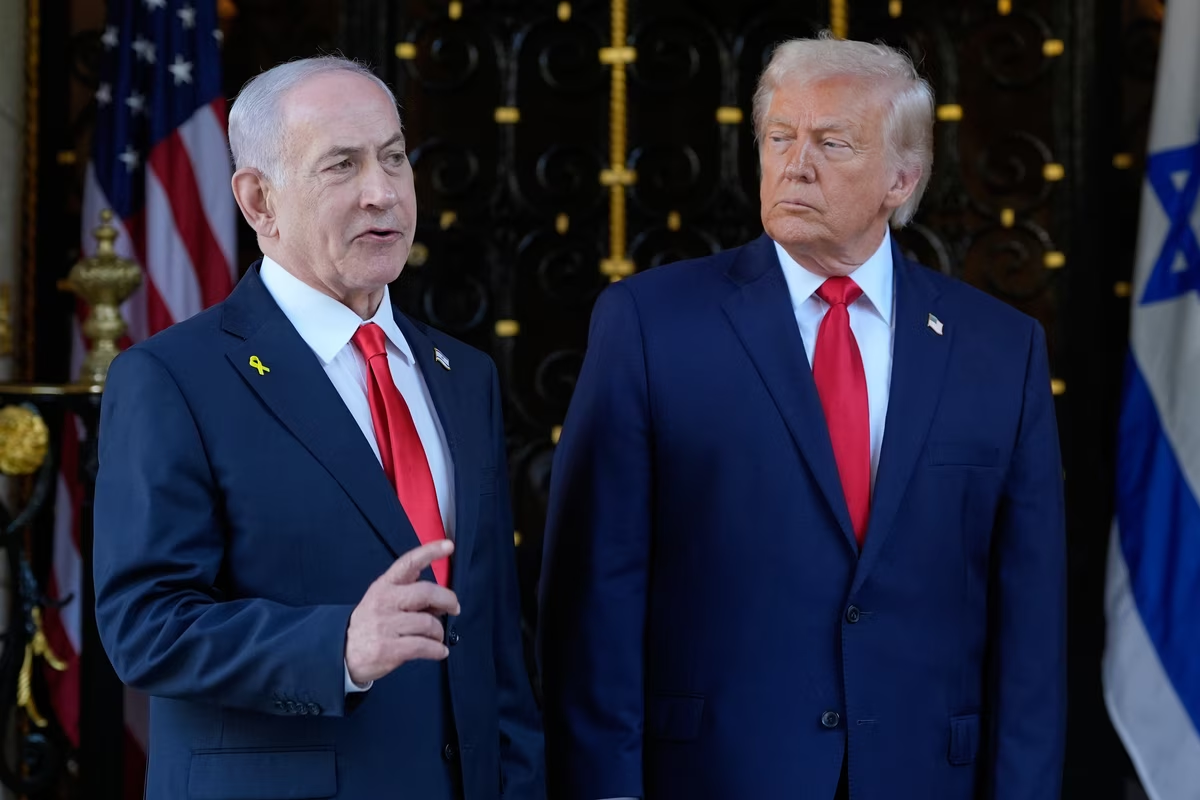
Washington, D.C-Last week, President Donald Trump declared that 95 percent of all issues with Iran had been resolved and overcome. The statement suggested that the diplomatic endgame was finally within reach—that after months of a disastrous, unwinnable war, the United States might actually secure an exit. Then, predictably, the phone rang. Benjamin Netanyahu was on the line. Within hours, the deal began its familiar death spiral, and once again the American president proved incapable of saying no to a foreign leader who has systematically hijacked U.S. foreign policy for his own political survival.
Netanyahu did not even do the dirty work himself. He simply unleashed his obedient quislings in Washington to complete the sabotage. Senator Lindsey Graham dutifully stepped forward to insist that Saudi Arabia, Qatar, and Pakistan must join the Abraham Accords as a condition for any peace with Iran, warning that refusal would carry "severe repercussions." Senator Tom Cotton followed with the predictable hardline denunciations, framing any diplomacy as capitulation to terrorism. The broader Israeli lobby machinery whirred into motion—op-eds appeared, television bookings were secured, donor calls were made—all coordinated to ensure that Trump understood the political price of defying Netanyahu's wishes.
The pattern is by now so established that it barely qualifies as news. Trump signals a breakthrough. Netanyahu activates his American network. Congressional allies issue threats and ultimatums. The deal collapses. Trump dutifully announces that negotiations have hit an unexpected snag, and the bombing continues. This is not alliance management between sovereign equals. This is a foreign government operating an influence machine on American soil to veto the foreign policy of the United States, and an American president who either cannot or will not resist.
The demand itself reveals the bad faith at work. After months of war that has hemorrhaged American credibility, convulsed global energy markets, and failed to achieve any of its stated military objectives, the exit ramp is blocked not by Iranian intransigence but by an Israeli prime minister who wants to use what remains of American leverage to extract diplomatic concessions that Arab states have no intention of granting. When Trump reportedly conveyed this demand to Gulf leaders, the silence that greeted him was deafening. They did not negotiate. They simply refused to respond, recognizing that Trump's demand was never truly his own. It was Netanyahu's demand, delivered by an American president reduced to the role of messenger.
Why does the President of the United States consistently defer to the Prime Minister of Israel? The cynical answer points to domestic politics: the pro-war ultraconservatives who scream appeasement at any hint of diplomacy, the donors who demand unflinching support for Israeli objectives, the evangelical base that views Middle Eastern conflict through theological lenses. Graham, Cotton, and their allies have demonstrated repeatedly that they will destroy any Republican who deviates from Netanyahu's preferred course. The political price of defiance is simply too high for a president constantly calculating his next primary challenge.
But the deeper explanation may be even simpler. Trump is being managed by a foreign leader who understands his psychological vulnerabilities with precision: his terror of appearing weak, his craving for the strongman image, his susceptibility to the argument that only continued military pressure demonstrates resolve. Netanyahu has spent decades mastering the manipulation of American politics. Trump is merely his latest and most susceptible subject. Every time the president considers ending the war, Netanyahu and his congressional enablers reframe the choice. Ending the war is surrender. Negotiation is appeasement. Diplomacy is weakness. And Trump, who has constructed his entire political identity around being the opposite of weak, folds. He announces new conditions. He authorizes more strikes. He adopts whatever position has been assigned to him.
The tragedy is compounded by the fact that Netanyahu is the biggest loser in this war, and he knows it. He launched this conflict promising to eliminate the Iranian threat once and for all. Instead, he has exposed Israel's military limitations, alienated Democratic support that took generations to build, and watched as Washington negotiates with Tehran while Israel is relegated to the sidelines. Israeli analysts are already calling whatever deal eventually emerges "Bibi's bomb"—the agreement that will allow Iran to acquire nuclear weapons on his watch. The man who built his career on stopping Iran will be remembered as the leader who failed catastrophically and dragged America down with him.
So he sabotages. He cannot permit a deal because a deal would expose the bankruptcy of his strategic vision. He cannot allow the war to end in anything short of total victory because anything less is his personal political death. He cannot afford to be sidelined while Trump and the Iranians negotiate the terms of his irrelevance. And he has, at his disposal, a network of American politicians willing to do precisely what he tells them, precisely when he tells them, to ensure that no diplomatic off-ramp ever materializes.
This is abdication dressed up as alliance. The President of the United States has effectively outsourced one of the gravest decisions any leader can make—whether to continue a war or pursue peace—to a foreign leader whose interests diverge fundamentally from American interests. Netanyahu needs the war to continue because peace on any realistic terms would be his political obituary. America needs the war to end because it is achieving nothing beyond the steady erosion of American power and the enrichment of adversaries who are cataloging every American military limitation.
These interests cannot be reconciled. Yet Netanyahu's need consistently prevails over America's need. He deploys his Grahams and his Cottons, activates his lobbyists and his donors, and watches as the American president salutes and complies. The phone will ring again. The obedient voices in Congress will amplify the message. The deal will die another death. And the war will grind on, compounding American defeat with every passing day, all in service of a foreign leader who has decided—correctly, it seems—that his political survival matters more to Washington than American lives, American interests, or American honor.
Share your opinion
The Netanyahu Veto: How One Foreign Leader Steers America’s War and Peace