







By: Said Arikat
May 13, 2026
News analysis
Washington, D.C- While the world remains transfixed by the horrors unfolding in Gaza and the expanding regional confrontation involving Iran, another historic transformation is quietly accelerating in the occupied West Bank. Far from the television cameras and emergency summits, Israel is steadily reshaping the territory into a fragmented landscape of permanent control, expanding settlements, military isolation, and creeping annexation. What is emerging is not merely a harsher occupation. It is the slow destruction of the geographic, political, and economic foundations of a future Palestinian state.
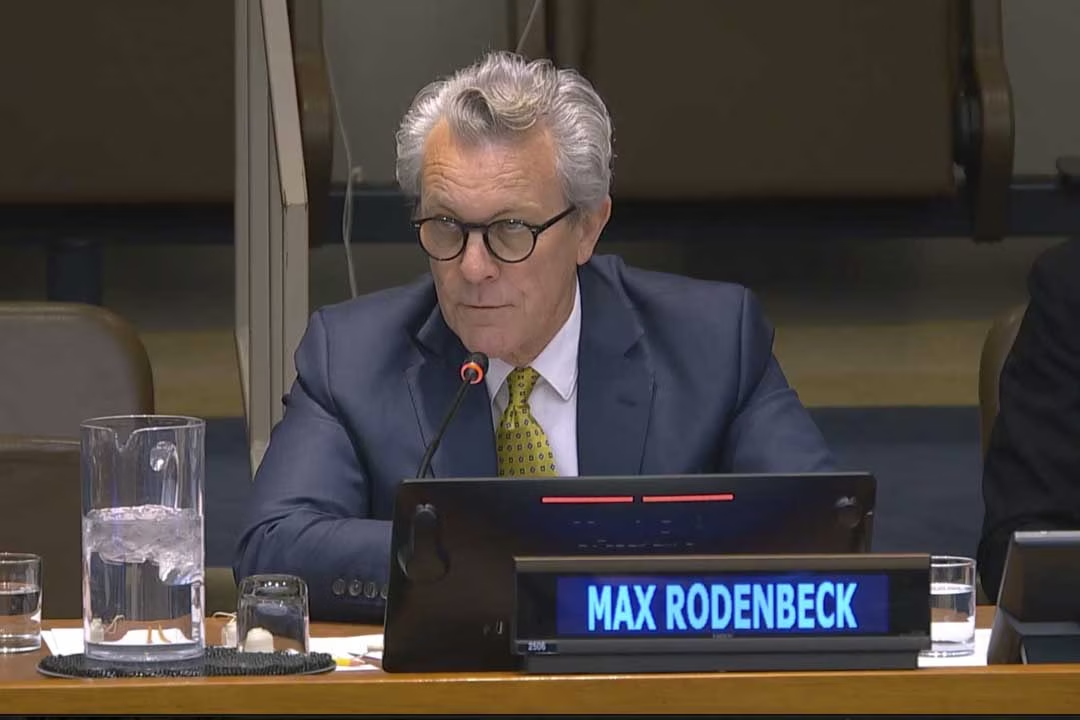
That was the stark warning delivered by Max Rodenbeck, director of the Israel-Palestine project at the International Crisis Group, during a briefing before the United Nations Security Council on May 8. His assessment painted a grim picture of a territory being systematically transformed into disconnected Palestinian enclaves surrounded by Israeli military infrastructure, settlements, and settler-controlled corridors.
According to Rodenbeck, Palestinians in the West Bank now confront more than 900 checkpoints, roadblocks, military gates, and movement restrictions that have turned ordinary life into a daily ordeal. Entire villages can be sealed off without warning. Workers spend hours trapped at checkpoints trying to reach their jobs. Students miss schools and universities. Patients struggle to access hospitals. Farmers are denied entry to their lands during critical harvest seasons.
But the deeper significance of these restrictions lies beyond the immediate suffering they inflict. They are not simply temporary security arrangements imposed during a moment of instability. They are instruments of territorial fragmentation designed to break Palestinian continuity and isolate Palestinian communities from one another. Roads are cut. Towns are separated. Economic life is paralyzed. Social cohesion slowly erodes.
The result is a map increasingly resembling disconnected islands of Palestinian population centers surrounded by expanding Israeli control.
At the same time, settler violence across large parts of the West Bank has escalated dramatically, particularly in vulnerable rural areas such as the Jordan Valley and the South Hebron Hills. Rodenbeck warned that these attacks can no longer be dismissed as the actions of isolated extremists. Increasingly, they occur within an atmosphere of institutional protection and near-total impunity.
Palestinian communities face sustained intimidation campaigns aimed at forcing residents from their homes and lands. Villages are attacked. Livestock is stolen or killed. Agricultural property is burned or vandalized. In many documented incidents, Israeli soldiers are present during settler assaults and are accused either of standing aside or actively protecting the attackers.
The distinction between unofficial settler violence and state authority is becoming dangerously blurred.
This violence directly serves the rapid expansion of Israeli settlements throughout the occupied territory. New outposts continue to emerge and are quickly connected to roads, utilities, military protection, and administrative support. Meanwhile, neighboring Palestinian communities face severe restrictions on construction, land use, and development. Homes are demolished while settlements expand.
Together, these policies are producing a reality that appears increasingly irreversible.
The most consequential development may be the growing role of Israeli Finance Minister Bezalel Smotrich, one of the strongest advocates of annexation within Israel’s far-right government. Smotrich has steadily acquired powers once exercised by Israel’s military administration in the occupied territories, effectively functioning as a civilian authority over large parts of the West Bank.
On the surface, these bureaucratic changes may appear technical. In reality, they represent a profound political shift.
Under international law, military occupation is theoretically temporary. Civilian governance implies permanence. By transferring authority from military structures to Israeli civilian institutions led by annexationist politicians, Israel is gradually erasing even the formal distinction between sovereign Israeli territory and occupied Palestinian land.
This is annexation by administration rather than declaration.
Road systems, planning authorities, land registration, infrastructure management, and territorial governance are increasingly absorbed into Israeli civilian control. The process advances incrementally, often quietly, but with enormous long-term consequences. Every bureaucratic change creates new “facts on the ground” that become harder to reverse politically or diplomatically.
Meanwhile, economic pressure is intensifying the crisis. Israel’s withholding of billions of dollars in Palestinian tax revenues has severely weakened the Palestinian Authority’s ability to function. Public-sector salaries are delayed. Essential services are deteriorating. Restrictions on Palestinian labor inside Israel have deepened unemployment and poverty across the West Bank.
The cumulative effect is a society being squeezed from every direction: economically weakened, geographically fragmented, politically paralyzed, and increasingly hopeless.
What makes this moment particularly dangerous is the weakness of the international response. The United States occasionally criticizes settlement expansion and settler violence, but such criticism has remained largely rhetorical. Washington appears unwilling to impose meaningful political costs on Israel amid broader regional instability following the Gaza war and the escalating confrontation with Iran.
But this hesitation carries consequences.
For Israel’s far-right leadership, the absence of meaningful international pressure reinforces the belief that creeping annexation can proceed without serious repercussions. And with every passing month, the territorial foundations of a viable Palestinian state continue to disappear.
The tragedy is that this transformation is unfolding gradually enough to avoid the shock of a single dramatic event. There is no formal declaration announcing the end of the two-state solution. No singular moment commanding global intervention. Instead, there are checkpoints, settlement roads, administrative decrees, land confiscations, economic restrictions, armed settlers, and bureaucratic transfers of authority — each appearing manageable in isolation, yet collectively reshaping the future of the conflict.
History may ultimately record that the Palestinian state did not collapse in one decisive war or diplomatic failure. It died slowly, silently, and piece by piece, while the world was looking somewhere else.
Share your opinion
The West Bank Is Dying in Silence