







Washington Message
Washington – Said Arikat - 7/5/2026
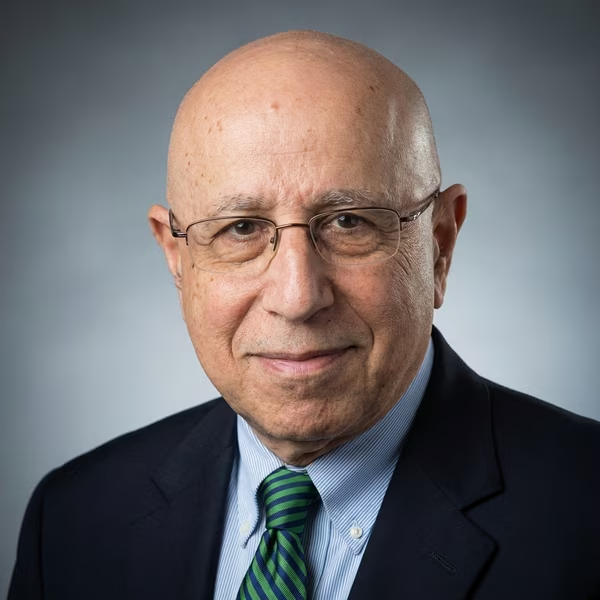
In a scene reflecting the accelerating decline of freedom of expression within American universities, "Rutgers University" in New Jersey succumbed to pressure from pro-Israel groups and decided to withdraw its invitation to Palestinian-American businessman Rami Ghandour to deliver the commencement speech at the College of Engineering, despite the widespread support he enjoys within the campus.
Ghandour, the CEO of the biotechnology company Arcellx and one of the university's most prominent alumni, was invited to deliver the commencement address on May 15, before the dean of the college, Alberto Coetinho, suddenly withdrew the invitation, under the pretext of a very limited number of students objecting to Ghandour's critical stances on Israel.
According to information circulating within the university, the number of objectors did not exceed four students, in contrast to widespread support from thousands of students and alumni who saw Ghandour's selection as an inspiring model for a successful graduate who combined professional excellence with involvement in human justice issues. However, the university administration chose, as its critics say, to respond to the voice of the politically and media-backed influential minority, ignoring the general mood within the campus.
A university spokesperson confirmed that the decision came after concerns about some students boycotting the ceremony due to Ghandour's posts related to Israel. But the university avoided disclosing the nature of those posts, which mostly included photos and reports about the war in Gaza, along with comments accusing Israel of committing war crimes and implementing an apartheid system against Palestinians.
Ghandour is known for his public human rights activism, and the university itself had previously celebrated his role as executive producer of the documentary "The Voice of Hind Rajab," which documents the story of the Palestinian child Hind Rajab, who was killed during Israeli military operations in Gaza. However, this celebration quickly faded when his political stance became subject to attack by pro-Israel pressure groups.
In an angry response, Ghandour described the university's decision as "painful and shameful," considering that the academic institution, which had previously used his human rights activism to improve its public image, abandoned its principles at the first real political test. He said: “They celebrated my social justice when it was convenient for them, then they backed down when it became costly.”
This development comes at a time when American universities are witnessing an unprecedented campaign of pressure targeting voices supportive of Palestinians, whether students, professors, or guest speakers. Since the outbreak of the war on Gaza, universities have become an open political arena, where administrations face repeated threats from Republican politicians and influential donors demanding the suppression of any discourse critical of Israel.
In a similar incident, the University of Michigan this week was forced to disavow a speech given by history professor Derek Peterson during a commencement ceremony, after he praised students in solidarity with Palestine. The speech sparked threats to cut funding to the university, which prompted the administration to publicly apologize, a move that angered academic freedom advocacy groups.
Observers believe that what happened at Rutgers clearly reveals the limits of "freedom of expression" within American academic institutions when it comes to Israel. While universities boast slogans of diversity and intellectual openness, they often back down in the face of any political or financial pressure related to pro-Israel lobbies, even if the objection comes from a very small number of individuals.
The case of Rami Ghandour reveals the moral decline that has afflicted a number of major American universities, which have come to treat freedom of expression as a selective privilege rather than a fixed academic right. Rutgers University did not cancel the invitation because of hate speech or incitement, but because of political criticism of Israel based on documented facts and international human rights reports. More dangerously, the university succumbed to pressure from only four students, ignoring thousands of students who supported Ghandour's participation. This reflects the extent of the influence that pro-Israel pressure groups now exert within American educational institutions, even at the expense of universities' independence and academic credibility.
What happened at Rutgers raises a fundamental question about the nature of American democracy and its actual limits. When universities, which are supposed to be spaces for free discussion, become unable to host a speaker who criticizes a war that has killed tens of thousands of civilians in Gaza, then talk of "intellectual pluralism" becomes an empty slogan. The war on Gaza has shown that there is a strict political ceiling within the United States that prevents real criticism of Israel without facing punishment or exclusion. Thus, academic institutions are gradually turning into tools subject to political intimidation and financial blackmail rather than independent arenas for thought and knowledge.
The striking paradox is that the increasing repression campaigns against voices in solidarity with Palestinians have begun to produce a counter-effect within American society, especially among youth and students. The more the pro-Palestine discourse is suppressed, the more widespread the conviction that there is an organized attempt to silence a humanitarian narrative related to rights and justice. Moreover, the repeated bowing of universities to pressure from pro-Israel lobbies harms the image of these institutions more than it protects them, as it reveals the fragility of their claim to independence. For many American students, universities today seem less willing to defend the principles they have long boasted about to the world.
Share your opinion
Rutgers University bows to pressure from pro-Israel lobbies, withdraws invitation to speaker who criticized the war on Gaza