






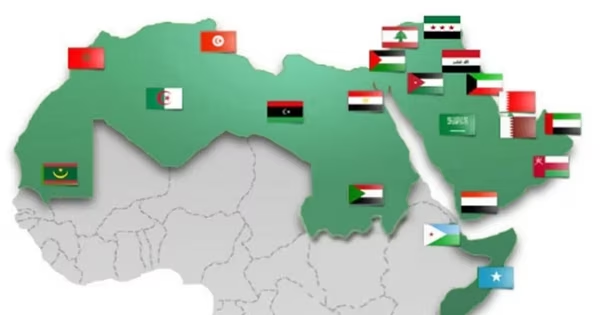

Arab and international attention today is focused on three strategic regions that summarize the map of major conflicts in the region. The Strait of Hormuz stands out as a primary arena for US-Iranian tension, casting its shadow over the global economy. In southern Lebanon, specifically in Bint Jbeil, the features of a military confrontation between the resistance and the Israeli occupation are crystallizing, a confrontation whose outcomes will shape the future of regional balances.
As for the Gaza Strip, the continuation of the Israeli war of extermination places the entire Palestinian issue at a decisive historical turning point. The consequences of this conflict will not only determine the fate of the resistance in the Strip but will also extend to include the future of Palestinian national rights and international efforts to find political solutions in light of the current deadlock.
Despite the centrality of these three fronts, the Arab scene cannot be reduced to them alone, as the Arab body suffers from bleeding wounds in other equally dangerous areas. In Palestine, the pace of Judaization is escalating in Jerusalem, the West Bank, and the occupied territories of 1948, indicating a comprehensive Zionist plan targeting the Palestinian presence in all its forms.
In the Syrian scene, the country is still reeling under the weight of repeated Israeli aggressions and external interventions that hinder reconstruction and stabilization efforts. The Syrian state faces complex challenges in its quest to establish new governance foundations, amidst a turbulent regional environment that increases the difficulty of economic and social recovery.
Sudan, meanwhile, is experiencing a humanitarian tragedy resulting from a civil war that has destroyed infrastructure and plunged the country into a dark tunnel of security and livelihood crises. This coincides with the instability in Libya and the ongoing conflicts in Yemen, which have drained the resources of the Yemeni people over many years of war and destruction.
In Iraq, the search for political and security stability remains a distant goal amidst regional and international tensions that affect its sovereign decision. Indirect confrontations between major powers have had clear impacts on the Iraqi economy, leaving citizens facing difficult living challenges despite the country's natural wealth.
The Arab Gulf states are not immune to these transformations; they live under the weight of surrounding security threats and face internal challenges related to economic transformation. At the same time, the effective role of joint Arab institutions, such as the Arab League and the Gulf Cooperation Council, is absent in resolving internal disputes or formulating a unified stance.
Amidst this rubble of crises, a fundamental question arises about the fate of the 'Arab Project' and whether there is hope for a new revival that transcends the current state of defeat. Dr. Sassin Assaf's book 'The Arab Revival Project' came to present ideas for civilizational renewal, attempting to revive the discussion about the concepts of unity, sovereignty, and independence.
In his work, Assaf reviews the historical transformations of Arabism and the development of the nationalist movement, highlighting the experience of President Gamal Abdel Nasser and the attempts of Arab thinkers to renew revivalist thought. The author believes that current crises require a return to the basic principles upon which Arab liberation movements were founded, while adapting them to the requirements of the era.
The revival project proposed by the book is embodied in four main pillars: unity, democracy, confronting occupation, and scientific and civilizational renewal. These foundations aim, at their core, to build a 'resistant society' capable of standing firm against external expansionist projects that aim to fragment the region.
However, the bitter reality indicates that most Arab parties and movements, whether nationalist, Islamist, or liberal, have failed to translate these slogans into realistic action programs. Indeed, we are witnessing a frightening decline today, where preserving the entity of the nation-state has become an end in itself, superseding the dream of greater Arab unity.
Protecting political systems and consolidating the pillars of governance has become a priority over safeguarding public freedoms, protecting human rights, or practicing true democracy. Resorting to external powers and being beholden to their will has become the preferred way for many to solve internal problems, leading to the erosion of national sovereignty in many countries.
This reality confirms the urgent need for a comprehensive and deep assessment of the Arab and Islamic reality, and an investigation into the true causes of the failure that has accompanied us throughout the last century. Escaping the predicament requires 'out-of-the-box' thinking that transcends rigid ideological frameworks that are no longer capable of interpreting or changing reality.
The question remains open: Will the current wars and crises be a catalyst for the birth of a new Arab-Islamic vision that achieves the desired liberation and revival? Or will these conflicts push the region towards further fragmentation and dependence on external powers? The future depends on the ability to launch a comprehensive Arab dialogue that places the interests of the peoples above all else.
Preserving the unity of states has taken precedence over Arab unity, and protecting political systems has become more important than freedoms and human rights.
Share your opinion
Beyond the Blazing Battlefields: Do Arabs Have a Project for Civilizational Revival?