







By Said Arikat
April 24, 2026
News analysis
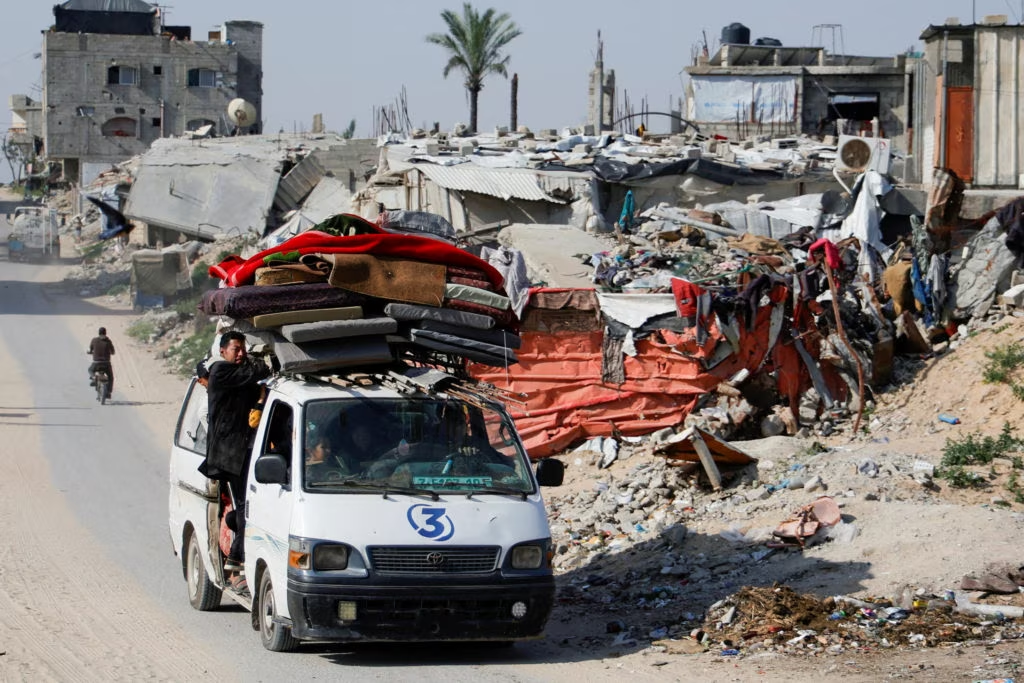
Washington, D.C- Six months after the October 10, 2025 Gaza ceasefire was announced with predictable diplomatic fanfare, it stands exposed as yet another arrangement designed less to end war than to manage it. What was marketed as a path to calm has instead become a mechanism for extending siege, occupation, and Palestinian suffering under the language of peace. Israel has steadily ignored major obligations under the agreement, while the United States, the Board of Peace, and envoy Nickolay Mladenov have acted less as guarantors than as enablers.
The Cairo negotiations remain deadlocked. Mediators insist the principal obstacle is Hamas’s refusal to disarm. That claim is politically convenient and fundamentally dishonest. It directs scrutiny toward Palestinian weapons while obscuring the more immediate issue: Israel has not implemented key commitments under Phase I, yet continues to demand fresh Palestinian concessions before honoring the terms it already accepted.
That is not diplomacy. It is coercion.
The Board of Peace, chaired by President Donald Trump, has promoted a phased plan requiring Hamas to surrender heavy weapons as a precondition for reconstruction. Mladenov has echoed the same formula, presenting demilitarization as the gateway to Gaza’s future. In practice, this means a shattered civilian population is told that food, shelter, medicine, and rebuilding will remain hostage until Palestinian factions comply with Israeli security demands.
Such logic turns humanitarian relief into blackmail.
Why should Palestinians disarm while Israel continues to bomb, occupy, blockade, and control Gaza’s borders? Why should the occupied surrender leverage while the occupier retains overwhelming military superiority, territorial control, and unconditional foreign backing?
The October ceasefire was supposed to be reciprocal. Israel was expected to withdraw from designated areas, dramatically expand humanitarian access, facilitate medical evacuations, and cease offensive operations. Yet reports indicate Israel still occupies roughly 53 percent of Gaza, entrenched behind the so-called Yellow Line while preserving effective control over much of the territory.
That is not a ceasefire. It is a repackaged occupation.
The death toll since the truce began exposes the fraud even more starkly. Hundreds of Palestinians—some estimates place the number between 700 and 800—have reportedly been killed by Israeli strikes, shelling, sniper fire, or near-daily attacks. Thousands of violations have been alleged, including raids beyond agreed lines and repeated bombardments.
When civilians continue to die under sustained military assault, the word ceasefire loses all meaning.
Yet Washington and its diplomatic partners have shown no comparable urgency in confronting these breaches. Instead, they recycle a familiar hierarchy: Palestinian obligations are immediate, binding, and endlessly monitored; Israeli obligations are flexible, negotiable, or excused under the broad label of security concerns.
This double standard is not a flaw in the process. It is the process.
Humanitarian aid offers another indictment. The agreement reportedly envisioned 600 aid trucks entering Gaza daily. That target has not remotely been met. Supplies remain trapped by inspections, delays, and sweeping restrictions on so-called dual-use goods, including materials essential for rebuilding homes, hospitals, and water systems.
A hungry civilian population is being used as leverage while diplomats speak of progress.
Medical evacuations reveal the same cruelty. Patients requiring urgent surgery, cancer treatment, or trauma care remain trapped by bureaucracy and closures. Transfers are sporadic, inadequate, and easily suspended. For many in Gaza, diplomacy is experienced not as hope, but as delay preceding death.
And where has the Board of Peace directed its pressure? Not at the party maintaining occupation positions or restricting aid. Reports indicate ultimatums were instead delivered to Hamas: accept the disarmament formula quickly or risk collapse of negotiations.
So Israel may retain troops, continue attacks, block assistance, and dictate movement, while Palestinians are told to surrender first and trust later.
No serious observer could mistake this for neutrality.
Hamas deserves criticism for authoritarian governance, repression, and strategies that have repeatedly deepened Gaza’s misery. But none of that erases Israel’s obligations under international law or under the ceasefire itself. Nor does it justify a mediation structure that treats Palestinian rights as conditional privileges while presenting Israeli demands as unquestionable facts.
Nickolay Mladenov’s role deserves particular scrutiny. Far from behaving as an honest broker, he has increasingly appeared aligned with Israeli priorities and dismissive of Palestinian grievances. Pressure is directed at Palestinians; patience is reserved for Israel. He speaks the language of balance while operationalizing imbalance.
That is not impartial diplomacy. It is complicity.
If Mladenov sought genuine peace, he would demand Israeli withdrawal from agreed zones, condemn civilian killings, insist on unrestricted humanitarian corridors, and oppose using starvation and reconstruction as bargaining tools. Instead, his emphasis remains centered on Palestinian disarmament, as though Gaza’s central problem were not occupation but insufficient submission.
The National Transitional Committee announced in January 2026 further illustrates the farce. A body of Palestinian technocrats was created to help govern and rebuild Gaza, yet reports suggest its members have not even been allowed into the territory. The mediators created a government barred from governing and called it progress.
The United States remains the indispensable enabler. No country has greater leverage over Israel, and none has shown less willingness to use it. Military support continues. Diplomatic shielding continues. Demands for Palestinian compliance continue. Palestinian rights to movement, sovereignty, reconstruction, and security remain indefinitely deferred.
Trump’s Board of Peace is not new architecture. It is old bias in a new suit.
If a genuine second phase is ever to emerge, accountability must come first. Israel must withdraw from agreed areas, halt attacks, allow full humanitarian access, and permit functioning Palestinian governance inside Gaza. Security discussions, including disarmament, can only occur within a credible political framework tied to ending occupation and recognizing Palestinian self-determination.
Anything else is another trap.
The past six months have made one truth unmistakable: ceasefires fail when one side may violate them with impunity while the other is ordered to capitulate. Gaza does not suffer from a shortage of proposals. It suffers from a surplus of bad-faith mediators.
Until that changes, this ceasefire will remain what it was from the outset: a cynical arrangement Israel never intended to honor, Washington never intended to enforce, and Mladenov’s conduct only helped undermine and discredit.
Share your opinion
The Ceasefire Israel Never Intended to Keep