






By: Said Arikat
April 23, 2026
News Analysis
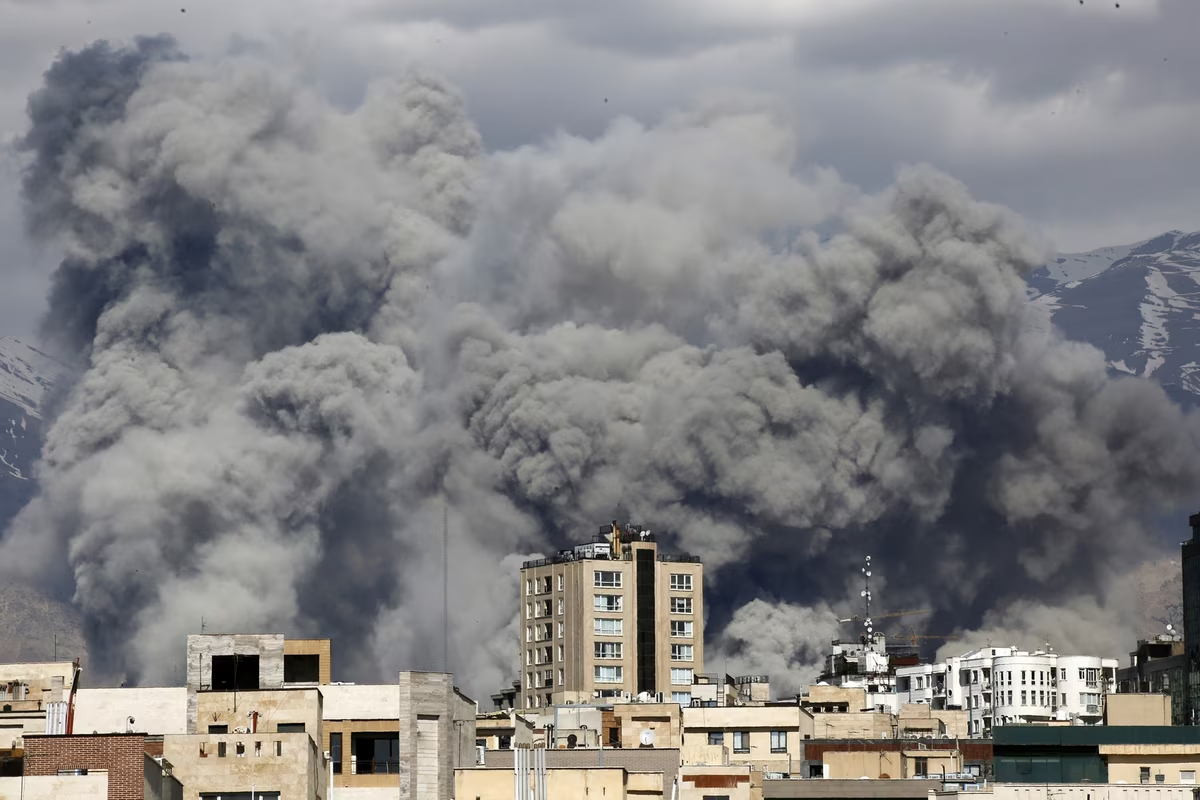
Washington, D.C-The United States possesses overwhelming military superiority over Iran. Its fleets dominate the seas, its intelligence networks span the region, and its strike capacity remains unmatched. If this confrontation were decided solely by missiles, aircraft carriers, and battlefield metrics, Washington would already have won.
But geopolitics is not an arms exhibition. It is a contest of endurance, legitimacy, economic resilience, and political discipline. On those fronts, the United States is squandering its advantages—and President Donald Trump’s erratic leadership is helping Iran convert weakness into leverage.
This is the central paradox of the crisis: America wins the visible war while losing the consequential one.
Trump has long mistaken unpredictability for strategic brilliance. He believes sudden threats, dramatic reversals, and public displays of fury keep adversaries off balance. In reality, they often keep allies off balance, markets on edge, and enemies opportunistic. One day he promises devastating retaliation; the next he suggests talks. One week he insists maximum pressure is working; the next he hints at compromise. He oscillates between escalation and improvisation with such frequency that no one can be certain whether policy exists beyond impulse.
That uncertainty is not strength. It is strategic leakage.
Iran understands a truth Trump appears unwilling to grasp: it does not need to defeat the United States militarily. It only needs to make American power costly, politically divisive, and economically destabilizing. That is precisely where the Strait of Hormuz becomes Tehran’s great equalizer.
The narrow waterway is one of the most important arteries of the global economy. A substantial share of the world’s oil and liquefied natural gas moves through it. Iran does not need to shut it entirely. It only needs to inject enough danger—real or perceived—to rattle insurers, delay shipping, and push prices upward.
And prices are where wars migrate into daily life.
Every rise in energy costs spreads quickly through the international system. Fuel becomes more expensive. Freight rates rise. Food prices follow. Inflation returns. Central banks delay relief. Governments already weakened by debt and domestic anger face new pressure. Consumers who cannot locate the Strait of Hormuz on a map still feel its consequences at the gas pump and grocery store.
This is how a weaker state punishes a stronger one.
Trump’s answer has too often been louder rhetoric rather than smarter strategy. He announces blockades, threats, deadlines, and ultimatums with theatrical certainty, only to dilute them later through exemptions, mixed messages, or sudden pivots. Such behavior creates the worst of both worlds: enough instability to alarm markets, but not enough coherence to compel adversaries.
The presidency becomes a source of volatility.
Even sanctions—Washington’s favored instrument—carry contradictions. Restricting Iranian exports can tighten supply and elevate global prices. Higher prices may partially offset Tehran’s lost volumes through residual sales, intermediaries, or shadow networks. The world economy absorbs the shock while Iran preserves enough revenue to endure. Punishment becomes distortion.
Meanwhile, Tehran wages an equally important battle in the realm of perception.
Across much of the Global South, the story is not one of American guardianship and Iranian aggression. It is one of a superpower using military and financial dominance in ways that destabilize markets and burden poorer nations. Iran presents itself as a country under siege resisting coercion. Whether entirely credible is secondary. Narratives succeed when they exploit existing grievances.
Trump’s conduct makes that easier. His insults, reversals, and impulsive declarations reinforce the image of an America governed by temperament rather than principle. Diplomacy requires steadiness. He offers spectacle. Strategy requires consistency. He offers improvisation. Coalition-building requires trust. He offers surprise.
Iran could not script a better opponent.
This is not because Tehran is stronger. It is because Washington is less disciplined than its own power requires. Great powers decline strategically when they confuse capability with wisdom. America still has the former in abundance. Under Trump, it often appears short on the latter.
There is historical precedent for this failure. In Iraq and Afghanistan, the United States repeatedly demonstrated tactical dominance while drifting politically. It could destroy targets faster than it could define success. It could topple regimes faster than it could build legitimacy. Military excellence could not compensate for strategic confusion.
The same danger now looms in the Gulf.
Allies privately worry not only about Iran, but about Trump himself. They value American protection while fearing American impulsiveness. Security guarantees become less reassuring when paired with a president who can reverse course overnight or trigger escalation through performative bravado.
Iran, by contrast, needs only patience. It can absorb pain if Washington remains divided, distracted, and inconsistent. Every month of elevated prices, nervous markets, and strained alliances works in Tehran’s favor. Time becomes a weapon.
The deeper lesson is that modern conflict is no longer decided merely by battlefield outcomes. It is decided by who can sustain coalitions, protect economic stability, maintain public confidence, and project credibility. Aircraft carriers matter. But so do grocery bills, investor confidence, and diplomatic trust.
Trump has never shown much interest in those subtler forms of power. He prefers visible force to durable strategy, headlines to architecture, disruption to competence. In doing so, he turns America’s greatest strengths into self-inflicted liabilities.
So yes, the United States may dominate the kinetic war. Its arsenal is larger, its navy stronger, its reach unmatched.
But if inflation spreads, allies hesitate, markets recoil, and Iran continues to survive while portraying America as reckless, then military superiority becomes strangely hollow.
Washington may command the battlefield, but Trump may be handing Tehran everything else..
Share your opinion
America’s Firepower, Trump’s Chaos, Iran’s Advantage