






By Said Arikat
April 21, 2026
News Analysis
Washington, D.C. — In a recent and unusually candid discussion, columnist and podcast host Ezra Klein interviewed two prominent scholars of Middle East politics: Shibley Telhami of the University of Maryland and Marc Lynch of George Washington University. Their exchange did not merely revisit another cycle of violence. It exposed the collapse of one of the most durable fictions in modern diplomacy: the claim that Israelis and Palestinians remain on a credible path to two states living side by side.
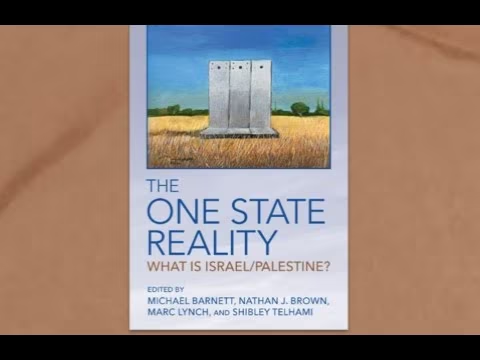
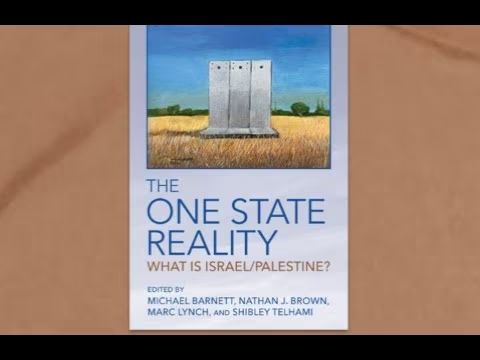
What emerged instead was a far starker truth. The two-state formula, repeated for decades by American presidents, European diplomats, and international institutions, has been emptied of substance. In practice, a one-state reality already exists. One power controls the entire territory between the Jordan River and the Mediterranean Sea. That power is Israel. The millions of Palestinians living under that control do so without equal rights, equal protections, or equal political standing.
This reality is no longer hidden by maps or slogans. Palestinians in Gaza, the occupied West Bank, East Jerusalem, and inside Israel itself live under separate legal and administrative systems designed to fragment their identity and restrict their freedoms. They face differing degrees of exclusion, surveillance, dispossession, and dependency. Israeli Jews, by contrast, enjoy full political rights and freedom of movement across the same land.
Telhami and Lynch are not polemicists. They are veteran scholars whose conclusions arise from years of studying public opinion, institutions, and regional politics. Their central point is simple: settlement expansion, military domination, and systematic territorial fragmentation have destroyed the material basis of Palestinian sovereignty. The language of peace survives, but the possibility it once described has largely vanished.
During the Oslo years of the 1990s, many believed a Palestinian state might genuinely emerge. Institutions were being built. Negotiations, however flawed, appeared to move forward. Palestinians could imagine independence as something tangible rather than rhetorical. International diplomacy still possessed credibility.
That period is over.
The second intifada, repeated wars, collapsing trust, and the steady rise of Israel’s hard right transformed the landscape. Settlements spread across strategic hilltops and valleys. Bypass roads linked settlers while bypassing Palestinians. Checkpoints, walls, closures, and military zones carved the West Bank into disconnected enclaves. Gaza was sealed under blockade, its economy strangled and society trapped. The Palestinian Authority remained, but largely as an administrator without sovereignty.
Yet Washington and much of Europe continued to speak as though the diplomatic process had merely stalled. Invoking a future Palestinian state became a convenient way to avoid confronting the unequal regime already entrenched in the present. The promise of tomorrow served to excuse the injustices of today.
Then came the Hamas attack of October 7, which Israel said killed 1,200 Israelis, including soldiers and civilians. The atrocity shocked Israeli society and intensified genuine fears. But Israel’s response did not revive peace. It unleashed catastrophic destruction on Gaza. Tens of thousands of Palestinians were killed, and over 150 thousand wounded and maimed. Entire families vanished beneath rubble. Neighborhoods were erased. Hospitals, schools, refugee camps, universities, water systems, and civilian infrastructure were shattered. Hunger, disease, and displacement became instruments of war.
For Palestinians, the message was unmistakable: even the most basic human rights — safety, shelter, food, movement, medical care, and life itself — could be suspended collectively. For much of the Israeli public, however, this devastation was tolerated, defended, or openly cheered as necessary punishment. That broad social consent is among the conflict’s darkest realities. It suggests the crisis is not only governmental policy, but a deeper moral hardening within Israeli society itself.
Meanwhile, in the West Bank, settler violence intensified, often under the protection or indifference of state authorities. Land seizures accelerated. Villages were attacked. Olive groves were burned. Families were driven from their homes. What had long been called temporary occupation now appears plainly permanent. Temporary systems do not last for generations while continuously expanding.
The result is a hierarchy of rights. Palestinian citizens of Israel vote, yet face entrenched discrimination in land allocation, resources, and national belonging. Palestinians in East Jerusalem hold residency that can be revoked. West Bank Palestinians live under military law without citizenship. Gazans have endured siege and mass destruction. Across all these categories, Palestinians remain governed but not equal.
Israel and its defenders invoke security, and security threats are real. Armed groups, rockets, regional hostility, and the trauma of October 7 cannot be dismissed. But no legitimate security doctrine can permanently justify denying millions of people political rights and basic dignity. Collective punishment does not create safety. Domination does not create peace.
Indeed, Israel’s military supremacy may be undermining the very security it seeks. Force can imprison a population, but it cannot erase national consciousness. Airstrikes can destroy buildings, but not demands for freedom. Repression can delay reckoning, never prevent it.
Klein’s conversation also highlighted a profound shift inside Israel. Ultranationalist and openly supremacist currents once considered fringe now shape the political center. The old question — whether Israel could remain both Jewish and democratic while ruling millions of disenfranchised Palestinians — is being answered in practice. Ethnonational control is prevailing over democratic principle.
For decades, American politics refused to face this transformation. Benjamin Netanyahu was often treated as the problem rather than as the expression of a broader consensus. U.S. administrations continued funding, arming, and shielding Israel diplomatically even as prospects for partition disappeared before their eyes.
Only two coherent futures remain: real partition into two viable sovereign states, or one state with equal citizenship for all. What cannot endure morally or politically is the present arrangement — one sovereign power, one territory, and two radically unequal systems of life.
The illusion is ending. The question is whether world leaders will continue protecting it, or finally confront the reality already in plain sight.
Share your opinion
Israel’s One-State Reality: The End of a Diplomatic Fiction