







By: Said Arikat
April 20, 2026
News Analysis
Washington, D.C- The so-called ceasefire between Israel and Lebanon began collapsing almost as soon as it was announced. Officially, the guns are quieter and diplomats are celebrating restraint. On the ground, however, a darker reality is emerging: Israel appears to be extending into southern Lebanon the same system of control, displacement, and devastation it refined in Gaza. What is taking shape is the Gazification of Lebanon.
The clearest sign is Israel’s imposition of a “Yellow Line,” a military demarcation zone cutting through southern Lebanon and placing broad areas under direct Israeli coercive power. In Gaza, similar lines fragmented communities, blocked displaced civilians from returning home, and transformed large swaths of land into de facto free-fire zones with little accountability.
That model is now moving north.
Israeli officials describe the line as a temporary ten-kilometer “security buffer zone.” But such language conceals more than it explains. “Buffer zone” suggests mutual safety and temporary necessity. In practice, it often means occupation by another name: one side controlling movement, dictating access, demolishing property, and reserving the right to kill or detain at will.
That is increasingly the reality in Lebanon.
Reports indicate civilians approaching the newly declared line have come under fire, while Israel frames such incidents not as violations of Lebanese sovereignty or ceasefire terms, but as legitimate enforcement. This inversion has become central to Israeli military doctrine: unilateral force is normalized, while opposition to it is criminalized.
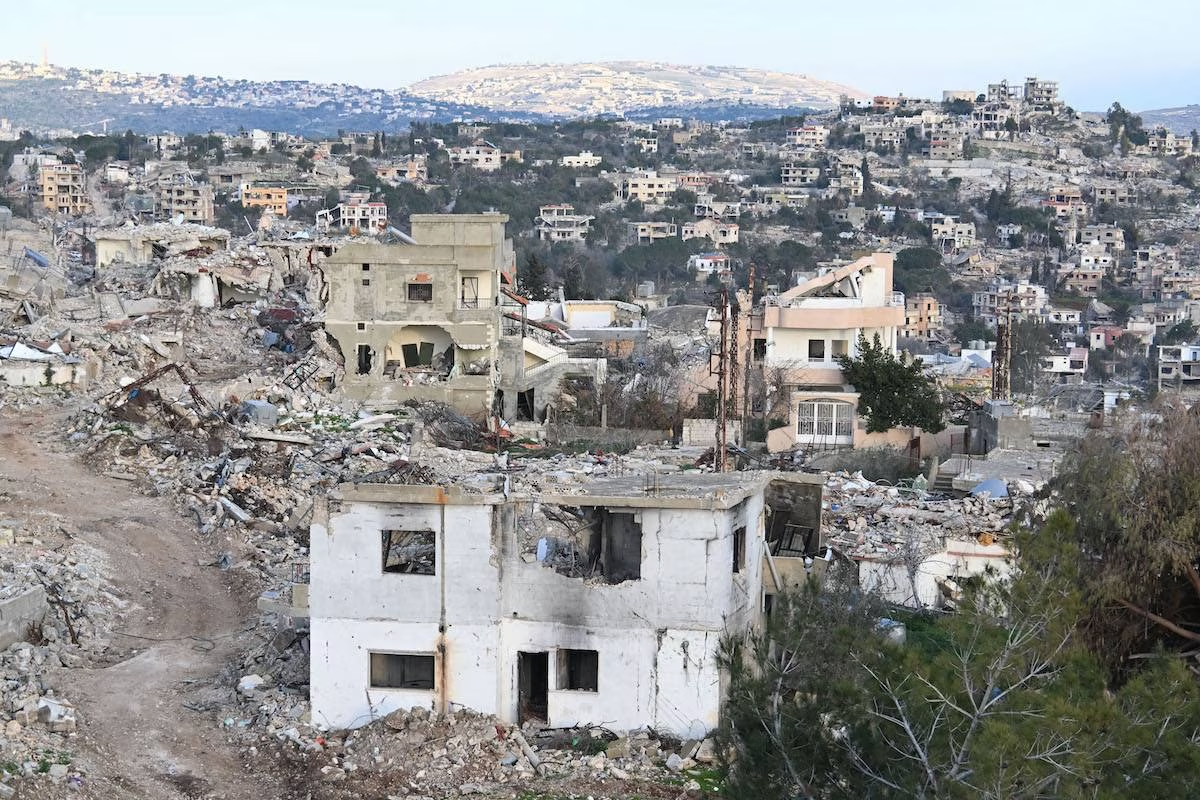
Meanwhile, demolitions continue. Homes in southern Lebanese towns—particularly in places like Bint Jbeil, long marked by repeated wars—are reportedly being destroyed under the banner of a ceasefire. What kind of ceasefire permits one side to keep razing civilian neighborhoods while presenting itself as the injured party?
The answer is clear: a ceasefire without enforcement is not peace. It is organized violence managed through diplomatic language.
Yet the deeper issue is not Israel’s conduct alone, but the impunity that sustains it. Israel has learned it can redraw boundaries by force, reinterpret agreements unilaterally, and devastate civilian infrastructure with little cost. That lesson was taught, financed, and repeatedly reinforced by the United States.
Washington remains Israel’s essential shield: at the United Nations through vetoes and diplomatic cover, through weapons transfers and military aid, and through the automatic invocation of “self-defense” regardless of scale or proportionality. Republican and Democratic administrations alike have treated Israel as exempt from standards imposed on every other state.
When Russia seizes land or creates “security zones,” Washington invokes sovereignty and international law. When Israel pursues structurally similar or harsher policies, the language suddenly shifts to security dilemmas and regional complexity. This double standard is not merely hypocritical—it is destabilizing. It teaches allies that law is selective, force negotiable, and civilian suffering politically manageable.
Lebanon now risks becoming the next proving ground for that doctrine.
The tragedy is sharpened by Lebanon’s own collapse. The country is already burdened by economic ruin, political paralysis, institutional decay, and the scars of successive wars. Southern communities have barely recovered from previous conflicts. For many families, displacement is not an exception but a recurring condition of life. To impose a new militarized zone on these communities is not a tactical necessity—it is the deliberate deepening of national trauma.
Israel’s defenders routinely cite Hezbollah’s presence near the border to justify virtually any level of force, as though the existence of an armed adversary authorizes collective punishment. But the bombardment of civilian towns, destruction of homes, and creation of open-ended control zones are not acts of security. They are instruments of domination. Such policies punish entire populations for realities they did not create, destroy prospects for moderation, and guarantee future rounds of violence.
This is what Gaza should have taught the world.
Instead, Gaza became a template: a territory carved up by barriers, civilians repeatedly displaced, neighborhoods reduced to rubble, humanitarian norms hollowed out, and foreign leaders insisting the catastrophe was regrettable but necessary. If that formula is now being replicated in Lebanon, the region is not moving toward peace—it is being reorganized around permanent war.
The United States bears singular responsibility because it alone possesses real leverage over Israel. It provides arms, intelligence cooperation, financial support, and diplomatic immunity. If Washington demanded verifiable ceasefires, respect for Lebanese sovereignty, and consequences for violations, Israeli calculations would shift quickly.
Instead, American policy remains trapped in an old reflex: protect first, question later—if at all.
That posture harms not only Palestinians and Lebanese civilians; it harms the United States itself. It fuels regional resentment, corrodes Washington’s claims to defend international law, and ties it to military practices much of the world increasingly rejects. Every village destroyed with American weapons, and every ceasefire emptied of meaning by American silence, further erodes U.S. credibility.
A real ceasefire in Lebanon would require an immediate halt to attacks by all parties, withdrawal from unilaterally imposed military zones, international monitoring, reconstruction assistance, and serious diplomacy based on mutual security rather than imposed force. It would also require Washington to stop mistaking alliance management for moral surrender.
The Gazification of Lebanon is not inevitable. It is a political choice—Israel’s to execute, America’s to underwrite, and the world’s to either accept or oppose.
As always, the price will be paid not by those who designed it, but by civilians forced to live beneath it.
Share your opinion
The Gazafication of Lebanon: How Israel Exports Destruction—and Washington Protects It