






By Said Arikat
April 18, 2026
News Analysis
Washington, D.C. — Palestinians know this script by heart. New envoys arrive with fresh mandates, new institutions are unveiled with polished names, and familiar slogans about peace, reform, and stability are repeated with practiced confidence. Yet the political outcome rarely changes. The faces rotate, the titles evolve, but the structure of domination remains intact.
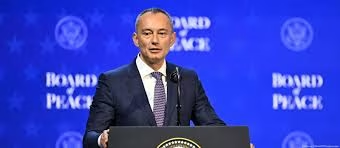
The latest figure to re-emerge in this cycle is Nickolay Mladenov, introduced in early 2026 as Director-General and High Representative for Gaza under the U.S.-backed “Board of Peace.” The title is sleek, the rhetoric humanitarian, the branding contemporary. But for many Palestinians, the substance is unmistakably old: another foreign administrator appointed not to end occupation, but to manage it more efficiently and render it more acceptable abroad.
Mladenov’s defenders present him as an experienced diplomat, a former United Nations envoy deeply familiar with the region’s complexities. But for many Palestinians, that résumé is not an asset—it is the indictment. Those who observed his years in office do not recall an honest broker or principled mediator. They remember a political operator whose consistent function was to preserve Israeli supremacy while containing Palestinian demands for freedom, sovereignty, and self-determination.
To many critics, Mladenov did not fail despite the system. He served it.
His broader record only reinforces that perception. During his tenure as UN Special Representative in Iraq, observers frequently described an official more invested in bureaucratic process, profile, and institutional maintenance than in transformative leadership or moral clarity. The pattern was familiar: prestigious office, polished diplomacy, limited courage.
That same pattern now appears poised to repeat itself in Gaza.
Throughout his years as UN envoy, Mladenov repeatedly elevated “security” as the organizing principle of diplomacy. In theory, security should apply equally to all peoples. In practice, under his stewardship, it overwhelmingly meant Israeli security first and Palestinian life second.
Palestinian rocket fire was condemned swiftly, publicly, and without hesitation. Yet Israeli bombardment, settlement expansion, siege, land confiscation, home demolitions, and the daily violence of military occupation were too often treated as regrettable complications rather than the central injustice driving the conflict.
Even in interpreting the October 7 Hamas attack, Mladenov emphasized incitement and hateful indoctrination while minimizing the political context of decades of occupation, blockade, dispossession, and systematic brutality. Such framing did not merely omit history—it distorted it.
This was not a matter of careless language. It reflected a broader Western doctrine: Palestinian resistance is treated as the problem, while Israeli occupation is treated as the backdrop. Symptoms are denounced. Causes are managed. Mladenov became one of the more polished executors of that formula.
Nowhere was this clearer than in Gaza.
Rather than advocate genuine liberation, he repeatedly promoted a model of economic relief in exchange for political silence. Cash transfers, temporary truces, donor conferences, infrastructure promises, and emergency understandings were marketed as progress. Rights were replaced with projects. Sovereignty was substituted with aid packages.
Gaza was to be stabilized, not freed. Pacified, not empowered.
That same logic now appears fully institutionalized in the so-called “Board of Peace,” a proposal to place post-war Gaza under externally supervised technocratic administration. In Washington policy circles, this may be sold as pragmatic governance. To Palestinians, it resembles colonial rule updated for the twenty-first century.
What is a government Palestinians cannot elect?
What is reconstruction without sovereignty?
What is administrative efficiency under military domination?
If Palestinians cannot choose their leadership, control their borders, manage their resources, or define their national priorities, then no boardroom structure—however elegantly branded—can disguise the absence of self-rule.
Technocracy is often invoked when democracy becomes inconvenient. Experts, appointees, and foreign overseers are presented as more “responsible” than the people themselves. In Gaza, the message is blunt: Palestinians may rebuild roads, hospitals, and ministries—but they may not determine their own political future unless Israel and foreign capitals consent.
Mladenov further deepened Palestinian distrust through his enthusiastic support for the Abraham Accords. Those agreements were celebrated in Washington as historic peace breakthroughs, yet they normalized relations between Israel and Arab states while leaving occupation untouched and Palestinians further marginalized.
Israel was rewarded diplomatically without meaningful concessions on settlements, borders, refugees, Jerusalem, or statehood.
That was not peace-making, It was political laundering.
For a man claiming concern for regional stability, Mladenov appeared remarkably comfortable with a framework in which Palestinians were instructed to wait indefinitely while others advanced their strategic and commercial interests.
Equally revealing was his repeated insistence on disarming Palestinian factions as a precondition for progress. Weapons in conflict zones are serious matters, and no society benefits from endless militarization. But demanding Palestinian disarmament while ignoring one of the most heavily armed states on earth exposes the selective morality at work.
Occupied people are routinely lectured about violence by those who enable, finance, or excuse the far greater violence of occupation itself. In such a framework, calls for Palestinian disarmament absent liberation are not a formula for peace, but a demand for surrender. Yet the deeper problem extends well beyond Mladenov as an individual. He has come to symbolize an international class of envoys who arrive promising to “de-escalate,” “coordinate,” and “stabilize,” while carefully refusing to confront the real source of instability: permanent occupation and the systematic denial of Palestinian national rights. They manage the consequences while protecting the causes. This helps explain why many Israeli officials viewed him favorably, and why many describe him as enemy of the Palestinians. He understood the limits they did not want crossed, and he mastered the language of humanitarian concern while operating safely within political boundaries set elsewhere. That may be considered successful diplomacy in elite circles; for those living under siege, it appears instead as a carefully managed betrayal.
They treat consequences while protecting causes.
This helps explain why many Israeli officials viewed him favorably. He understood the limits they did not wish crossed. He could speak the language of humanitarian concern while operating safely within political boundaries drawn elsewhere. That may qualify as successful diplomacy in elite circles.
For those living under siege, it looks more like managed betrayal.
If Gaza is to have a future worthy of its people, it will not emerge from Washington committees, foreign trusteeships, or recycled administrators such as Mladenov. It must come from Palestinian legitimacy, Palestinian consent, and Palestinian leadership.
The world keeps offering Palestinians managers when they are demanding freedom.
Nickolay Mladenov may carry a new title in 2026, but to many Palestinians he remains what he has long represented: the polished international face of a failed order—one that mistakes domination for stability, obedience for peace, and occupation for governance.
Share your opinion
Nickolay Mladenov Returns: A New Title, the Same Machinery of Control Sustaining Occupation