







Washington – Said Arikat – 17/4/2026
News Analysis
In a scene reflecting the complexities of US policy in the Middle East, reports revealed a rare meeting between American officials and Hamas leaders in Cairo, in an attempt to advance the stalled negotiations regarding the second phase of the ceasefire agreement in the Gaza Strip. However, this meeting, instead of reflecting a real diplomatic breakthrough, highlights a recurring pattern in the American approach: managing the crisis instead of solving it, and imposing conditions instead of building understandings.
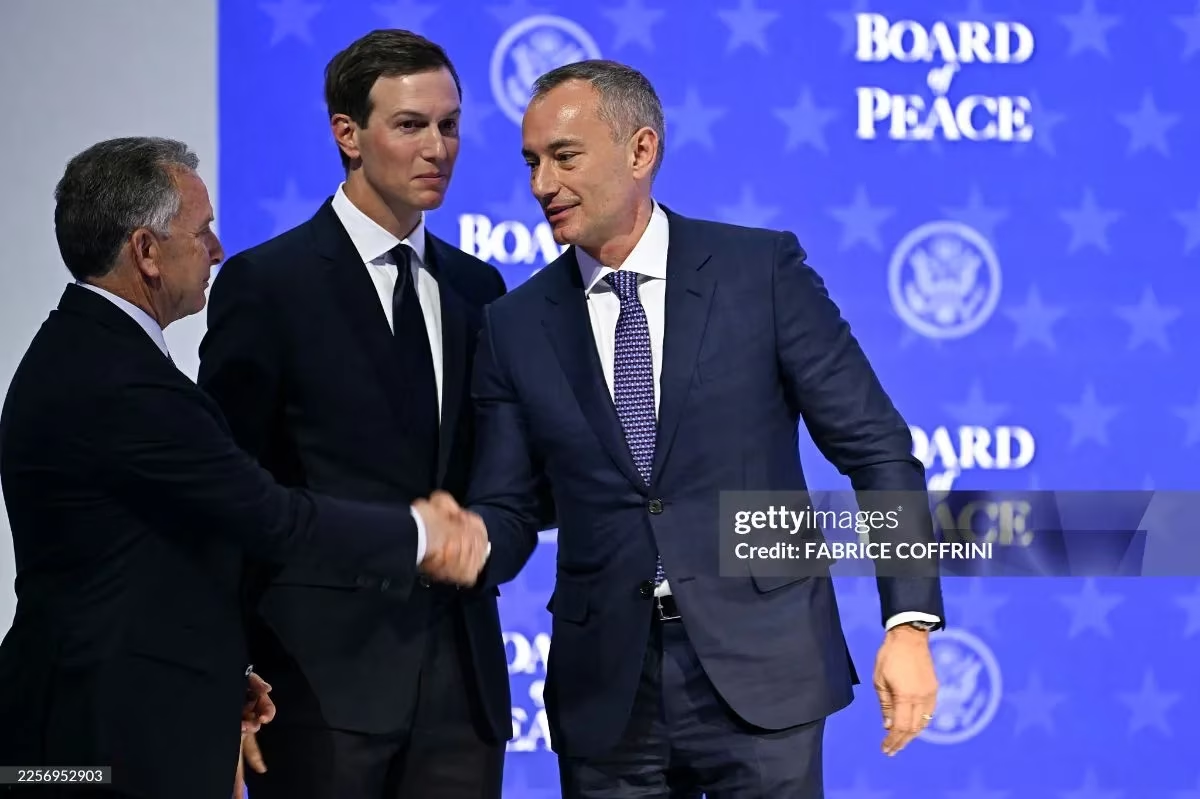
The meeting, which included Hamas's chief negotiator Khalil al-Hayya, and US advisor Ari Lightstone, along with Nikolay Mladenov (dubbed the enemy of Palestine), came in the context of efforts by what is known as the "Peace Council" supported by Washington, which is responsible for shaping the post-war phase in Gaza. Although this negotiating channel appears on the surface to be a positive step, it fundamentally reflects a clear imbalance in the nature of American mediation, which does not hide its structural bias towards the Israeli vision.
The American proposal is based on an equation that, at first glance, seems logical: the reconstruction of Gaza in exchange for the disarmament of Hamas. But this equation, when deconstructed, reveals a deep flaw in the prioritization, as a complex political process is reduced to a single security condition, while fundamental issues such as lifting the siege, ensuring the flow of aid, and stopping field violations are postponed or marginalized.
Hamas, for its part, did not reject the proposal solely on ideological grounds, but rather based on field data indicating the continuation of Israeli strikes within the Strip, the decline in humanitarian aid, and the expansion of Israeli control areas. These realities, which Washington has been unable to curb despite its influence, weaken any claim of a mediator role, and turn negotiations into a process of negotiation under pressure.
More significantly, the United States, which succeeded in October 2025 in brokering an agreement that relatively stopped the war, has been unable to translate this success into a sustainable path. Instead of building on the first phase, it reproduced the same logic: security first, and everything else later. This approach not only reflects a lack of understanding, but perhaps also reflects the absence of a real political will to impose a balance of commitments.
In the field, Israel continues to carry out near-daily strikes, announcing the targeting of Hamas elements and leaders, which exacerbates tension and undermines trust. Although Washington exerted some formal pressure to increase aid, it did not link this to any binding mechanism or accountability, making these steps closer to cosmetic improvements than to fundamental change.
Within this context, a fundamental paradox emerges: the United States seeks to impose a model for governing Gaza in the post-war phase, including a multinational force and a technocratic administration, but at the same time ignores the political conditions that would make this model viable. The absence of local consensus and the continuation of the occupation in its various forms make any imposed arrangements vulnerable to collapse.
Ultimately, this negotiating path cannot be separated from the broader framework of American policy in the region, which suffers from a deepening credibility crisis. Washington, which presents itself as a mediator, in reality plays a dual role: supporting a military and political party, while at the same time trying to manage the repercussions of this support through limited-impact diplomatic channels.
This contradiction is clearly reflected in the current negotiation process, where Hamas is asked to make major strategic concessions, while no real guarantees are offered for fundamental Palestinian rights. Instead of American mediation being a tool for achieving balance, it becomes a mechanism for reproducing an existing imbalance, which explains the ongoing stalemate.
America's insistence on linking reconstruction to disarmament, without addressing the political and humanitarian roots of the conflict, not only reflects a flawed reading of reality, but also perpetuates an unsustainable negotiating model. Past experiences have proven that stability is not imposed through unilateral security conditions, but is built through comprehensive settlements that address causes, not consequences.
Furthermore, the continuation of Israeli military operations, under American silence or justification, weakens any trust in the neutrality of mediation, and reinforces the impression that Washington uses diplomacy as a cover for managing the conflict, not for ending it. This approach, while achieving short-term tactical gains, exacerbates crises in the long run.
Given these facts, it seems that the future of Gaza will remain hostage to this American contradiction: between rhetoric that promotes solutions and practices that perpetuate the crisis. Unless Washington reconsiders its approach and moves from a logic of conditions to a logic of balance, any agreement will remain fragile, any truce temporary, and any peace postponed.
Share your opinion
US-Hamas Meeting in Cairo: Conditional Diplomacy or Crisis Management?