







By: Said Arikat
April 17, 2026
News Analysis
Washington, D.C- On April 15, 2026, a political threshold gave way. Forty of the Senate’s forty-seven Democrats voted to halt the transfer of offensive weapons to Israel—joined by seven of ten Jewish senators. This was not a symbolic protest but a structural rupture. What once seemed politically untouchable is now plainly contested: the erosion of automatic American support for Israel is no longer gradual—it is accelerating in full view.
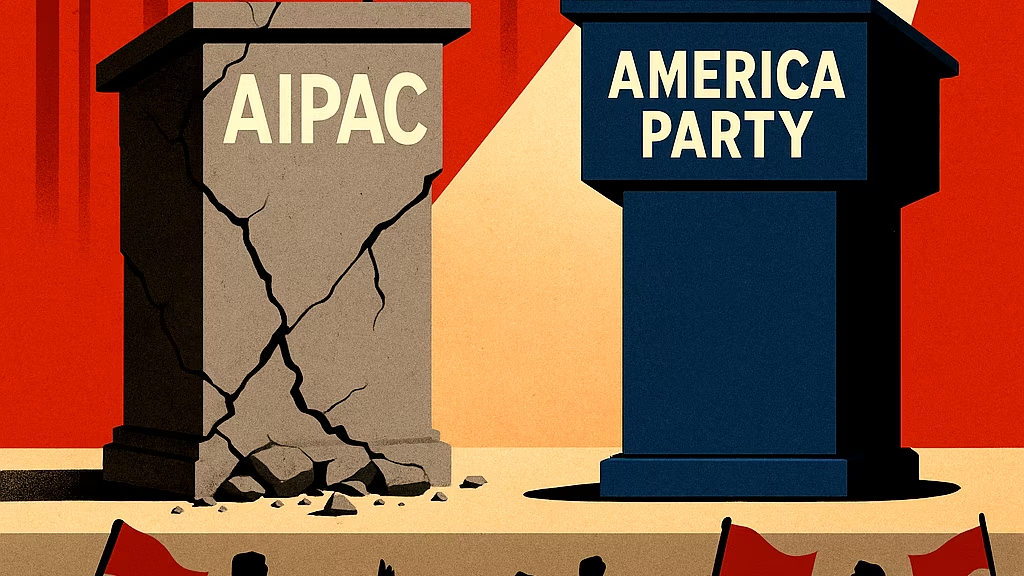
At the center of the old order stands AIPAC, long one of Washington’s most disciplined and effective lobbying machines. For decades, its influence helped enforce a narrow policy consensus in which support for Israel was treated less as a matter of debate than as a political requirement. That consensus depended on a feedback loop between lobbying power, elite alignment, and a public narrative that framed Israel as a democratic outpost under siege. Today, that loop is breaking. AIPAC still commands money, access, and institutional loyalty, but its ability to define the terms of debate is weakening as public skepticism—especially among younger Americans—sharpens into open dissent.
This shift cannot be explained by recent events alone. The war in Gaza has acted less as a cause than as an accelerant. The deeper erosion began years earlier, driven by the steady expansion of settlements, the entrenchment of occupation, and increasingly explicit rhetoric from Israeli leaders that signaled indifference—if not hostility—toward Palestinian political rights. Over time, these realities hollowed out the moral framework that pro-Israel advocates relied on. What the current war has done is make that contradiction unavoidable, confronting Americans with the human consequences of policies long shielded from sustained scrutiny.
In this context, pro-Israel lobbying has become more exposed—and more controversial. Its traditional strategy of insulating Israel from accountability by locking in bipartisan elite support now appears less like effective advocacy and more like democratic distortion. When overwhelming segments of one party’s electorate—and now a decisive majority of its senators—move in one direction, while policy remains tethered to long-standing lobbying pressure, the gap becomes difficult to justify. The issue is no longer simply influence; it is the perception that influence has overridden public sentiment and delayed political accountability.
The repeated efforts in Congress to curtail arms transfers, even when unsuccessful, reflect a system under strain. What was once politically prohibitive is now increasingly routine. Lawmakers are beginning to test the limits of a once rigid orthodoxy, not because lobbying pressure has disappeared, but because defying it is no longer politically fatal. The balance of risk is shifting—from challenging the status quo to defending it.
Looking ahead, the trajectory points toward further confrontation. Public opinion is being shaped in real time by images of civilian devastation, humanitarian restrictions, and rhetoric that many Americans interpret as endorsing collective punishment or permanent displacement. These are not episodic shocks; they are cumulative forces. Each new escalation reinforces a narrative in which U.S. support appears less like alliance management and more like complicity.
This raises a deeper question about the sustainability of the entire framework underpinning U.S.-Israel relations. A model built on lobbying strength, elite consensus, and largely unconditional support is increasingly at odds with a political culture that is more skeptical of foreign entanglements and more attuned to human rights violations. Under these conditions, maintaining the status quo requires not just persuasion, but continual insulation from public accountability—a strategy that grows harder to sustain over time.
None of this implies an imminent collapse of the bilateral relationship. Strategic and military ties remain deeply entrenched. But their political legitimacy is eroding. As the disconnect between policy and public opinion widens, pressure will build for a recalibration—toward conditionality, oversight, and a redefinition of what support for Israel actually entails. The question is no longer whether change will come, but how disruptive it will be when it does.
For AIPAC and allied organizations, the challenge is existential. Continuing to defend Israeli government actions without distinction risks accelerating their loss of credibility in a political environment that is no longer willing to separate alliance from accountability. Adapting would require a break from decades of reflexive advocacy—a shift toward acknowledging that unconditional support has political and moral limits. Whether such a transformation is possible within existing institutional frameworks remains doubtful.
What is clear, however, is the direction of travel. As long as Israeli policies toward Palestinians are widely perceived as coercive, expansionist, and indifferent to civilian harm, the divergence between American public opinion and the positions enforced by pro-Israel lobbying will continue to widen. And as that gap expands, so too will the political space for challenging both.
The implication is stark: the future of U.S. policy toward Israel will be shaped less by the enduring reach of its traditional lobby and more by the persistence of public dissent—and by a growing unwillingness to accept the costs of policies increasingly seen as unjust. This is not a temporary rupture in perception; it is the early stage of a deeper political realignment, one that is likely to intensify rather than recede in the years ahead.
Share your opinion
The Waning Grip: Israel, AIPAC, and America’s Breaking Consensus