







Washington – Said Arikat – 4/6/2026
As US military operations against Iran continue since their launch on February 28, 2026, under the name "Operation Overwhelming Fury," recent opinion polls reveal an unprecedented widening of American opposition to this war, as it enters its sixth week, an indicator reflecting a growing gap between the US administration's policies and domestic public opinion.
According to poll data published in early April, this war is among the US military operations that have generated the most public rejection since their inception in modern history. A CNN poll conducted on April 1 showed that about 66% of Americans oppose, to varying degrees, the decision to resort to military action against Iran. A joint poll by Reuters and Ipsos also showed that two-thirds of Americans prefer a swift end to military intervention, even if the stated objectives are not fully achieved.
These results reflect a general trend towards caution regarding involvement in a prolonged conflict, especially with rising concerns about the possibility of sending ground troops, an option that President Donald Trump's administration has not ruled out yet. Data indicates that more than 75% of Americans oppose the deployment of ground troops in Iran, a clear indication of the historical sensitivity associated with extended wars in the Middle East.
In the same context, a Pew Research Center poll showed that 40% of Americans believe the war makes the United States less safe, compared to only 22% who believe it enhances the country's security, reflecting a decline in confidence in the effectiveness of current military operations.
Reasons for Escalating Opposition
Observers link this public rejection to several intertwined factors, primarily direct economic repercussions. Global oil prices have seen a sharp rise since the outbreak of the conflict, which has been reflected in fuel prices within the United States, exceeding $4 per gallon in late March, increasing living pressures on citizens.
The ambiguity surrounding the US strategy also contributes to public anxiety, as estimates indicate that about 67% of voters believe the administration lacks a clear plan to manage or end the conflict. This concern is exacerbated by warnings of broader regional repercussions, especially amid tensions related to the Strait of Hormuz, a vital artery for global energy supplies.
Field Developments and Political Escalation
On the ground, recent days have witnessed a remarkable escalation in political and military rhetoric, with President Trump giving Iran a deadline ending on Tuesday, April 7, to reopen the Strait of Hormuz, threatening "severe" consequences, including targeting vital infrastructure such as power plants and bridges.
In contrast, estimates of human casualties within Iran vary, but human rights reports, including those published by the "Hrana" agency (concerned with human rights), indicate thousands of deaths since the start of operations.
Regarding military operations, US forces announced on April 5 their success in rescuing a crew member of an F-15E aircraft, who had been lost inside Iranian territory since Friday, in an operation described as complex and sensitive.
Despite President Trump's announcement of the operation's success, its behind-the-scenes details revealed a heavy price paid by the United States, represented by the bombing and destruction of two of its most advanced aircraft. While US commando teams successfully reached and secured the pilot, the force faced a fatal obstacle after the front wheels of two military transport aircraft sank into the sand of the desert runway, according to the American account revealed by the New York Times.
After desperate attempts to free the two aircraft, forces were forced to request alternative planes. Before withdrawing at sunrise, American fighters bombed and completely destroyed the stranded aircraft.
The decision was governed by an extremely sensitive "strategic necessity." The Wall Street Journal explained that the destroyed aircraft were MC-130J models, highly advanced aircraft, each costing more than $100 million.
This exorbitant material cost to save a single individual opened the door to a more serious strategic question in military decision-making circles: If Iran's sands cost America hundreds of millions of dollars and nearly thwarted a limited rescue operation, what price will Washington pay if it decides to launch a large-scale ground attack?
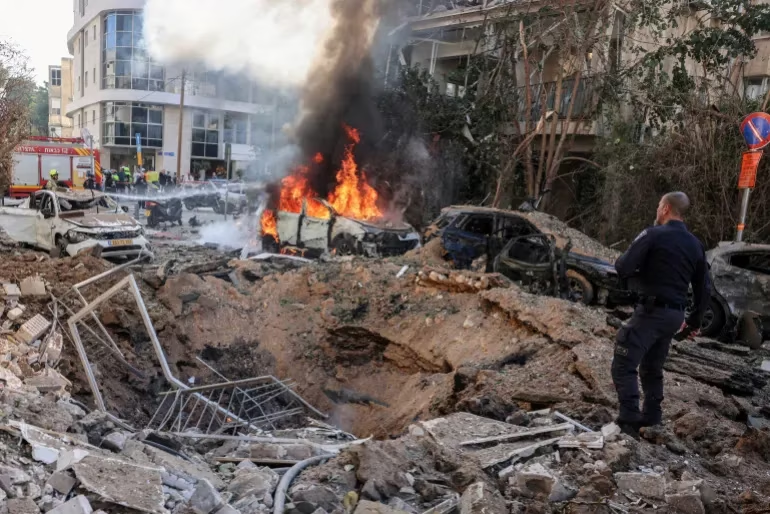
This development comes amid continued airstrikes and growing fears of the conflict escalating into a broader regional confrontation, which could involve multiple parties in the Middle East, exacerbating anxiety within and outside the United States.
The widespread public rejection of the war with Iran reflects a structural shift in the American public mood towards the use of military force, especially after bitter experiences in Iraq and Afghanistan. Americans are now more inclined to measure the cost of wars not only by strategic criteria but also by their direct economic and social repercussions. The absence of a clear and achievable goal also reinforces doubts about the utility of this conflict. This shift may impose increasing constraints on decision-makers in Washington and limit their ability to continue open-ended military operations without genuine and sustained public support.
The economic dimension also plays a central role in shaping public opposition to the war, as rising fuel and basic commodity prices directly link foreign policy to the living conditions of the American citizen. With increasing reliance on global energy, any disruption in the Strait of Hormuz becomes a direct threat to the American economy. This interconnectedness enhances public sensitivity to external crises and makes it difficult for the administration to justify continued military operations without providing a clear vision for reducing economic damage or ensuring market stability in the short and medium term.
The recent escalation in American rhetoric, especially the threat to target Iranian infrastructure, reflects a transition from limited military pressure to a strategy that may carry risks of conflict expansion. Such steps could push regional parties to engage directly or indirectly, opening the door to a multi-front war. In the absence of a clear international consensus, Washington may find itself facing increasing diplomatic isolation. This scenario raises serious questions about the US administration's ability to achieve its goals without sliding into a long and costly political and military conflict.
Share your opinion
Public Rejection of Iran War Escalates in the United States as it Enters its Sixth Week Amid Fears of Conflict Expansion