







By: Said Arikat
April 6, 2026
News Analysis
Washington, D.C- In a dramatic episode that captures both the sophistication and contradictions of contemporary warfare, U.S. special operations forces—working in close coordination with the Central Intelligence Agency—executed a high-risk mission to rescue an American airman downed deep inside Iranian territory. The operation has been widely celebrated in Washington as a remarkable feat of precision, coordination, and courage. Yet beyond the operational triumph lies a more unsettling reality: the mission reveals not only the reach of American military power, but also its strategic limitations and ethical ambiguities in an era defined by protracted and increasingly opaque conflicts.
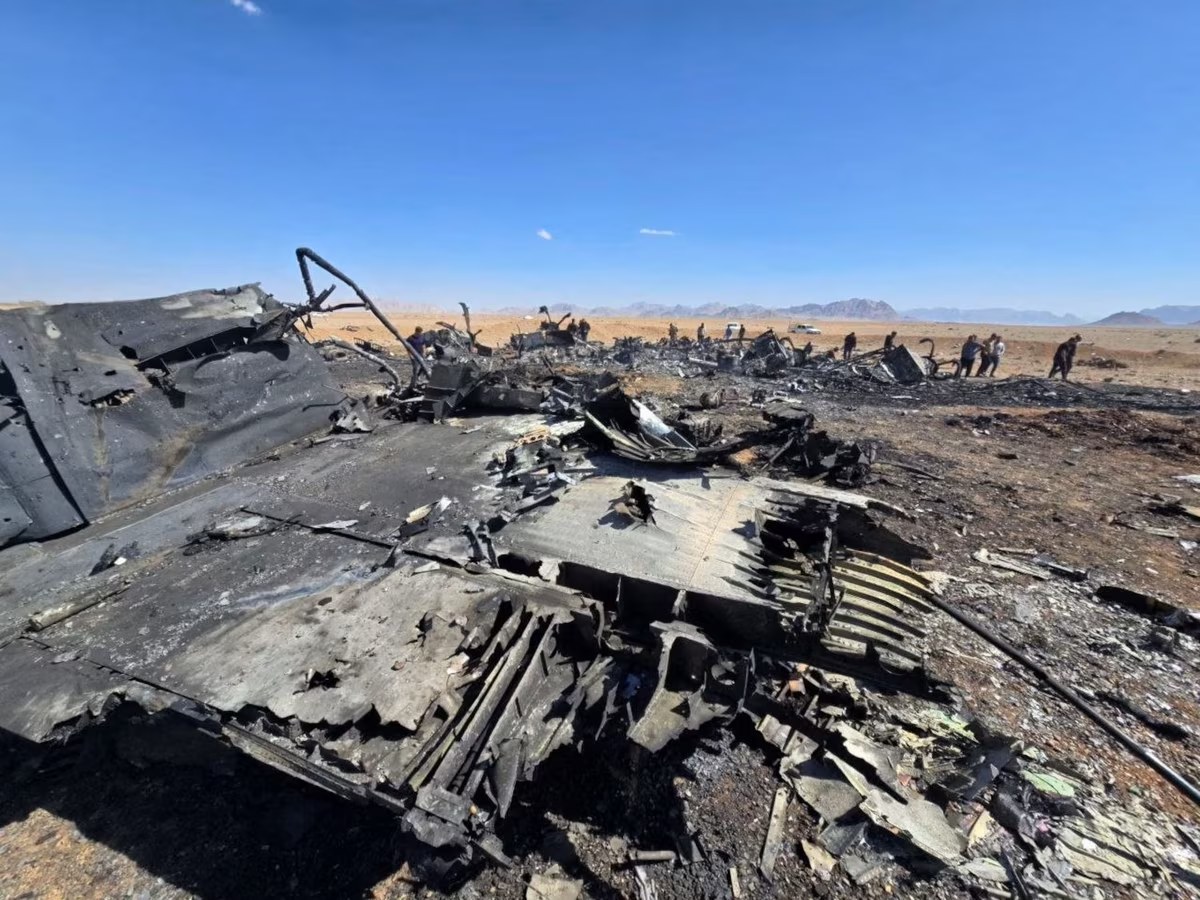
The incident began with the downing of a U.S. F-15E fighter jet over rugged mountainous terrain during an active combat sortie over Iran. While one crew member was quickly recovered, the weapon systems officer was left stranded—injured, isolated, and surrounded by hostile forces, including Iranian units and local armed groups conducting an intensive search. What followed was not merely a rescue effort but a race against time with profound geopolitical stakes. The prospect of an American serviceman falling into Iranian custody raised the specter of intelligence compromise, propaganda exploitation, and rapid escalation between two adversaries already locked in a volatile confrontation.
To cast this mission as unprecedented, however, would be historically misleading. The United States has conducted similarly daring—and arguably more perilous—rescues under even more constrained conditions. On June 8, 1995, U.S. forces extracted F-16 pilot Scott O’Grady from hostile territory in Bosnia, six days after his aircraft was shot down. Surviving with minimal supplies while evading Bosnian Serb forces, O’Grady’s rescue required a complex Marine Corps operation conducted under constant threat of enemy air defenses. That episode, like the current one, demonstrated not only technical capability but also institutional resolve, reminding us that such feats are part of a longer tradition rather than a wholly new threshold of military prowess.
Central to the recent mission’s success was the seamless integration of military and intelligence capabilities. The Central Intelligence Agency’s role extended far beyond surveillance; it orchestrated a sophisticated deception campaign within Iran, spreading false narratives that the downed airman had already been extracted. This tactic diverted search efforts and created a narrow operational window. While effective, such reliance on disinformation underscores a broader transformation in warfare, where controlling perception can be as decisive as controlling territory. It also raises enduring ethical questions about the normalization of deception as a primary instrument of statecraft.
Technological superiority played a decisive role as well. Advanced surveillance systems, real-time data analysis, and precision sensing enabled U.S. forces to locate the stranded airman in what one official described as a “needle in a haystack” scenario. Yet this capability highlights a striking paradox: the same military apparatus that can pinpoint an individual in near-impossible terrain continues to struggle with articulating a coherent strategy to end the broader conflict in which such incidents occur. Tactical brilliance coexists with strategic drift.
The final phase of the operation—authorized directly by President Donald Trump—involved the most perilous maneuver. Rescue helicopters penetrated Iranian airspace at low altitude to evade detection, coming under ground fire that injured several personnel. Despite these risks, the team successfully secured the airman and executed a rapid extraction. As a discrete military action, the mission achieved its objective with impressive efficiency. But its significance cannot be assessed in isolation from the wider strategic environment.
Indeed, the rescue provided a symbolic boost to a U.S. administration navigating the pressures of an ongoing and undefined conflict. Recovering a single serviceman carries immense moral and political weight, reinforcing the military’s commitment to leaving no one behind. However, such victories risk sustaining a narrative of dominance that obscures deeper structural challenges. They can create the illusion of progress in a conflict where the underlying dynamics remain unresolved.
The operation also reflects a broader transformation in warfare itself. The battlefield now extends into the informational domain, where narratives, misinformation, and psychological operations shape outcomes alongside kinetic force. The deception campaign exemplifies this shift, illustrating how success increasingly depends on the manipulation of perception. Yet this evolution carries risks: as adversaries adapt, the informational domain may become an arena of escalating competition, amplifying uncertainty and increasing the likelihood of miscalculation.
Equally significant is the precedent set by the mission’s geographic scope. The downing of an American aircraft and the subsequent rescue operation inside Iran mark a notable escalation in direct engagement. Although the incident ended without catastrophic losses, it underscores the fragility of the current equilibrium. Each such intrusion risks triggering retaliatory actions that could spiral beyond control in an already volatile region.
Yet if the operation reflects the precision of American military power, President Donald Trump’s rhetoric reveals a starkly different dimension—one marked not by discipline, but by excess. In a post on Truth Social, the president warned that if Iran did not reopen the Strait of Hormuz by a fixed deadline, the United States would “totally destroy” the country. The language was crude, maximalist, and strikingly indifferent to the norms of responsible statecraft.
That indifference is made more troubling by a basic strategic fact: Iran is not a nuclear-armed state. This is not a case of mutual nuclear deterrence between equals, but a sweeping threat directed at a non-nuclear country. The imbalance sharpens the sense that the rhetoric is less about deterrence than about coercion untethered from proportionality, projecting dominance at the expense of credibility.
Such language carries real strategic risk. By framing policy in the form of ultimatums, the president narrows the space for de-escalation while increasing the likelihood of reciprocal escalation. It encourages defiance rather than compromise, particularly in a region where sovereignty and dignity are deeply intertwined with political decision-making. In this sense, the rhetoric is not merely undisciplined—it is counterproductive.
Moreover, tone matters in international politics. When the leader of the United States adopts language that appears impulsive or openly punitive, it risks eroding allied confidence while hardening adversarial resolve. It introduces a dangerous form of ambiguity—one that obscures intent rather than clarifies it, increasing the risk of miscalculation.
This dissonance between operational discipline and rhetorical volatility encapsulates a central paradox of American power. On the battlefield, the United States demonstrates unparalleled capability to act decisively. In the political arena, however, that precision is often undermined by messaging that amplifies risk rather than containing it.
In the final analysis, the rescue stands as both a testament to American military prowess and a cautionary tale about its limits. It is a story of audacity and competence, but also of ambiguity and unresolved tension. The enduring question is not whether the United States can execute such missions, but whether it can align its tactical excellence with a coherent and credible strategy—one grounded less in threats of destruction than in the difficult work of preventing it.
Share your opinion
Rescue and Reckoning: America’s Strategic Blind Spot