






By: Said Arikat
April 5, 2026
News Analysis
Washington, D.C- In the mid-1970s, as the global economic order was being rewritten after the collapse of the Bretton Woods system, a consequential arrangement took shape—one that would anchor American financial dominance for decades. Today, it is known as the “petrodollar system.” Critics, including journalist Chris Hedges, have called it a “gangster deal,” a phrase that, while provocative, captures the fusion of power, money, and coercion at its core.
In the spring of 1977, shortly after leaving office as U.S. Secretary of State, Henry Kissinger reflected on the shifting global landscape. He outlined the strategic logic that would define the petrodollar era, even if he did not use the term explicitly: in a world no longer anchored to gold, control over energy flows—and the currency used to price them—would shape geopolitical power.
This system did not emerge in a vacuum. For much of the mid-20th century, global oil was dominated by seven major companies—five American and two British—known as the “Seven Sisters.” These corporations controlled oil exploration, production, and export across the Gulf. Their dominance was intertwined with a regional political order shaped largely by British imperial influence. With the exception of Saudi Arabia, most Gulf monarchies were structured under British oversight. As Britain’s role declined after World War II, the United States assumed the position of principal external protector, ensuring stability and continued access to energy.
By the early 1970s, this order began to shift. Oil-producing states asserted greater sovereignty, and the 1973 oil embargo demonstrated their leverage. At the same time, the United States faced a structural challenge. In 1971, it ended the convertibility of the dollar into gold, dismantling the “Bretton Woods” system and raising a crucial question: what would sustain global demand for the dollar?
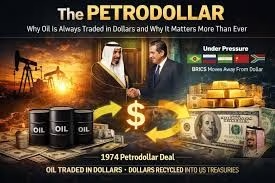
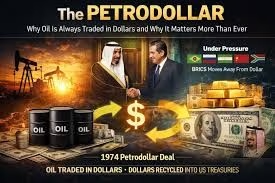
The answer came through a strategic alignment with key oil producers, particularly Saudi Arabia. The United States offered military protection, arms sales, and political backing. In return, oil would be priced in U.S. dollars, and surplus revenues would be reinvested into American financial markets.
This marked a transformation rather than a rupture. Direct corporate control by the Seven Sisters gave way to a state-centered system in which oil-producing countries formally controlled their resources but remained embedded in a global framework anchored in U.S. power. The underlying alignment endured: Gulf oil remained closely tied to Western—now primarily American—strategic interests.
The system created a powerful cycle. Because oil is indispensable, countries needed dollars to purchase it. Oil exporters accumulated large dollar reserves and reinvested them in U.S. Treasury bonds and financial markets. The dollars spent on oil flowed back into the United States, effectively financing its deficits.
Kissinger’s analysis made clear that this architecture was deliberate. Energy, finance, and security were fused into a single framework. By placing the dollar at the center of global energy trade, the United States secured a form of economic leverage without historical precedent.
This “petrodollar recycling” allowed the United States to sustain high levels of consumption and borrowing. Dollars circulated globally only to return as investment, reinforcing American financial dominance.
Yet the system also rested on unequal relationships. Gulf monarchies depended on U.S. protection, and their economic policies aligned closely with American interests. While these arrangements brought wealth and stability, they also constrained autonomy.
If the system aligned global energy with American financial power, its persistence has often depended on confronting those who attempt to step outside it. From the Middle East to Latin America, tensions have emerged when oil-rich states seek greater independence.
After April 9, 2003, when Baghdad fell, Iraq’s oil sector came under the authority of the U.S.-led occupation. While formally held for the Iraqi state, the restructuring of the industry and direction of energy policy were shaped under American oversight, placing vast reserves within Washington’s sphere of influence during that period.
A similar pattern followed in Libya after the 2011 NATO intervention and the fall of and assassination of Muammar Qaddafi. As the Libyan state fractured, European and Western energy firms reasserted their presence. Though no single power controlled Libya outright, influence over its oil sector shifted decisively outward.
In countries such as Venezuela and Iran, disputes over sovereignty, sanctions, and control of energy resources continue to reflect the entanglement of oil and geopolitics. U.S. policy is framed in terms of security and stability, yet the overlap with energy interests raises enduring questions.
This is where Chris Hedges’ critique resonates. To call the system a “gangster deal” is to highlight an imbalance sustained not by formal treaty, but by incentives, pressure, and the backing of military power. There is no single agreement mandating dollar-based oil trade; rather, it persists through a convergence of interests shaped by power.
At the same time, oil-producing states were not merely passive actors. They negotiated, adapted, and derived substantial benefits from the system, channeling petrodollars back into Western economies in ways that generated returns, stability, and deeper integration into global finance. Yet this arrangement came with a strategic trade-off: particularly in the case of GCC states, elements of sovereign autonomy were effectively ceded in exchange for security guarantees and the protection afforded by the United States. The relationship was thus asymmetric, but ultimately mutually reinforcing.
The consequences have been profound. The petrodollar system entrenched the dollar as the world’s reserve currency and tied global stability to energy flows. It also deepened the strategic importance of the Gulf, contributing to decades of geopolitical tension.
Today, the system shows signs of strain. Emerging powers are exploring alternatives to dollar-based trade, and shifts in global energy are reshaping markets. Yet the architecture outlined in 1977 remains resilient.
The petrodollar order was not accidental. It was built through strategy, rooted in an earlier era of corporate dominance, and sustained by geopolitical power. Whether viewed as stability or dominance, it underscores a fundamental truth: economic systems are constructed through power—and endure through it.
Share your opinion
The Petrodollar Order: Power, Oil, and the Architecture of American Dominance