







By: Said Arikat
April 4, 2026
News Analysis
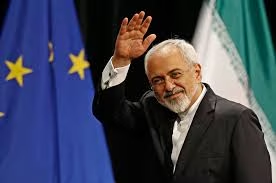
Washington, D.C- In times of war, the language of victory is often loud, emotional, and absolute. It celebrates endurance, defiance, and the ability to withstand overwhelming force. But as Mohammad Javad Zarif—Iran’s former foreign minister—argues in an essay published in Foreign Policy on Friday, April 3, 2026, the true measure of victory is not how long a nation can fight—it is whether it knows when to stop.
Zarif’s argument unfolds against the backdrop of a brutal and unresolved conflict between Iran, the United States, and Israel. His central claim is both simple and deeply counterintuitive: Iran, having endured sustained military pressure without collapsing, has already achieved its most important objective. It has survived. From this perspective, the continuation of war is not a path to greater success, but a risk to what has already been secured.
This framing challenges a powerful current within Iranian public sentiment. After weeks of bombardment, loss, and humiliation, calls for continued resistance carry emotional force. They are rooted not only in the current war but in a long history of grievances—missed diplomatic openings, broken agreements, and punitive sanctions that have shaped Iran’s worldview. Zarif does not dismiss this anger. Instead, he acknowledges it as real, justified, and politically potent. But he also warns that anger, left unchecked, can distort strategic judgment.
What makes Zarif’s essay compelling is precisely this tension between emotion and calculation. He recognizes that for many Iranians, negotiation feels like capitulation, especially when dealing with a counterpart widely perceived as unreliable. Yet he insists that diplomacy is not about trust—it is about leverage. And in his view, Iran now possesses more of it than at any point in recent years.
The war, as Zarif presents it, has exposed the limits of military power. Despite the scale of U.S. and Israeli operations, they have failed to decisively weaken Iran’s core capabilities or destabilize its political system. At the same time, Iran’s retaliatory actions have demonstrated that it can impose costs, even under sustained attack. This mutual inability to achieve decisive victory has produced a familiar but dangerous equilibrium: a stalemate sustained by escalation.
It is precisely this moment, Zarif argues, that creates an opening for diplomacy. The goal should not be a temporary cease-fire that merely pauses the violence, but a more comprehensive agreement that addresses the underlying sources of conflict. He outlines a framework that includes limits on Iran’s nuclear program, the lifting of sanctions, the reopening of critical trade routes, and a mutual commitment to nonaggression.
These proposals are not new, but their significance lies in timing. In earlier negotiations, Iran entered talks under economic pressure and political isolation. Now, Zarif suggests, it can negotiate from a position of resilience. This shift, he believes, could enable a more balanced and reciprocal agreement—one in which concessions are matched by tangible benefits.
Still, Zarif’s vision is not without its contradictions. He argues that Iran’s endurance proves the limits of coercion, yet he calls for compromises that Iran has historically resisted. This raises an important question: if resistance has worked, why change course? Zarif’s answer is subtle but important. Resistance, he suggests, can preserve sovereignty, but it cannot build prosperity. It can prevent defeat, but it cannot secure a stable and prosperous future.
In this sense, his essay is less about ending a war than about redefining national strength. He challenges the idea that security is achieved solely through military capability or ideological steadfastness. Instead, he points to economic integration, diplomatic engagement, and regional cooperation as equally essential components of long-term stability. This is a familiar theme in Zarif’s career, but it carries new urgency in the context of an ongoing conflict.
The obstacles to such a shift, however, are formidable. Trust between Iran and the United States remains deeply eroded. Domestic politics on both sides reward confrontation more than compromise. And the broader regional environment is fragmented, with multiple actors pursuing competing agendas. Zarif acknowledges these challenges, suggesting that external powers may need to play a role in guaranteeing any agreement. Yet even with such guarantees, skepticism will persist.
Perhaps the most striking aspect of Zarif’s argument is its moral dimension. Beneath the strategic calculations lies a simple but profound concern: the human cost of continued war. Infrastructure can be rebuilt, and political positions can shift, but lost lives cannot be recovered. By urging an end to hostilities, Zarif is not only making a geopolitical argument—he is making a humanitarian one.
At the same time, his appeal is pragmatic. Prolonged conflict, he warns, risks expanding beyond its current boundaries, drawing in additional states and deepening regional instability. What is now a contained—if intense—confrontation could evolve into something far more destructive. In that scenario, even a resilient Iran would face costs that no victory could justify.
Zarif’s essay ultimately asks a difficult question: what does it mean to win? If victory is defined as the total defeat of an adversary, then this war has no clear endpoint. But if it is defined as the preservation of sovereignty and the opportunity to build a better future, then Iran may already be closer to it than it appears. The challenge is to recognize that moment—and to act on it.
History shows that many nations have fought courageously in war but failed to turn their battlefield gains into lasting peace. Zarif is warning Iran not to repeat that pattern. He is not calling for surrender, but for strategic thinking—for leadership that recognizes that how a war ends can matter even more than how it begins.
Whether that message will resonate is uncertain. In the heat of conflict, restraint is rarely popular. But as Zarif suggests, the hardest victory is not defeating an enemy—it is choosing, at the right moment, to stop fighting.
Share your opinion
The Hardest Victory: Zarif’s Case for Ending War Through Diplomacy